A Reading by MaggieBench Cushions
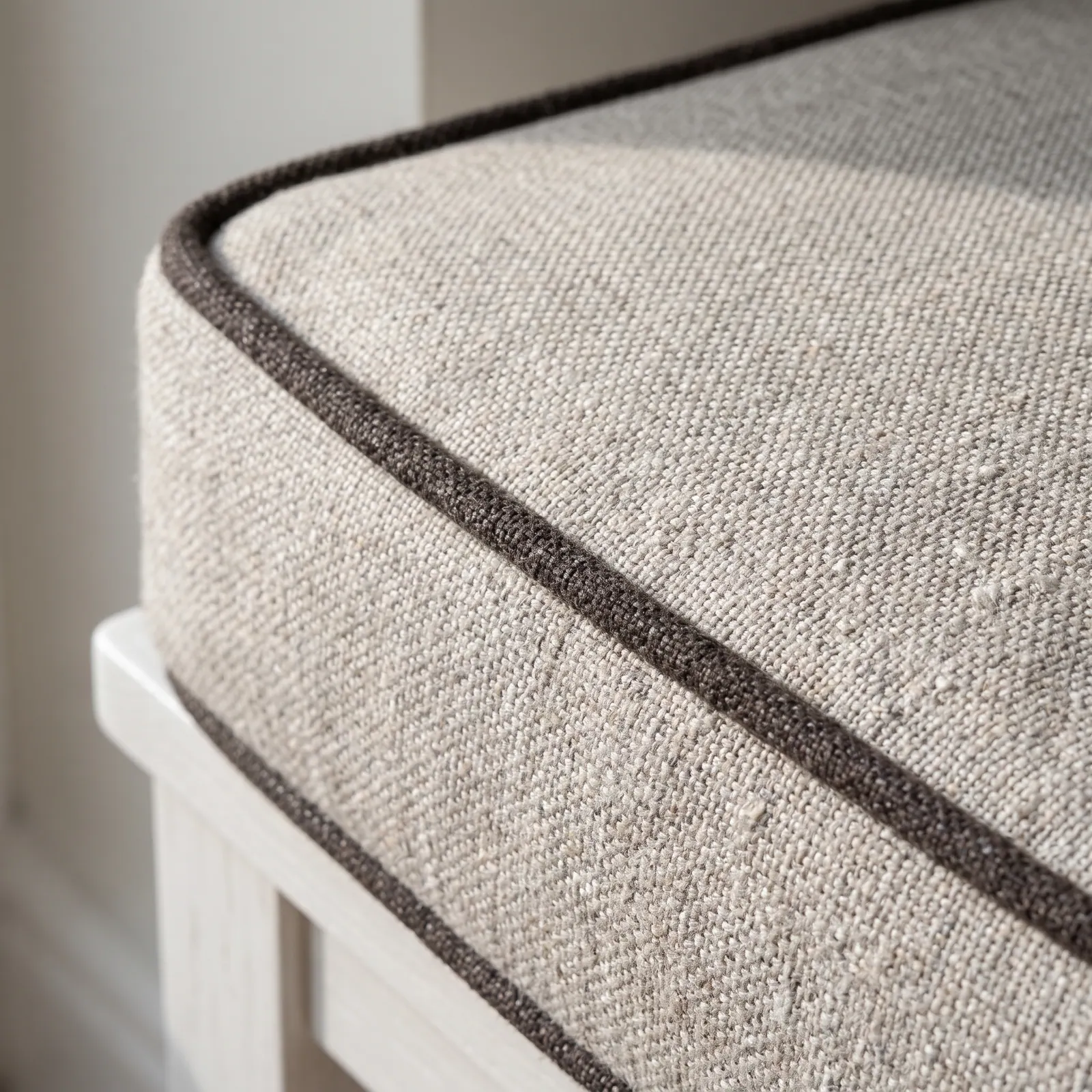
The hand of an oatmeal slub weave with brown welt piping
I'll take the letters first this time and the fabric second, because a cloth's hand is really about living with it, and the letters are where people tell me how that goes.

 Save
The quick answer
A linen-look slub weave feels dry and slightly nubby, looks like linen without real linen's creasing, and wears well on a custom bench cushion when a welt holds the edges square. This oatmeal cover has brown tweed piping top and bottom. It is synthetic, so wash covers at 86°F (30°C) on gentle and iron low or steam.
Buyer questions
- A common question
My new cushion measures about half an inch wider than what I ordered. Is that normal?
The workshop's answerWithin limits, yes. Inch orders are converted to the nearest centimeter, so 29.5 x 111.25 in became 29½ x 111½ in (75 x 283 cm). Handmade cushions carry a tolerance of about 3/8 in (1 cm) either way, most noticeable on long pieces where foam and fabric behave a little differently, and the edge relaxes slightly with use.
- A common question
Can you put something on the bottom so the cushion stops sliding around on my bench?
The workshop's answerYes. A non-slip base is an add-on, charged per cushion. The underside is then finished in an anti-slip material that holds the cushion in place on a bench or window seat.
- A common question
My wooden window seat is 12 in deep. If I order a 14 in deep cushion, will the 2 in overhang break down the front edge?
The workshop's answerNo. An overhang of up to 2 in (5 cm) is common and won't damage the cushion, because high-density foam keeps its shape and the front edge stays structured. For extra support the foam can be made slightly firmer, with a supporting inner wrap so the edge holds long term.
Now, the reading
The 141 in seat that wanted to be one piece
A buyer in the US asked for a seat 141 in (358 cm) long, 38.5 in (98 cm) deep and 5 in (12.5 cm) tall: velvet, French tufted, in a soft cream or off-white that would not feel scratchy. That last request is the heart of this page. People choose a cushion with their eyes and keep it with the backs of their legs.
The buyer also weighed a wide-wale corduroy with thick piping and no tufting. The workshop proposed two cushions of 70.5 x 38.5 x 5 in (179 x 98 x 12.5 cm), and cream linen came in at the same cost as the velvet. The buyer wanted one piece with no join and went to a local upholsterer who could make it.
Fair enough. If you need a single piece that long, a local shop may suit you better, and I would rather say so than sell you a join you'll resent.
Reading the hand: slubs, welt and a corner in side light
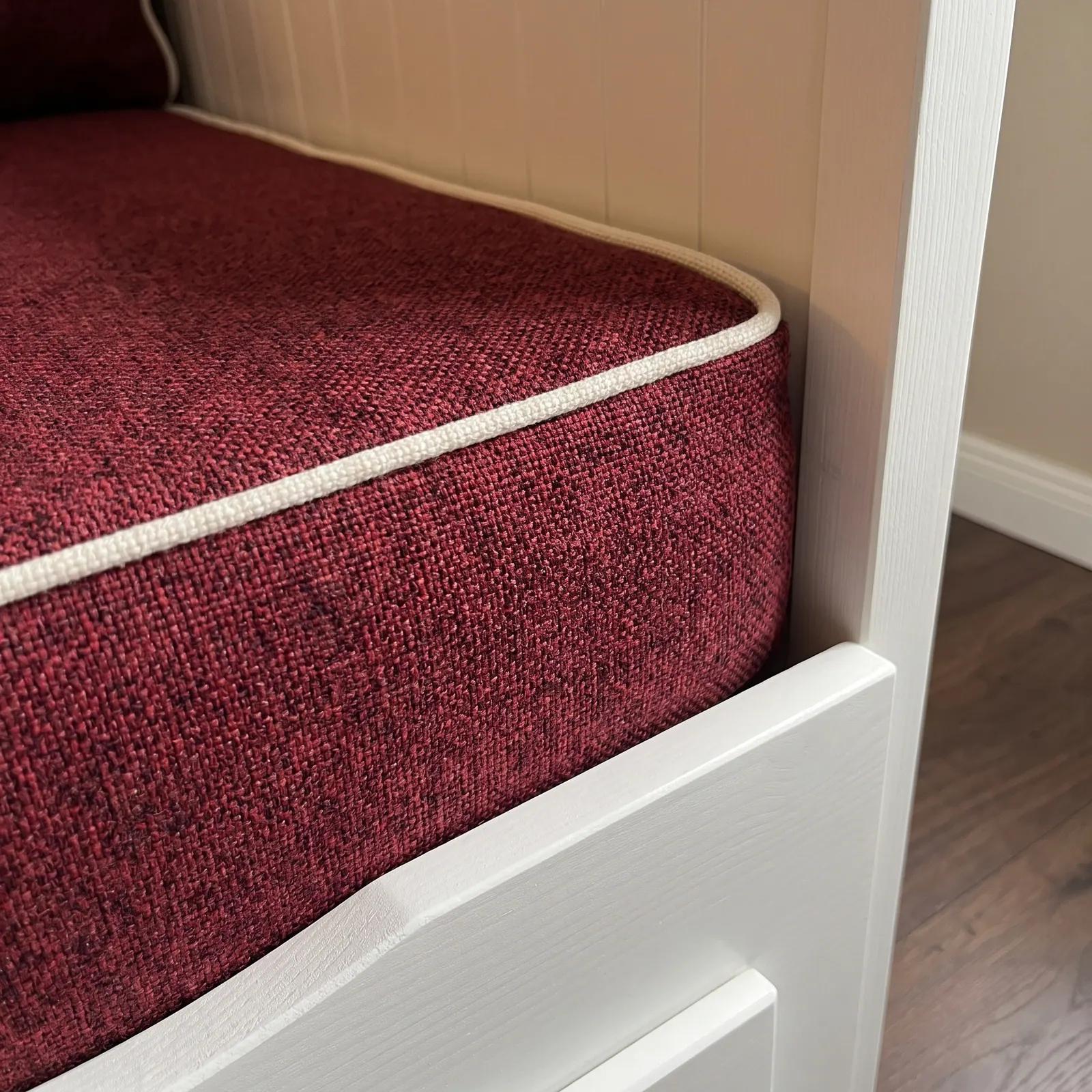
Right, then, the photograph. It is one corner, shot in low side light so every thread throws a shadow. The weave is an oatmeal greige with slubs, those thick and thin threads that give the look of linen without real linen's habit of creasing the minute you sit. Run a hand over it and you feel the irregularity: a dry, slightly nubby hand, not slick and not scratchy.
The piping is a brown tweed welt, sewn tight to the seam top and bottom. A straight welt is a kind of honesty, and this one tells the truth twice. It keeps the top panel square in use, and with a second row along the bottom, the side reads as a band of its own. At the corner the welt turns in one smooth curve, no pleats and no puckers. That turn is the hardest bit of sewing on any box cushion, and the camera went straight for it.
Now look down at the white-painted bench rail. The cushion sits snug with no overhang, which is right for a bench with a frame. On an open ledge a little overhang is fine, as the letters above say.
When your samples come, dear, do what this photographer did: hold them in side light by a window, not only under the ceiling fixture, and press one against the back of your arm. How does yours feel? Browse the family in linen-look fabrics, compare it with the real thing in real linen versus linen-look, and see sizes in bench cushions.
Pinned by Maggie: five stitches worth a look
Five pins on one corner: the rounded turn, the slub weave, the top welt, the bottom piping and the bench rail.
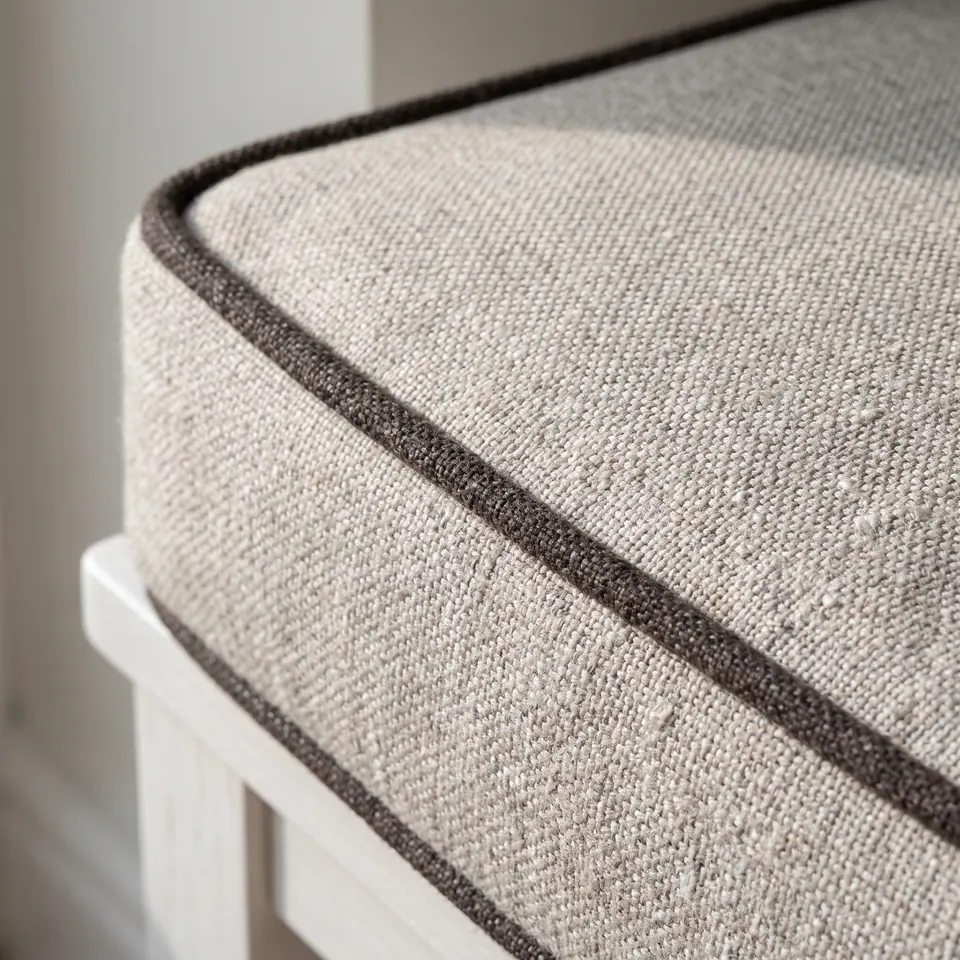
- Rounded box corner
The piping turns the corner in a smooth curve with no pleats or puckers.
- Slub weave
Irregular thick and thin threads give the linen look without real linen's creasing.
- Top welt line
Brown welt sewn tight to the seam keeps the top panel square in use.
- Bottom piping
Piping top and bottom makes the box side look like a band of its own.
- Painted bench rail
The cushion sits snug on the rail with no overhang.
- Rounded box cornerThe piping turns the corner in a smooth curve with no pleats or puckers.
- Slub weaveIrregular thick and thin threads give the linen look without real linen's creasing.
- Top welt lineBrown welt sewn tight to the seam keeps the top panel square in use.
- Bottom pipingPiping top and bottom makes the box side look like a band of its own.
- Painted bench railThe cushion sits snug on the rail with no overhang.
How this cloth feels, wears and cleans
- Feels dry and slightly nubby under the hand, from thick and thin slub threads; soft, not scratchy.
- Looks like linen without real linen's quick creasing.
- Wears square: the welt holds the top panel, and edges relax a little with use, which is normal.
- Cleans in the machine: covers wash at 86°F (30°C) on a gentle cycle.
- Irons low: it is a linen-look synthetic, so use a lowered setting or steam, never a hot iron.
On the cutting table: the oatmeal corner
| Cushion | Box-edge bench cushion on a white-painted bench |
|---|---|
| Fabric | Oatmeal greige slub weave, linen-look |
| Hand | Dry, slightly nubby, soft rather than scratchy |
| Piping | Contrast brown tweed welt on the top and bottom seams |
| Corner | Rounded box corner, welt turned in one curve |
| Fit | Snug on the rail, no overhang |
| Tolerance | About 3/8 in (1 cm) either way on handmade sizes |
| Care | Covers wash at 86°F (30°C) on gentle; low iron or steam |
| Best for | Benches and window seats that want a linen look without creases |

Have it made
Have this made — ask Maggie’s workshop
I once cut a lovely cushion two inches short, and I have not forgotten it. That is why the workshop goes over your measurements with you on the phone. — Maggie
Leave your details and the workshop will call you to confirm measurements, fabric, foam and piping. No prices, dates or payment on this page: it is a request, not an order.
A linen-look slub weave gives the texture of linen without real linen's creasing, but it is synthetic: iron it low or steam it, never hot.
Maggie
Questions buyers ask next
Is a linen-look slub weave scratchy against bare legs?
Not this kind. A slub weave has a dry, slightly nubby hand from its thick and thin threads, which reads as texture rather than roughness. Ask for samples and press them against your arm before you decide.
Why put piping on both the top and bottom seams of a box cushion?
Piping on both seams makes the side band read as a separate strip and helps the box keep its square shape in use. It also means a flipped cushion still shows a finished, piped edge.
What is the best way to compare fabric samples at home?
Hold them by a window in side light as well as under the ceiling light. Side light shows slubs, pile and weave that flat light hides, and daylight gives the truer color.
Stitch straight — Maggie
Piped corners and box edges, up close
 Save
 Save
 Save
 Save
 Save
 Save