 Save
- Boxed corner
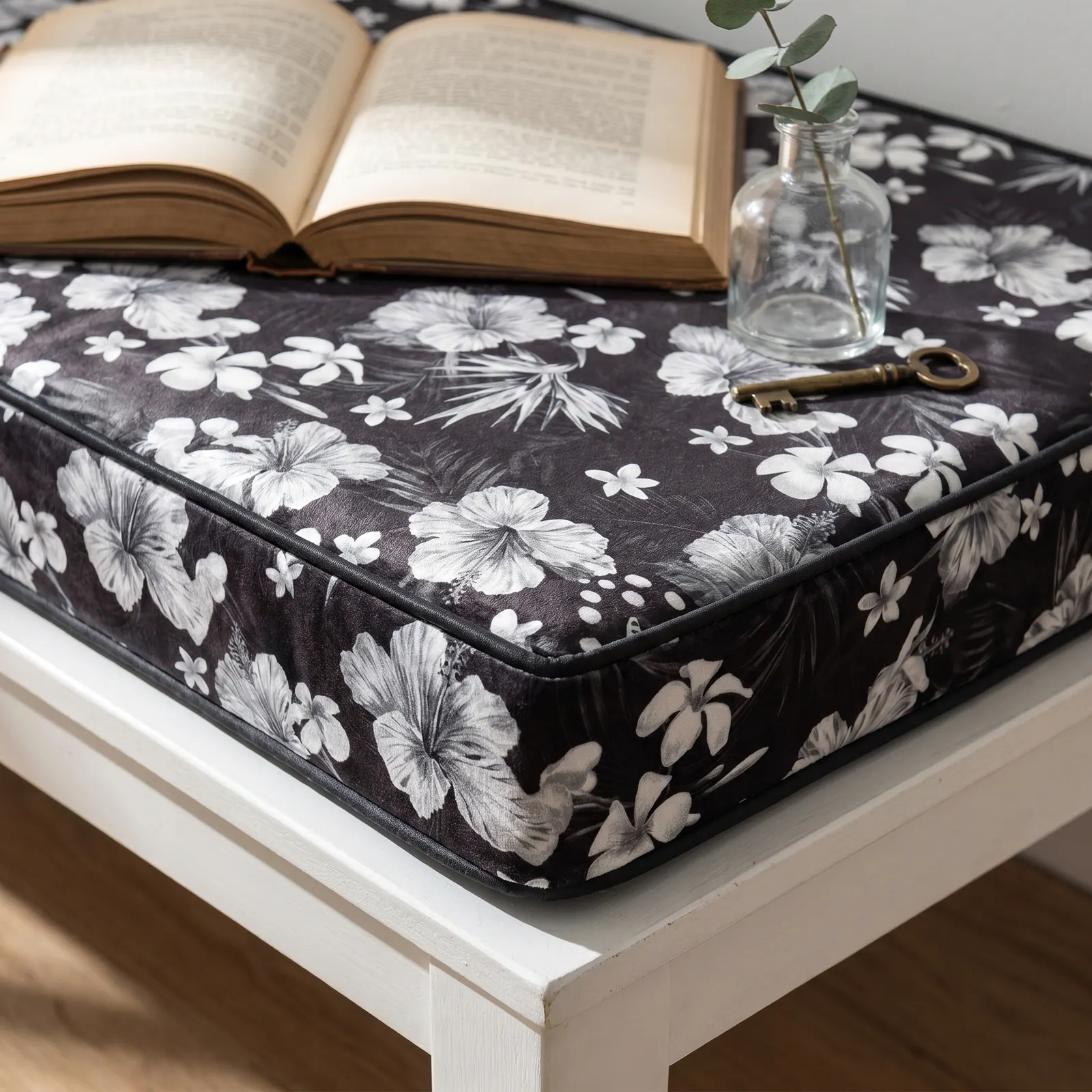
The flowers run over the gusset uninterrupted at a square corner.
- Black piping
Solid black repeats the darkest ground and frames each face of the box.
- Antique book
Sepia pages keep the palette muted so the cushion's contrast leads.
- Glass bottle
A clear bottle with one sprig is the only green in the frame.
- Brass key
A small warm metal accent on a cool monochrome print.
Plate Monochrome Hibiscus Print Cushion with Black Piping, Close Up
A tropical hibiscus print in grays and white, finished with solid black piping for a calm, classic look.
A Reading by ÉlodieBench Cushions
A gray hibiscus bench cushion, black piping and three small objects
A tropical flower drained of its color becomes a quiet, bookish thing. I read this close-up for its props, because each one was chosen to keep the print in charge.

The quick answer
To style a monochrome print bench cushion, keep every prop inside the print's palette and allow one warm note and one green. Here a charcoal hibiscus box cushion with black piping carries an antique book in sepia, a brass key for warmth and a clear bottle holding a single eucalyptus sprig. Three small objects, and most of the print stays uncovered.
Pinned by Élodie: a corner, a line and three objects
Five pins move from the squared corner and the black piping up to the open book, the glass bottle and the brass key.
The numbers match the pins on the plate.
- Boxed cornerThe flowers run over the gusset uninterrupted at a square corner.
- Black pipingSolid black repeats the darkest ground and frames each face of the box.
- Antique bookSepia pages keep the palette muted so the cushion's contrast leads.
- Glass bottleA clear bottle with one sprig is the only green in the frame.
- Brass keyA small warm metal accent on a cool monochrome print.
A tropical flower, printed in charcoal
A hibiscus is supposed to shout. Printed in charcoal, dove gray and chalk white, it lowers its voice, and a tropical flower can suddenly sit among old books and dark wood. That is the first decision in this photograph, and every prop follows from it.
This custom bench cushion is a true box cushion, square at the corner, and the flowers run over the gusset without a break. No seam interrupts a petal. On a large print, that continuity is what makes a cushion look cut for its bench rather than from a roll.
The piping is solid black: the darkest ground of the print, repeated as a line. It frames each face the way a black mat frames an etching. White piping would have drawn a second, brighter outline and split the attention.
The light comes softly from the side. It lifts the white petals and lets the charcoal fall back, so the print gains depth with no color at all. The eye sits down first, and here it sits on contrast. More shapes live in the bench cushion atlas, and the case for dark welts is in matching, contrast or no piping.
The still-life kit around the hibiscus bench cushion
- An antique book, left open: sepia pages are the only warm paper tone, so the print's black and white still lead.
- A clear glass bottle with one eucalyptus sprig: the single green in the frame. One sprig, never a bouquet, or the flowers start competing.
- An antique brass key: a small warm metal on a cool print, the job a brass lamp base does in a gray room.
- A white painted bench: it disappears, so the charcoal box reads as one clean block.
- Nothing tall: every object stays low and small, and most of the seat stays bare.
The back cushion that could not take Velcro
A buyer wrote to the workshop about a bench with a wooden back panel. They wanted a seat cushion and a matching back cushion, 50 x 13 3/4 in (127 x 35 cm), in linen, with a fabric tab on the back cushion that would fasten to the wood with Velcro.
The workshop could not make Velcro tabs and said so plainly. It offered corner ties instead, wrapped around the wooden panel to hold the back cushion in place. The buyer also learned that a different piping color, or any of the four thicknesses, did not change the price.
I keep this story beside a styling page because it is the same lesson in another key: when one fixing is not possible, a simpler one often looks better. Ties are quiet. The options are laid out in ties and non-slip backing. Which small object on your shelf could carry the one warm note, my friends?
Buyer questions: a dog, an angle and what sits inside
- A common question
We have a dog and two small boys. Is a linen like L-07 or a velvet the better choice for our bench?
The workshop's answerEither works. The L-07 linen has a weave that is easy to clean, and everyday marks wipe off. Velvet is durable and soft, and spills wipe clean by hand. For a deeper clean, the covers come off and are machine washable at 86°F (30°C).
- A common question
My window seat is angled at the sides. How do I measure it so the numbers actually work?
The workshop's answerMeasure the depth straight from front to back at 90 degrees, never along the slant, and measure each angled side as a straight line from corner to corner. The workshop checks the geometry: a 40 in (102 cm) front, 30 in (76 cm) back and 17 in (43 cm) depth gives angled sides a little under 18 in, not 22 in (56 cm). Sketch the shape with each number on its edge, or send a wide corner-to-corner photo.
- A common question
Is the foam memory foam, or something sturdier?
The workshop's answerSturdier. The cushions use 32-density high-comfort foam (32 kg/m³, about 2 lb/ft³). It is a firm, high-density foam, not memory foam, and it is resilient, so it holds its shape and does not sag over time.
On the cutting table: the hibiscus bench cushion
| Cushion | Rectangular box cushion for a bench |
|---|---|
| Hibiscus in charcoal, dove gray and white | |
| Piping | Solid black contrast piping framing each face |
| Edge | Boxed, square corners; the print runs over the gusset |
| Foam | High-density, about 2 lb/ft³ (32 kg/m³); firm, not memory foam |
| Cover | Removable; machine washable at 86°F (30°C) |
| Props | Antique book, glass bottle with eucalyptus, brass key |
| Best for | A classic living room that wants a tropical motif without bright color |

Have it made
Have this made — ask Élodie’s workshop
Color is easier to settle in a conversation than on a screen. Tell the workshop about the room and the light it gets, and the fabric choice follows. — Élodie
Leave your details and the workshop will call you to confirm measurements, fabric, foam and piping. No prices, dates or payment on this page: it is a request, not an order.
A tropical print in charcoal, gray and white needs only black piping and three small props: one paper, one brass, one sprig of green.
Élodie
Questions buyers ask next
Should piping match the darkest color in a print?
Matching the darkest ground, as the black piping does here, frames the cushion without adding a new line of color. A lighter piping draws a bright outline around the print instead. Choose dark when the print should lead, light when you want the edge itself to show.
Can a large floral print continue over the side of a box cushion?
It can, as on this cushion: the hibiscus runs over the gusset at a square corner with no break in the flowers. If placement matters to you, say so in your order note and attach a reference photo of the look you want.
What props suit a black, gray and white cushion on a bench?
Low, small objects in the print's own tones: old paper, dark wood, clear glass. Add one warm metal such as brass and one living green, like a single eucalyptus sprig. Keep most of the seat bare so the print still reads.
How can a back cushion stay on a wooden bench back without Velcro?
Corner ties are the simple answer. When a buyer asked for Velcro tabs on a back cushion, the workshop offered ties at the corners that wrap around the wooden back panel instead, holding the cushion without fixing anything to the wood.
With color and care — Élodie