A Reading by ÉlodieBench Cushions
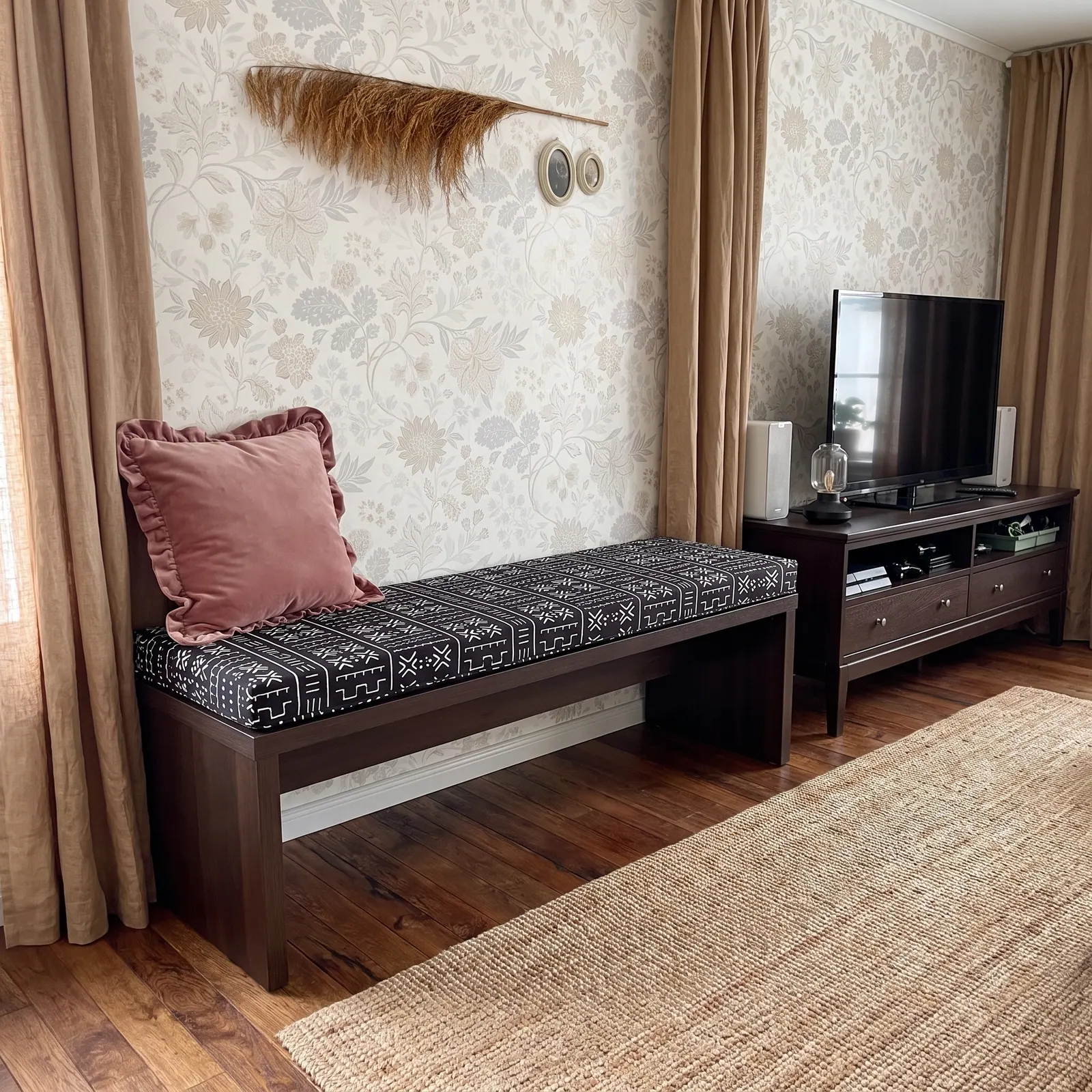
A black mudcloth-style bench cushion, measured against floral wallpaper
Two patterns share this wall, and only one of them is allowed to raise its voice. Here is how the cushion's depth and height keep the peace.

 Save
The quick answer
On an open-frame bench with no lip, a custom bench cushion must match the bench top exactly, because any overhang shows. Measure the real bench, not a product photo, and remember that the cushion's thickness adds to the seat height. A bold graphic print holds its own against busy floral wallpaper when the two differ in scale and contrast.
The cushion, cut open
Cover fabric. A removable, zippered cover. Machine wash at 86°F (30°C) on a gentle cycle and air dry.
Piping. A fabric-covered cord sewn into the seams. It sits on the seam line, so it does not change the size.
Fiber wrap. Polyester fiber (Dacron) batting around the foam: it fills the cover out and softens the edges.
Foam core. About 2.0 lb/ft³ (32 kg/m³) high-resilience foam, firm to medium-firm, cut to the ordered size.
Zipper. Along the back band, as hidden as possible. The zipper side faces down or toward the wall.
Base panel. The underside of the cover. A non-slip fabric backing can cover the whole of it instead.
A seat with nothing to hide behind
Read this bench from the floor up, the way you would read a cross-section.
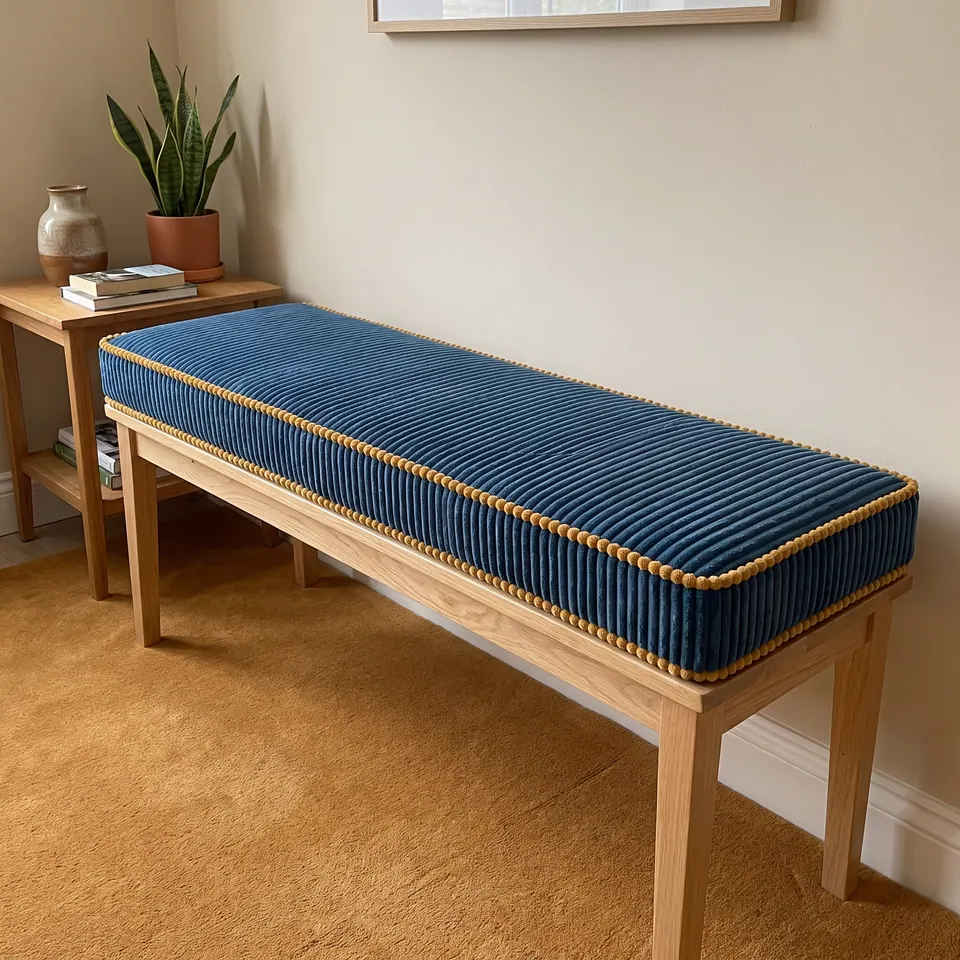
Dark oak boards. A jute rug. Then the open wood frame: legs, rails, a flat top and no lip at all. No rim to tuck an edge into, no apron to hide a soft corner. Whatever the cushion does, the whole room sees it.
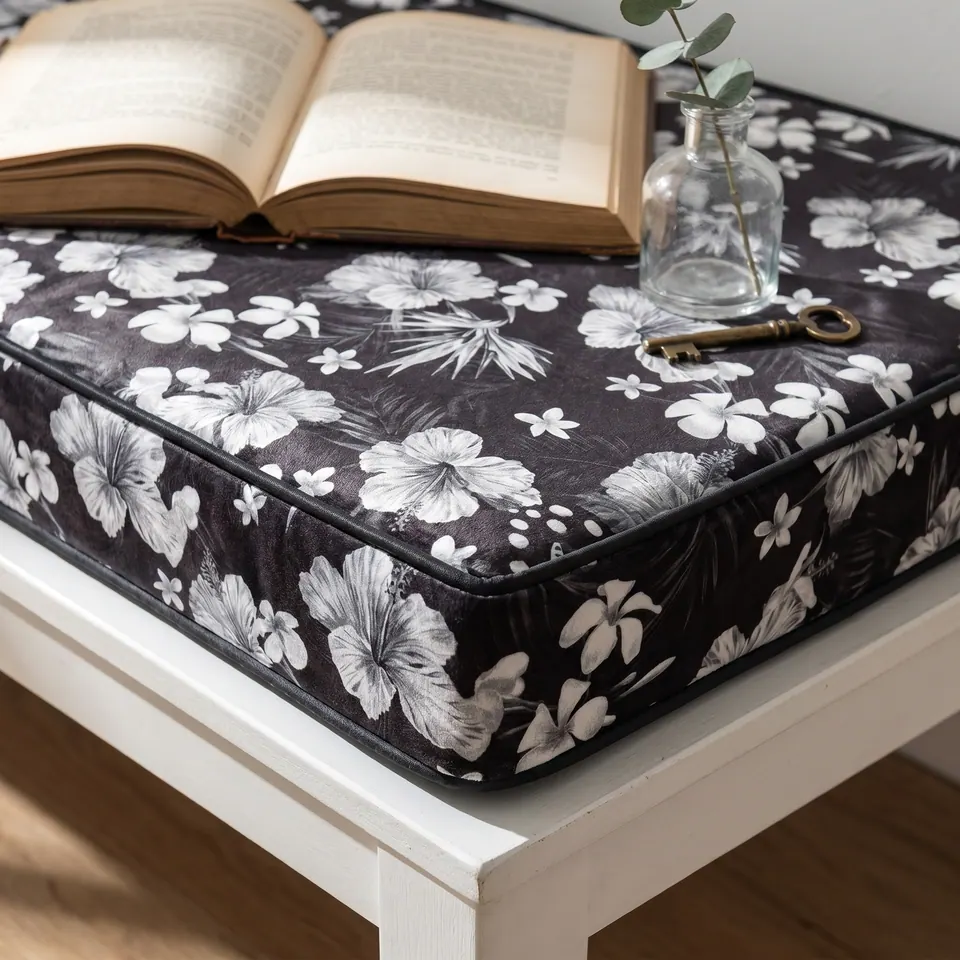
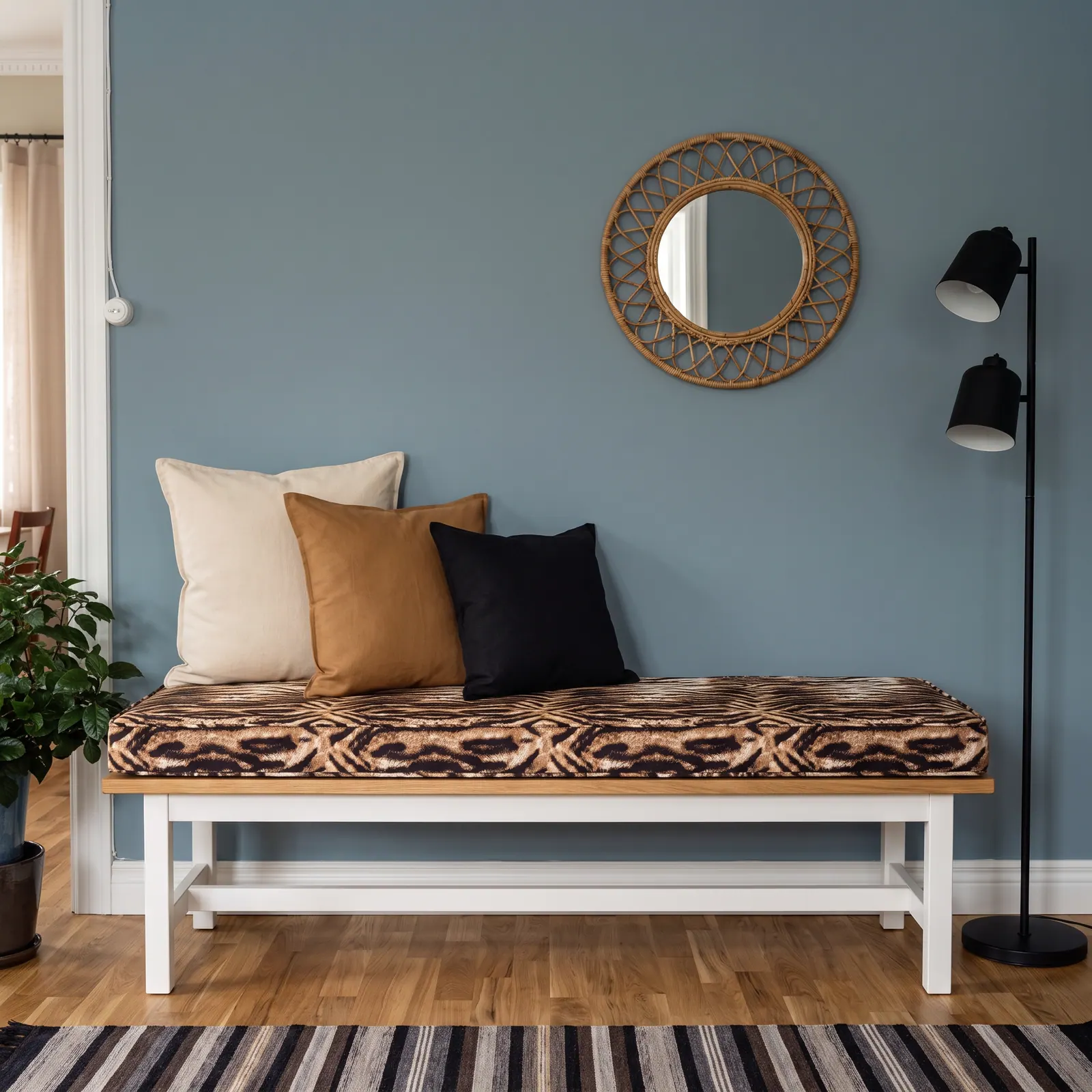
So the cushion is cut to the bench top, edge to edge. Its box wall stands straight, wrapped in the same ink-black print, and self piping finishes the top and bottom seams so the outline stays one clean line. A contrast welt would draw a second frame around the first.
Now the proportion. The cushion's depth must equal the frame's depth, and its thickness sits on top of the bench height. On a slim open frame, a moderate slab keeps the bench looking like a bench; a very tall one starts to look like a mattress on legs. Before you choose a thickness, run the numbers through the seat height calculator.
Top panel to floorboards
| Top panel | Ink-black mudcloth-style print with hand-drawn bone-white marks |
|---|---|
| Box wall | Same print, so the visible sides read as part of the seat |
| Piping | Self piping at the top and bottom seams |
| Core | Foam cut square to the bench top |
| Depth | Equal to the frame; an open frame has no lip to hide overhang |
| Thickness | Adds to the seat height, so check it before ordering |
| Sizing | Listed sizes set the price; the order note sets the size |
| Care | Zippered cover, washable at up to 86°F (30°C) |
| Best for | Living room benches below patterned walls |

Have it made
Have this made — ask Élodie’s workshop
A fabric reads one way at noon and another at dusk. Mention your light, and the workshop will weigh it with you. — Élodie
Leave your details and the workshop will call you to confirm measurements, fabric, foam and piping. No prices, dates or payment on this page: it is a request, not an order.
Pinned by Élodie
Five pins, from the graphic print to the open frame that forgives nothing.
- Black mudcloth-style cushion
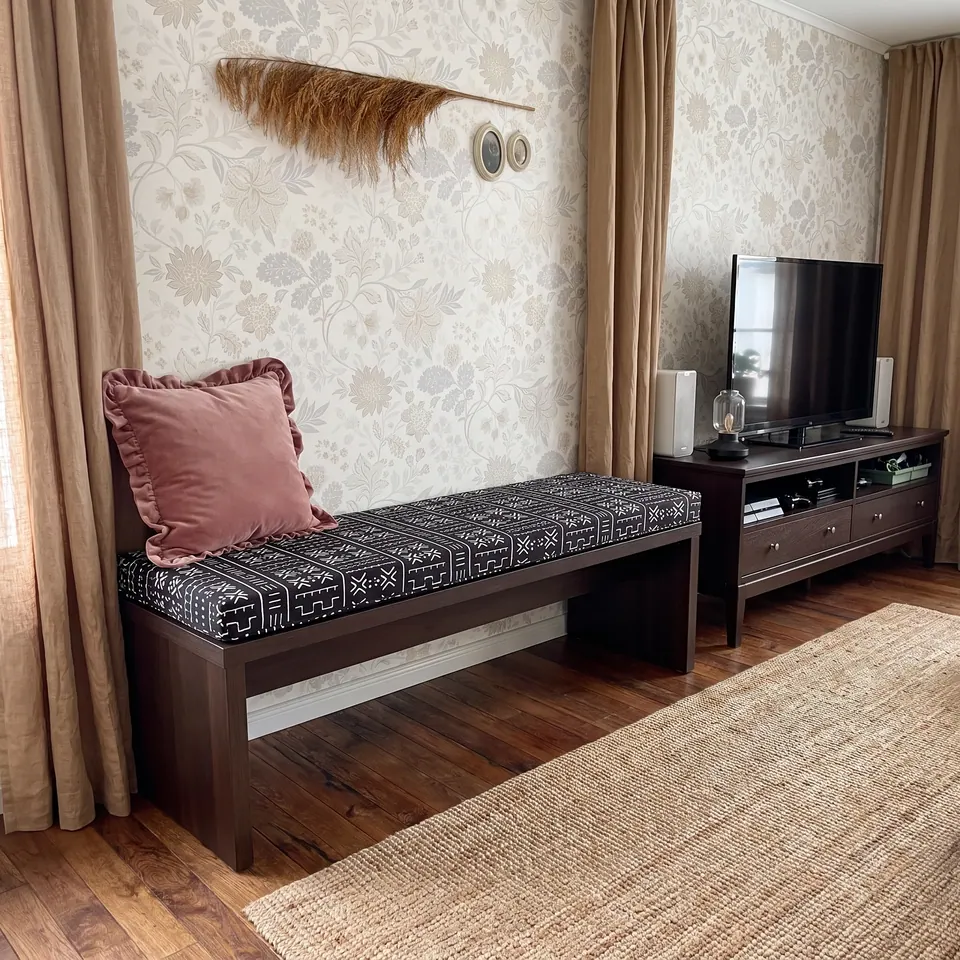
A bold graphic print holds its own against busy floral wallpaper.
- Rose velvet ruffle
One warm pillow is enough when the wall is already patterned.
- Dried palm frond
The natural hanging links the cushion's hand-drawn marks to the jute and linen.
- Jute rug
Jute softens the dark floor and suits the tribal-style print.
- Open wood frame
With no lip to hide an overhang, the cushion must match the bench top exactly.
- Black mudcloth-style cushionA bold graphic print holds its own against busy floral wallpaper.
- Rose velvet ruffleOne warm pillow is enough when the wall is already patterned.
- Dried palm frondThe natural hanging links the cushion's hand-drawn marks to the jute and linen.
- Jute rugJute softens the dark floor and suits the tribal-style print.
- Open wood frameWith no lip to hide an overhang, the cushion must match the bench top exactly.
Why ink black can stand in front of flowers
The eye sits down first, and here it sits on the bench.
Behind it, the wallpaper is a faint cream floral, softened by diffused light through caramel linen curtains. In front, the cushion is ink black with bone-white marks drawn by hand, bold and graphic. Two patterns share one wall and neither fights, because they differ in scale and in contrast. Another floral would have argued with the wall. A graphic print simply stands in front of it.
Then the props. A single dusty rose velvet pillow with a ruffled edge brings warmth, and one is enough when the wall is already patterned. The dried palm frond above carries the hand-drawn feeling of the print up the wall and ties it to the jute and linen. The jute rug softens the dark floorboards and suits the print's earthy mood. Two small round mirrors catch the soft light, and a glass cloche lamp keeps the corner lit after dusk. The dark wood console under the television repeats the bench wood, so the bench belongs to the room and not only to the wall.
What pattern is already on your walls? Start there, then choose the cushion. There are more ideas in the bench cushion atlas, among the living room cushions and in matching a cushion to paint and wallpaper.
Two depths guessed from a photograph
A buyer got in touch before the furniture had even arrived. Working from product photos, they ordered two cushions: 15.7 x 63 in (40 x 160 cm) and 47.2 x 18.9 in (120 x 48 cm).
Then the bench was delivered, and the tape told a different story. Both depths were 15.7 in (40 cm).
The fabric was already cut. The workshop stopped and recut both cushions at the corrected 15.7 in depth. On an open frame, the first number would have left more than 3 in (8 cm) hanging in the air, a shelf of print with nothing under it.
The lesson is plain, my friends: measure the furniture in your room, not the photograph of it. How to measure a bench for a cushion walks through it.
Buyer questions: linen covers, odd shapes, one long seat
- A common question
What are the fabrics in the linen range made of, and can their covers be washed?
The workshop's answerThey are linen. Like the rest of the range, the covers are removable and wash at up to 86°F (30°C). There are no close-up photos of that range, so use the fabric chart or order samples to see the weave.
- A common question
Can you make a bench cushion in an irregular shape? And how thick is the French-style tufted one?
The workshop's answerYes, irregular shapes are made from a drawing with the sizes marked. The French-style tufted velvet bench cushion is normally 4 in (10 cm) thick and can be made 6 in (15 cm). One set was 28 x 70 in (71 x 178 cm) with a matching back pillow.
- A common question
I don't like the seams between my sofa's three seat cushions. Could one long bench cushion replace them?
The workshop's answerYes. One long cushion instead of three gives a clean, seamless look, and many buyers do exactly this. Send the length, width and thickness plus your fabric code for a quote.
Questions buyers ask next
Can a patterned bench cushion sit in front of patterned wallpaper?
Yes, if the two patterns differ in scale and contrast. A faint, pale floral on the wall and a bold, dark graphic print on the cushion let each one read on its own. Two florals of similar weight tend to argue.
How does cushion thickness change the look of a bench?
The thickness sits on top of the bench height, so a thick pad lifts the seat and changes how the bench lines up with the sofa and chairs around it. Check the finished height against your other seats before you choose.
Do I order the listed size or my exact size?
Your exact size. The listed size options only set the price; write the real measurements in the order note and the cushion is cut to them. On an open frame with no lip, that exactness keeps the edge from hanging over.
Does the print show on the sides of a box cushion?
On this cushion the box wall is cut from the same print and finished with self piping, so the sides read as part of the seat. On an open frame the sides are fully visible, which is why a contrast wall would look like a band of trim.
With color and care — Élodie
More photographs to read
 Save
 Save
 Save
 Save
 Save
 Save