A Reading by MaggieBanquette & Kitchen Nook Cushions
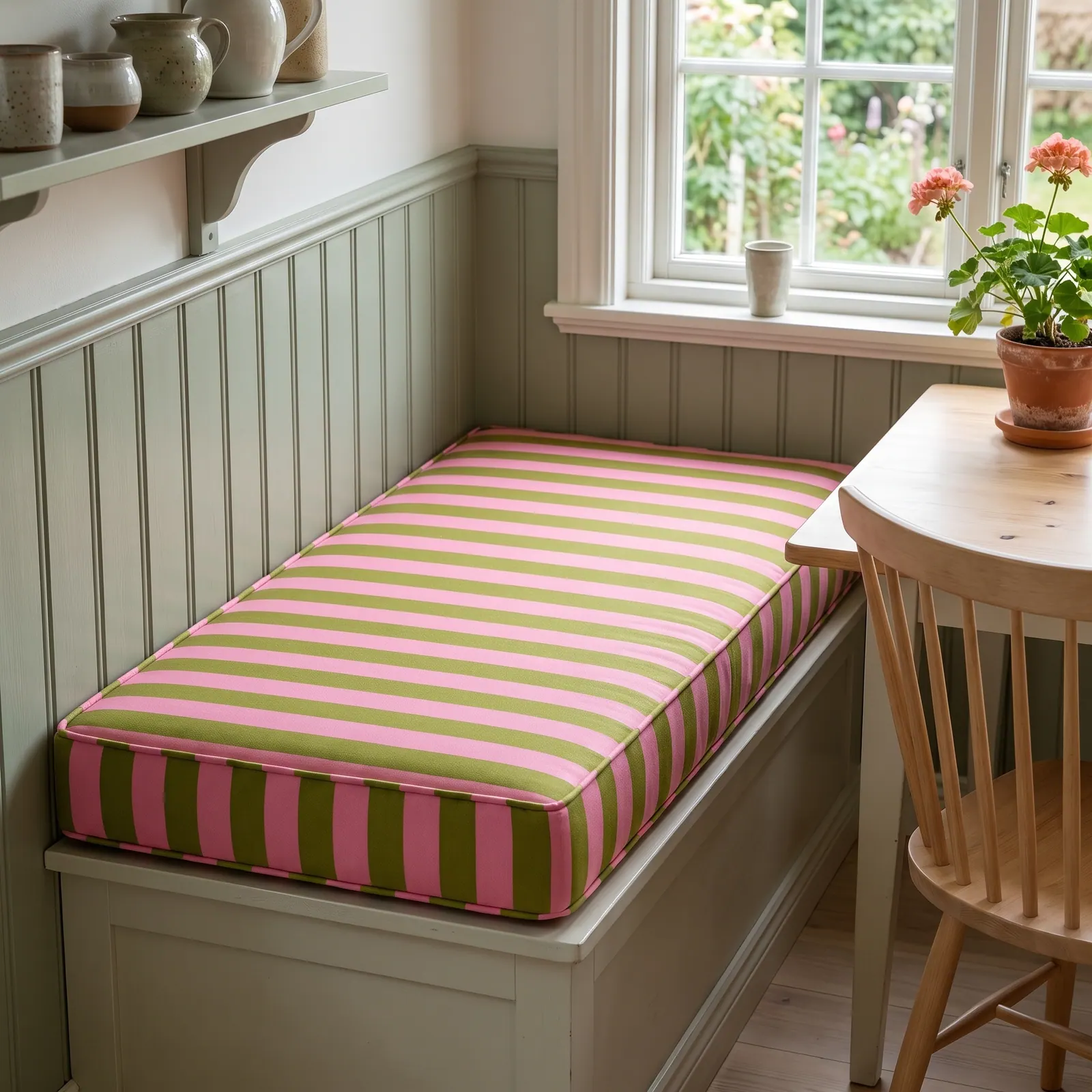
A letter about a green pinstripe banquette cushion and the depth it gives away
A letter from the cutting table, about a café corner that gets its proportions right and a dining bench that met at 120 degrees.

 Save
The quick answer
A banquette cushion should be chosen as a pair of numbers, seat thickness and back thickness, measured against the bench depth, because an upright back cushion takes depth away from the seat. Use a firm box seat with a separate lift-off back. For a corner that meets at an angle other than 90°, such as 120°, order two trapezoid cushions that meet at the angle.
Newport ·
Dear reader,
A letter on banquette cushion thickness and bench depth
You asked how thick a banquette cushion should be, and for decades I've answered with a question: how deep is your bench? Thickness and depth are one decision wearing two hats.
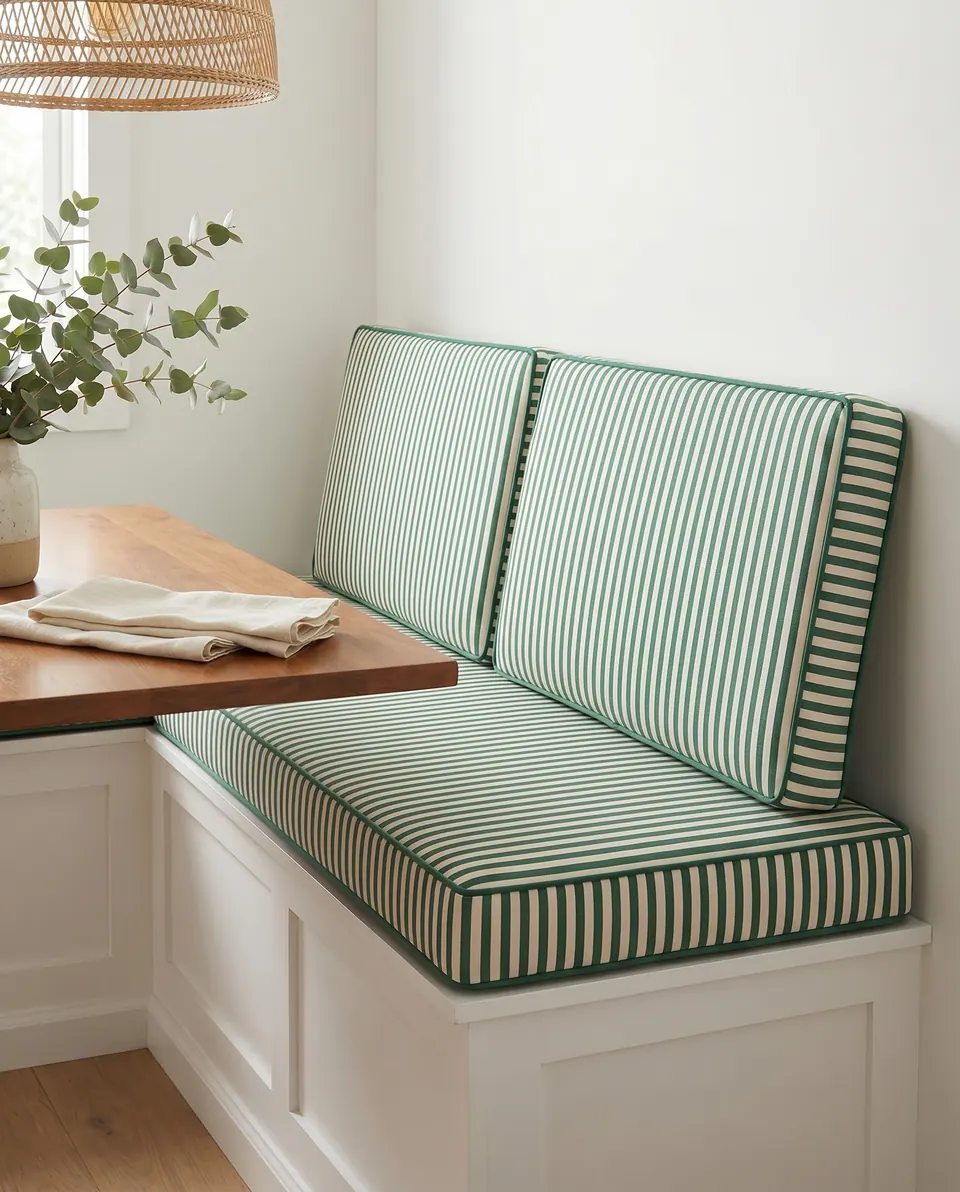
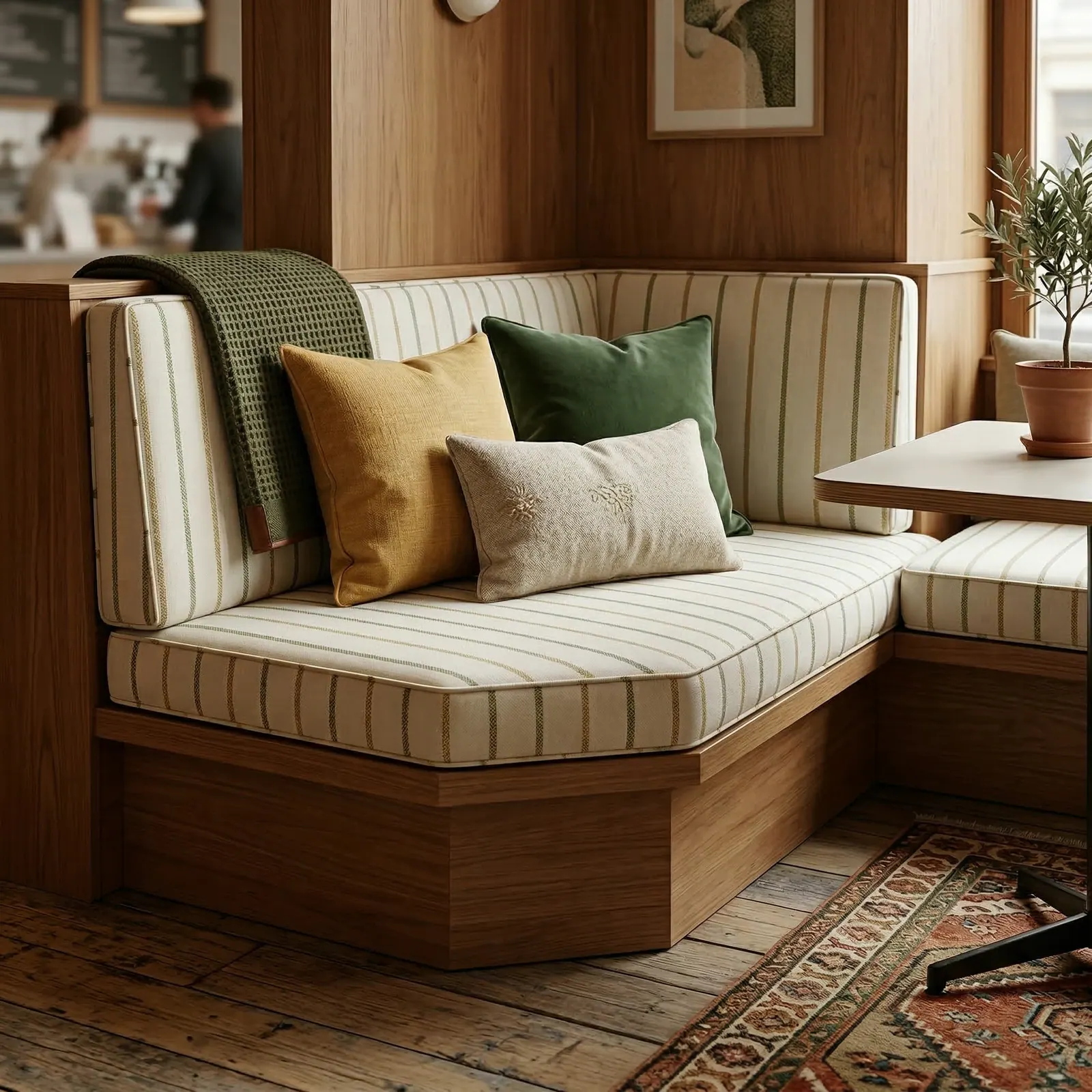
Look at this café corner. The seat is a firm, piped box cushion in ivory with thin green pinstripes. Behind it stands a separate back cushion, upright and removable. That back cushion is doing something quiet. It takes a slice of the bench's depth for itself, and what's left in front of it is the seat you actually sit on. Order a plush, thick back for a shallow bench and you'll perch on the front edge like a sparrow on a wire.
So I work in this order. Bench depth first, wall to front edge. Back cushion thickness second. Whatever remains is your sitting depth, and the seat thickness then has to suit the table height above it. Measure the bench, not the cushion you used to have. The banquette thickness and table height guide and the seat height calculator will do the arithmetic.
The fabric earns its keep too. This is an outdoor acrylic doing indoor duty in a café, where a seat sees all-day traffic. For kitchen and café seating, buyers usually ask for high-density foam with a medium-firm feel, and that's the right call for a seat like this one.
Then the pillows, layered large at the back to small in front: a mustard linen for warmth, a moss velvet that repeats the stripe in a richer texture, and an embroidered oatmeal lumbar. The olive waffle throw softens the walnut corner, and the olive tree in terracotta keeps the greens honest. The small café table and the red and navy kilim-style rug finish the room without asking for attention.
So tell me: what's the depth of your bench, wall to front edge? Everything else follows from that number.
Pinned by Maggie: the walnut nook, pin by pin
Five pins, from the firm pinstripe box seat to the olive waffle throw softening the walnut corner.
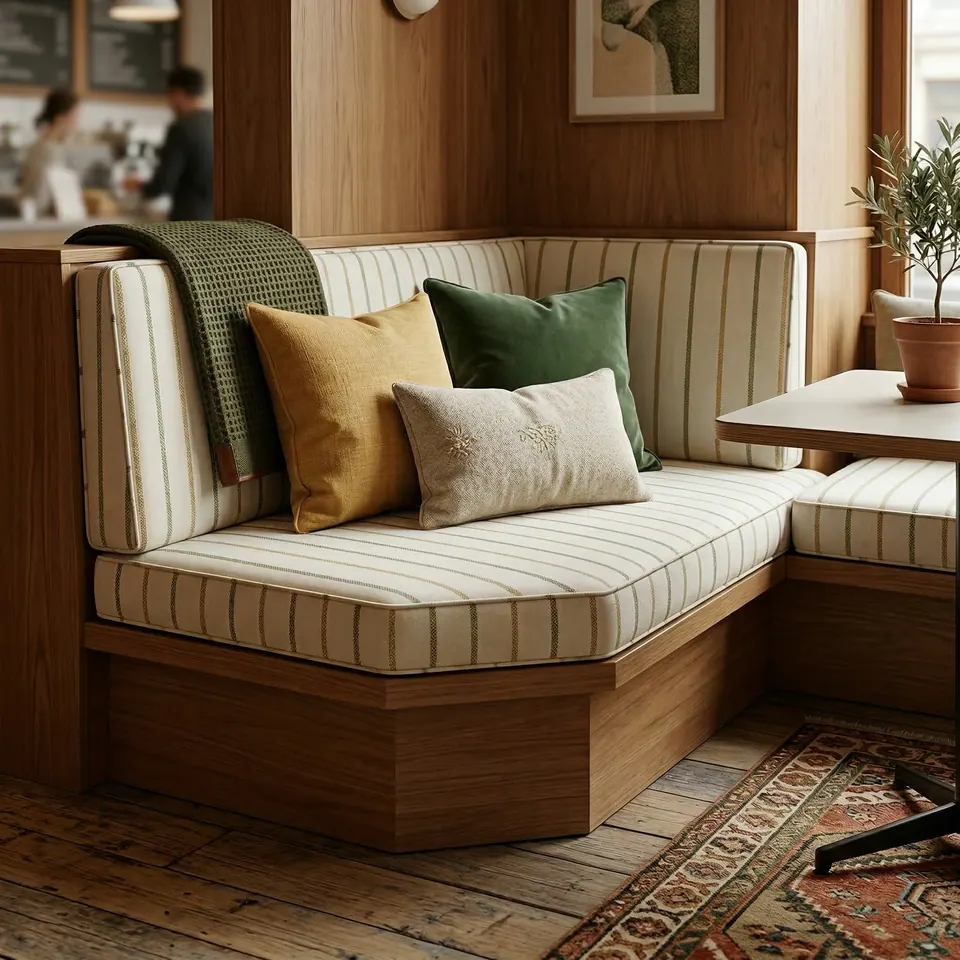
- Pinstripe box seat
A firm piped seat stands up to all-day café use.
- Separate back cushion
Removable back panels make cleaning and replacement easy.
- Mustard linen pillow
Adds warmth against the green pinstripe without clashing.
- Moss velvet pillow
Picks up the stripe color in a richer texture.
- Olive waffle throw
Repeats the green and softens the walnut corner.
- Pinstripe box seatA firm piped seat stands up to all-day café use.
- Separate back cushionRemovable back panels make cleaning and replacement easy.
- Mustard linen pillowAdds warmth against the green pinstripe without clashing.
- Moss velvet pillowPicks up the stripe color in a richer texture.
- Olive waffle throwRepeats the green and softens the walnut corner.
A dining corner at 120 degrees, one inch off
A buyer messaged the workshop about a dining corner bench whose two sides met at 120 degrees, not 90. They weren't sure how to measure it, or whether to order one cushion or two.
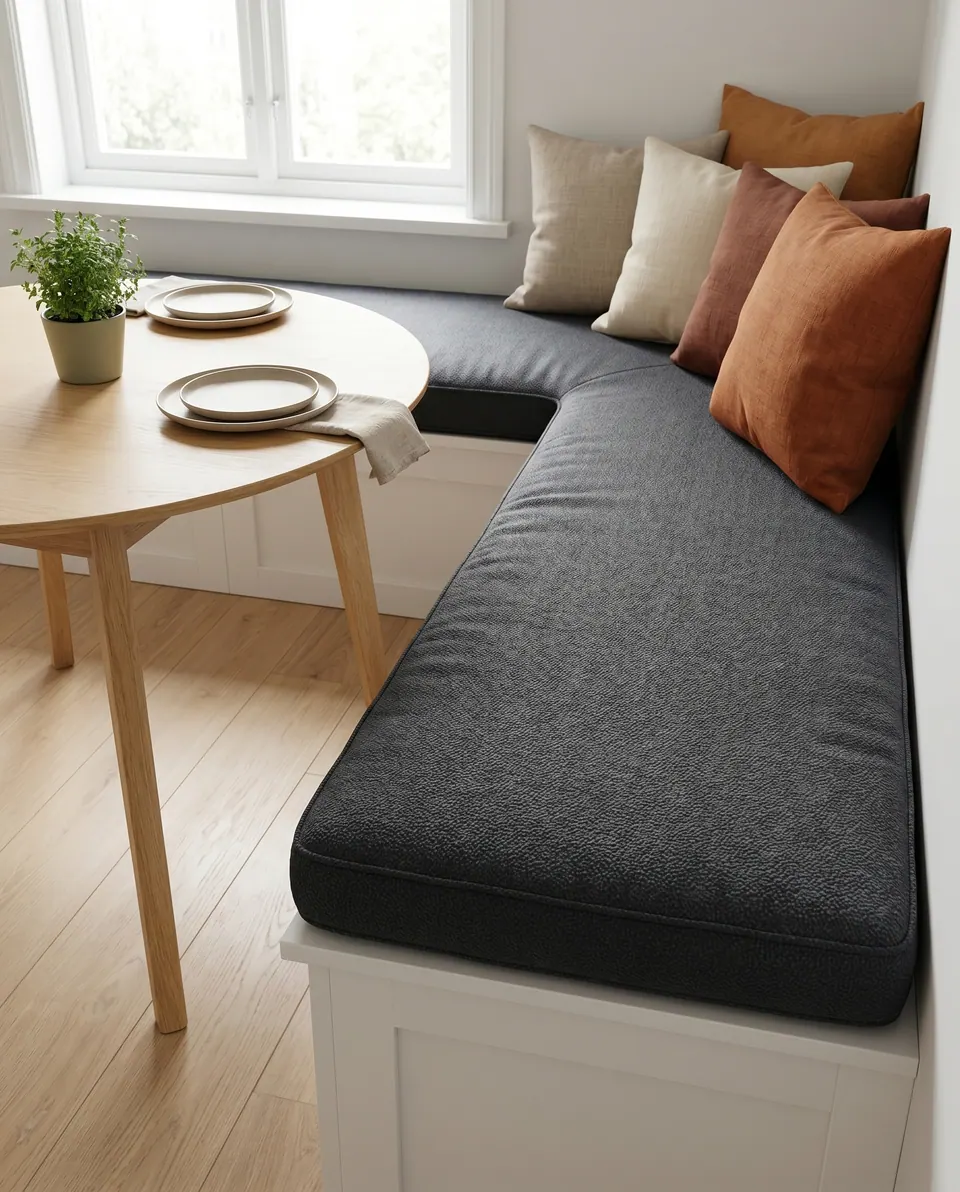
The shop asked for photos and a hand drawing with every size on it. The drawing showed what the photos hid: the right side was 1 in (2.5 cm) narrower than the left, because of a window frame. One cushion would have fought that inch all its life. The shop recommended two trapezoid cushions from its trapezoid listing, each cut to its own side and meeting at the angle.
Angled corners work best as two trapezoids, drawn with every side measured. The angled breakfast nook sketches show more of them, and every other shape lives with our banquette cushions.
Measuring an angled banquette in four moves
Photograph the corner
One photo of the whole bench from across the room, then one of each end and one of the corner itself.
Draw it by hand
Sketch the bench from above. It needn't be pretty; it must show every side.
Measure each side separately
Back edge, front edge and depth on both sides. A window frame can steal an inch from one side only.
Mark where the pieces meet
Draw the joint at the angle, so each side becomes its own trapezoid.
Buyer questions: woven stripes, folding arms and soapy cloths
- A common question
Could you make the stripes in two colors I pick, with a third color for the piping?
The workshop's answerNot the stripes: they're woven into the fabric, not sewn on, so the stripe colors are fixed. A different piping color is no problem. The workshop suggests the closest existing stripe instead, such as a beige stripe when there's no brown one.
- A common question
Can a long bench cushion have folding sections that turn up onto the arms?
The workshop's answerYes. A 74 3/4 x 23 5/8 in (190 x 60 cm) cushion was quoted in three sections of 13 3/4, 47 1/4 and 13 3/4 in (35, 120 and 35 cm), with two fold seams so the ends fold up onto the inside of the arms. It was quoted in an outdoor fabric with foam, alongside separate 17 3/4 x 23 5/8 in (45 x 60 cm) back cushions.
- A common question
My natural linen bench cushions have gotten dirty. How should I clean them?
The workshop's answerWipe them with a soapy cloth. The workshop says that works best for these cushions.
On the cutting table: the café corner
| Product | L-shaped banquette cushion set with separate backs |
|---|---|
| Fabric | Ivory with green pinstripe, outdoor acrylic |
| Piping | Self piping |
| Seat | Firm box cushion |
| Back | Upright, lift-off back cushion |
| Foam feel | High-density, medium-firm, as café buyers usually ask |
| Corner rule | Non-square corners: two trapezoids |
| Best for | Kitchen nooks, café corners, daily dining |

Have it made
Have this made — ask Maggie’s workshop
Have the tape measure handy when they call. Old cushions shrink and sag; the seat underneath does not. — Maggie
Leave your details and the workshop will call you to confirm measurements, fabric, foam and piping. No prices, dates or payment on this page: it is a request, not an order.
A banquette cushion's back takes depth from the seat: bench depth minus back cushion thickness is the seat you actually sit on.
Maggie
Questions buyers ask next
Should an L-shaped banquette cushion be one piece or two?
Two. A corner banquette is easier to fit and to clean in two pieces that meet at the corner. When the corner is not 90 degrees, each piece becomes a trapezoid, cut to its own side, so an uneven wall or window frame affects only one cushion.
What foam feel suits a kitchen banquette?
Buyers with kitchen and café seating usually ask for high-density foam with a medium-firm feel. It keeps a flat, even top through daily meals, which matters when the table height is fixed and every inch of seat height counts.
Why use a separate back cushion on a banquette?
A back that lifts off can be cleaned or replaced on its own, and you can choose its thickness separately from the seat. That matters because every inch of back cushion comes off the depth you sit on.
How do I layer throw pillows on a banquette?
Large at the back, small in front. In the café corner, a mustard linen and a moss velvet pillow lean against the back cushion, with an embroidered lumbar pillow in front and a waffle throw over the corner.
Stitch straight — Maggie
More photographs to read
 Save
 Save
 Save
 Save
 Save
 Save