 Save
A Reading by MaggieDining Chair Cushions & Pads
A green outdoor chair cushion with ties, made for an hour on an iron chair
An old wrought-iron chair is lovely for four minutes and cruel for forty. Maggie reads the green seat pad that takes care of the other thirty-six.
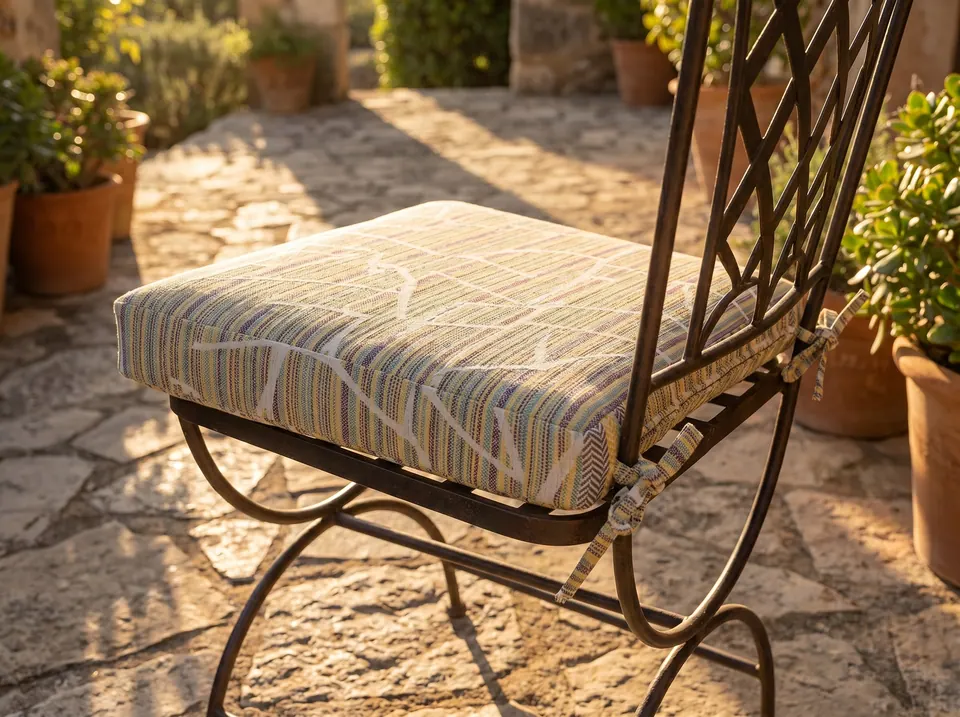
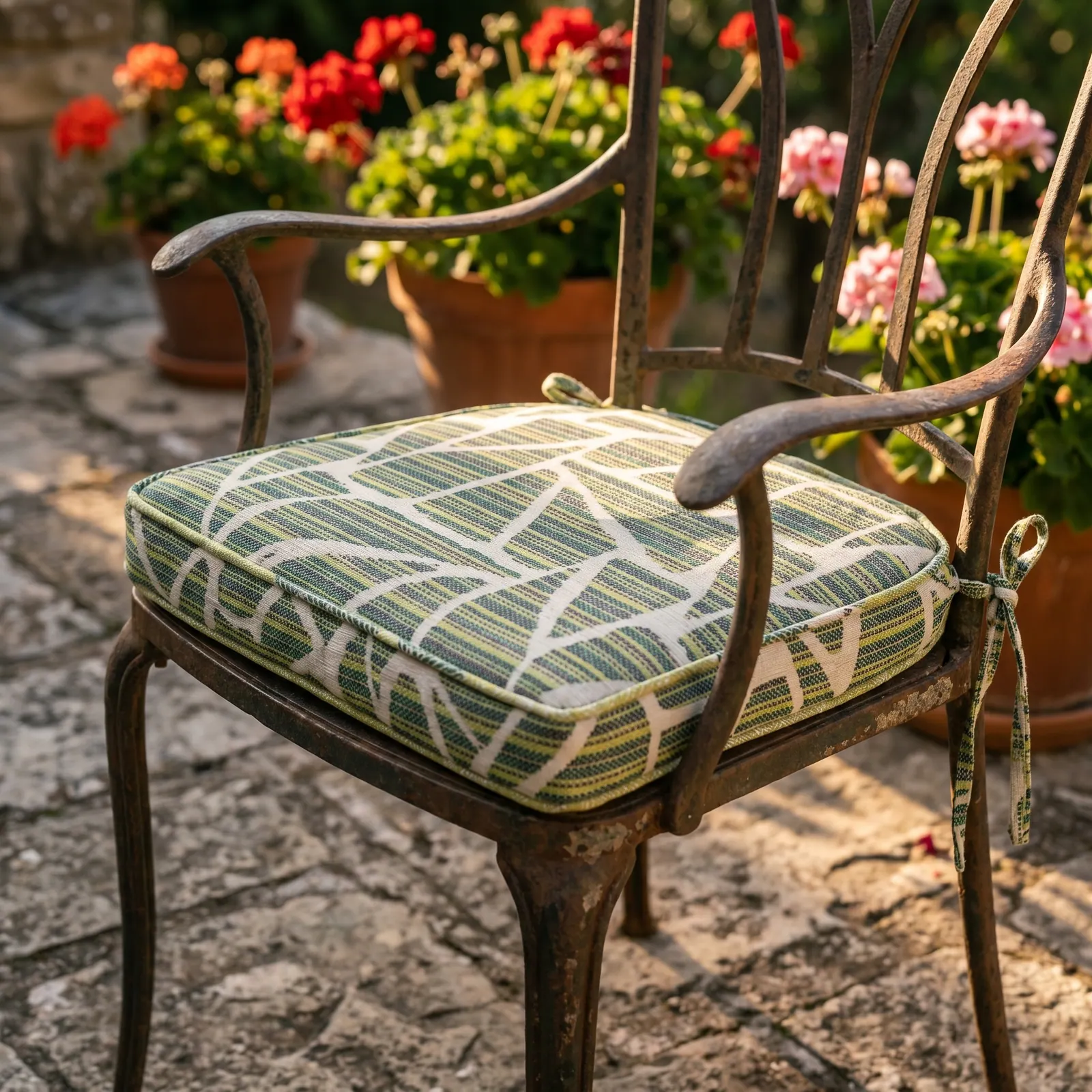
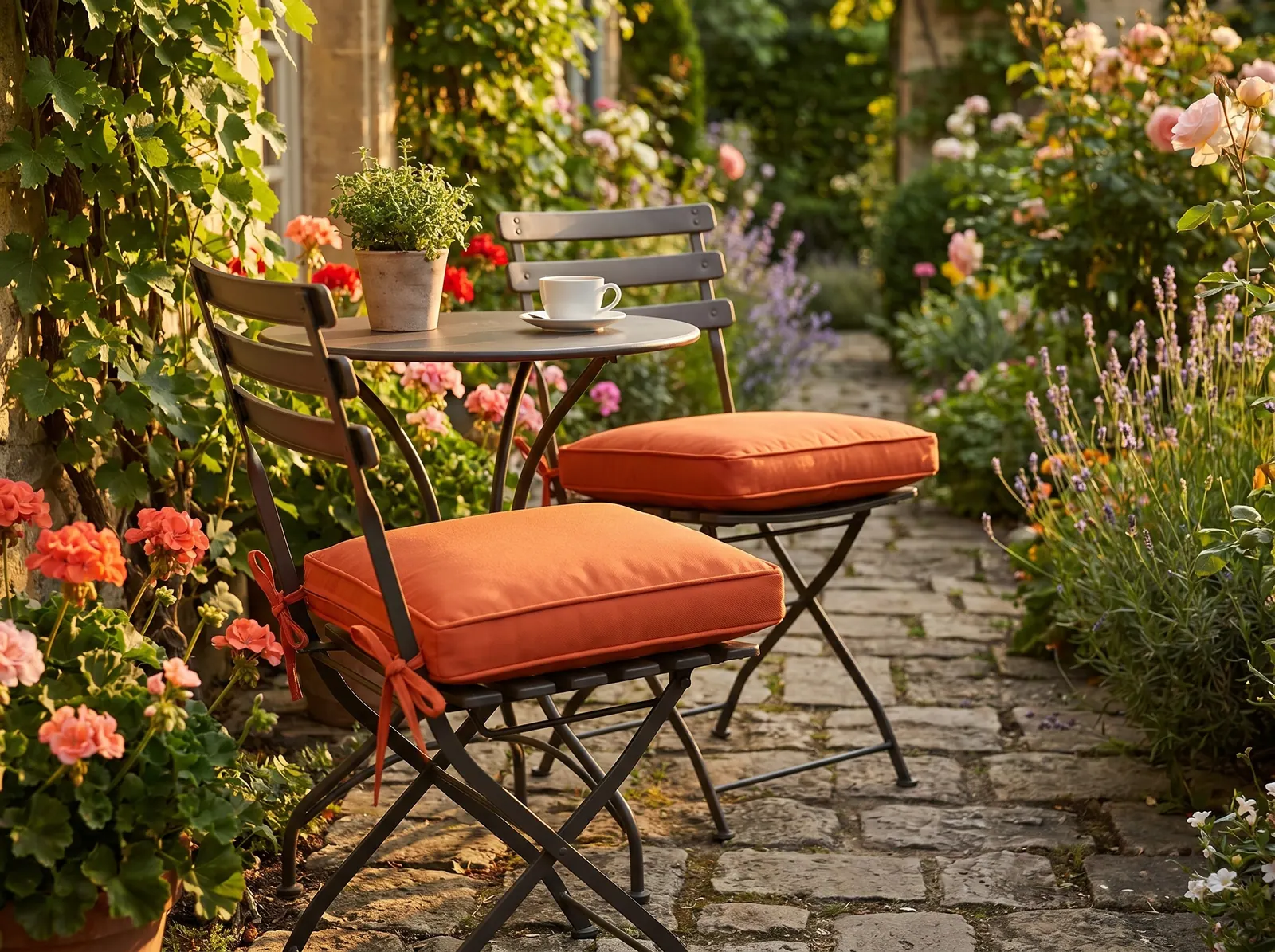
A green graphic seat pad with ties sits on an old wrought-iron chair among red and pink geraniums.

The quick answer
A chair cushion with ties makes an iron chair comfortable for long sitting when it is 3 to 4 in (8 to 10 cm) thick, cut from dense foam wrapped in batting, and tied at the back legs so it cannot creep forward. Trace the seat itself on paper, because antique metal seats often taper and the chair's overall size tells you nothing.
Four minutes on bare iron, an hour on a good pad
Bare wrought iron is a fine thing to look at and a poor thing to read a novel on. The scrolls press into the backs of your thighs, the seat tips you slightly forward, and by the second chapter you are perched rather than sitting.
This pad fixes that with three plain decisions. It has a boxed edge rather than a flat one, so there is real depth under you. It follows the chair's slightly tapered seat instead of hanging off the corners. And it is tied at the back legs, which is the whole game on metal, where a cushion slides the moment you shift your weight.
The fabric is a leafy green with white branching lines, piped in pale green. That piping earns its place: against dark iron it draws a clean outline, so the pad reads as tailored rather than tossed on. A straight welt is a kind of honesty, and on a scrolled chair it is the only straight line in sight.
Red and pink geraniums in terracotta pots give the green its opposite, and rust-brown iron on sun-bleached limestone keeps the corner warm in late sun.
Pinned by Maggie: seat, piping, tie and geraniums
Follow the pins from the branch-line seat to the pale green piping, then back to the tie at the rear leg, the detail most people forget.
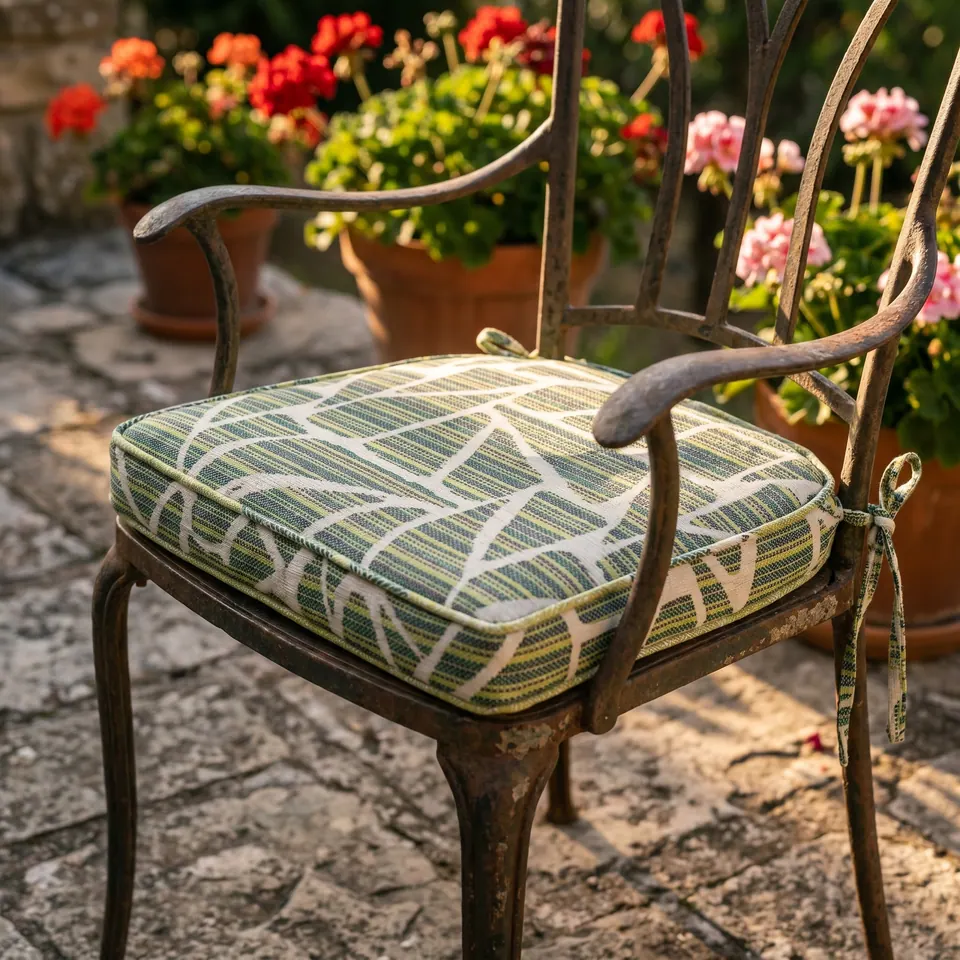
- Branch-line seat pad
Leafy green with white lines pairs with the geranium foliage.
- Piped front edge
Pale green piping gives the pad a sharp outline on dark iron.
- Tie at back leg
Ties matter on metal chairs, where a pad slips easily.
- Red geraniums
Red flowers supply the contrast the green fabric needs.
- Wrought-iron arm
Rust-brown iron keeps the scene warm and aged.
- Branch-line seat padLeafy green with white lines pairs with the geranium foliage.
- Piped front edgePale green piping gives the pad a sharp outline on dark iron.
- Tie at back legTies matter on metal chairs, where a pad slips easily.
- Red geraniumsRed flowers supply the contrast the green fabric needs.
- Wrought-iron armRust-brown iron keeps the scene warm and aged.
My long-sitting checklist, earned the hard way
Sitting through dinner and sitting through a whole afternoon are different tests. Here is what I check before a pad goes on an outdoor chair:
- Depth first. For a deep seat on a metal armchair the workshop suggests 3 to 4 in (8 to 10 cm) of 32-density high-resilience foam. Thinner pads give up under an afternoon's weight.
- A soft wrap. Batting around the foam rounds the front edge, so there is no hard line across the backs of your legs.
- Ties at the back corners. Two ties at the rear legs stop the forward creep. The tie placement pattern shows where they go.
- The seat, not the chair. Trace the seat on paper. Antique iron seats taper, and a rectangle cut to the widest point pokes out at the back.
- Color checked outdoors. Greens shift more than most colors between a screen and a terrace.
I once cut a pad from a catalog chair size and spent a summer watching it overhang like a tongue. What chair do you actually sit in longest?
Two iron armchairs, measured from the outside in
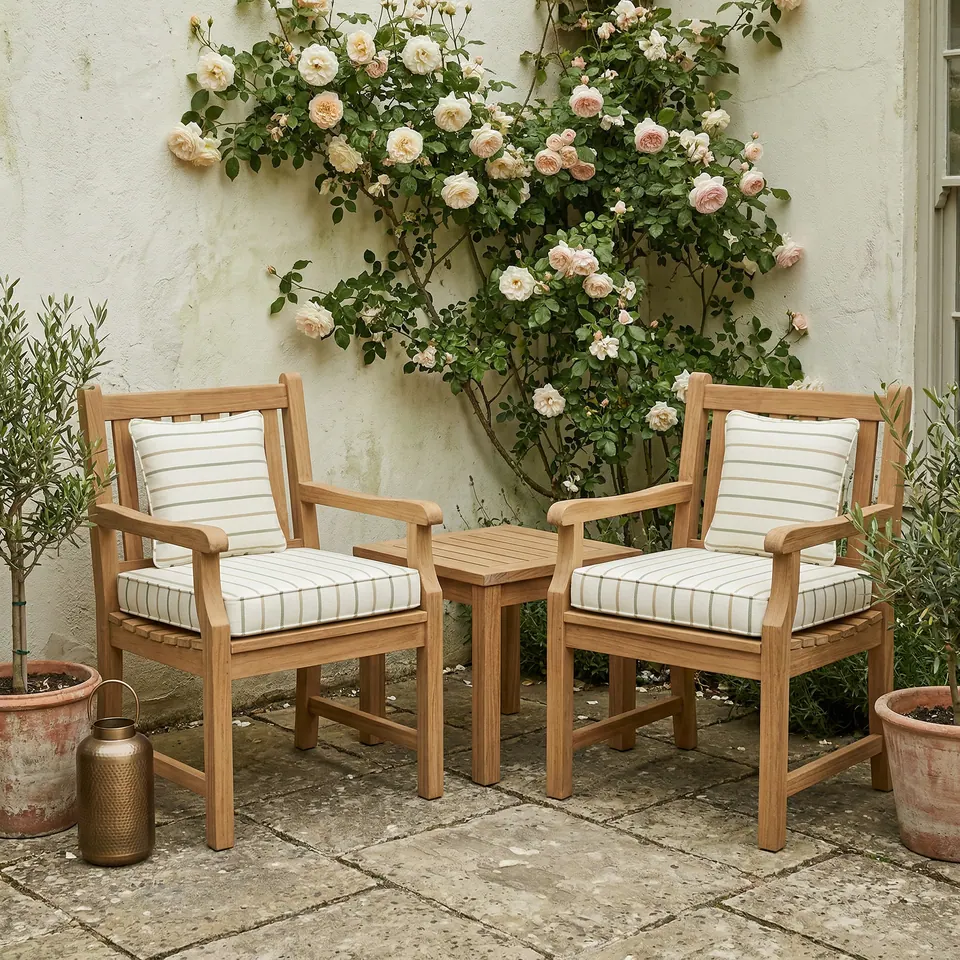
A buyer got in touch about two metal armchairs in a country-house style, still on their way. They wanted deep seat and back cushions with piping, in a linen-look or a fine ticking stripe, for outdoor use all year. The only numbers they had were the chairs' overall size: about 20.75 x 22.25 x 36 in (52.7 x 56.7 x 91.5 cm).
The workshop said that was not enough to cut from. It asked them to wait for the chairs and then measure between the armrests, the depth of the seat itself, and the back height they wanted. It suggested seats 3 to 4 in (8 to 10 cm) thick in 32-density high-resilience foam wrapped in batting, with ties at the back corners.
It also talked them out of the ticking. That stripe is 100% cotton and not suited to outdoor use, so outdoor linen-look fabrics were the sensible call; the outdoor acrylic shelf shows the family this green pad comes from. Measure the seat, dear, not the chair.
On the cutting table: the iron-chair seat pad
| Piece | Outdoor chair cushion with ties for a wrought-iron armchair |
|---|---|
| Shape | Chair pad traced to a slightly tapered seat |
| Fabric | Green outdoor fabric with white branch lines (code 660) |
| Piping | Contrast piping in pale green |
| Edge | Box edge |
| Thickness | 3 to 4 in (8 to 10 cm) for long sitting on a deep seat |
| Foam | 32-density high-resilience foam wrapped in batting |
| Fastening | Ties at the back legs |
| Best for | Terrace reading, long lunches, metal chairs that slip |

Have it made
Have this made — ask Maggie’s workshop
Have the tape measure handy when they call. Old cushions shrink and sag; the seat underneath does not. — Maggie
Leave your details and the workshop will call you to confirm measurements, fabric, foam and piping. No prices, dates or payment on this page: it is a request, not an order.
On a metal chair, a seat pad without ties is only visiting: two ties at the back legs keep the cushion put through an afternoon of reading.
Maggie
Buyer questions: odd chairs, tricky greens, a folding ottoman
- A common question
Do you make seat and back cushions for a Barcelona-style chair?
The workshop's answerYes, on request. Because of the chair's intricate design and the detailed work involved, it is a pricier model and is not listed. Send reference photos, your fabric choice and exact dimensions, and the workshop quotes the seat and backrest cushions.
- A common question
Will olive green 123 clash with my curtains? Greens are so hard to judge online.
The workshop's answerColor 123 shifts noticeably with light: under white light it reads yellow-lime, and under warm light it looks much calmer. Greens, and sage especially, are the hardest colors to judge on a screen, so check close-ups under your own lighting or order samples first.
- A common question
Does the folding ottoman open into a bed, and can it be made in velvet instead of corduroy?
The workshop's answerYes to both. The foldable ottoman opens out into a bed, and it can be made in regular velvet instead of corduroy. Extra covers can be ordered separately later.
Questions buyers ask next
How do I measure an antique iron chair for a seat pad?
Lay paper on the seat and trace it, marking where the back posts and arms meet the seat. Old iron seats often taper toward the back, so a traced template fits better than a rectangle taken from the widest point.
Why do cushions slide around on metal chairs?
Metal is smooth and often slightly sloped, so every shift of weight nudges the pad forward. Ties at the back legs anchor it. Tie around the rear legs or a low back rail so the knots sit out of the way.
Is cotton ticking a good choice for an outdoor chair cushion?
Not outdoors. The workshop's ticking stripe is 100% cotton, which suits indoor chairs. For a terrace or patio, choose one of the outdoor fabrics, such as an outdoor linen-look weave, which is what the workshop steers outdoor buyers toward.
What thickness suits a chair cushion for long reading sessions?
For a deep seat, 3 to 4 in (8 to 10 cm) of dense foam wrapped in batting holds up through an afternoon. On a dining chair pulled up to a table, check the gap under the tabletop before choosing the thicker end.
Stitch straight — Maggie
More photographs to read
 Save
 Save
 Save
 Save
 Save
 Save