A Reading by HanaDaybed Cushions & Covers
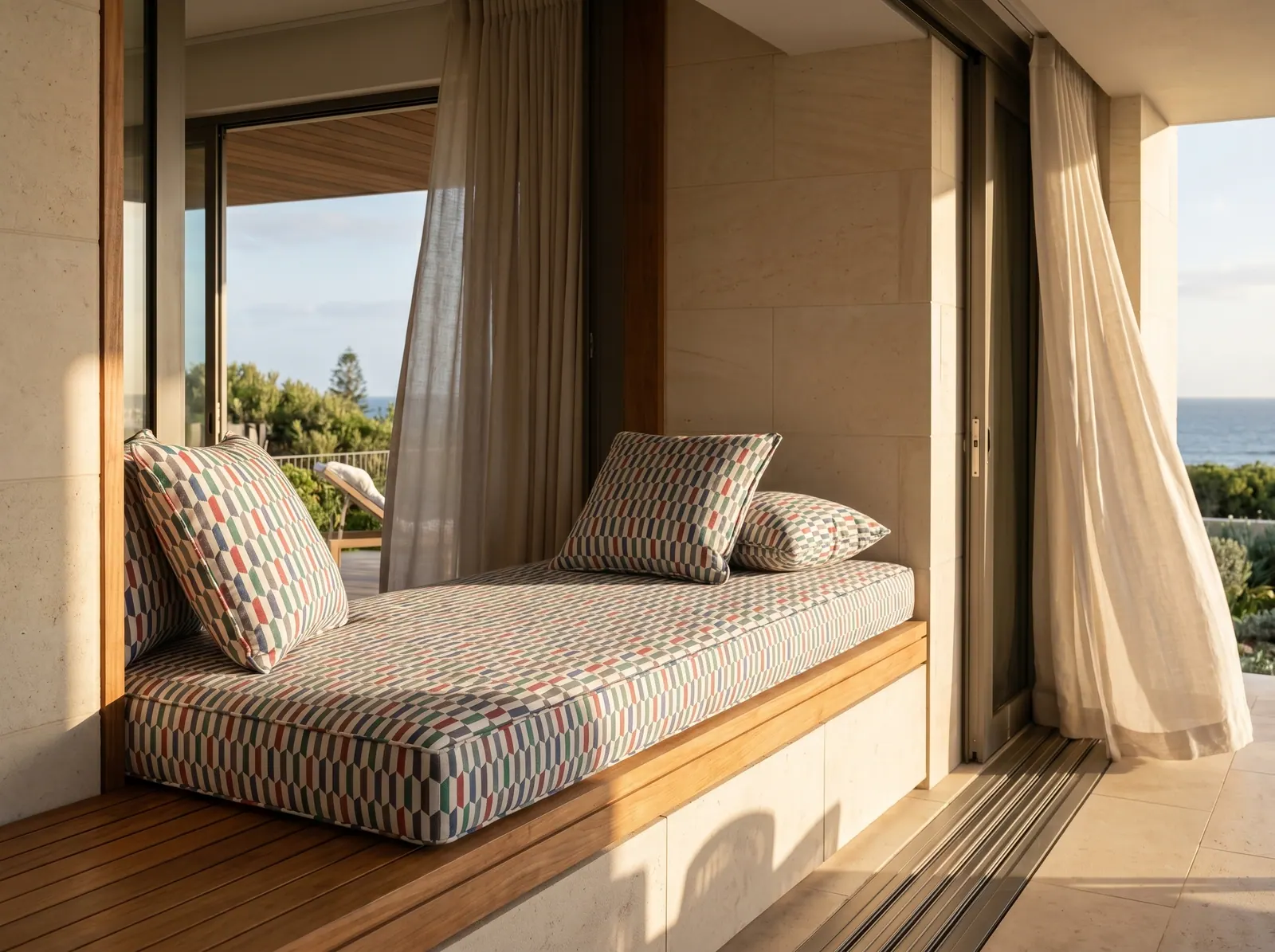
A geometric tile-print daybed cushion on a deep sea-view ledge
A deep ledge, one small geometric print, three pillows and an open door to the sea. Hana measures what the eye only feels.

 Save
The quick answer
A daybed cushion on a built-in ledge should be chosen by three numbers together: ledge height, ledge depth and cushion thickness. Thickness adds to the sitting height, and depth decides if you sit up or lie back. Bench cushions in the same order as this one were made 3 in (8 cm) and 4 in (10 cm) thick.
The cushion, cut open
Cover fabric. A removable, zippered cover. Machine wash at 86°F (30°C) on a gentle cycle and air dry.
Piping. A fabric-covered cord sewn into the seams. It sits on the seam line, so it does not change the size.
Fiber wrap. Polyester fiber (Dacron) batting around the foam: it fills the cover out and softens the edges.
Foam core. About 2.0 lb/ft³ (32 kg/m³) high-resilience foam, firm to medium-firm, cut to the ordered size.
Zipper. Along the back band, as hidden as possible. The zipper side faces down or toward the wall.
Base panel. The underside of the cover. A non-slip fabric backing can cover the whole of it instead.
Three numbers, one ledge
A daybed is a bench deep enough to lie down on. The difference is depth.
This one is a built-in ledge beside open sliding doors: a teak slatted platform against limestone, with the sea beyond the terrace. On it, a mattress-size daybed cushion in a small geometric tile print of cream, brick red, teal and slate blue.
Read it with three numbers.
- Ledge height. Where the wood sits above the floor.
- Cushion thickness. It adds to the ledge, almost inch for inch. The sitting height is the sum.
- Depth. Shallow, and you sit upright. Deep, and you lie back.
Height is a feeling. Here the ledge is deep and the cushion moderate, so the body chooses to recline. Try the numbers for your own ledge in the seat height calculator, and read cushion thickness and seat height.
On the cutting table, top to platform
| Piece | Built-in ledge daybed cushion, mattress size |
|---|---|
| Fabric | Small, dense geometric tile print, outdoor grade |
| Colors | Cream, brick red, teal, slate blue |
| Edge | Box |
| Piping | Self piping |
| Setback | Stops short of the front edge; a strip of teak shows |
| Pillows | Three in the same print: two at the wall, one in the corner |
| Thickness in the same order | Bench cushions at 3 in (8 cm) and 4 in (10 cm) |
| Best for | Sunrooms, ledges by open doors, damp-prone corners |

Have it made
Have this made — ask Hana’s workshop
A good size is a quiet thing. You notice it only when it is wrong. Let the workshop check yours first. — Hana
Leave your details and the workshop will call you to confirm measurements, fabric, foam and piping. No prices, dates or payment on this page: it is a request, not an order.
Pinned by Hana
Five pins, from the dense print on the cushion top to the strip of teak left bare at the front.
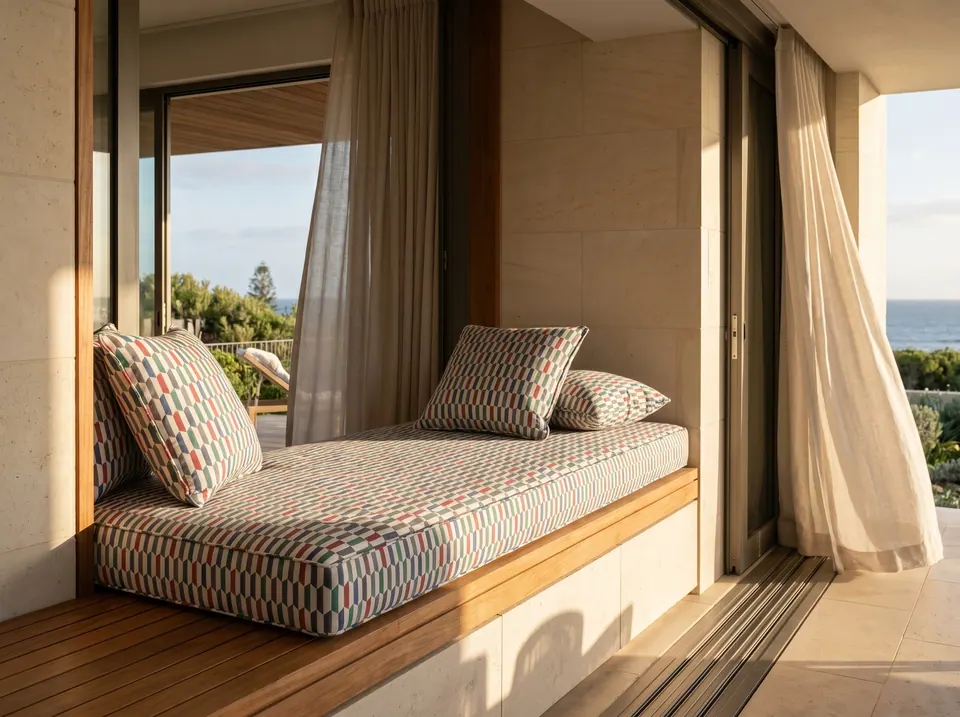
- Daybed cushion top
A small dense geometric can cover a mattress-size cushion without shouting.
- Corner pillow
One pillow propped in the corner turns the ledge into a lounging spot.
- Paired pillows
Two pillows against the stone wall make a soft backrest.
- Sheer curtain
Moving linen softens the hard stone and glass.
- Teak platform edge
A strip of teak left showing frames the cushion like a mount.
- Daybed cushion topA small dense geometric can cover a mattress-size cushion without shouting.
- Corner pillowOne pillow propped in the corner turns the ledge into a lounging spot.
- Paired pillowsTwo pillows against the stone wall make a soft backrest.
- Sheer curtainMoving linen softens the hard stone and glass.
- Teak platform edgeA strip of teak left showing frames the cushion like a mount.
Pattern, stone, and a curtain that moves
The print is small and dense. That is why it can cover something as large as a mattress, and three pillows as well, without feeling loud from across the room. A large pattern at this size would read as a rug.
The cushion stops just short of the teak edge. A strip of wood stays visible, like a mount around a print.
The pillows gather at the wall end. Two lean against the limestone as a soft backrest. One sits propped in the corner. Nothing at the open end, so the ledge reads as a place to lie back.
Stone and glass are hard. The sheer linen curtains, moving in the breeze, are the only soft vertical thing in the frame. Low golden sun warms the cream and the brick red and leaves the teal cool.
The fabric is outdoor acrylic, used indoors. By open doors, damp and spills come in with the breeze. More ideas for bright rooms are in sunroom cushions.
How deep is your ledge, from wall to edge?
One print. Three pillows at one end. A strip of wood, left bare.
Samples first, then two rooms
A buyer in the US started with fabric samples, somewhere between five and ten of them. They arrived within days. The question that followed was a good one: which fabrics could cover daybed mattresses?
All of them, the workshop said. Only velvet is indoor-only.
The order became two daybed mattress covers with large and small bolster pairs, in two outdoor fabrics with piping in a soft woven fabric. Then bench cushions for a second room: three at 3 in (8 cm) thick and three at 4 in (10 cm). The workshop refunded part of that order as a bulk discount.
Outdoor-grade fabric, used inside. Where spills or damp are likely, it is the calm choice. Samples first is always the calm start; see fabric swatches before ordering.
Buyer questions: a play-mat cover, a daybed, a fabric rule
- A common question
Can you make a fully zippered, washable box cover for a mini crib mattress I use as a floor play mat?
The workshop's answerYes. A removable, washable, fully zippered box cover for a 37 3/4 x 23 3/4 x 3 in (96 x 60 x 8 cm) mattress is no problem. Order through the cover listing: pick the size range and write the exact size and fabric code in the personalization box.
- A common question
Do you make covers for the IKEA Hemnes daybed, and how soon do they ship?
The workshop's answerYes. One Hemnes daybed cover, ordered together with a bench cushion, shipped within 2 days and was delivered 3 to 5 business days after dispatch.
- A common question
Are any of your fabrics off-limits for bench cushions or daybed mattress covers?
The workshop's answerNo. Every family, from the linen-look weaves, velvet and the soft 900-series to linen and the outdoor range, can be used for bench cushions and daybed mattress covers, and families can be mixed, such as a linen body with velvet piping. The one caution: velvet is indoor-only and not water-resistant, so choose the outdoor range for anything that may get damp.
On a built-in daybed, cushion thickness adds to the ledge height: measure both together before choosing between 3 in and 4 in.
Hana
Questions buyers ask next
Does cushion thickness change the seat height of a daybed?
Yes, almost one for one. A 4 in (10 cm) cushion raises the sitting surface about 4 in above the ledge, a little less once it compresses under you. Measure the ledge height first, then choose the thickness.
Can outdoor fabric be used for an indoor daybed?
Yes. Outdoor-grade fabric works indoors wherever spills or damp are likely, such as a ledge by open doors, a sunroom or a family bench. Velvet is the one family kept strictly indoors.
Should daybed pillows match the cushion?
In a small nook, one tight geometric for the cushion and every pillow keeps the ledge calm. Group the pillows at the wall end, two against the wall and one in the corner, so the ledge reads as a place to lie back.
Why leave wood showing at the front of a built-in daybed?
A narrow strip of the platform left visible frames the cushion and keeps the front edge from looking overstuffed. It also lets the wood sit beside the stone and linen as part of the room's materials.
— Hana
More photographs to read
 Save
 Save
 Save
 Save
 Save
 Save