A Reading by HanaIKEA Hemnes Daybed Covers & Cushions
A burgundy Hemnes daybed cover, and how much pattern it can hold
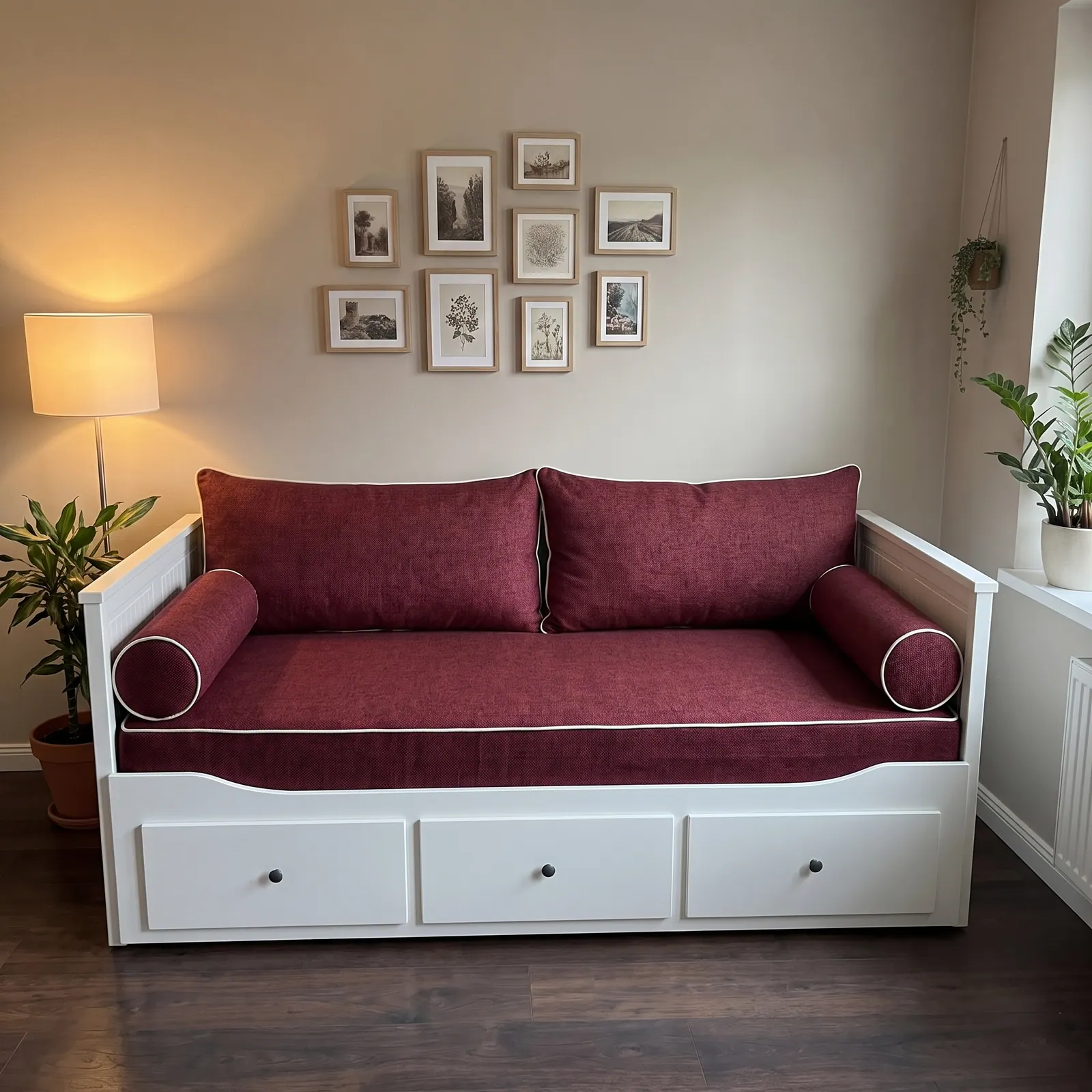
Seen straight on, this daybed is all symmetry. Two backs, two bolsters, one level line of ivory piping. My notes are about what you can add to that calm without losing it.
 Save
The quick answer
A Hemnes daybed cover set reads as a sofa when the mattress cover's piping runs level from arm to arm and the backs and bolsters come in equal pairs. To mix patterns, put a stripe on one piece only, pull the plain color for the rest out of that stripe, and let the weave of the fabric supply the texture.
The front view, folded in half
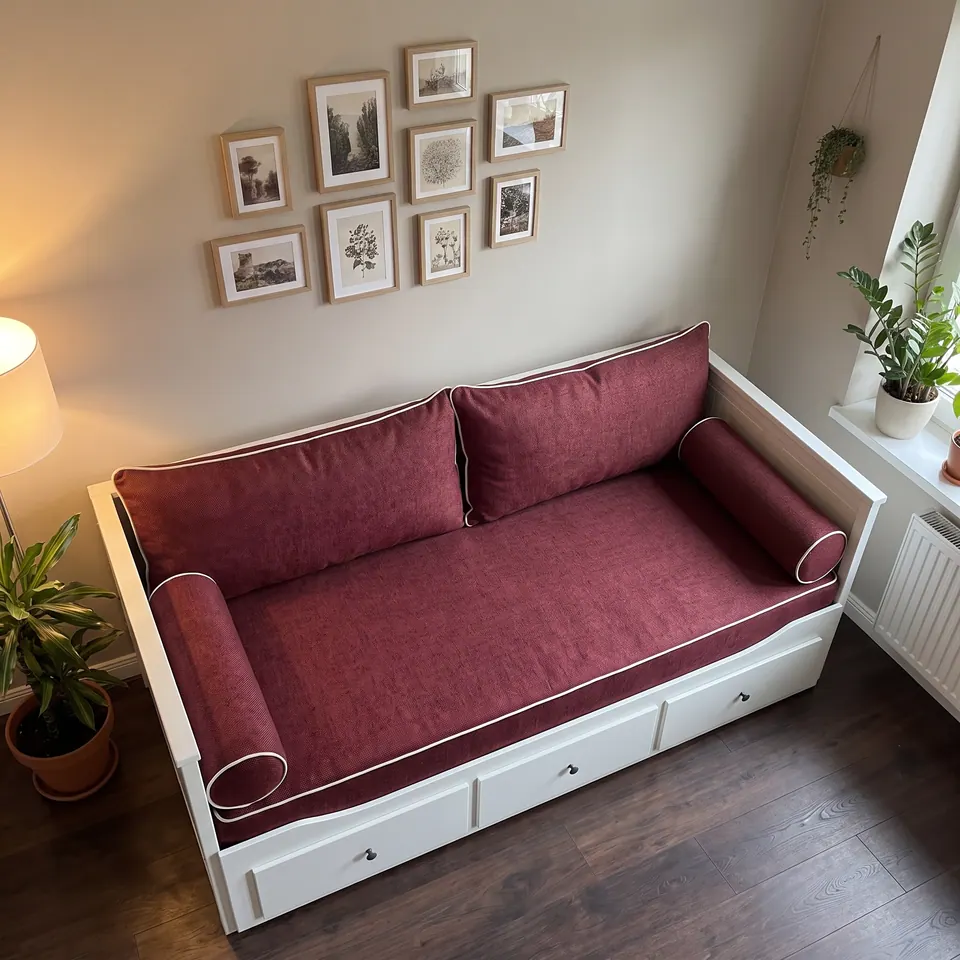
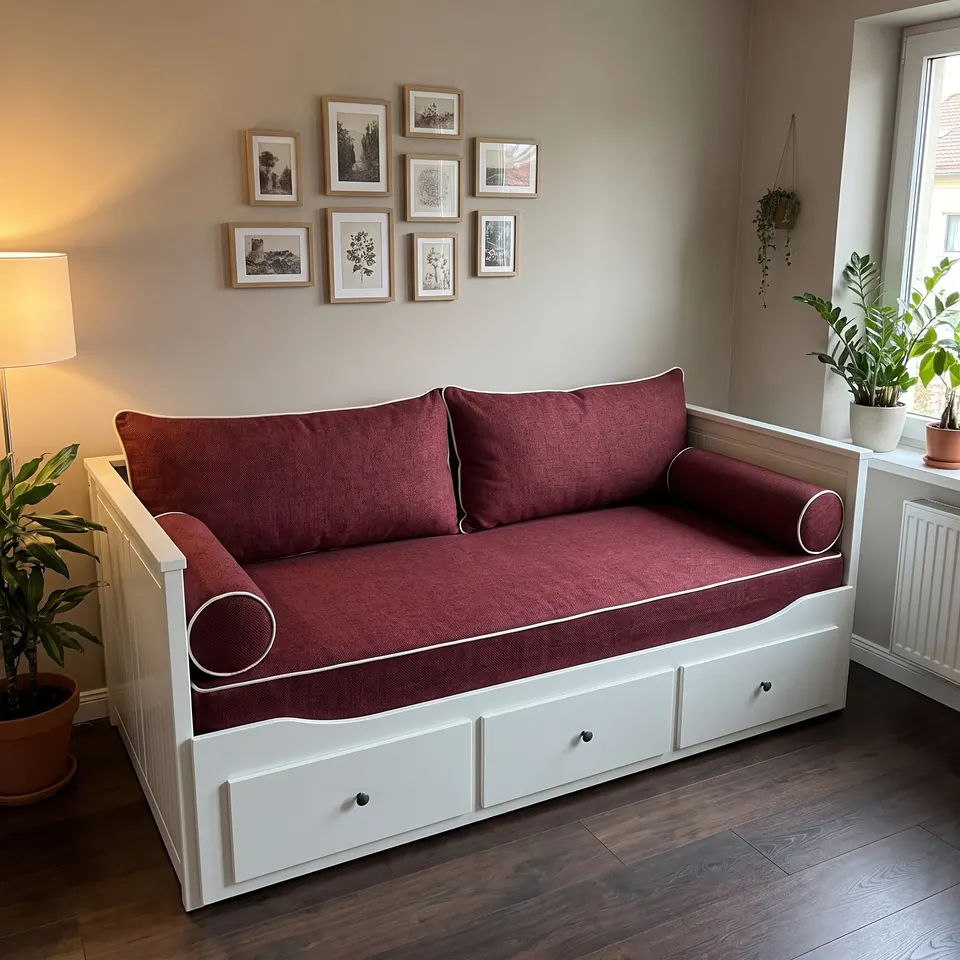
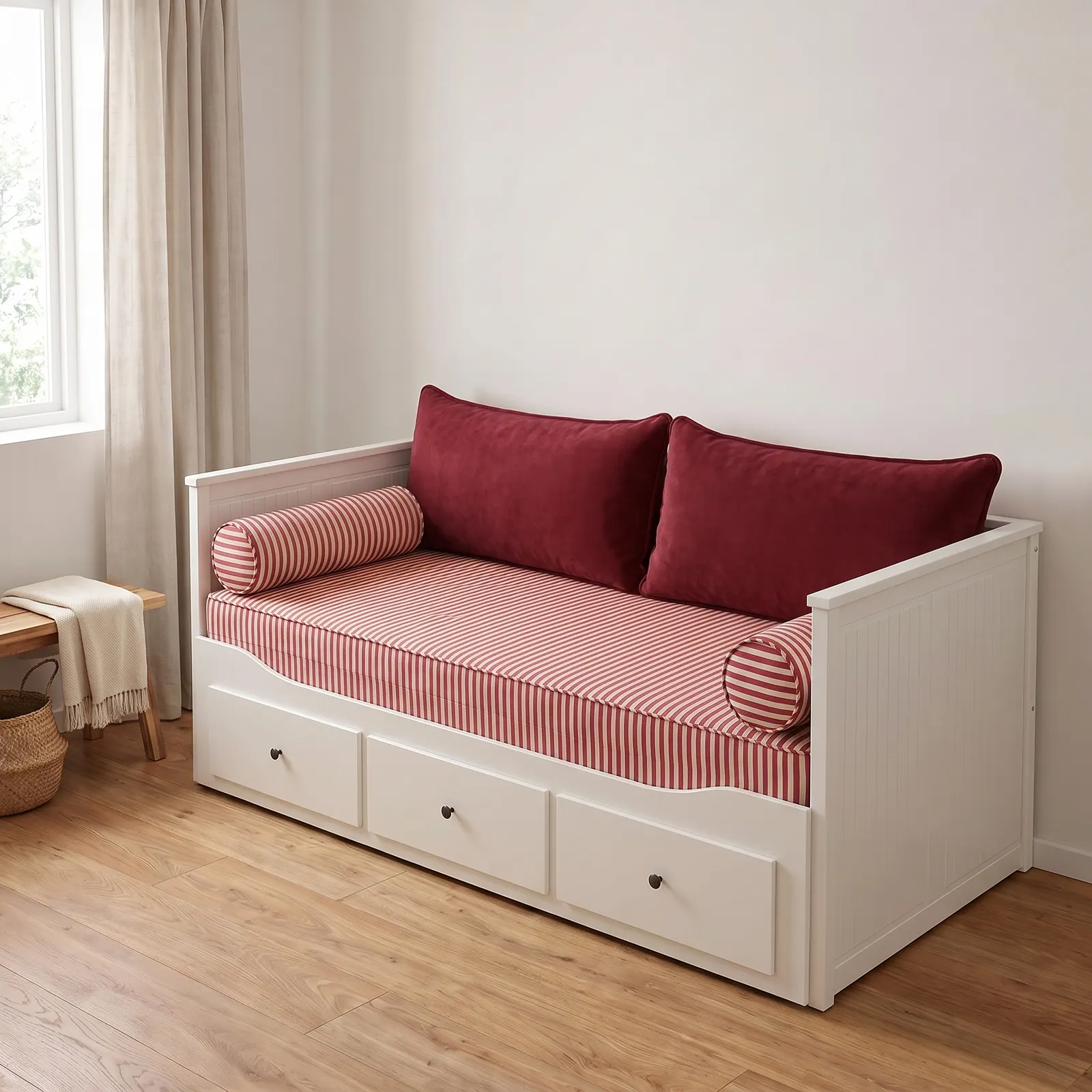
Fold the photograph down the middle and each side answers the other. Two burgundy back cushions of equal width. Two bolsters, round ends toward you, each ringed in ivory piping. Above them, ten small oak frames, grouped no wider than the backs. At the edges, something tall on each side: a lit floor lamp with a linen shade on the left, a dracaena in a terracotta pot and a hanging pothos by the window on the right.
The ivory piping is the line that matters. It runs level along the front of the mattress cover, arm to arm. That one straight line is why the white Hemnes frame reads as a sofa and not a bed. A loose cover would let the line dip in the middle, and the whole front would go soft.
Burgundy under evening lamplight turns deeper, close to wine. The linen-look weave keeps the color from going flat; you can see grain in it even from across the room. The dark wood floor holds the red down. The white frame and pale wall give it air.
The stack, in numbers
| Measure | Inches | Centimeters |
|---|---|---|
| One mattress, as labeled | 4¾ | 12 |
| Two stacked, as they sit | 9½ | 24 |
| Length | 78¾ | 200 |
| Width | 35½ | 90 |
From a real order. The cover was cut to the second row, not the first.
Pinned in my notebook
Five marks on the photograph: the lamp, a bolster end, one back cushion, the frames and the piping line.
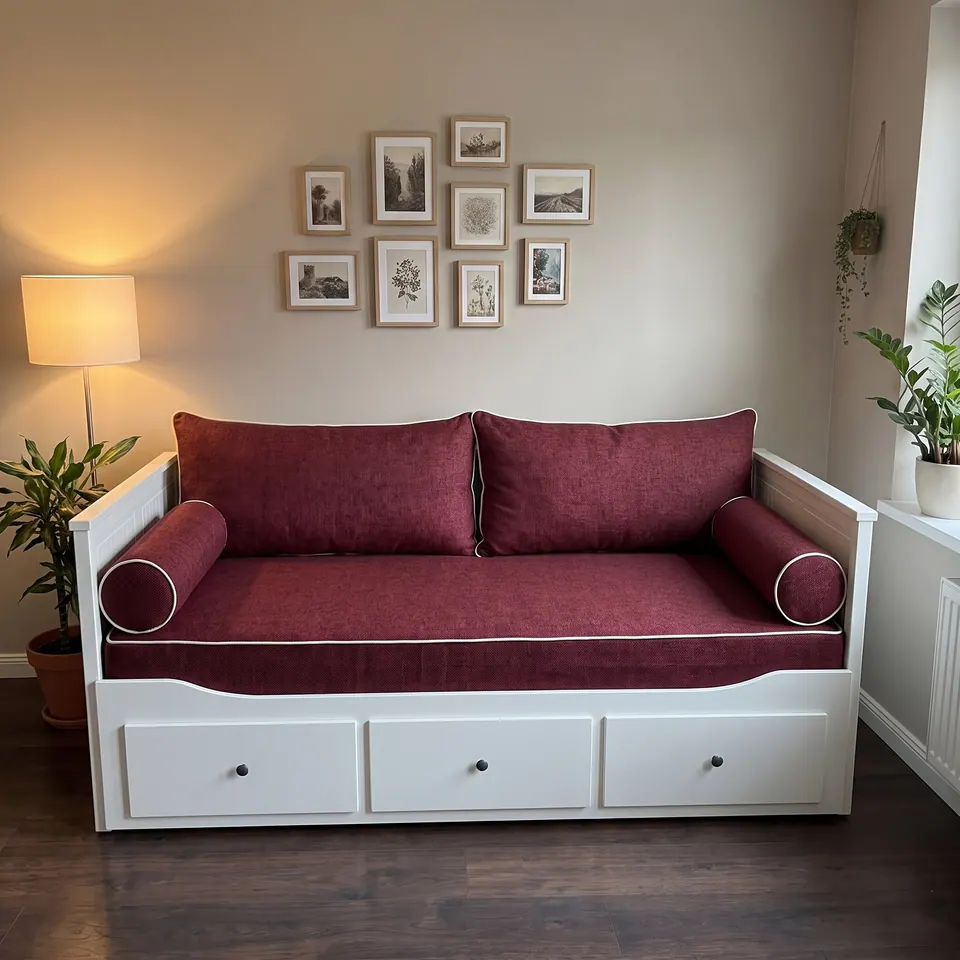
- Round bolster end
Seen head-on, the ivory piping ring shows a neatly finished bolster end.
- Level mattress piping
The piping runs level from arm to arm, the mark of a well-fitted cover.
- Burgundy back cushion
Two equal backs keep the frontal view symmetrical.
- Clustered frames
The frames are grouped to about the width of the back cushions for balance.
- Floor lamp glow
A warm lamp on one side and a plant on the other frame the daybed.
- Round bolster endSeen head-on, the ivory piping ring shows a neatly finished bolster end.
- Level mattress pipingThe piping runs level from arm to arm, the mark of a well-fitted cover.
- Burgundy back cushionTwo equal backs keep the frontal view symmetrical.
- Clustered framesThe frames are grouped to about the width of the back cushions for balance.
- Floor lamp glowA warm lamp on one side and a plant on the other frame the daybed.
One stripe, one plain, one texture
There is no stripe in this photograph. The pattern is on the wall: ten frames in a grid, and a grid is a pattern. The burgundy is the plain. The slub of the weave is the texture. The recipe is already in place.
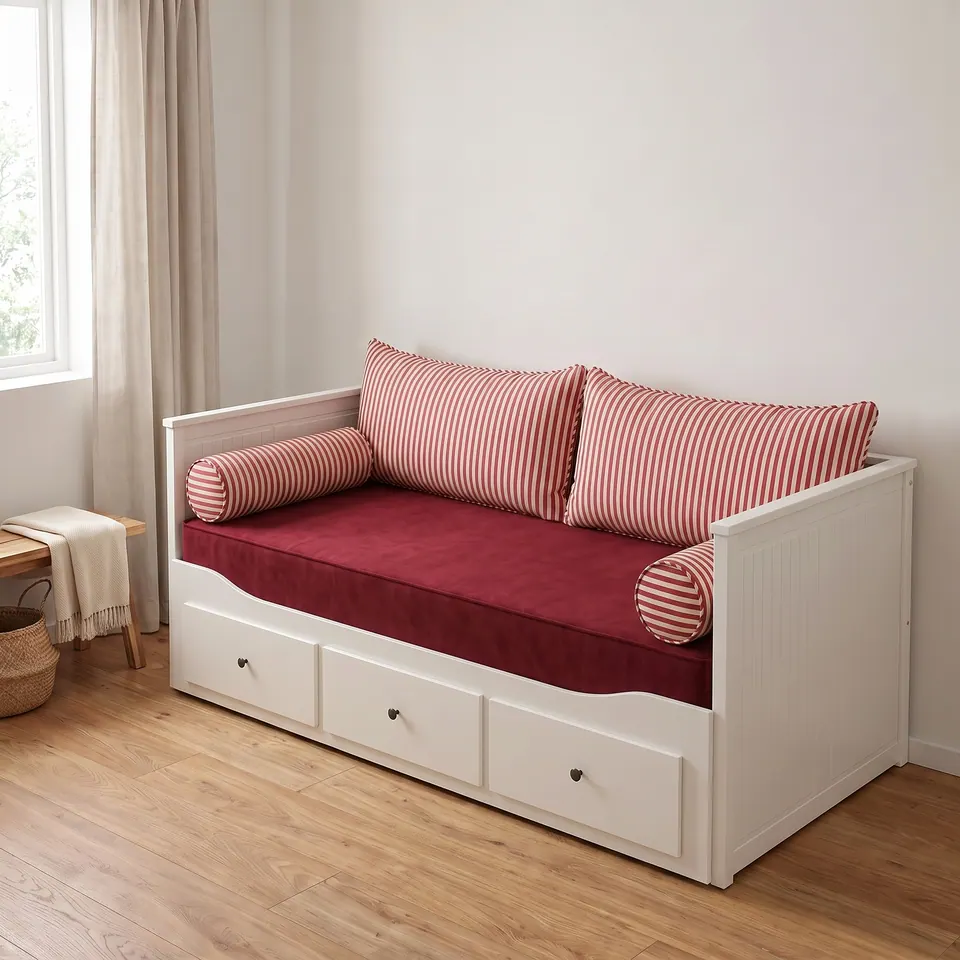
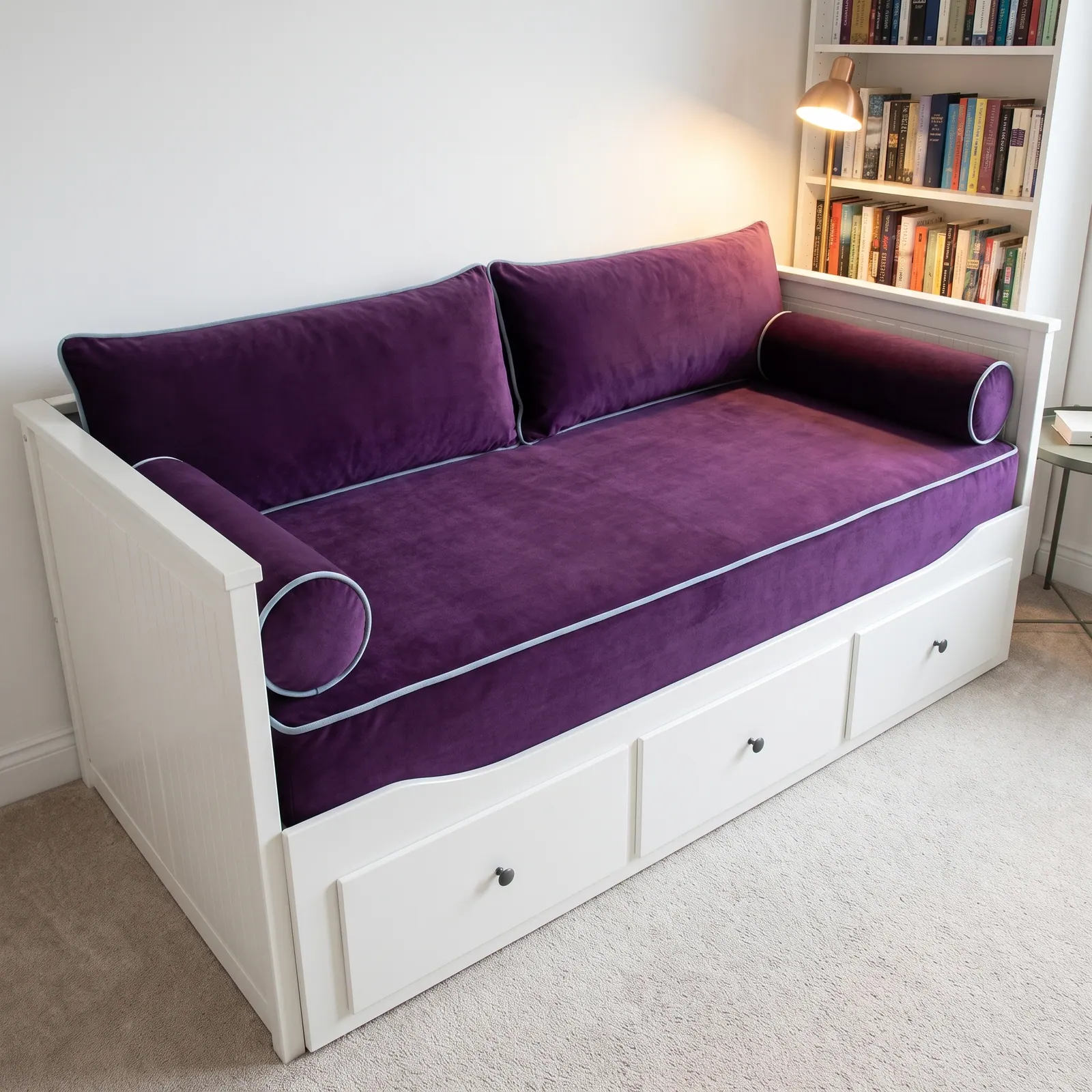
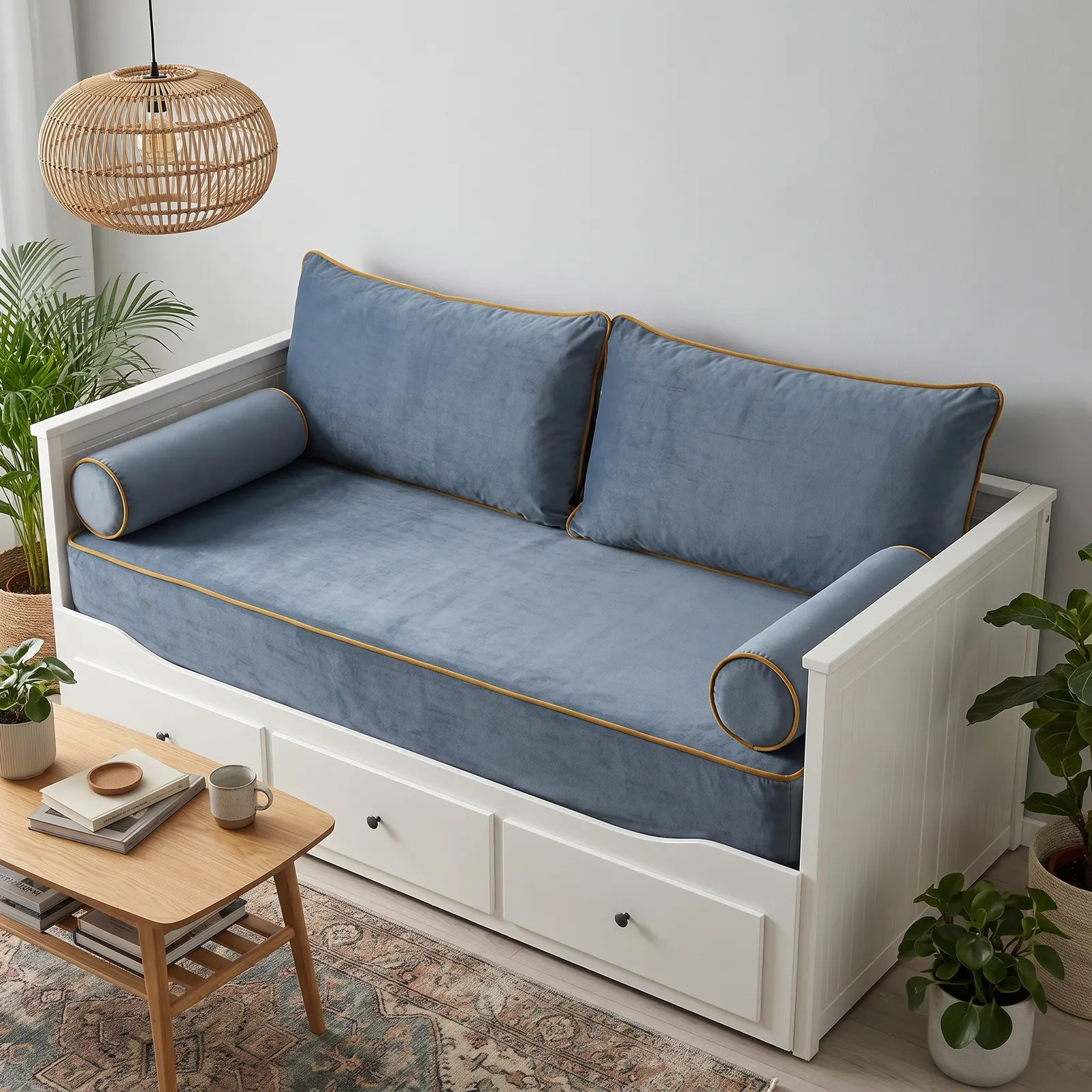
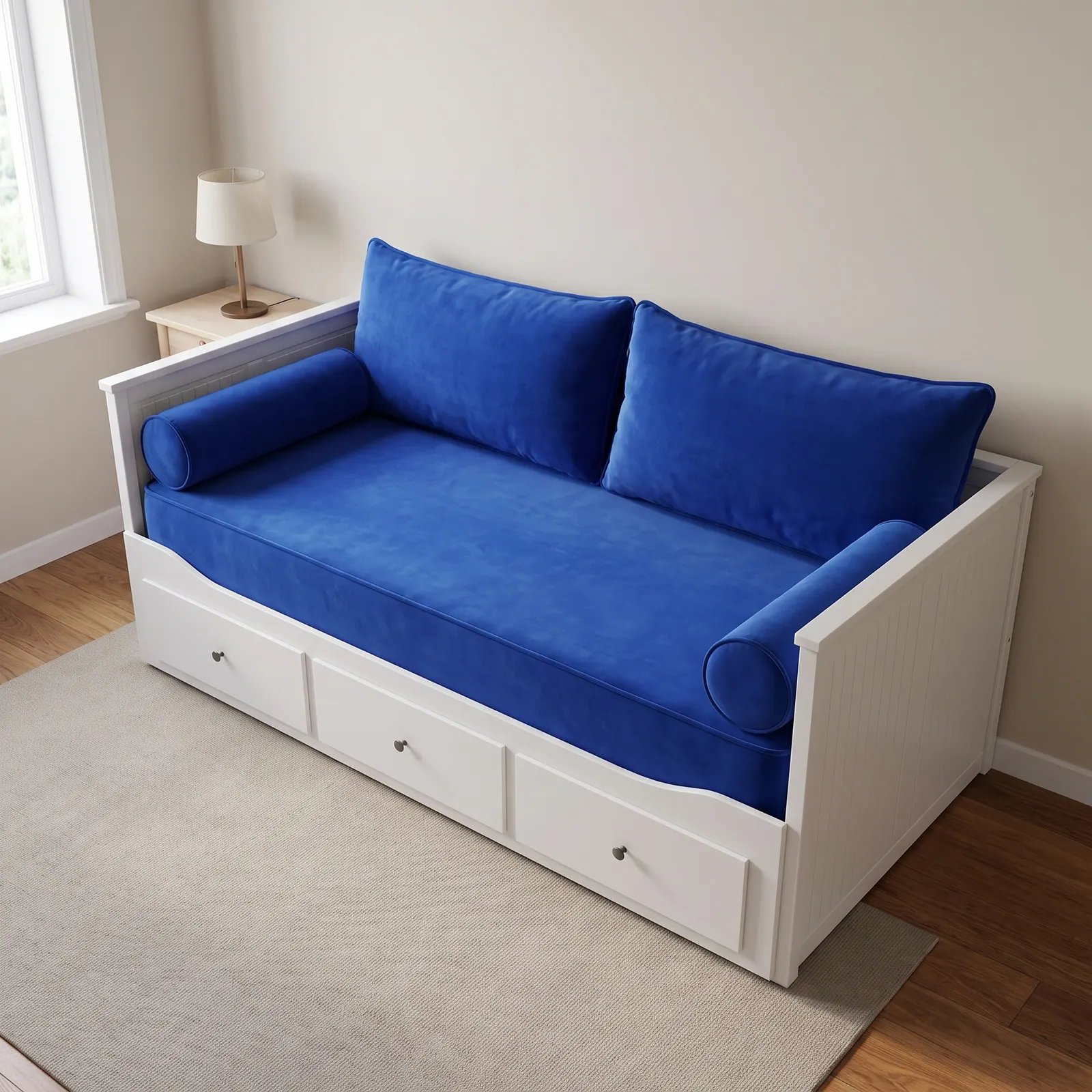
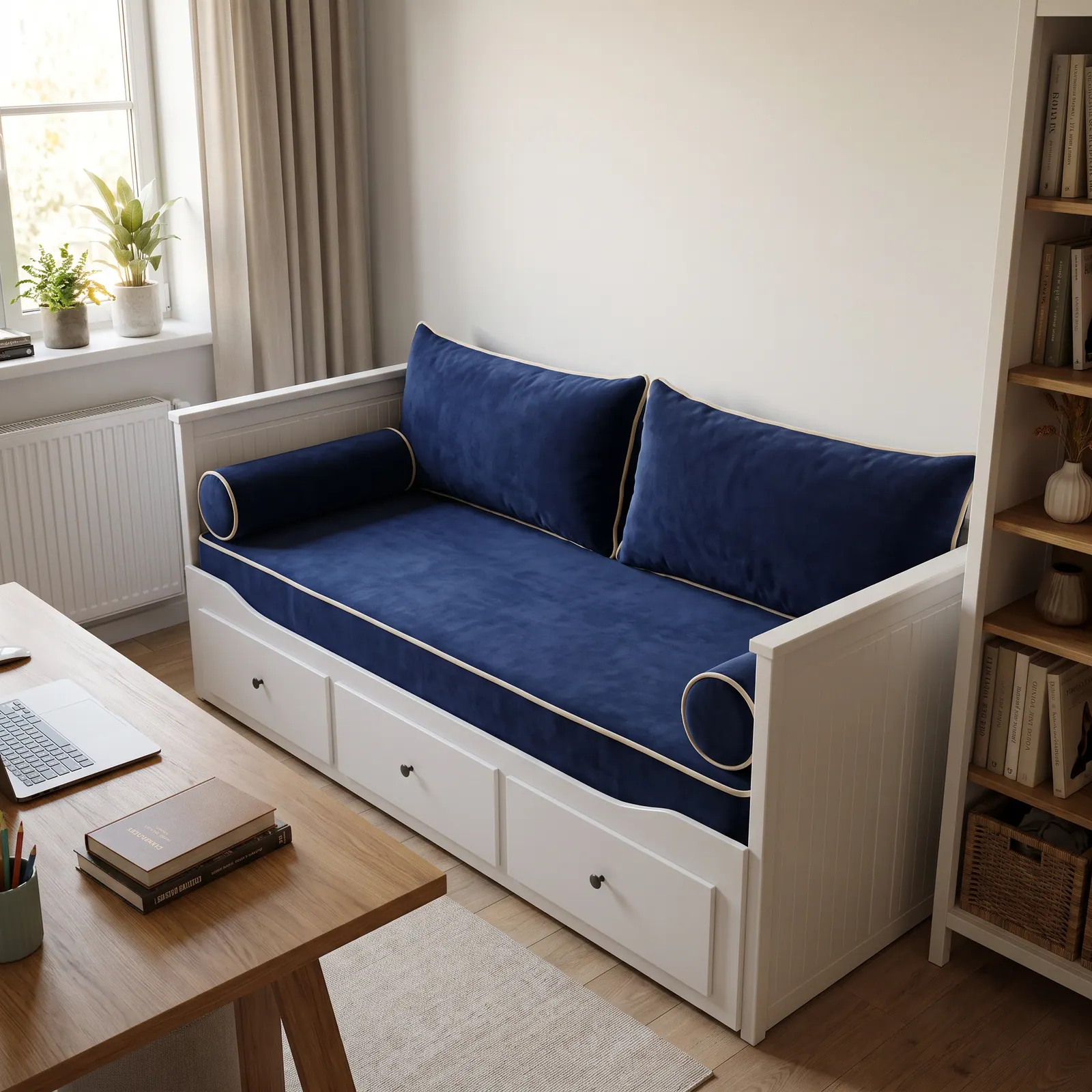
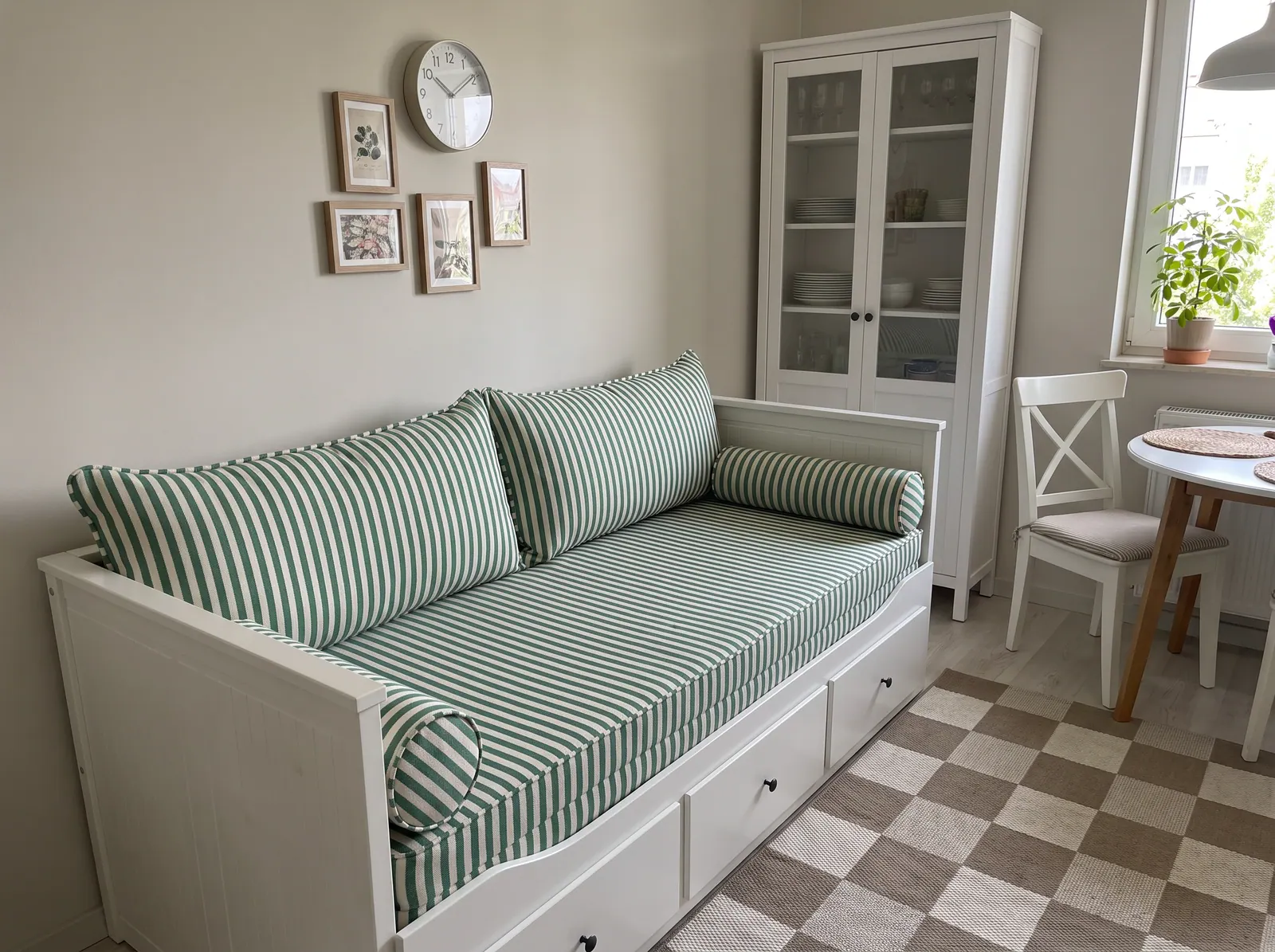
If you want stripes on the daybed itself, keep the three parts and move them. In one of the gallery photos, crimson back cushions sit on a striped seat, and the backs take their red straight out of the stripe. In another, a green stripe covers the whole daybed and the breakfast nook around it stays plain.
The rules I keep:
- One stripe per piece of furniture. Two stripe widths side by side start to argue.
- The plain color comes out of the stripe, not near it.
- Texture reads as a quiet pattern. One slubbed weave beside one stripe is enough.
- Hold the art to the width of the back cushions.
For the proportions of backs and bolsters, see styling a daybed like a sofa.
The wall holds the pattern. The fabric holds the texture. The piping holds the line.
Two mattresses, one height
A buyer wrote to the workshop partway through ordering a daybed cover set. The question is one we see often: do you need the back cushion sizes, or the mattress?
Their daybed held two mattresses stacked, each 4¾ in (12 cm) thick, on a 78¾ x 35½ in (200 x 90 cm) footprint. Together they stood 9½ in (24 cm) tall. The workshop answered that daybed sizes vary too much to trust a standard number, and that the cover would be made to the buyer's own measurements.
They kept the color they had chosen first. The cover followed the stack, not the label on one mattress. The Hemnes cover measuring notes walk through the same steps.
- Sizes
- 78¾ x 35½ x 9½ in (200 x 90 x 24 cm), two 4¾ in (12 cm) mattresses
The lesson: Measure the stacked mattress height as it sits, not the label size of one mattress.
Asked at the cutting table
- A common question
My daybed has two mattresses on top of each other. Can one cover go around both, with the zipper somewhere I can actually get them in?
The workshop's answerYes. One cover is made to the combined height, for example 31½ x 78¾ x 12½ in (80 x 200 x 32 cm), and the zipper is placed so both mattresses slide in and out. A matching neck roll can be added in the same fabric.
- A common question
I already have back pillow inserts. Could you make really tight covers just for those?
The workshop's answerThe workshop suggested making its own inserts instead, with no change to the set price. No thickness had been given, and nobody knew whether the old inserts were foam or fiber-filled, which makes a tight fit unpredictable. With the workshop's own inserts, everything sits properly.
- A common question
What does a big daybed or floor-mattress size cushion run?
The workshop's answerIt is quoted per cushion, from your size and thickness. Seat-only examples in past orders ran from 50 x 50 in up to 95¾ x 31½ in (243 x 80 cm). Send length, width and thickness for a real number.
The set, written down
| Piece | IKEA Hemnes daybed cover set: mattress cover, two back cushions, two bolsters |
|---|---|
| Mattress cover | Box edge, cut to the mattress stack as it sits |
| Fabric | Linen-look, burgundy, with a visible slub |
| Piping | Contrast ivory, along the cover front and around each bolster end |
| Back cushions | Two, equal width, sized from the full span |
| Bolsters | Two, round, ends facing the room |
| Zipper | Placed so a stacked pair of mattresses slides in and out |
| Styling | One tall object at each end; art no wider than the backs |
| Best for | A bedroom daybed that sits as a sofa by day |
Have it made
Have this made — ask Hana’s workshop
Leave your numbers and the height you like to sit at. The rest is a short conversation. — Hana
Leave your details and the workshop will call you to confirm measurements, fabric, foam and piping. No prices, dates or payment on this page: it is a request, not an order.
On a daybed, put the stripe on one piece only, the seat or the backs, and pull the plain color for the rest straight out of that stripe.
Hana
Questions buyers ask next
Do the back cushions and bolsters in a daybed set come filled?
Yes. In a full daybed set the back pillows and bolsters arrive with their inserts, ready to use. The mattress cover is a cover only; your own mattress, or mattress stack, goes inside it.
Can I have rectangular pillows instead of the round bolsters?
Yes. Order the full set with two extra rectangular pillows in place of the round bolsters, or order the back pillows and the mattress cover separately and leave the bolsters out.
How long should the back cushions be on a 78¾ in (200 cm) daybed?
Back cushions are sized from the full span so they sit flush. A 78¾ in (200 cm) daybed takes two 39⅜ in (100 cm) backs, which also keeps the front view symmetrical.
Should I measure my old daybed cover or the mattress?
Measure the mattress, or both mattresses stacked, exactly as they sit on the frame. Old covers stretch or shrink over time, so their numbers drift away from the real size underneath.
— Hana
More photographs to read
 Save
 Save
 Save
 Save
 Save
 Save