A Reading by NateBench Cushions
A tiger-print bench cushion and the pattern math around it
Partner, count the patterns before you count the pillows. This corner holds exactly two, plus three plains and one texture, and that arithmetic is why it doesn't look like a zoo.

 Save
The quick answer
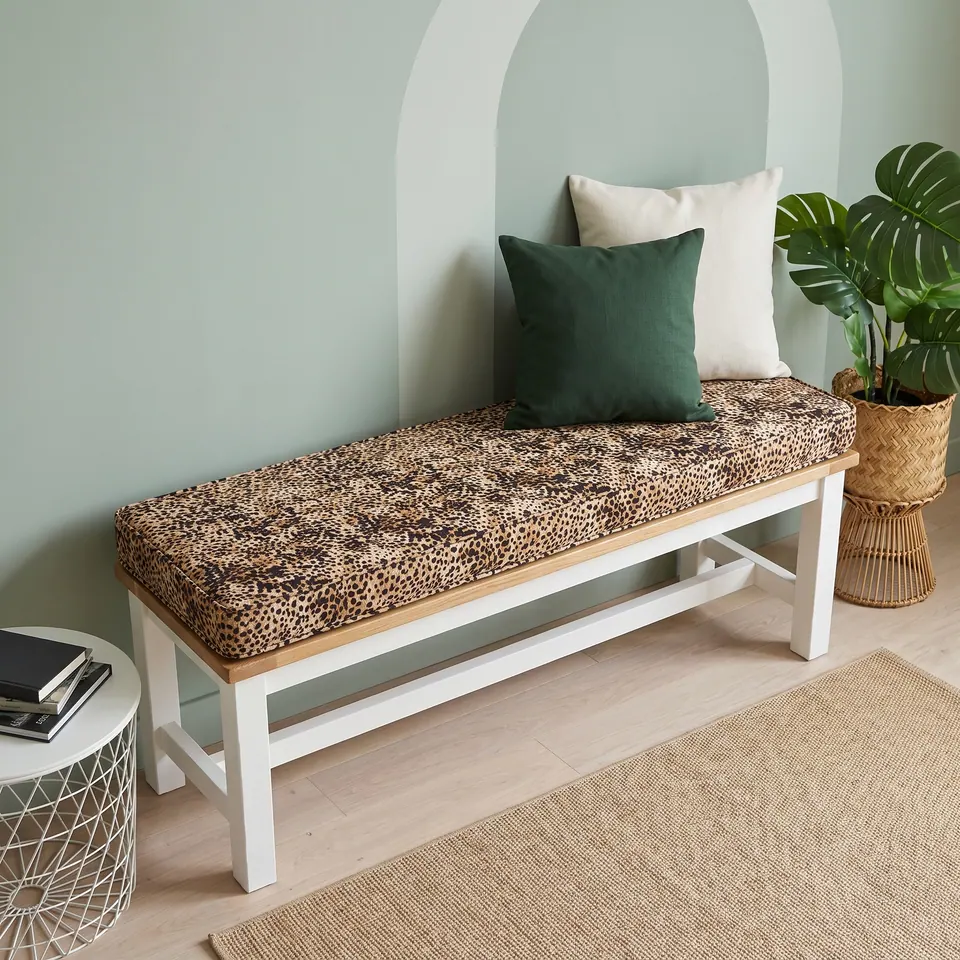
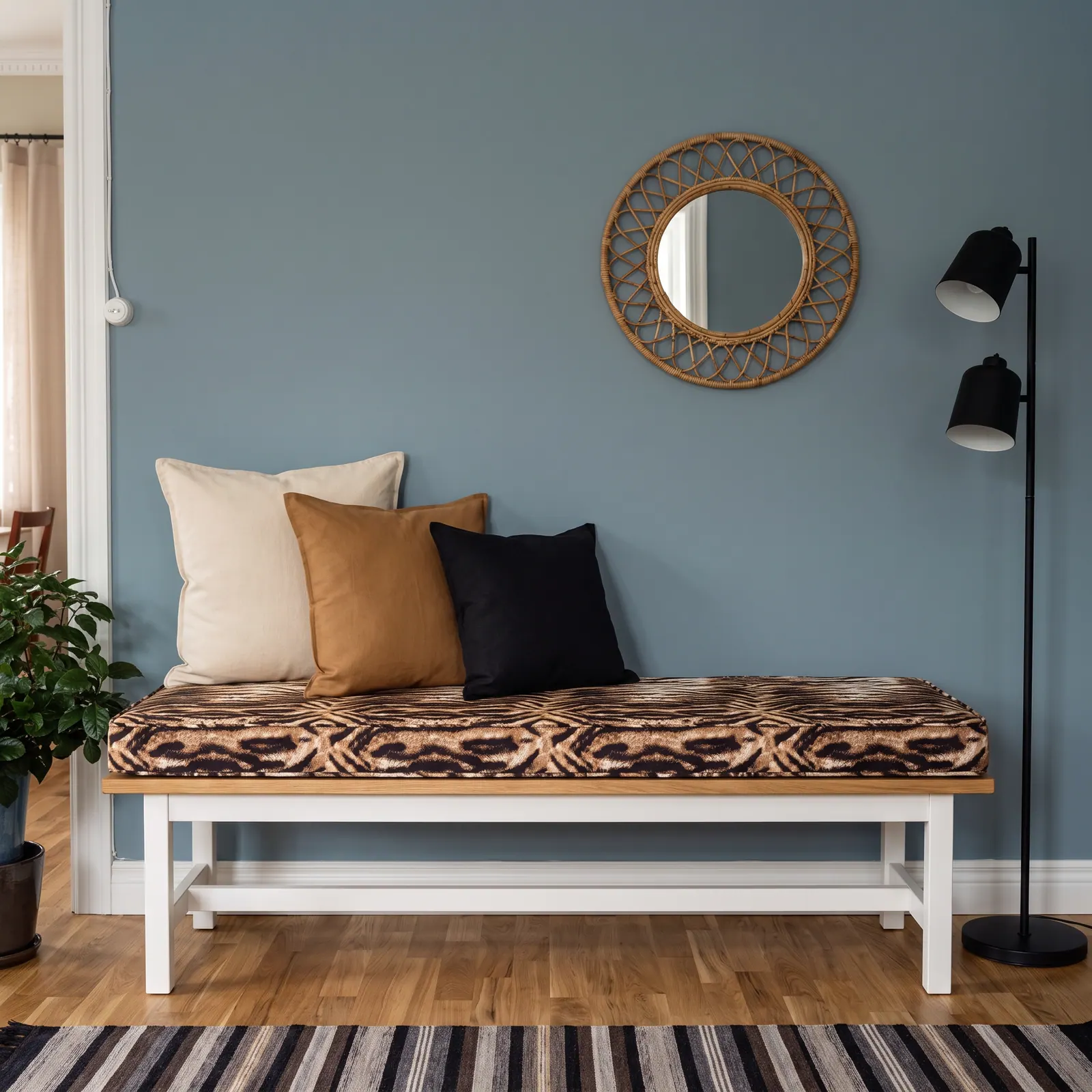
To mix patterns around a printed bench cushion, pair one wavy print with one straight-line pattern and let three plain pillows step down in size and value between them. Here a tiger fur print meets a striped rug, with cream, caramel and black pillows. Tan against dusty blue works because the two sit opposite on the color wheel.
One 18 x 19 in bench cushion, cut open
Cover fabric. A removable, zippered cover. Machine wash at 86°F (30°C) on a gentle cycle and air dry.
Piping. A fabric-covered cord sewn into the seams. It sits on the seam line, so it does not change the size.
Fiber wrap. Polyester fiber (Dacron) batting around the foam: it fills the cover out and softens the edges.
Foam core. About 2.0 lb/ft³ (32 kg/m³) high-resilience foam, firm to medium-firm, cut to the ordered size.
Zipper. Along the back band, as hidden as possible. The zipper side faces down or toward the wall.
Base panel. The underside of the cover. A non-slip fabric backing can cover the whole of it instead.
Pattern math on a dusty blue wall
Start with an inventory. Patterns: two. The tiger fur print on the bench cushion, which is organic and wavy, and the black-and-gray striped rug, which is all straight lines. Plains: three pillows. Texture: a rattan sunburst mirror, a rubber plant in a dark pot, oak floorboards.
Two patterns get along when they differ in kind. Wavy over straight never competes, because the eye files them in different drawers. Two wavy prints would fight over the same drawer.
The pillows are a sequence, not a pile. Cream, then caramel, then black, each smaller and darker than the last, so the eye walks down the steps and lands on the seat. The caramel one is the bridge: it shares the tan of the print and the calm of a plain.
Color does the rest. Tan and dusty blue sit opposite on the color wheel, so the print looks richer here than it would against white. The black twin-head floor lamp repeats the darkest stripes and adds height on the right, and the round mirror hangs off-center to balance it. Angles are just lengths in disguise, and balance is too: a tall thin thing on one side, a wide round thing on the other.
The cushion is a box edge with self piping. On a print this busy, a contrast cord would draw a second outline; self piping lets the pattern run right to the seam. For a living room with muted blue or gray-blue walls, an amber or tan print is one of the safest bold choices. What print would you try against yours?
Who does what in this corner
Two patterns, three plains, one texture. Each piece has one job.
| Piece | Pattern | Scale | Job |
|---|---|---|---|
| Bench cushion | Tiger fur print, wavy | Large | The lead; warm against the cool wall |
| Rug | Black and gray stripe, straight | Medium | Straight lines under wavy ones |
| Cream pillow | Plain | Largest pillow | First step, the lightest value |
| Caramel pillow | Plain | Middle | Bridge to the tan in the print |
| Black pillow | Plain | Smallest | Last step; points to the seat |
| Rattan mirror | Texture | Round | Balances the tall black lamp |
Pinned by Nate
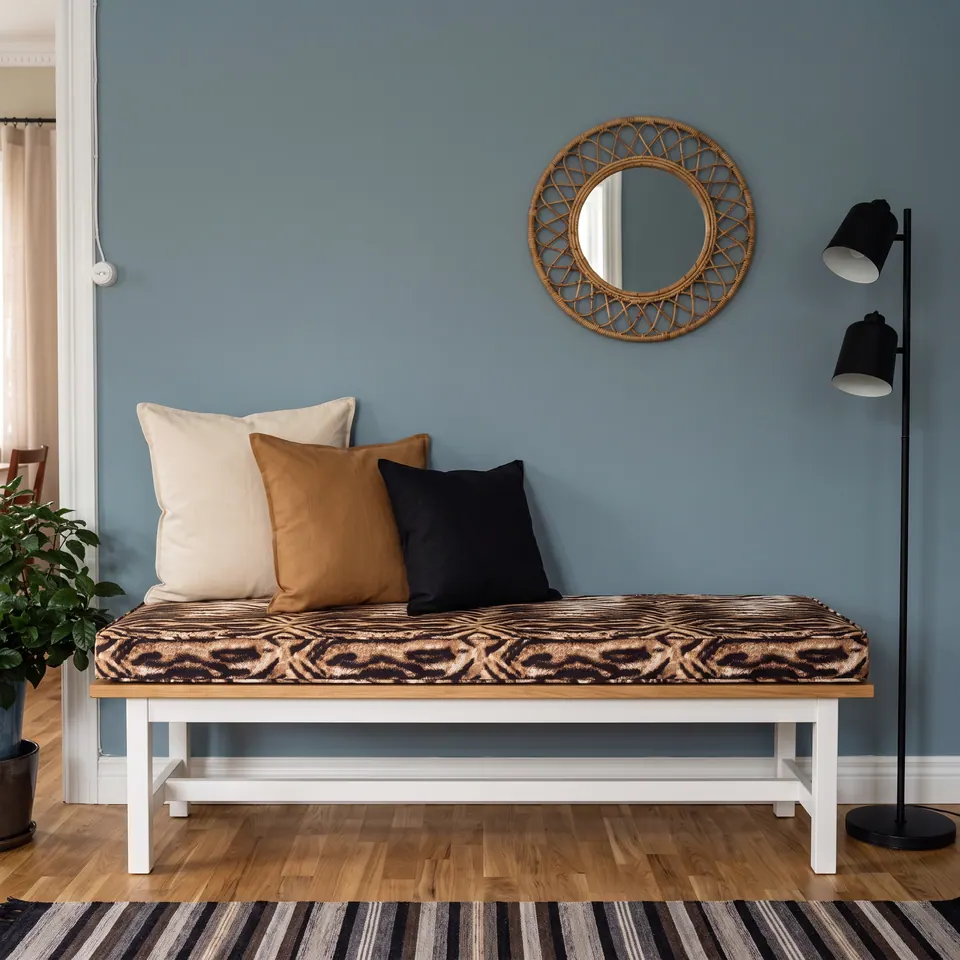
Five places where the pattern rules show up in the photograph.
- Tiger fur print
Against cool blue, the warm tan fur print looks much richer than it would on white.
- Stepped pillows
The pillows get smaller and darker from cream to caramel to black, leading the eye down to the seat.
- Rattan mirror
Hung off-center, it balances the tall floor lamp on the right.
- Black floor lamp
A black lamp repeats the darkest stripes and adds height.
- Striped rug
Straight stripes underfoot contrast with the wavy fur markings.
- Tiger fur printAgainst cool blue, the warm tan fur print looks much richer than it would on white.
- Stepped pillowsThe pillows get smaller and darker from cream to caramel to black, leading the eye down to the seat.
- Rattan mirrorHung off-center, it balances the tall floor lamp on the right.
- Black floor lampA black lamp repeats the darkest stripes and adds height.
- Striped rugStraight stripes underfoot contrast with the wavy fur markings.
Three cushions, 54 inches, one choice
A buyer in the US had a bench 19 in (48 cm) deep and 54 in (137 cm) long and wanted three cushions, each 18 x 19 in (46 x 48 cm), in beige linen. The arithmetic is clean: 3 × 18 in = 54 in, wall to wall. The second wish was zippers, so the covers could go in the washer.
Here the workshop had to say no to half of it. Tufted French-style cushions are buttoned and hand-stitched closed through the filling, so they cannot have zippers. The choice was tufted without zippers, or plain cushions with zippered, washable covers. Not both.
One engineering note on the numbers. Handmade cushions can differ from the order by about 1/2 to 1 in (1 to 2 cm), so three pieces laid end to end will have a little give. Plan for it, or try the split first in the bench cushion builder.
- Sizes
- Bench 19 x 54 in (48 x 137 cm); three cushions 18 x 19 in (46 x 48 cm)
- Fabric
- Beige linen or linen-cotton
The lesson: Decide early between the tufted look and removable washable covers; you can't have both.
A tufted bench cushion is stitched closed through its filling, so it cannot have a zipper; if you want washable covers, choose plain.
Nate
Three bench cushion questions
- A common question
Do you make L-shaped bench cushions, and as one piece or two?
The workshop's answerBoth. A small L can be made as a single L-shaped piece; a larger L is made as two cushions meeting at the corner, which sits flush and is more practical. Send a drawing with measurements. Each cushion of a two-piece L is ordered separately and produced together. One L banquette of 18 x 70 in plus 18 x 42 in was made as one piece, 2 in thick.
- A common question
Which fabric and piping colors are on the cushion in your listing photo? I want exactly that one.
The workshop's answerSend a screenshot of the exact photo, because a listing shows several cushions, and the workshop names the body and piping codes for that one.
- A common question
Is your velvet a performance velvet? I have kids and want a kitchen bench that's easy to clean.
The workshop's answerYes. It is a 100% polyester high-performance velvet with good stain resistance and durability. Wipe or spot-clean quick messes, and machine wash the covers at 86°F (30°C) for a deeper clean.
On the cutting table
| Cushion | Bench cushion, box edge |
|---|---|
| Tiger fur print in tan, black, cream and brown | |
| Piping | Self piping |
| Standard thickness | 4 in (10 cm); 2, 3 and 5 in also offered |
| Foam | About 2.0 lb/ft³ (32 kg/m³), firm to medium-firm |
| Fastening | Hidden zipper on plain cushions; tufted ones have none |
| Tolerance | About 1/2 to 1 in (1 to 2 cm), handmade |
| Care | Zipped: 86°F (30°C) gentle, air dry. Tufted: spot-clean |
| Best for | Living-room benches against cool walls |

Have it made
Have this made — ask Nate’s workshop
Precision starts on the phone. Give the workshop your measurements and they will read them back to you, edge by edge. — Nate
Leave your details and the workshop will call you to confirm measurements, fabric, foam and piping. No prices, dates or payment on this page: it is a request, not an order.
Questions buyers ask next
What thickness is standard for a bench cushion?
4 in (10 cm) is standard for seat, bench and window-seat cushions, and most buyers keep it. 2, 3 and 5 in are also offered, and in-between sizes such as 2 1/2 or 4 1/2 in can be written in.
Can a tufted cushion be washed?
Not in a machine. The cover is sewn through its filling, so it cannot come off. Wipe or spot-clean it gently by hand with a cloth, mild soap and water.
Do I include the piping in my measurements?
No. Give the bench's exact size. The cushion is cut to it, and the piping sits on the seams, so it does not change the finished size.
Can I match two prints across separate orders later?
Plan to order them together. Dye batches can differ slightly between orders, so an exact match across separate orders is not guaranteed, even when the fabric code is the same.
± 1/4 in — Nate
More bold prints on benches
 Save
 Save
 Save
 Save
 Save
 Save