A Reading by CallumBench Cushions
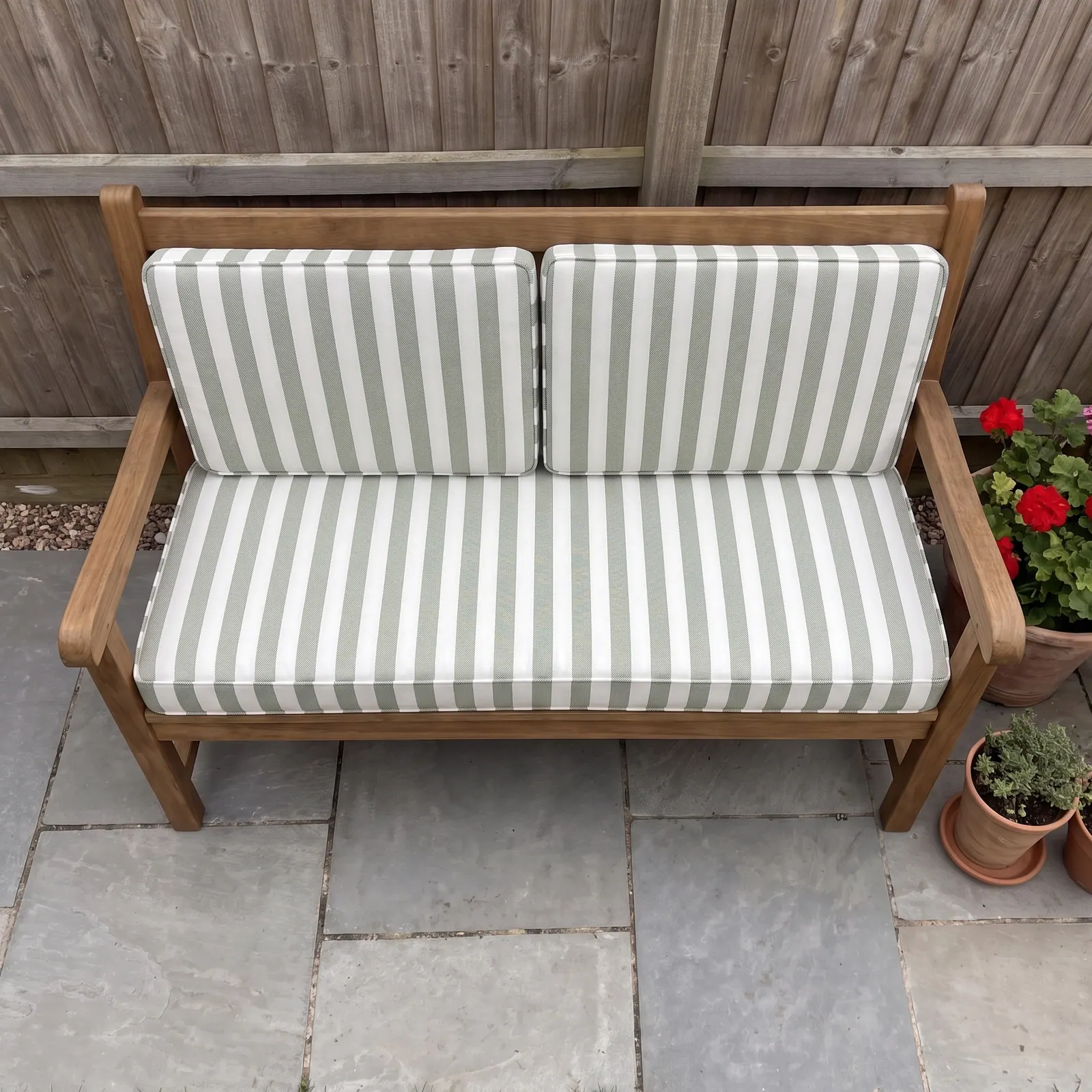
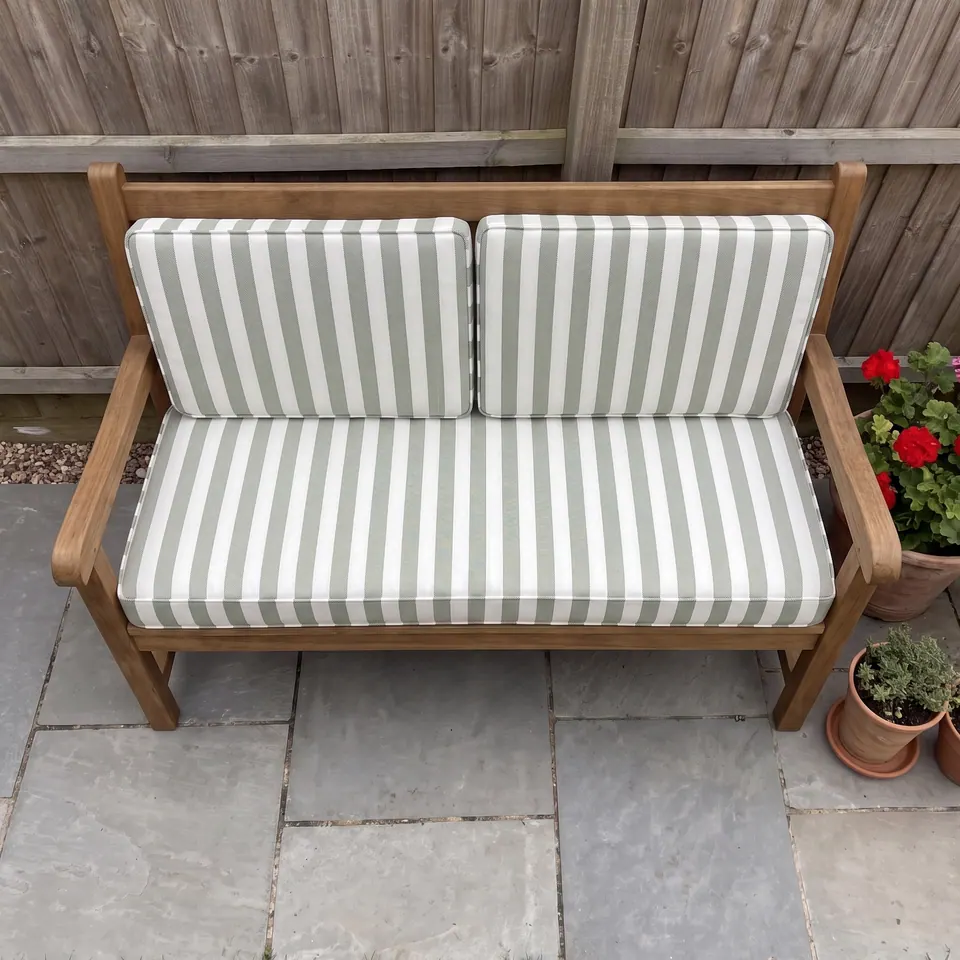
A sage stripe custom bench cushion that makes a narrow bench look wider
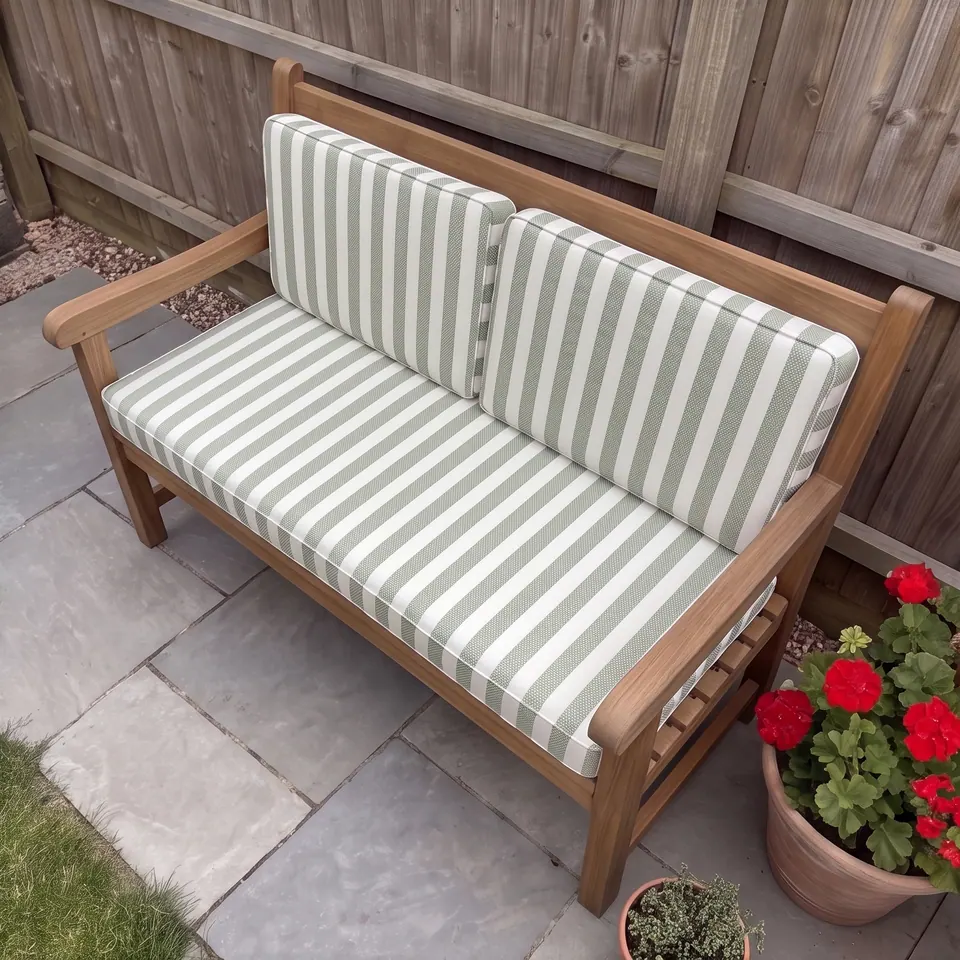
Straight on, this teak bench is all right angles and nowhere to hide. Good. Narrow spots punish sloppy fits, and this one has none.
 Save
The quick answer
For a narrow garden bench, make the seat cushion exactly as wide as the space between the arms and stop the back cushions just below the top rail. Here sage stripes on white, a level line across both backs and a finger's width of teak left showing make a tight spot by a fence feel calm and generous. A 3 in cushion keeps the profile low.
Buyer questions
- A common question
My bench needs a size that isn't on the menu. How do I order it?
The workshop's answerPick the size range your measurements fall into; the menu only sets the price. Then write your exact size, say 67.5 x 20 in, with the thickness and fabric code in the personalization note, and the cushion is made to that. Not sure which range? Send your measurements and the workshop tells you which option to choose.
- A common question
My window seat is an odd shape, close to a trapezoid. How should I send the measurements?
The workshop's answerSend a photo of the space and a drawing with every side labeled A, B, C, D, plus the depth, ideally in centimeters. On a bay window, measure every breaking point. If a side is missing, such as the D side, the workshop asks for it before quoting.
- A common question
Which thicknesses can I choose, and which would you pick?
The workshop's answerThe standard options are 2, 3, 4 and 5 in, all at the same price. Most buyers choose 3 or 4 in: 3 in gives a neater, lower profile on a window seat, and 4 in gives more cushioning. The listing photos are mostly 3 to 4 in, and the default seat sits around 3 to 4 in (7.5 to 10 cm).
Now, the reading
What the front view gives away
Rain doesn't negotiate, and neither does a narrow bench.
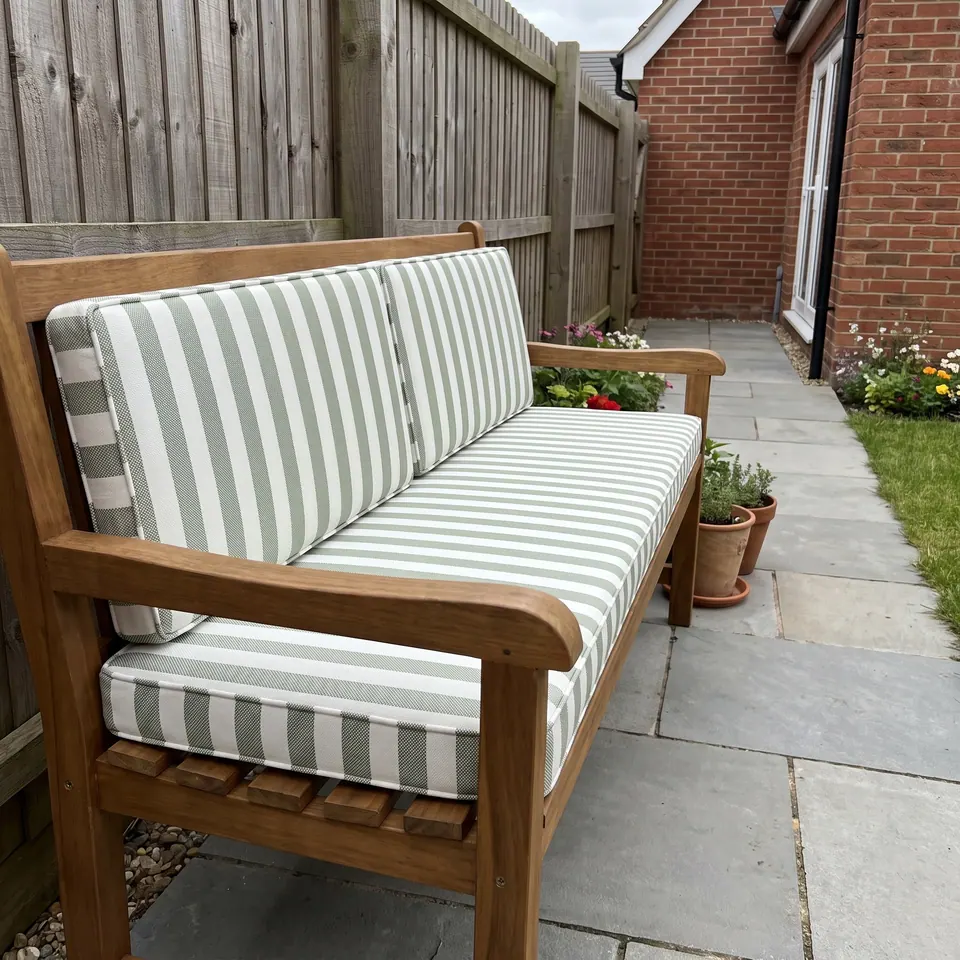
Seen from the front there is nothing to hide behind. A teak bench on gray sandstone, a weathered timber fence behind it, a gravel border, two terracotta pots. The cushions have one job: fill the bench without swelling it.
The seat runs arm face to arm face and stops. No overhang. On a narrow bench an overhang reads as bulk, and bulk makes a small space feel smaller.
The two back cushions stop just below the top rail, both at the same height. That level line is the calmest thing in the picture. Above it a strip of teak still shows, about a finger wide, so the bench keeps its own outline instead of turning into a stuffed box. How wide is your bench between the arms, friend? That number is the whole seat.
The light is soft and overcast. Bright colors go flat under a gray sky; sage on white holds up, sitting between the silvered fence and the honey teak and arguing with neither. The one warm note is planted, not sewn: red geraniums in terracotta right beside the arm, thyme in the next pot. Keep the cushion quiet and put the color in a pot you can move.
The cloth is from the water-repellent membrane family. It buys you time in a shower; it is not a roof. The Pattern on water-repellent vs waterproof cushions spells out the difference, and the bench cushions atlas has more narrow builds.
Pinned by Callum: five marks on a narrow bench
Five pins walk the bench from arm to arm: both back cushions, the seat's front edge, the teak armrest and the red geraniums doing the only shouting.
- Left back cushion
The back cushion stops just below the top rail so the teak frame still shows.
- Right back cushion
Both backs are the same height, giving a level line across the bench.
- Seat front edge
The seat cushion fills the space between the arms without overhanging.
- Red geraniums
One warm accent is planted right beside the arm.
- Teak armrest
Sage stripes suit silvered timber and honey teak better than a bright color.
- Left back cushionThe back cushion stops just below the top rail so the teak frame still shows.
- Right back cushionBoth backs are the same height, giving a level line across the bench.
- Seat front edgeThe seat cushion fills the space between the arms without overhanging.
- Red geraniumsOne warm accent is planted right beside the arm.
- Teak armrestSage stripes suit silvered timber and honey teak better than a bright color.
Thirteen inches deep, sixty-six long
A buyer in the US wrote to the workshop about an antique meeting-house bench: 13 x 66 in (33 x 168 cm). Narrow as a pew, because that is close to what it was. No stock length came near.
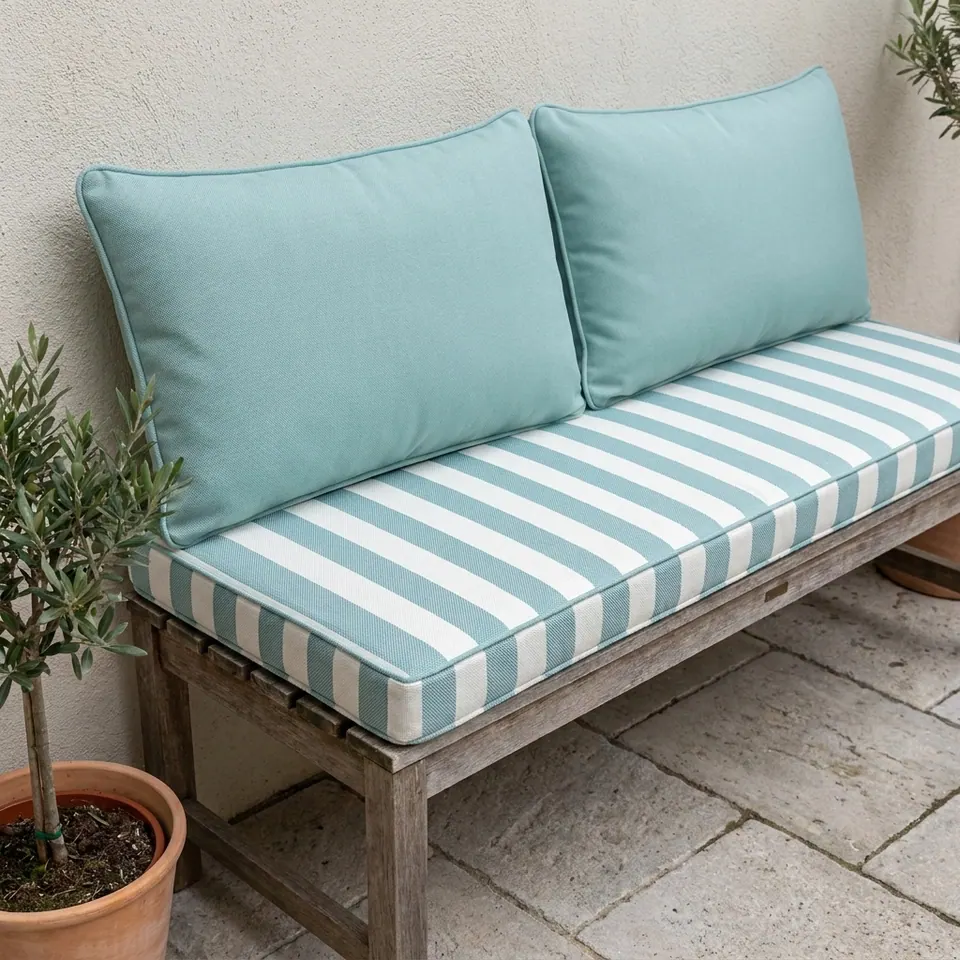
The workshop told them to pick the 13 x 61 in option and state the true 66 in length. The cushion was made at 66. They chose an ice-blue soft fabric with tan linen piping and asked whether mixing two fabric types was all right. It was.
One more line went on the order: leave the parcel in the street-level garage, because the cottage sits below a long run of steps. Narrow benches tend to live in old places, and old places have stairs.
Old benches rarely match stock sizes. Order the nearest option and restate the true length.
Narrow-spot rules, in the order I cut them
- Measure between the arms, not across them, and make the seat exactly that width.
- Stop the back cushions a finger's width below the top rail.
- Match both back heights so the line across the bench runs level.
- Choose 3 in for a lower, neater profile; 4 in if the bench is hard and the sitting is long.
- Put the bold color in a planter, not on the cushion.
On the cutting table: the fence-side bench
| Product | Custom bench cushion set: one seat, two back cushions |
|---|---|
| Fabric | Water-repellent membrane cloth, sage stripe on white |
| Edge | Box edge |
| Piping | Self piping |
| Seat width | Arm face to arm face, no overhang |
| Back height | Just below the top rail; both backs level |
| Thickness options | 2, 3, 4 or 5 in; 3 in for a low profile |
| Setting | Teak bench on sandstone paving by a weathered fence |
| Best for | Side yards, narrow patios and old benches off the size menu |

Have it made
Have this made — ask Callum’s workshop
Sun, rain, salt. Say which of them your cushion will meet, and the workshop will plan around it. — Callum
Leave your details and the workshop will call you to confirm measurements, fabric, foam and piping. No prices, dates or payment on this page: it is a request, not an order.
On a narrow garden bench, stop the back cushions a finger's width below the top rail. The teak frame stays visible and the bench keeps its shape.
Callum
Questions buyers ask next
How wide should a cushion be on a bench with arms?
Exactly the distance between the arm faces, measured at seat level. A cushion that overhangs or bulges against the arms looks bulky, and on a narrow bench that bulk makes the whole spot feel tighter than it is.
Should back cushions cover the whole back of a garden bench?
Not necessarily. Stopping them just below the top rail leaves a strip of wood showing, so the bench keeps its outline. Make both back cushions the same height so the line across the bench runs level.
What cushion color suits a gray timber fence and a teak bench?
A soft, grayed color such as sage on white sits between silvered timber and honey teak without fighting either. Put the strong accent in a planter nearby, like red geraniums in terracotta, where it can change with the seasons.
Fair winds — Callum
More photographs to read
 Save
 Save
 Save
 Save
 Save
 Save