A Reading by CallumBench Cushions
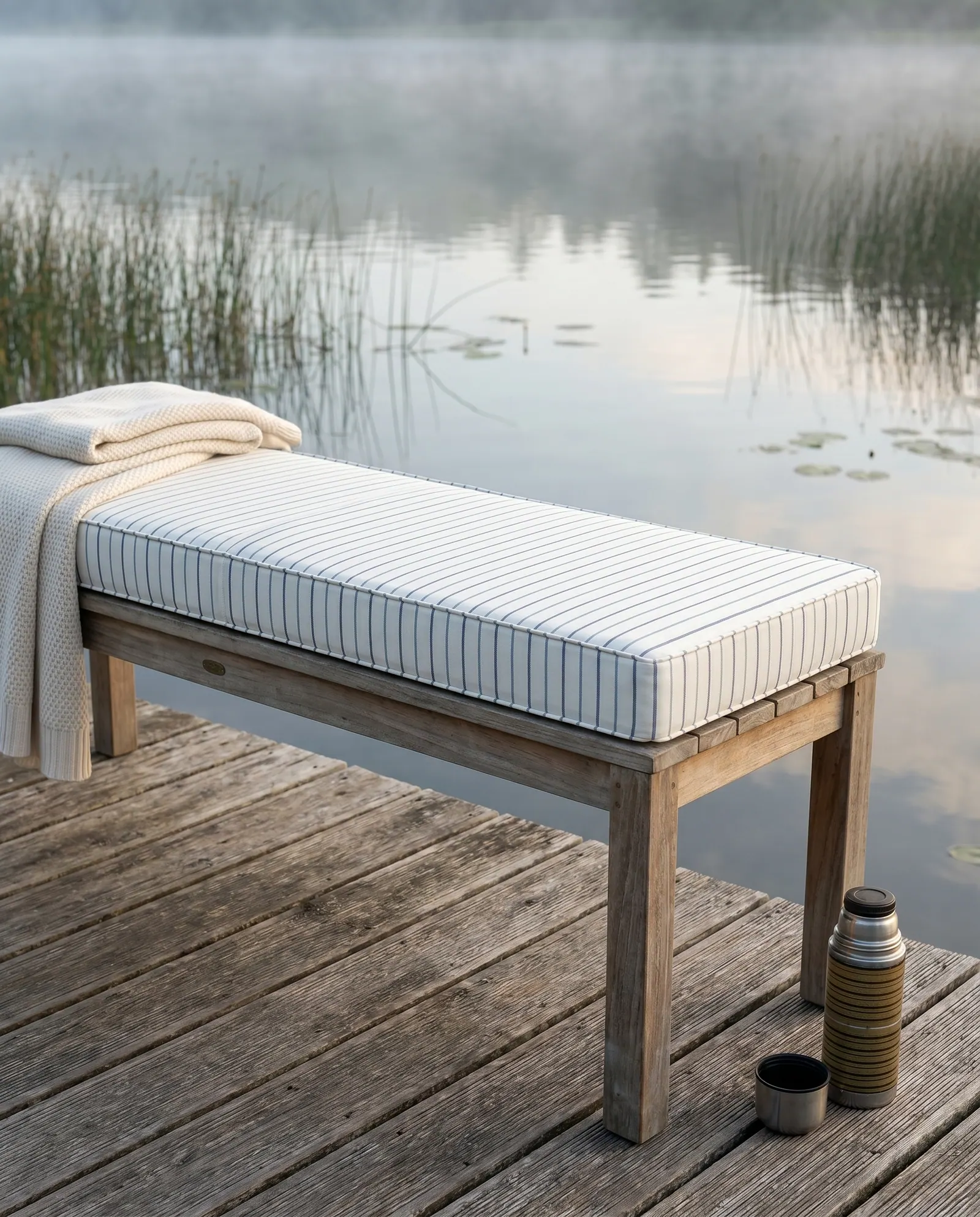
A navy pinstripe outdoor bench cushion on a misty jetty, cut open
Dew on the boards by six, fog on the water till nine. One custom bench cushion, one stripe, one plain, one knit, and the job each of them does out there.
 Save
The quick answer
An outdoor bench cushion mixes patterns best as one stripe, one plain and one texture, each at a different scale. Here a fine navy pinstripe on white carries the pattern, silvered teak is the plain, and a chunky cable-knit throw is the texture. Keep the stripe on the cushion, since a water-repellent cover handles morning dew better than wool.
The 2 in straight bench pad, cut open
Water-repellent cover. White with a fine navy pinstripe. Dew beads on the face instead of soaking in, and the cover zips off for washing.
Self piping. Cut from the same pinstripe, so the edge adds a line but never a new color.
Fiber wrap. Polyester fiber (Dacron) batting around the foam: it fills the cover out and softens the edges.
Foam slab. 2 in (5 cm) of high-density foam, about 2.0 lb/ft³ (32 kg/m³), the workshop standard.
Zipper. Along the back band, as hidden as possible. The zipper side faces down or toward the wall.
Base panel. A plain underside. Hook-and-loop straps can be sewn on if the pad has to stay put on a sloping or slick bench.
Small, large, none: three scales on one bench
Fog sits on the lake and the bench has been out all night. The cushion on it is the only crisp thing in the picture, and that is the point.
Look at the scale. The navy pinstripe is fine enough to read as pale gray from the shore and as lines only once you sit down. The cable knit on the end is fat and chunky, a pattern you could count with your fingers. Between them is the silvered teak: no print at all, only grain. Small, large, none. That spacing is why three textures share one bench without arguing.
The stripes turn over the boxed front and line up from top to side, so each line reads as one line from seat to edge. The self piping is cut from the same cloth. A contrast welt would have added a fourth line to a picture that already has plenty.
The cushion stands taller than the bench's top rail. On a thin, weathered seat that extra height is the comfort, and the old wood still shows below it.
Then the props. The throw lives on the end, not spread across the seat, so the cushion takes the dew and the wool stays dry. The thermos sets the hour. The reeds and the gray water set the palette: white with navy is about the only color that belongs out there at dawn. Anything warmer would look lost.
People search for waterproof outdoor cushions. This cover is water-repellent: dew beads and rolls off the face, and you still bring it in when real weather is coming. Water-repellent is a promise; waterproof is a contract. The difference is laid out in water-repellent vs waterproof cushions, and the cloth lives with the water-repellent membrane fabrics.
What does the bench at your water's edge measure?
Pinned by Callum: the jetty at dawn
Five pins, from the stripe on the seat to the reeds in the fog.
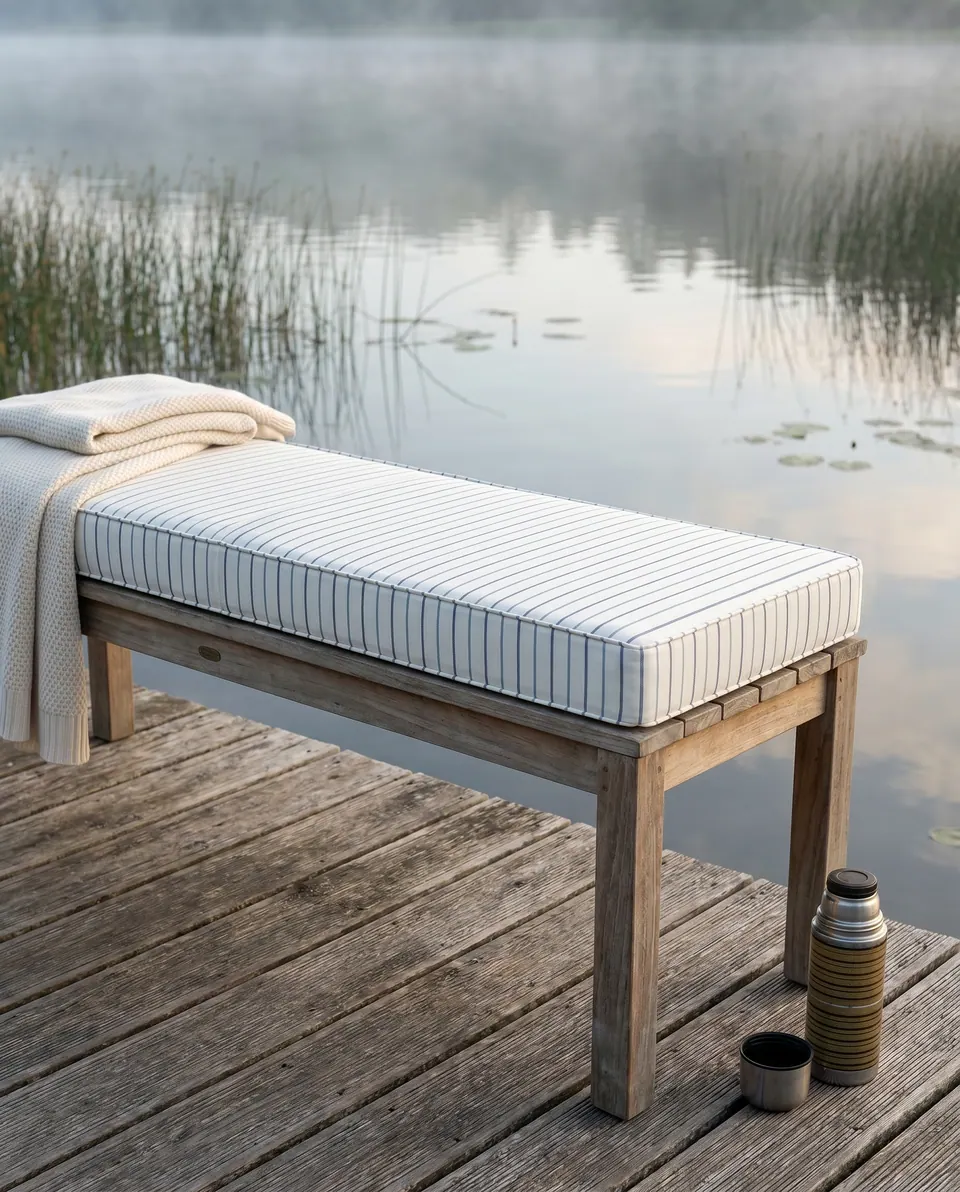
- White pinstripe top
Thin navy lines on white keep the seat looking crisp against the gray water.
- Matched boxed front
The stripes turn neatly over the edge, lining up from top to side.
- Cream knit throw
A chunky throw on the end is a practical touch for cool mornings by the water.
- Thermos and cup
The flask on the boards sets the scene: a quiet first coffee at the lake.
- Reeds in the mist
The muted lake gives the white fabric a soft glow rather than glare.
- White pinstripe topThin navy lines on white keep the seat looking crisp against the gray water.
- Matched boxed frontThe stripes turn neatly over the edge, lining up from top to side.
- Cream knit throwA chunky throw on the end is a practical touch for cool mornings by the water.
- Thermos and cupThe flask on the boards sets the scene: a quiet first coffee at the lake.
- Reeds in the mistThe muted lake gives the white fabric a soft glow rather than glare.
Stripe, plain, texture: who does what on the jetty
Pattern mixing is mostly a question of scale. This is how the three layers split the work.
| Layer | In the photo | Scale | Job |
|---|---|---|---|
| Stripe | Navy pinstripe on white, on the cushion | Fine: reads pale gray from the shore | Carries the pattern and takes the dew |
| Plain | Silvered teak bench and jetty boards | None: grain only | Rests the eye between stripe and knit |
| Texture | Cream cable-knit throw | Chunky: cables you can count | Warmth for the first hour, then it goes inside |
A stepped bench, drawn before it was quoted
A buyer got in touch with two benches and one tape measure. The first was straight: 86⅝ x 18½ in (2200 x 470 mm). The second stepped. One long edge ran 75⅜ in (1915 mm). The other edge broke in two: 54⅛ in (1375 mm) at 16⅜ in (415 mm) deep, then 21¼ in (540 mm) at 14½ in (367 mm) deep.
Both pads were to be 2 in (5 cm) thick. The workshop asked for a drawing with every width change written on it, looked it over, and quoted from that. No drawing, no quote.
A stepped bench hides two depths in one cushion. Miss the step and the narrow end sits almost 2 in proud of the seat. The drawing is where you catch it, not the delivery day. The bench cushion builder is a good place to sketch one first.
- Sizes
- 86⅝ x 18½ in (2200 x 470 mm); stepped 75⅜ in (1915 mm) long, 16⅜ in (415 mm) then 14½ in (367 mm) deep; 2 in (5 cm) thick
The lesson: Stepped benches are quoted from a drawing that shows each width change.
Buyer questions: wipe-clean cloth, thickness, and a pad that stays put
- A common question
What fabric would you suggest for a kitchen dining bench that I can wipe clean?
The workshop's answerBoth the soft fabric and the velvet are easy to clean. One buyer went with the soft fabric for two bench cushions, 14.5 x 43 x 3 in and 15.5 x 58 x 3 in.
- A common question
Which thicknesses can I order? Could you do 2.5 inches?
The workshop's answerThe order page offers 2, 3, 4 and 5 in (5 to 12.5 cm), and 2.5 in can be made too. If you picked the wrong thickness, tell the workshop before production and the order is adjusted.
- A common question
My entry bench cushion keeps sliding around. Can you add velcro?
The workshop's answerYes. Hook-and-loop straps can be sewn on to hold the cushion in place. Write the request in the personalization box together with your fabric code and whether you want piping.
On the cutting table
| Cushion | Outdoor bench cushion, boxed edge, full length of a teak bench |
|---|---|
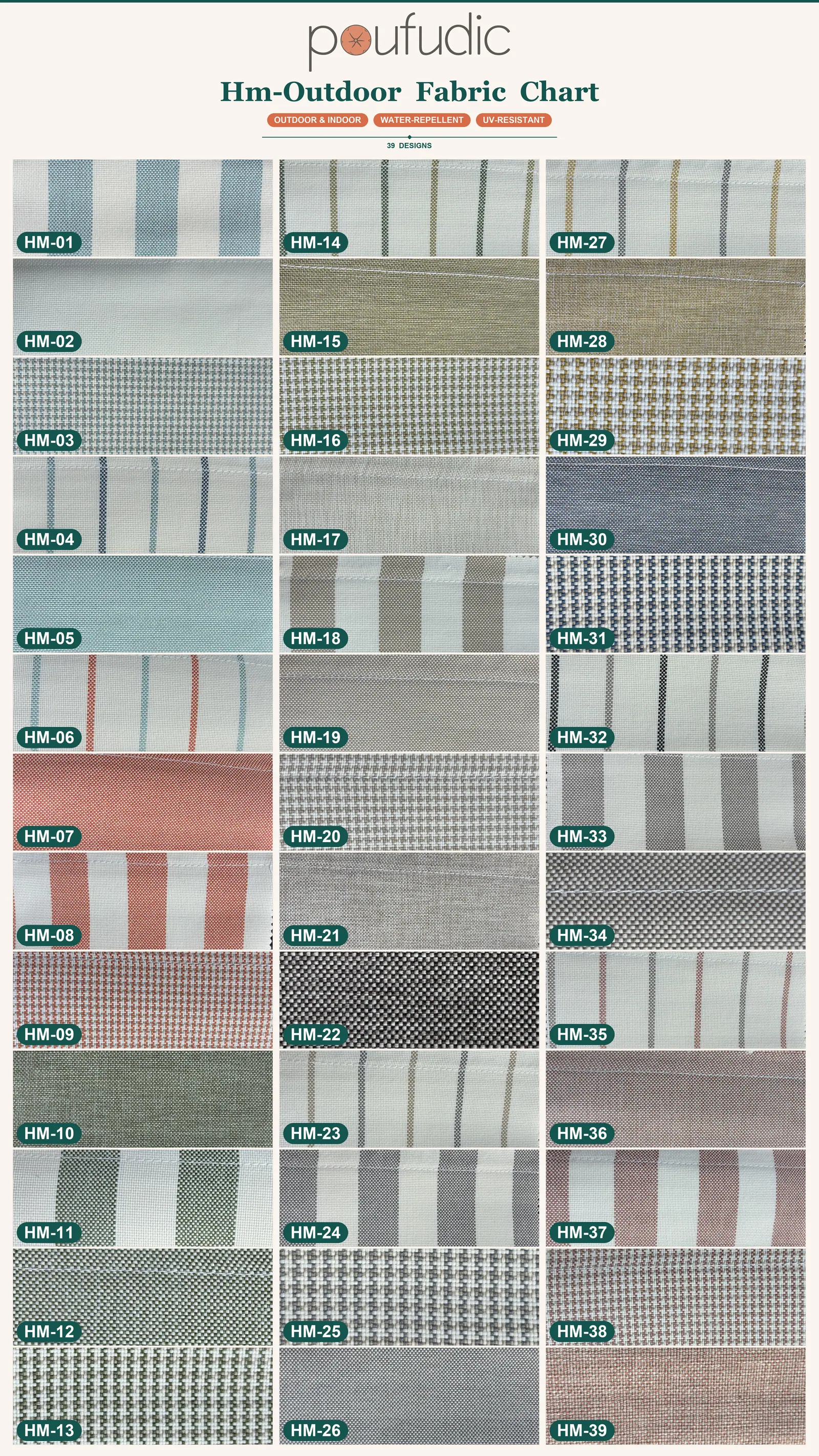
| Fabric | White with a fine navy pinstripe, water-repellent outdoor membrane cloth |
| Piping | Self piping, cut from the same stripe |
| Stripe | Turned over the boxed front, lined up from top to side |
| Thickness | 2, 3, 4 or 5 in (5 to 12.5 cm); 2.5 in on request |
| Foam | High-density, about 2.0 lb/ft³ (32 kg/m³), standard |
| Fastening | Hook-and-loop straps on request, written in the personalization box |
| Pair with | A plain wool throw, kept off the seat |
| Best for | Jetties, docks and porches where dew settles every morning |

Have it made
Have this made — ask Callum’s workshop
Tell them where it lives. Porch, deck or boat: the weather picks the fabric and the foam before anyone else does. — Callum
Leave your details and the workshop will call you to confirm measurements, fabric, foam and piping. No prices, dates or payment on this page: it is a request, not an order.
A stepped bench cushion is quoted from a drawing that marks every width change. Skip the drawing and the narrow end comes out almost 2 in too deep.
Callum
Questions buyers ask next
Is a water-repellent bench cushion the same as a waterproof one?
No. A water-repellent cover makes dew and light rain bead up and roll off the face. Waterproof means water does not get through at all, which is a job for the whole build, not the cloth alone. On a jetty, water-repellent plus bringing the pad in before storms is the practical pairing.
How do I mix a striped cushion with other patterns?
Change the scale. Put one fine stripe on the cushion, keep the bench or wall plain, and bring texture in with something chunky, like a cable-knit throw. Three different sizes read as calm; two patterns at the same size start to fight.
Which way should the stripes run on a bench cushion?
On this jetty pad the stripes turn over the boxed front and line up from top to side. Say the direction you want in your order note; the Pattern on stripe direction walks through the choices and how the roll width affects them.
Can a bench cushion be made for a stepped or notched bench?
Yes. Send a drawing with every edge and every width change measured. The workshop checks it before quoting; one real stepped pad was 16⅜ in deep for 54⅛ in, then 14½ in deep for the last 21¼ in, all 2 in thick.
Fair winds — Callum
Stripes, checks and solids for outdoor seats
 Save
 Save
 Save
 Save
 Save
 Save