CushionGuide

A Reading by MaggieBench Cushions

A custom bench cushion in mauve hexagon jacquard, up close, and the patterns it can live with

Maggie leans in on a boxed jacquard edge, raised cream lines and self piping, then sets out the rules for putting stripes, plains and texture beside a geometric.

The quick answer

To mix patterns around a hexagon jacquard bench cushion, let the geometric be the medium-scale pattern, pair it with a finer stripe or a plain, and bring in texture through linen, stoneware or chenille instead of a second bold print. Keep to one color family, and use self piping so the pattern runs unbroken down the boxed side.

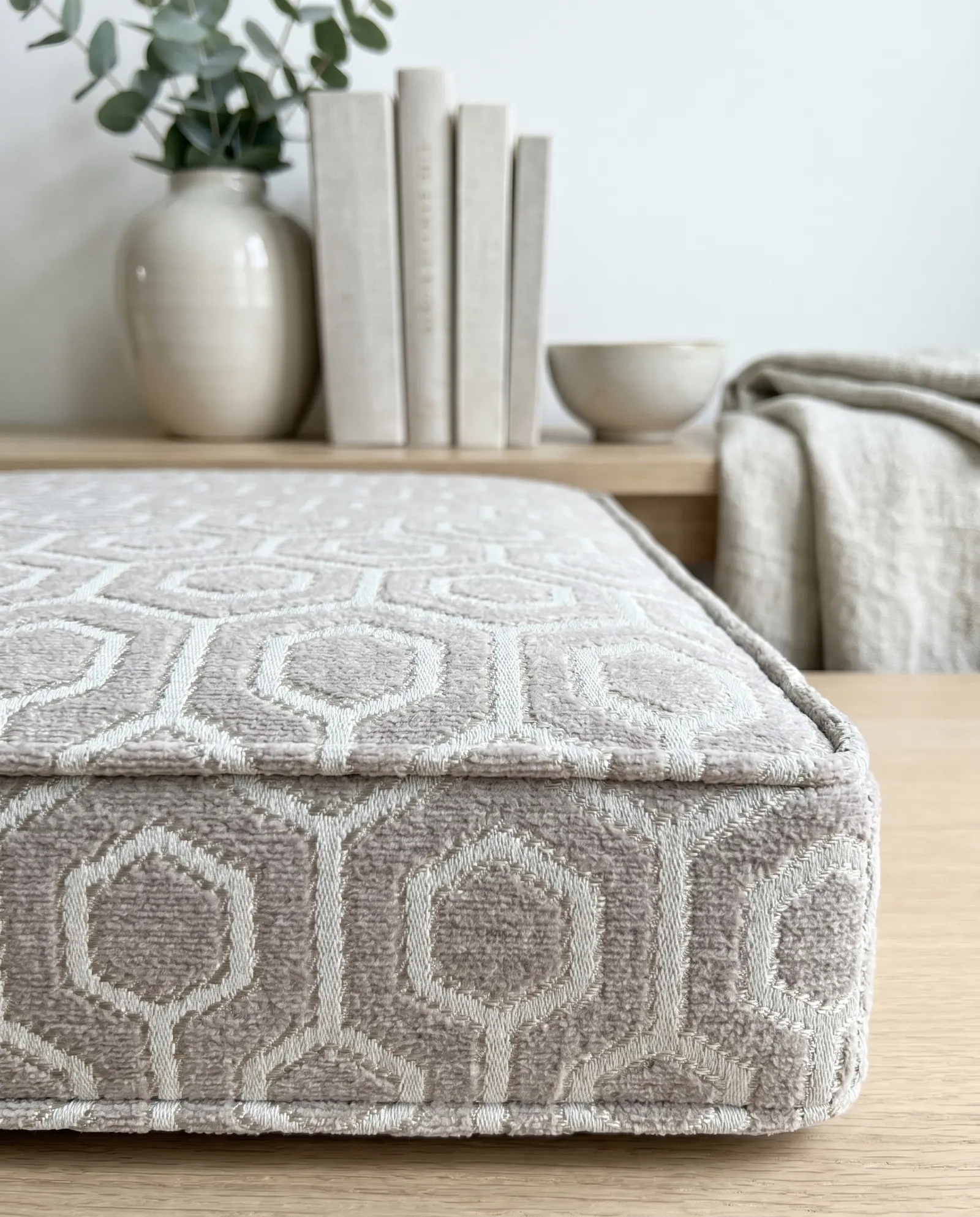
Close-up of a mauve-taupe and cream hexagon jacquard box cushion with self piping on a pale oak surfaceSave
The close view shows what a room shot can't: raised cream lines and a pattern that continues down the boxed side.

Pinned by Maggie

Start low on the patterned side band, move to the sharp piped corner, then climb to the raised cream lines and the one sprig of eucalyptus.
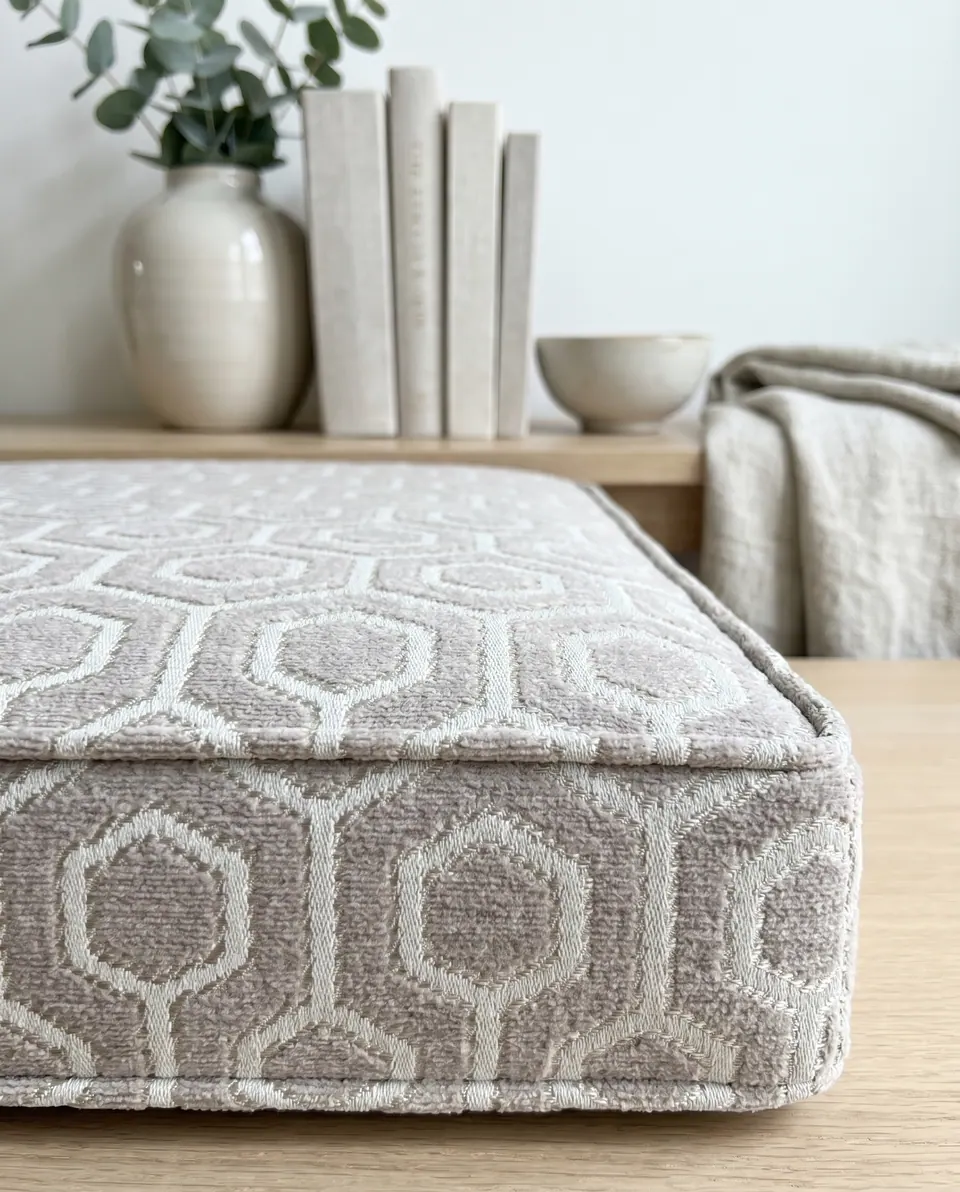
Pinned: Close-up of a mauve-taupe and cream hexagon jacquard box cushion with self piping on a pale oak surface
  1. Patterned side band

    The hexagon carries on down the boxed side, so the cushion looks cut from one block.

  2. Piped corner

    Self piping gives the boxed corner a sharp, even ridge.

  3. Raised chenille lines

    The cream lines stand above the ground, something you feel as much as see.

  4. Eucalyptus stems

    Blue-green leaves are the only color against mauve and cream.

  1. Patterned side bandThe hexagon carries on down the boxed side, so the cushion looks cut from one block.
  2. Piped cornerSelf piping gives the boxed corner a sharp, even ridge.
  3. Raised chenille linesThe cream lines stand above the ground, something you feel as much as see.
  4. Eucalyptus stemsBlue-green leaves are the only color against mauve and cream.

What a close-up tells you that a room shot won't

Right, then. This is a construction photo, and I like it better than most room shots. A box cushion in mauve-taupe and cream hexagon jacquard sits on pale oak, and the camera is close enough to show how it was made.

Three things to check, in this order: - The side band. The hexagons carry on down the boxed side, so the cushion looks cut from one block, not a lid on a box. - The piping. Self piping in the same jacquard, so the corner reads as a clean ridge instead of a colored outline. A contrast cord here would frame a pattern that is already a grid. - The surface. Those cream lines are raised chenille, standing above the ground. You feel them as much as see them, and that texture is half the pattern.

The styling knows its job. Cream-jacketed books, a stoneware vase and a small bowl, an oatmeal linen throw, all in one neutral family. Eucalyptus is the only color that isn't mauve or cream, and its blue-green makes the mauve look warmer.

When you shop for a patterned box cushion, ask for a photo of the side band. I once let a floral out of my shop with its side band running upside down. Once, dear. The top tells you the color; the side tells you the finish. More woven patterns live on the jacquard and damask shelf, and box edge versus knife edge explains why the side band exists at all. What is the busiest pattern already in your room?

Mixing a geometric with stripes, plains and texture

  • Give each pattern its own scale: the hexagon is medium, so pair it with a fine stripe or a large, loose one.
  • Keep one color family: mauve, cream and oatmeal here, so a cream-and-taupe stripe would join without a fight.
  • Let plains do the resting: linen, stoneware and book jackets give the eye somewhere to stop.
  • Count texture as pattern: raised chenille, linen slub and glazed clay add interest without a second print.
  • Use one accent color once: the eucalyptus is the only green, and that restraint is why it lands.

A real project

The trapezoid whose numbers couldn't all be true

A buyer wrote to the workshop about an angled window bench: 40 in (102 cm) front, 30 in (76 cm) back, 17 in (43 cm) deep and 22 in (56 cm) angled sides. The shop drew it to scale and the geometry wouldn't close. With that front, back and depth, the sides should be about 17.5 in (44 cm), not 22.

So the shop explained the method: measure depth at 90 degrees to the front, never along the slope, and measure each side from corner to corner. The buyer re-measured with photos. The corrected numbers, a 48.5 in (123 cm) front, 41.5 in (105 cm) back, 13 in (33 cm) sides and 12.5 in (32 cm) depth, made a consistent, gentle trapezoid, and the piping color was settled before cutting.

Check the arithmetic before the scissors, always. The trapezoid measuring pattern and the trapezoid calculator will check yours, and the bench cushion atlas has the plain rectangles.

On the cutting table: the hexagon box

PieceRectangular box cushion
FabricHexagon jacquard, mauve-taupe ground with raised cream chenille lines
Side bandSame jacquard, pattern carried around the edge
PipingSelf
EdgeBox
Pattern scaleMedium geometric
Pairs withFine stripes, plain linen, stoneware textures
MeasuringSend true measurements; the workroom adds the allowances
Best forQuiet Japandi and minimal rooms

Order this cushion

Have it made

Have this made — ask Maggie’s workshop

Have the tape measure handy when they call. Old cushions shrink and sag; the seat underneath does not. — Maggie

Leave your details and the workshop will call you to confirm measurements, fabric, foam and piping. No prices, dates or payment on this page: it is a request, not an order.

Fabric · Foam · Pipingwhat the workshop will confirm with you

Fabric
Hexagon jacquard, mauve-taupe ground with raised cream chenille lines
Foam
The core: its density and thickness set the feel.
Piping
Self
Only for this request: no marketing calls or texts. Outside the US, add the country code.
In inches: length × depth × thickness, plus any angles or cut corners.

* Required. A member of the workshop team will call you to talk it through; nothing is charged and nothing is made until you have agreed on every detail with them.

We use these details only to answer this request and make your cushion: your name and contact details, the cushion details and photos you send, the page you came from and the ad or link that brought you, if any. The workshop that makes the cushions receives them. We don't sell them or share them for advertising, and we delete requests after 24 months. Privacy notice for requests.

Nothing is made or charged until you approve the details.

Want to pick the shape and add photos? Use the full quote form

Cards: discounts, trapezoids, half inches

  1. A common question

    If I order several cushions at once, do you give a discount?

    The workshop's answer

    Often, yes: multi-cushion orders have been quoted as one set, which can come in lower than pricing each cushion alone. Send every piece in one message so the quote covers the whole set, with the shipping cost for your address on the same quote.

  2. A common question

    What measurements do you need for a trapezoid bay window seat cushion?

    The workshop's answer

    Every edge, front, back or window edge, left angled end and right angled end, plus the depth. Label them with the letters on the shop's trapezoid template, or photograph a rough sketch with a number on each edge. The shop checks that the geometry closes, calculates any missing edge and sends a full list (front, window edge, depth, slanted sides, thickness, piping) for you to confirm before cutting. Small differences in the slanted sides are treated as hand-measuring tolerance.

  3. A common question

    Should I take half an inch off my measurements so the cushion fits?

    The workshop's answer

    No. Send your true, exact measurements. The shop handles all the fitting allowances in production so the cushion fits.

On a patterned box cushion, ask for a photo of the side band: the top shows the color, but the side shows whether the pattern was cut with care.

Maggie

Questions buyers ask next

Can a hexagon jacquard cushion sit beside a striped pillow?

Yes, if the scales differ and the colors share a family. A fine cream-and-taupe stripe beside a medium hexagon reads as layered; a stripe as bold as the hexagon would compete. Keep a third piece plain so the eye can rest.

Why does self piping suit a geometric jacquard box cushion?

Self piping lets the pattern run from the top over the corner and down the side band, so the edge reads as a clean ridge. A contrast cord would frame the grid and make the whole cushion look busier.

What are the raised lines on a chenille jacquard?

They are soft, velvety chenille yarns woven so that certain lines stand above the flat ground. On this cushion the cream hexagon outlines are raised, so the pattern has a texture you can feel as well as see.

How can I tell whether my trapezoid measurements add up?

Draw it to scale or use a calculator. Half the difference between front and back, together with the square depth, fixes the length of each slanted side. If your measured sides are far off that result, re-measure the depth at 90 degrees.

Stitch straight — Maggie