CushionGuide

A Reading by RosaWindow Seat Cushions

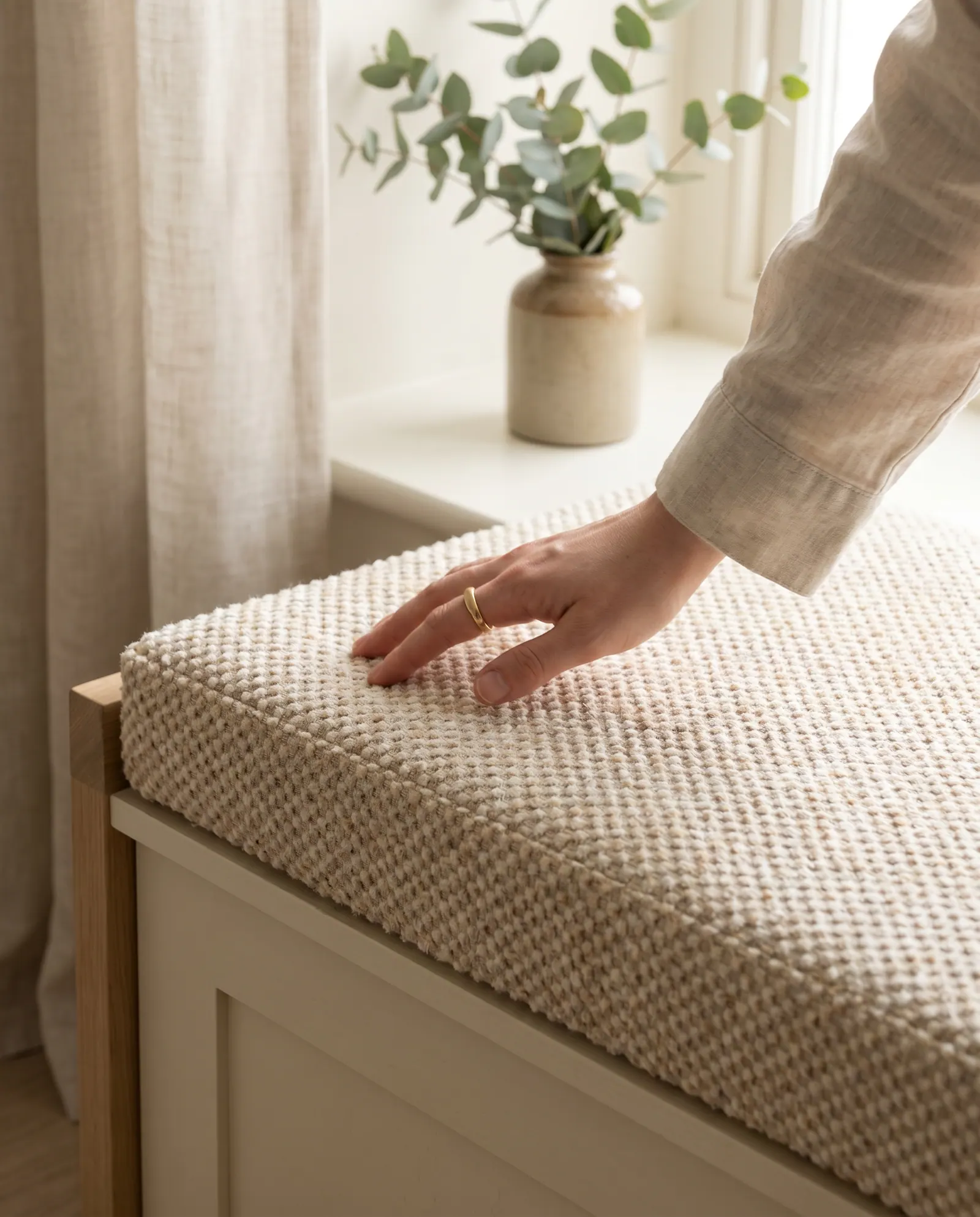
An oatmeal dotted chenille window seat cushion, tested under one hand

Rosa reads a photo with no room in it, only a hand, a cushion and a sprig of eucalyptus, and finds a whole lesson in mixing.

The quick answer

A textured window seat cushion counts as a pattern even when it is one color. This oatmeal dotted chenille carries its pattern in raised dots you feel under the palm, so the plains around it, cream cabinet and flax curtain, only need to differ in weave. Add one green and the mix is done, no stripe required.

Hand with a gold ring pressing into an oatmeal dotted chenille window seat cushion beside eucalyptus and linen curtainsSave
A light press shows how the nubbly weave feels under the hand and how firmly the fill holds its edge.

Pinned by Rosa: five things the chenille is telling you

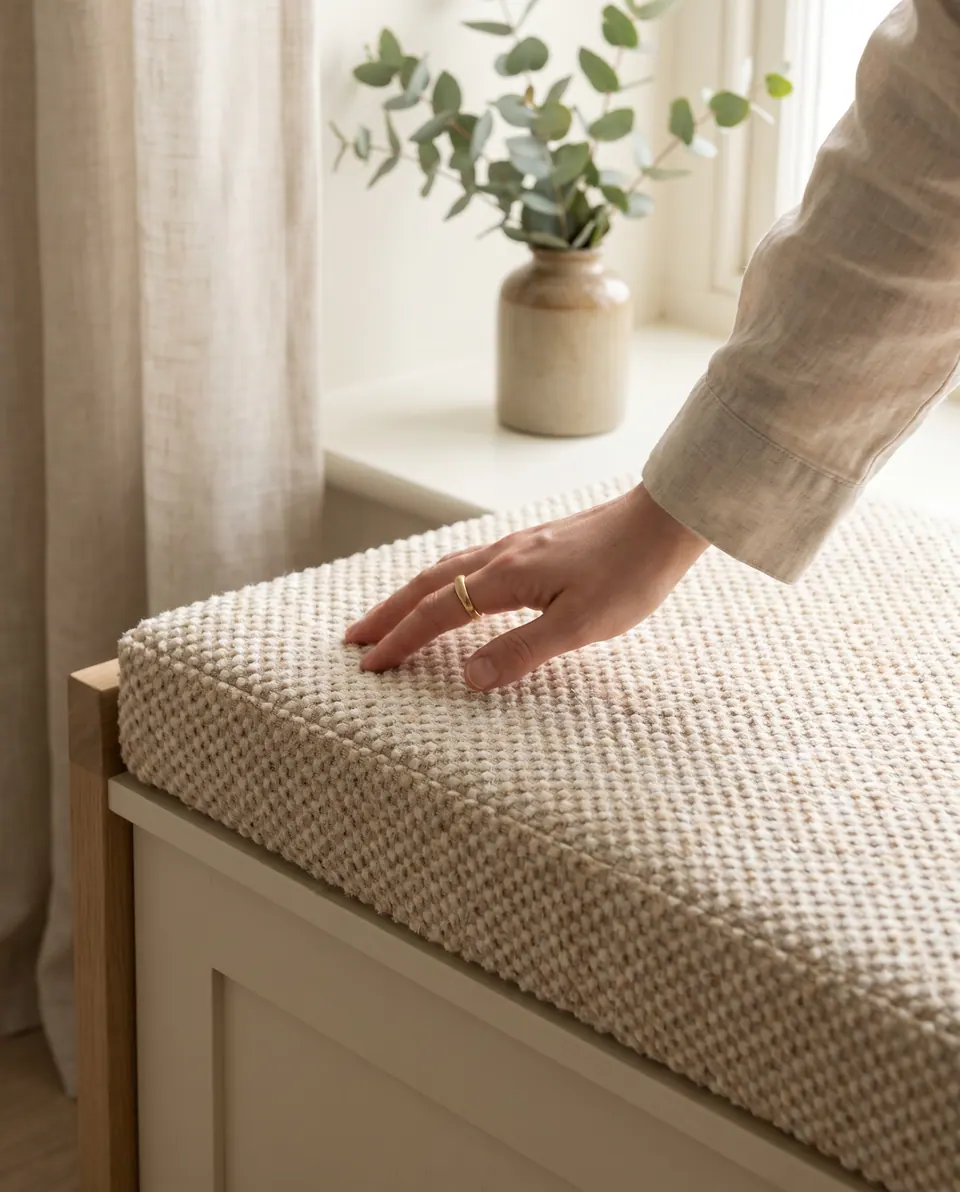
Five pins on a close-up, from the pressing palm to the linen sleeve that keeps it real.
Pinned: Hand with a gold ring pressing into an oatmeal dotted chenille window seat cushion beside eucalyptus and linen curtains
  1. Hand pressing the seat

    A palm on the fabric shows scale and how the fill holds under light pressure.

  2. Square cushion edge

    The edge keeps its line even where the hand presses nearby.

  3. Eucalyptus in stoneware

    The only green in a scene of oat, flax and cream.

  4. Linen curtain

    Flax linen sits a shade darker than the cushion, framing it softly.

  5. Linen shirt sleeve

    The sleeve keeps it a real-hands photo rather than a studio product shot.

  1. Hand pressing the seatA palm on the fabric shows scale and how the fill holds under light pressure.
  2. Square cushion edgeThe edge keeps its line even where the hand presses nearby.
  3. Eucalyptus in stonewareThe only green in a scene of oat, flax and cream.
  4. Linen curtainFlax linen sits a shade darker than the cushion, framing it softly.
  5. Linen shirt sleeveThe sleeve keeps it a real-hands photo rather than a studio product shot.

A photo with no room in it

Most photos of a window seat cushion show a room. This one shows a hand. A palm with a gold ring presses into oatmeal dotted chenille on a cream cabinet with an oak edge, and a linen shirt sleeve slides into the frame. Eucalyptus stands in a stoneware crock, and a flax linen curtain hangs a shade darker than the cushion.

It is a touch photo, and it answers the questions a screen cannot. How big is the weave? The knuckles and the ring are your ruler. How soft? Soft enough to rest a palm on. How firm? The box edge keeps its line even where the hand presses nearby. There is no piping at all, so the only edge is the fabric folding over the fill.

Now the mixing, neighbor, which is sneakier than it looks. There is no stripe here and no print, yet the corner does not feel plain. The chenille dots are the pattern. The flax curtain is the plain. Stoneware, linen sleeve and oak edge bring three more textures. Oatmeal sits between the cream cabinet and the flax, so the only true contrast is the green eucalyptus.

When did you last buy a fabric without touching it? Next time, ask for a close-up of your chosen fabric under a hand like this one. Textured weaves live in jacquard and damask, and more nooks wait among our window seat cushions.

Mixing fabrics by touch, one layer at a time

  • Let one textured fabric play the pattern; a dotted chenille does that job on its own.
  • Keep the nearest plain one shade darker, like the flax curtain beside the oatmeal seat.
  • Add hard textures, stoneware and oak, so every soft thing has a partner.
  • Allow one true color, and make it something green and alive.
  • If you add a stripe later, keep it on a pillow and pull its color from the weave.

A real project

Cream velvet, a fuchsia border, and a trapezoid upside down

A buyer wrote in about a kitchen corner bench and ordered five velvet cushions in cream with a fuchsia border: a long seat of 68 1/2 x 16 1/8 in (174 x 41 cm) at 2 in (5 cm) thick, slimmer backrests at about 1 1/8 in (3 cm), and a 2 in (5 cm) trapezoid tucked against the oven, with parallel sides of 36 1/4 and 9 1/2 in (92 and 24 cm). Four 16 x 16 in (40 x 40 cm) accent pillows joined them, fuchsia with cream and turquoise with fuchsia. Now that is a mix: a plain seat, a bold border, and pillows that trade the same colors back and forth.

Every piece had a non-slip bottom and a zipper, so the horizontal backrests would not fall. The buyer loved the colors and the quality. But the trapezoid's non-slip ended up on the seating face, and a trapezoid cannot simply be flipped the way a rectangle can. The workshop remade it right away.

On any asymmetric shape, mark which face is the top side. See non-slip bases and ties for where the grip belongs.

Sizes
seat 68 1/2 x 16 1/8 x 2 in (174 x 41 x 5 cm); backrests about 1 1/8 in (3 cm) thick; trapezoid 2 in (5 cm) with 36 1/4 and 9 1/2 in (92 and 24 cm) parallel sides

The lesson: On asymmetric shapes, mark which face is the top; a trapezoid cannot be turned over to fix a reversed non-slip base.

Buyer questions: bolsters, bay shapes, backs that slide

  1. A common question

    Can you make a seat cushion with matching armrest bolsters, back pillows and a lumbar?

    The workshop's answer

    Yes. Send the seat size as length x depth x thickness and how many bolsters and back pillows you want, and the workshop sizes them to match. Everything ships filled and ready to use. One such set was quoted for a 44 1/2 x 62 1/2 in (113 x 159 cm) cushion with bolsters.

  2. A common question

    Can you make an irregular bay-window cushion from photos and measurements, or do I need a paper template?

    The workshop's answer

    Photos plus measurements are enough; a paper template is welcome but not required, and there is no template or shape surcharge. The workshop checks that the numbers reconcile: a 106 in (269 cm) front, a 56 in (142 cm) back and two 35 in (89 cm) diagonals give about a 24 1/2 in (62 cm) seat depth. The price covers the foam insert, the removable zippered cover and the angled cutting.

  3. A common question

    How do I keep back cushions from sliding around?

    The workshop's answer

    It depends on what they lean against. Against a frame, railing or slats, matching fabric ties let you tie them on. Against a flat wall or a solid backrest, a non-slip backing works better.

On the cutting table: the oatmeal window seat

CushionBox-edge window seat cushion
FabricOatmeal and ivory dotted chenille, code P50
PipingNone; the fabric folds straight over the edge
BaseCream cabinet with an oak edge
Edge testHolds its line under a pressing hand
NeighborsFlax linen curtain, stoneware crock, eucalyptus
Pattern mixTexture as pattern, linen as plain, one green
Best forWindow seats and reading nooks in calm, pale rooms

Order this cushion

Have it made

Have this made — ask Rosa’s workshop

Swings sway, rockers rock, dogs circle three times. Tell the workshop what your seat goes through, and they will plan for it. — Rosa

Leave your details and the workshop will call you to confirm measurements, fabric, foam and piping. No prices, dates or payment on this page: it is a request, not an order.

Fabric · Foam · Pipingwhat the workshop will confirm with you

Fabric
Oatmeal and ivory dotted chenille, code P50
Foam
The core: its density and thickness set the feel.
Piping
None; the fabric folds straight over the edge
Only for this request: no marketing calls or texts. Outside the US, add the country code.
In inches: length × depth × thickness, plus any angles or cut corners.

* Required. A member of the workshop team will call you to talk it through; nothing is charged and nothing is made until you have agreed on every detail with them.

We use these details only to answer this request and make your cushion: your name and contact details, the cushion details and photos you send, the page you came from and the ad or link that brought you, if any. The workshop that makes the cushions receives them. We don't sell them or share them for advertising, and we delete requests after 24 months. Privacy notice for requests.

Nothing is made or charged until you approve the details.

Want to pick the shape and add photos? Use the full quote form

A dotted chenille window seat cushion is already the pattern; give it plain linen, stoneware and one green, and skip the stripe.

Rosa

Questions buyers ask next

Does a one-color textured cushion count as a pattern?

In a pale room, yes. Raised dots or a nubbly weave catch light and shadow, so the eye reads them the way it reads a small print. Treat the textured cushion as your pattern and keep its neighbors plain.

Why ask for a photo of fabric under a hand?

Because a hand is a ruler everyone owns. It shows the scale of a weave and how the surface gives under light pressure, two things a flat product shot hides.

Does a textured window seat cushion need piping?

Not necessarily. Here the dotted chenille goes without, and the box edge still holds a clean line. On a busy weave a cord can look fussy; on a flat fabric it tends to sharpen the edge.

Which side of an odd-shaped cushion is the top?

Whichever face you mark before ordering. Rectangles can be flipped; trapezoids and other asymmetric shapes cannot, so a non-slip base sewn to the wrong face means a remake. Say which face sits up in the order note.

Porch light's on — Rosa