CushionGuide

A Reading by CallumChaise Lounge & Sunbed Cushions

A greige waffle sunbed cushion, read for its edge and shape

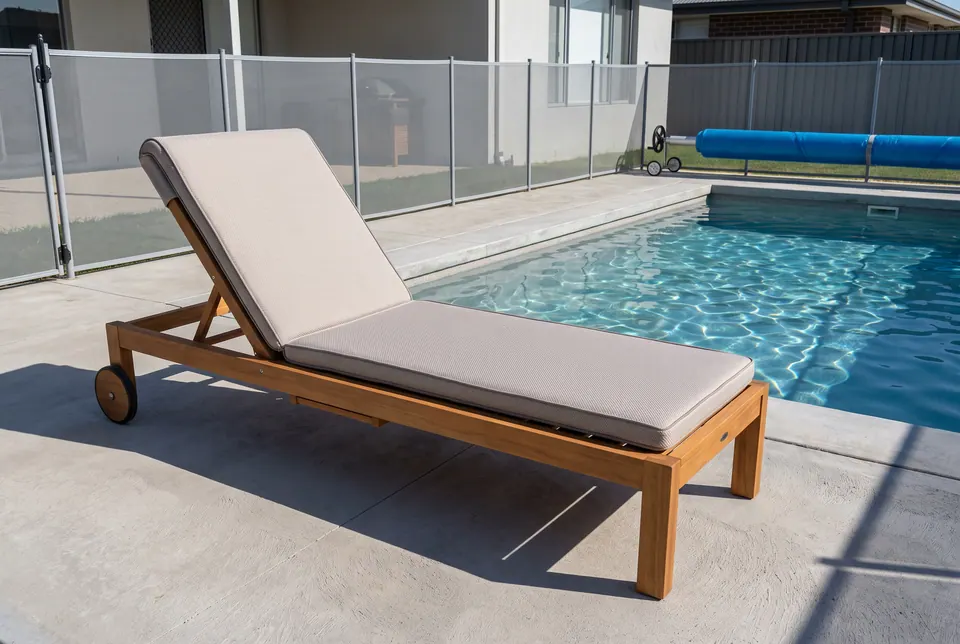
Pool deck, bright sun, a teak lounger on wheels. The cushion is quiet on purpose. Its edges are not.

The quick answer

A sunbed cushion for a wood lounger works best as two box-edged pieces, a seat and a separate backrest, so the back can tilt without folding a seam. Self piping keeps the outline crisp without adding a line of color. Cut it snug to the frame, especially on a lounger with wheels that gets moved around the deck.
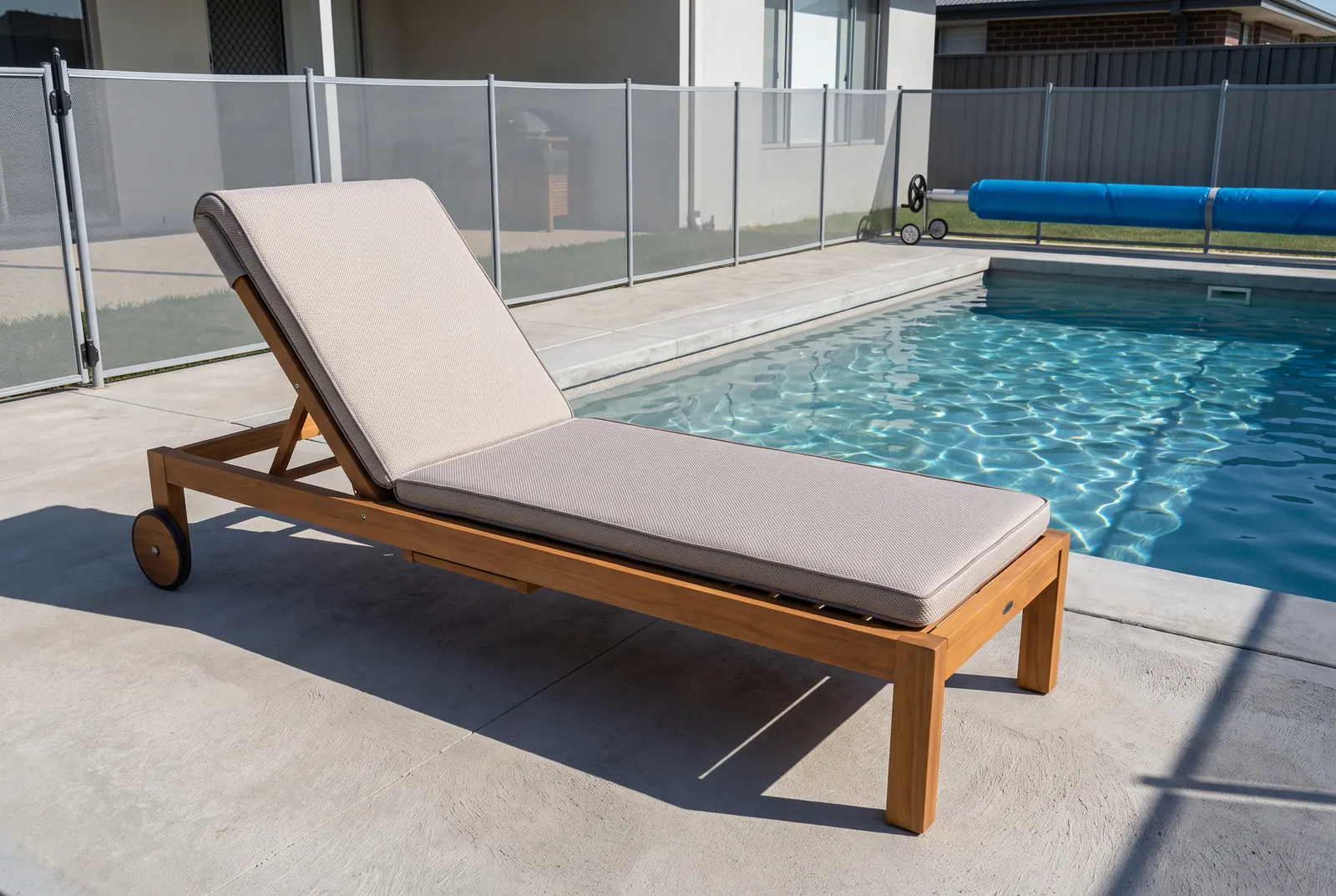
Greige waffle-texture sun lounger cushion with self piping on a teak lounger with wheels beside a fenced poolSave
A quiet greige with a waffle texture lets the warm teak frame do the talking.

Pinned by Callum: four marks on a pool lounger

Four pins, from the greige backrest down to the wheel that decides how snug the fit must be.
Pinned: Greige waffle-texture sun lounger cushion with self piping on a teak lounger with wheels beside a fenced pool
  1. Greige backrest

    A quiet neutral lets the warm teak frame be the feature.

  2. Waffle texture seat

    The waffle weave stops a plain color looking flat in full sun.

  3. Teak frame

    Honey wood stands out because the cushion is neutral.

  4. Lounger wheel

    Wheels mean the cushion must stay put when moved, so snug sizing matters.

  1. Greige backrestA quiet neutral lets the warm teak frame be the feature.
  2. Waffle texture seatThe waffle weave stops a plain color looking flat in full sun.
  3. Teak frameHoney wood stands out because the cushion is neutral.
  4. Lounger wheelWheels mean the cushion must stay put when moved, so snug sizing matters.

Two boxes that meet at the hinge

Greige is the color you pick when the frame is the star. Here the frame is honey teak on two wheels, and the sunbed cushion stays out of its way.

The edge is what I read. Both pieces are box cushions: flat top, flat bottom, a straight wall all round. Self piping traces each seam in the same greige, and in hard pool-deck sun that piped line throws a thin shadow. The shadow keeps a pale cushion from looking like a mattress pad. The box edge versus knife edge pattern shows the difference in cross-section.

There are two boxes, not one. Back and seat meet at the lounger's hinge, so when the backrest goes up each piece rides its own part of the frame and no seam folds under load. The seat is about as deep as the teak side rail, which keeps the profile level from end to end.

The waffle weave earns its keep too. A flat greige goes chalky in full sun; the waffle catches small shadows all day.

Look past the cushion: a mesh safety fence, a blue solar cover roll, a gray house wall. Nothing is styled. This is a working pool deck. What does your lounger do when you pull it into the shade? If it rolls, cut the cushion snug, or it creeps. The sunbed size pattern covers the measuring, and the chaise and sunbed cushions atlas shows more frames.
Box, knife or unpiped: three edges on a lounger

EdgeWhat it looks likeOn a teak lounger
Box edge, pipedFlat top and bottom, a straight side wall and a cord at each seamTailored against wood; holds its outline in strong sun
Box edge, no pipingThe same straight wall, finished with a plain seamCleaner and quieter; ask for it at quote time
Knife edgeTwo panels sewn at one seam, fuller in the middleSofter and pillow-like; looks less fitted on a slatted frame
A real project

Width and length, swapped

A buyer wrote to the workshop to replace two outdoor cushions with ties, and wanted the back cushion made as one piece instead of two. The shop told them to add each cushion to the order on its own line and write 'backrest pillow' on the back one.

Then the shop checked the numbers. Seat and backrest lengths did not agree, and width and length looked swapped. So the shop asked for a photo of the real piece with every measurement written on it.

The re-measure came back larger than the order, and the shop charged less than the full difference. Numbers on a photo catch what numbers in a message miss. The quote checklist lists what to send, and the outdoor acrylic library shows the cloth.

On the cutting table: the greige lounger set

ProductSunbed cushion in two pieces, seat and backrest
FabricOutdoor acrylic, greige waffle weave
EdgeBox edge on both pieces
PipingSelf piping in greige
FrameTeak lounger with wheels
Seat depthAbout level with the teak side rail
FitSnug to the frame so it stays put when the lounger moves
Best forPool decks and sunny patios

Order this cushion

Have it made

Have this made — ask Callum’s workshop

Tell them where it lives. Porch, deck or boat: the weather picks the fabric and the foam before anyone else does. — Callum

Leave your details and the workshop will call you to confirm measurements, fabric, foam and piping. No prices, dates or payment on this page: it is a request, not an order.

Fabric · Foam · Pipingwhat the workshop will confirm with you

Fabric
Outdoor acrylic, greige waffle weave
Foam
The core: its density and thickness set the feel.
Piping
Self piping in greige
Only for this request: no marketing calls or texts. Outside the US, add the country code.
In inches: length × depth × thickness, plus any angles or cut corners.

* Required. A member of the workshop team will call you to talk it through; nothing is charged and nothing is made until you have agreed on every detail with them.

We use these details only to answer this request and make your cushion: your name and contact details, the cushion details and photos you send, the page you came from and the ad or link that brought you, if any. The workshop that makes the cushions receives them. We don't sell them or share them for advertising, and we delete requests after 24 months. Privacy notice for requests.

Nothing is made or charged until you approve the details.

Want to pick the shape and add photos? Use the full quote form

Buyer questions: quotes, pairs and back cushions

  1. A common question

    Can you quote custom outdoor seat cushions, with or without piping and ties?

    The workshop's answer

    Yes. The shop quoted seven white 30 x 30 in (76 x 76 cm) outdoor seat cushions as one order, and a single mangrove green cushion of about 55 x 23.5 in (140 x 60 cm), 4 in (10 cm) thick, with no piping and no ties. Both extras are optional.

  2. A common question

    Can the seat and back cushions of my outdoor sofa be priced separately? I might only do the seat.

    The workshop's answer

    Yes, seat and back are priced separately. For standard rectangles there is no manual quote: enter width and length on the listing page to see each price, pick the closest size, then write your exact measurements, thickness and fabric in the Personalization section.

  3. A common question

    Do you make back cushions as well as seats for outdoor chairs and sofas?

    The workshop's answer

    Yes. There is a ready listing for bench cushions with backrests, so the seat and back cushions are ordered together through it.

A sunbed cushion made as two box-edged pieces lets the backrest tilt on its own. One long piece folds at the hinge every time the back goes up.

Callum

Questions buyers ask next

Should a sunbed cushion be one piece or a separate seat and back?

On a lounger with an adjustable back, two pieces are kinder to the seams because each moves with its own part of the frame. One long piece works on a flat sunbed but folds at the hinge every time the back goes up.

Is a knife edge or a box edge better for a teak pool lounger?

A box edge keeps a flat top and a straight side wall, so it looks tailored against wood and holds its outline in strong sun. A knife edge is softer and domed, more like a pillow, and tends to look less fitted on a slatted frame.

Why choose a waffle weave over a flat greige for a lounger in full sun?

In full sun a flat pale color can look chalky and blank. A waffle weave catches small shadows across its surface, so a quiet neutral still has depth while the teak frame stays the feature.

How do I stop a cushion creeping on a lounger that has wheels?

Cut it snug to the frame on every side and measure the bare lounger, not an old cushion. A lounger that gets rolled into the shade shifts its cushion each time, and a loose fit lets it drift toward the foot.

Fair winds — Callum