 Save
A Reading by ÉlodieBench Cushions
A geometric jacquard bench pad under a sash window, and the plain things that let it speak
Rust, navy, teal and cream in one weave. Everything else in this room was chosen to stay quiet, and each quiet thing has a job.
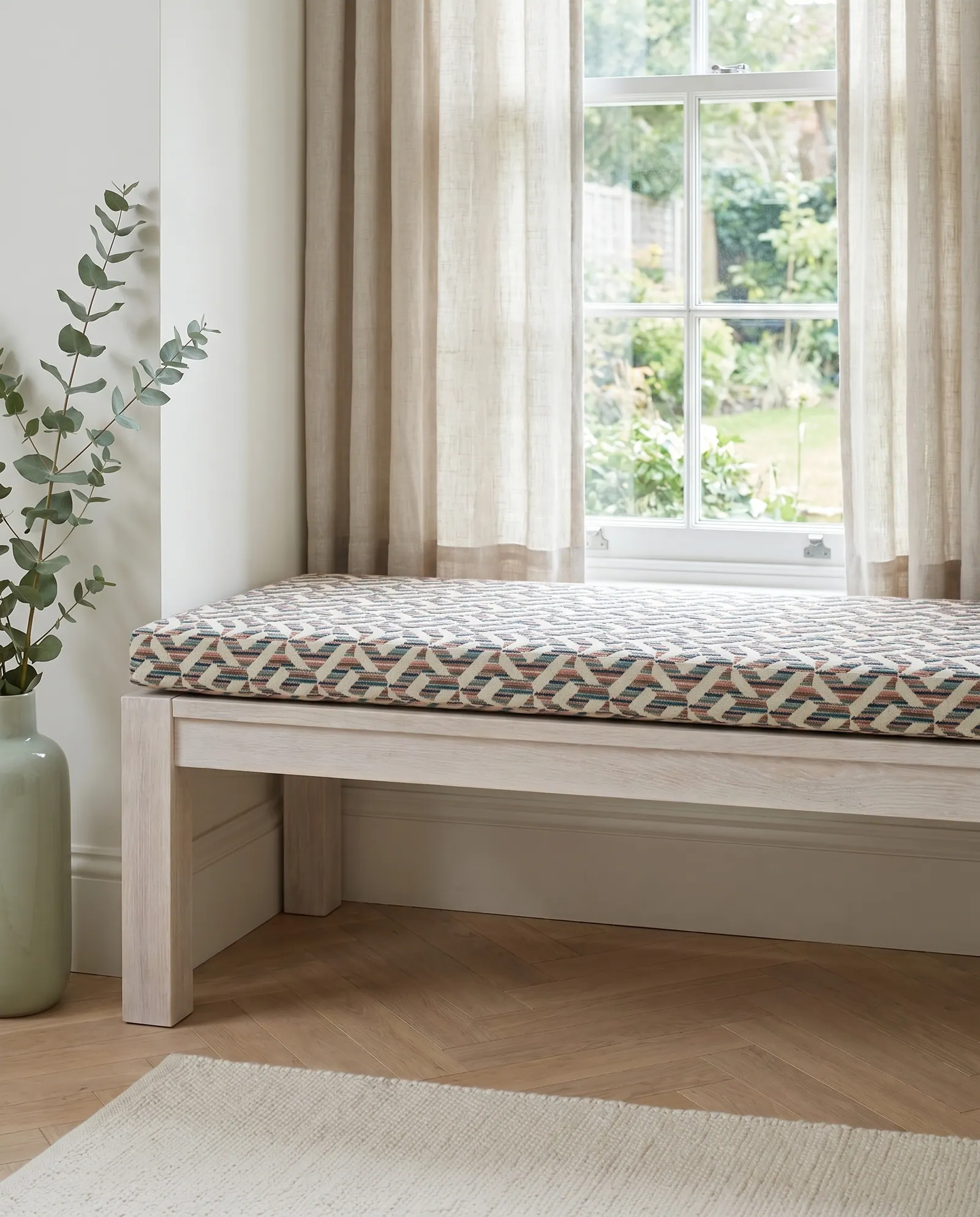
A slim geometric jacquard pad gives a limed oak bench pattern and color. Plain linen and eucalyptus keep the rest of the scene quiet.

The quick answer
A patterned bench pad works when everything around it stays plain and one color from the weave repeats nearby. On this limed oak bench, a slim geometric jacquard in rust, navy, teal and cream sits with flax curtains, a white wall and eucalyptus stems that echo the teal thread. Keep the pad slim on an open-frame bench; a thick box looks top-heavy.
Four colors in the weave, one idea in the room
Four colors live in this weave: rust, navy, teal and cream. That is a whole conversation already, and the room around it knows to listen.
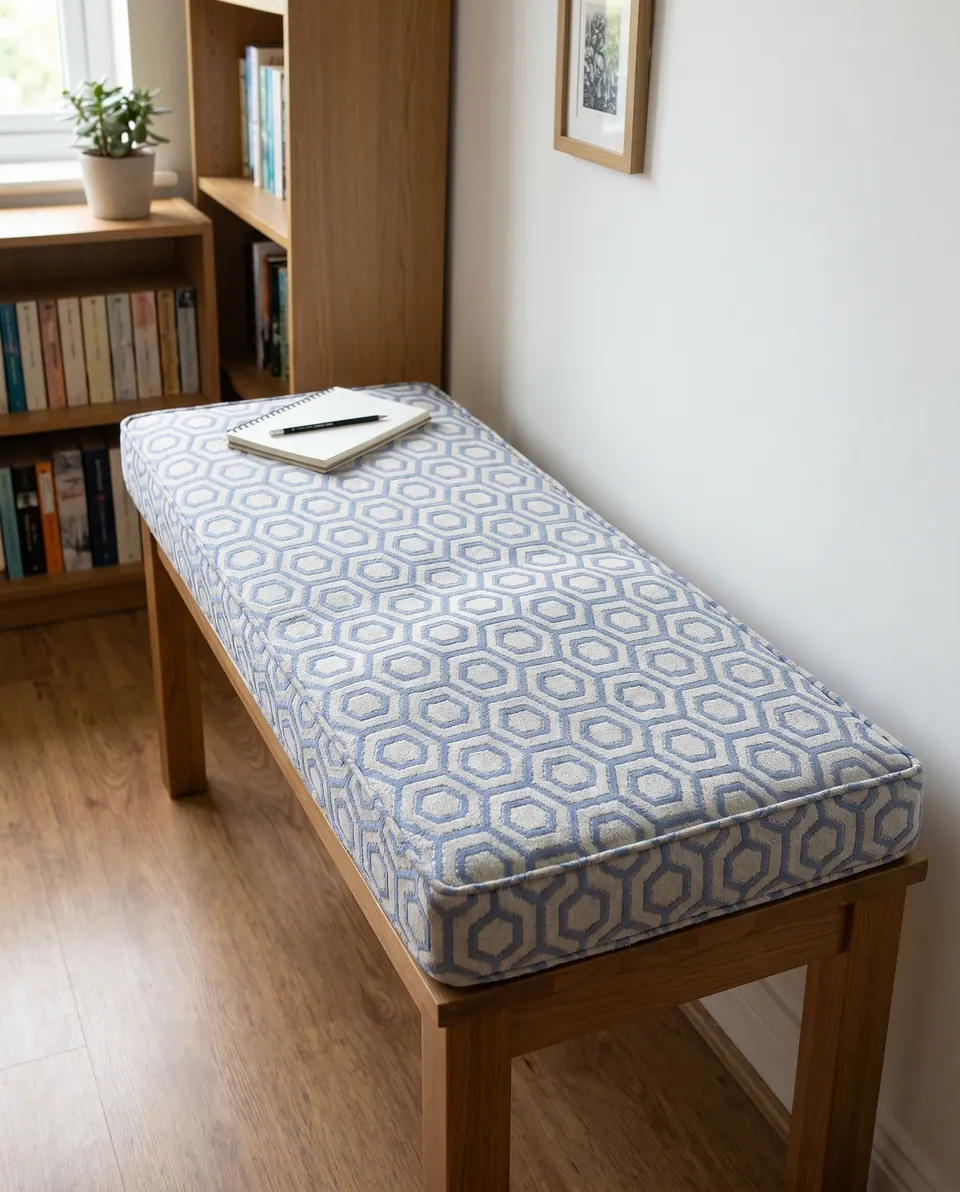
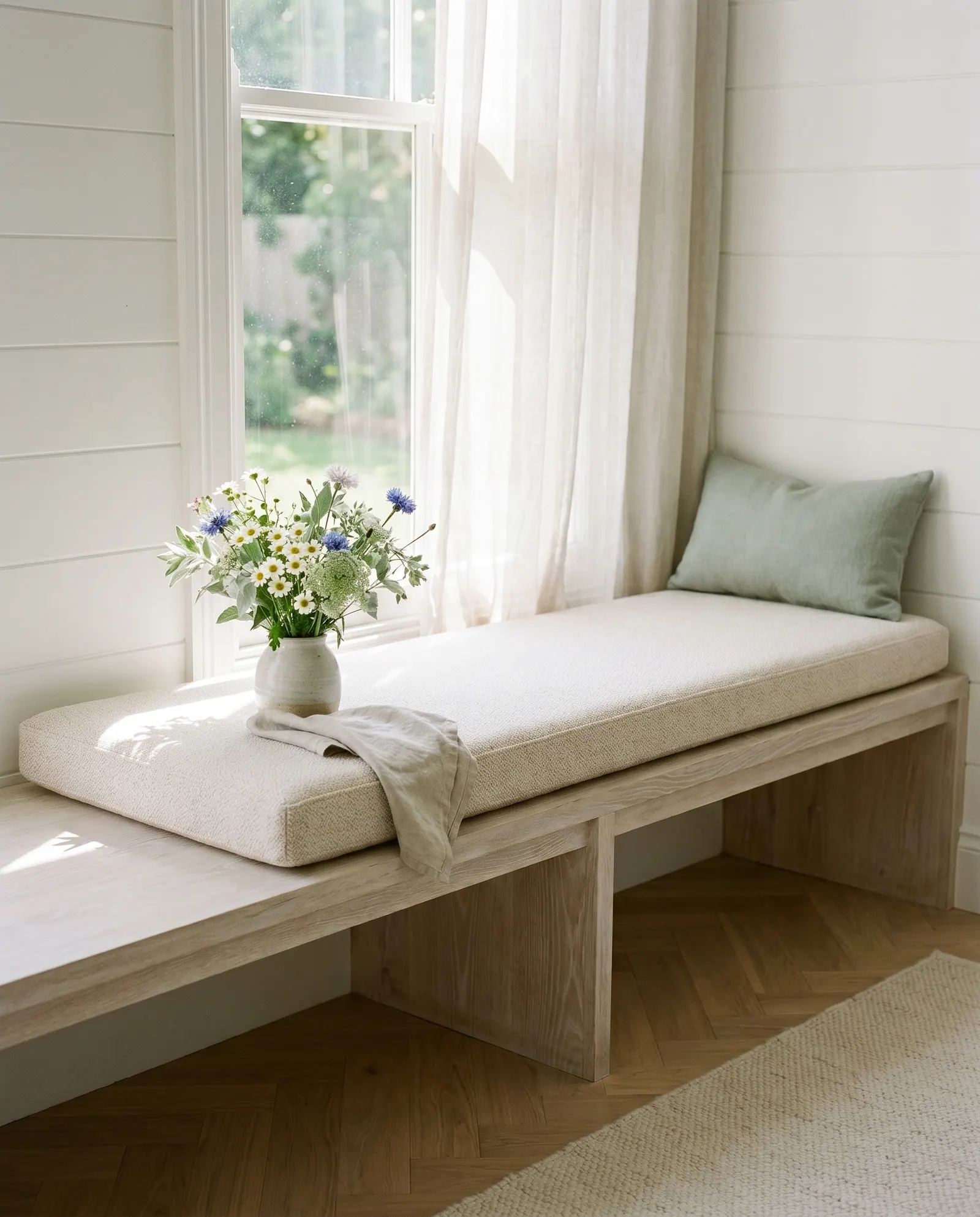
The seat is a pad, slim rather than deep, and that is the first good decision. The bench stands on slender limed oak legs; a tall box cushion would sit on them like a hat two sizes too big. There is no piping, so the pattern runs straight over the edge and down the side band. That makes the corners matter: ask how the repeat will fall where the top meets the side, because a geometric block that breaks at the edge is the first thing the eye finds.
The light is cool garden daylight from the sash window, and it treats the jacquard kindly. A woven pattern has relief, so side light gives each block a small shadow, and the cream ground reads as texture rather than flat paint. See the family in jacquard and damask.
Pinned by Élodie
Five pins, each on something chosen to stay quiet around the pattern.
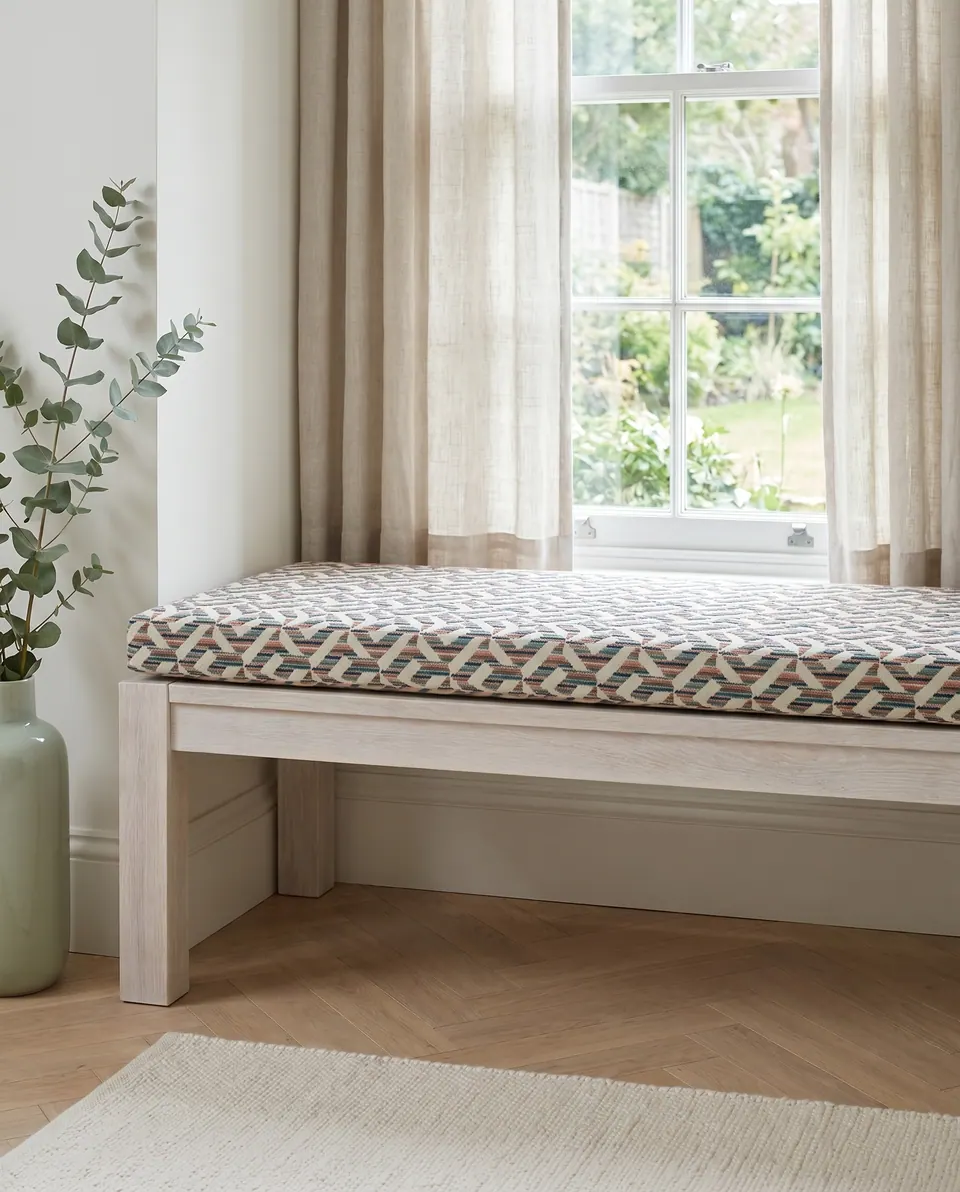
- Geometric jacquard
The interlocking block pattern hides crumbs and wear better than a solid on a thin pad.
- Wrapped side edge
With no piping the pattern runs over the edge, so matching the repeat at the corners matters.
- Eucalyptus stems
Gray-green leaves pull the teal thread out of the weave.
- Limed oak leg
A pale limed frame keeps a busy pattern from looking heavy.
- Flax curtains
Plain flax curtains are the quiet partner a patterned seat needs.
- Geometric jacquardThe interlocking block pattern hides crumbs and wear better than a solid on a thin pad.
- Wrapped side edgeWith no piping the pattern runs over the edge, so matching the repeat at the corners matters.
- Eucalyptus stemsGray-green leaves pull the teal thread out of the weave.
- Limed oak legA pale limed frame keeps a busy pattern from looking heavy.
- Flax curtainsPlain flax curtains are the quiet partner a patterned seat needs.
Quiet partners for a jacquard bench pad, prop by prop
- Eucalyptus in a sage ceramic vase. The gray-green leaves pull the teal thread out of the weave. One bunch of stems is the entire accent.
- Plain flax curtains. A patterned seat needs a plain partner at eye level, and natural flax is the quietest fabric in the room, on purpose.
- The limed oak frame. A pale frame keeps a busy pattern from looking heavy. Dark walnut would have made this pad shout.
- Cream wool rug, herringbone oak. Cream repeats the ground of the jacquard at floor level; the herringbone brings its own geometry, but in one soft color.
- The garden beyond the glass. Green outside, teal in the weave, eucalyptus in between: three steps of the same cool note.
To copy it, find the smallest color in your pattern and repeat it once, nearby, in something natural. Keep every other surface plain. Which thread in your fabric would you pull out? For more seats in this spirit, browse bench cushions and living room cushions.
Two navy benches, 84 and 71 inches long
One buyer wrote in with two long wooden benches and a clear list: navy fabric, cushions of 17 1/2 x 84 in (44.5 x 213 cm) and 17 1/2 x 71 in (44.5 x 180 cm), 3 in (7.5 cm) foam, single piping and an anti-slip bottom. The workshop quoted both in its best-quality 28-density foam.
I like that order because it is the practical twin of this photograph. A hard wooden bench sat on every day asks for foam, a piped edge that holds its line, and a base that grips so the cushion does not creep. A slim pad suits an open-frame bench like this one; the piped 3 in cushion with a grippy base suits a hard seat that works every day.
A four-color jacquard bench pad needs plain partners: flax curtains, a pale oak frame and one green stem that repeats the teal thread.
Élodie
On the cutting table: the jacquard bench pad
| Cushion in the photo | Slim box-edge bench pad, no piping |
|---|---|
| Fabric | Geometric jacquard in rust, navy, teal and cream |
| Piping | None; the pattern runs over the edge |
| Thickness options | 2, 3, 4 or 5 in (5 to 12.5 cm); a thin profile suits slender legs |
| Thinner still | 1 in (2.5 cm) pads are made only without piping |
| Foam | High-density polyurethane, about 2.0 lb/ft³ (32 kg/m³), fiber-wrapped |
| Non-slip base | Optional grippy bottom panel for hard wooden benches |
| Cover care | Zippered, removable; wash at 86°F (30°C), no tumble dryer |

Have it made
Have this made — ask Élodie’s workshop
A fabric reads one way at noon and another at dusk. Mention your light, and the workshop will weigh it with you. — Élodie
Leave your details and the workshop will call you to confirm measurements, fabric, foam and piping. No prices, dates or payment on this page: it is a request, not an order.
Measurements, bay thickness and listing colors
- A common question
Do I just send you the exact measurements for my bench cushion?
The workshop's answerYes. Write your exact measurements and your color choice in the personalization or notes box when you order, and the workshop takes it from there.
- A common question
What thickness can a trapezoid bay window cushion be, and is the piping extra?
The workshop's answerThickness can be 2, 3, 4 or 5 in. One bay seat quoted this way had a 107 1/2 in back edge, a 55 in front edge, two 32 1/2 in angled sides and a 23 in depth. Piping costs nothing extra and can be a different color, and the cover comes off to wash at 86°F (30°C), with no tumble dryer.
- A common question
Which fabric and piping colors are on the cushion in your listing photo?
The workshop's answerAsk, and the workshop names the exact fabric code and piping code for any cushion in a listing photo, such as a navy velvet with ivory piping or a linen piped in a second linen. Photos can show a slightly different tone from the real fabric.
Questions buyers ask next
Can a thin bench pad be made without piping?
Yes, and no piping costs the same as piping. Pads thinner than 2 in (5 cm), down to 1 in, can only be made without piping, and a patterned fabric then runs over the edge unbroken.
Does a geometric jacquard hide crumbs better than a solid?
Usually, yes. A multi-color woven pattern breaks up the surface, so small marks and wear show less than on a plain solid. The cover still unzips, so it can be washed at 86°F (30°C) on a gentle cycle and air dried.
How do I pick a pattern color to repeat in the room?
Take the smallest color in the weave, not the largest, and repeat it once in something natural nearby: a stem, a vase, a book spine. Here the teal thread is echoed by eucalyptus, which ties the bench to the garden view.
With color and care — Élodie
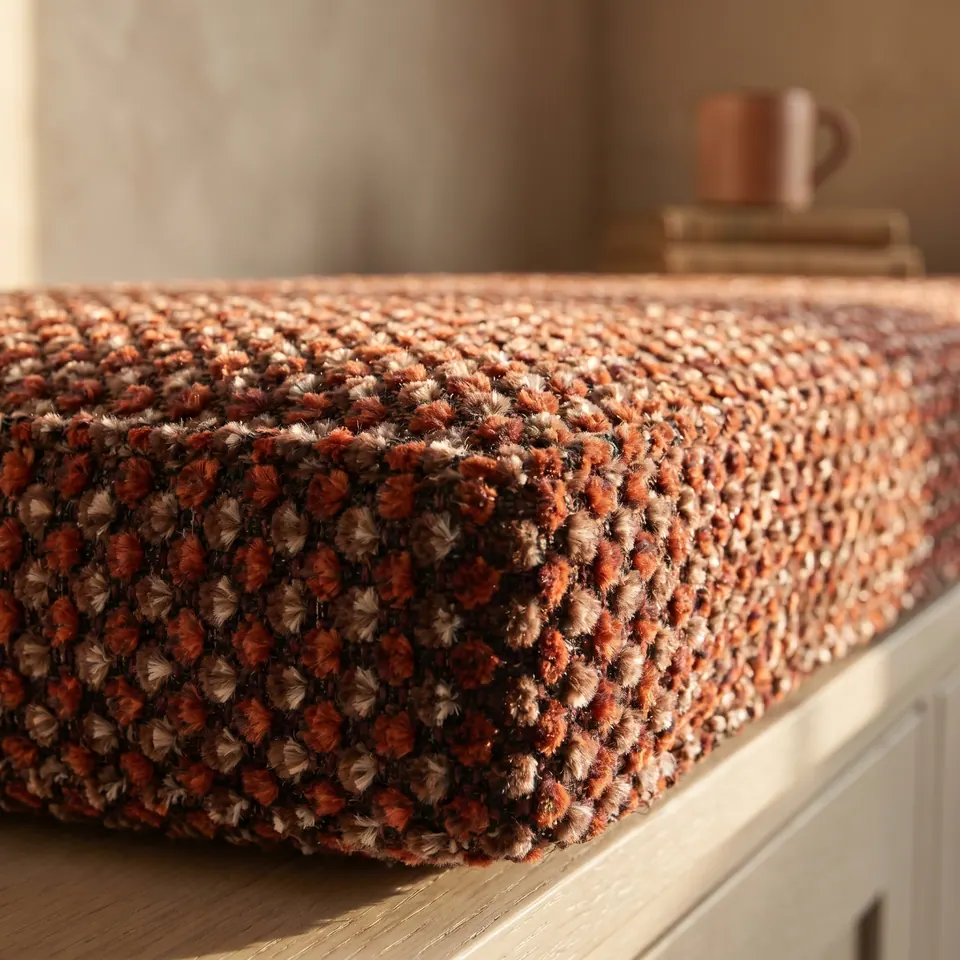
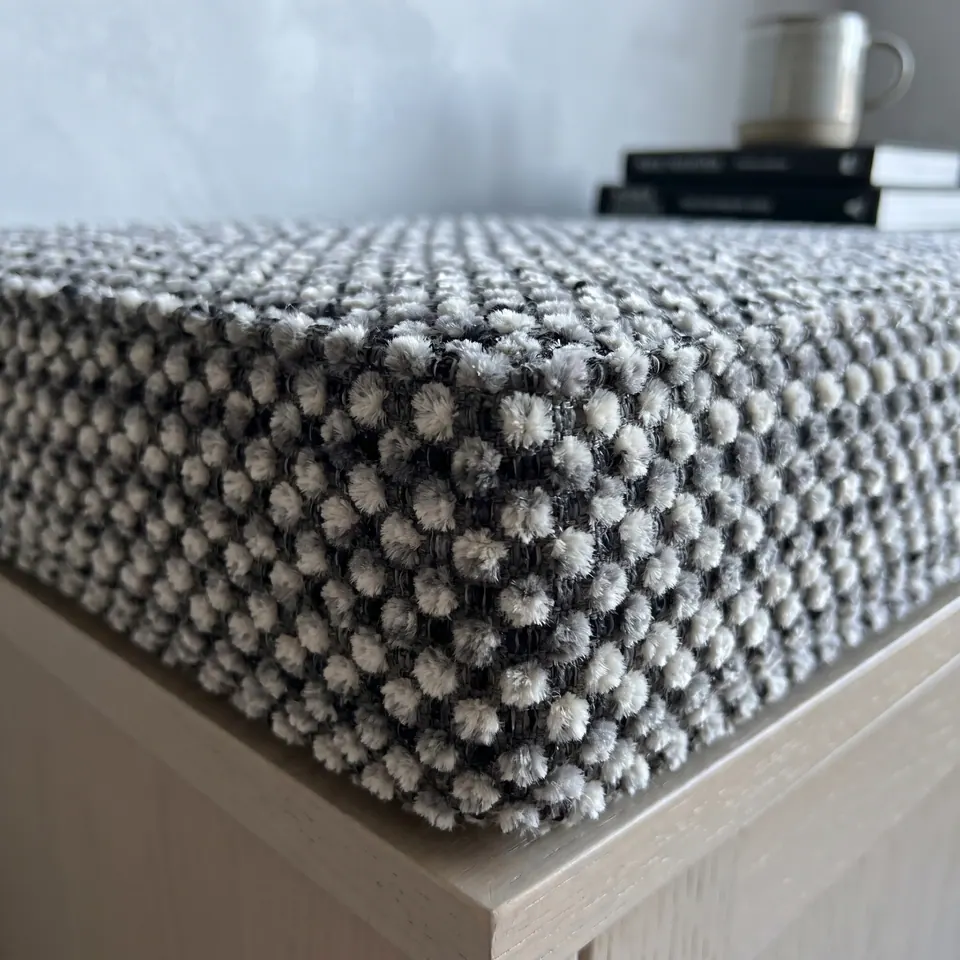
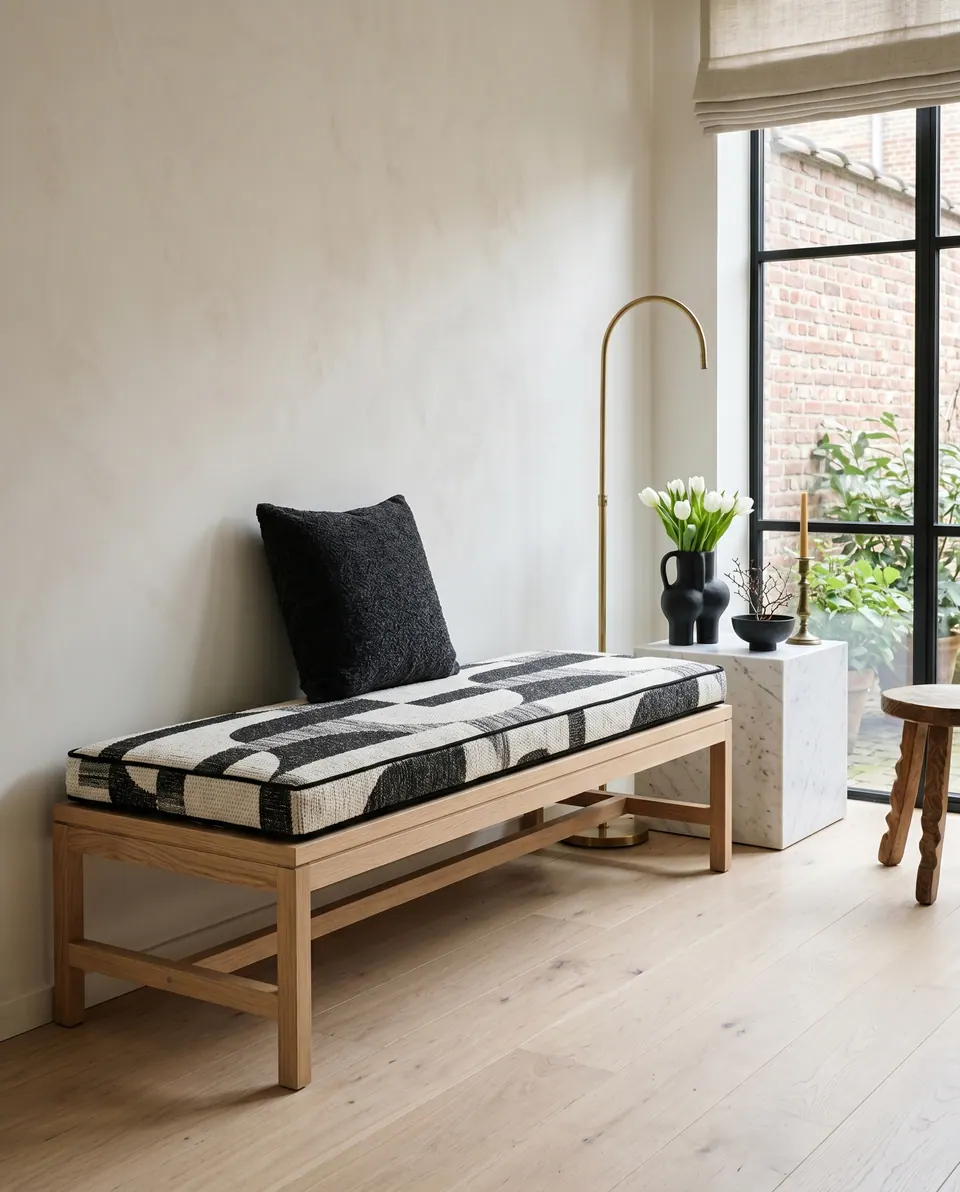
Woven seats on pale oak, from rust to mushroom
 Save
 Save
 Save
 Save
 Save
 Save