A Reading by RosaWindow Seat Cushions
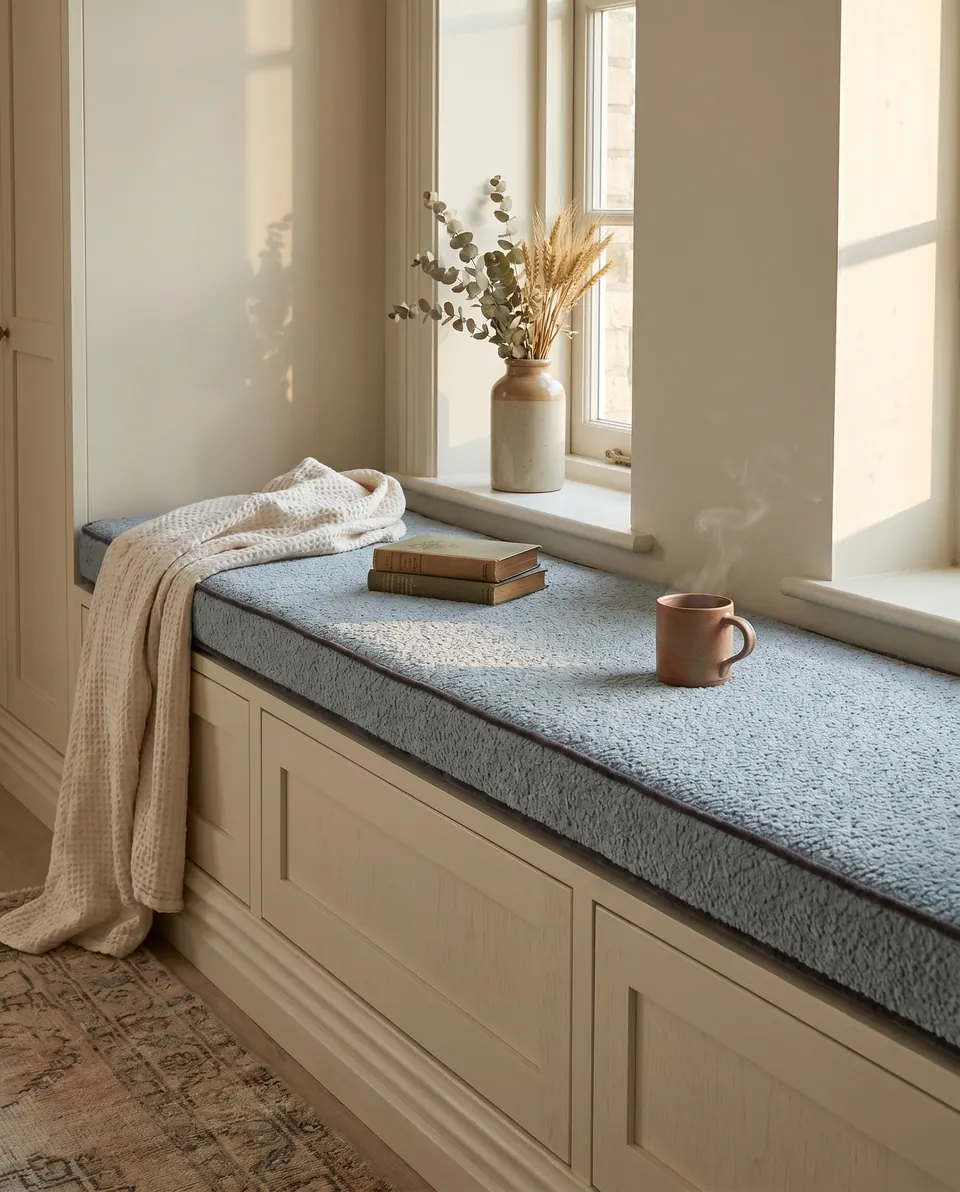
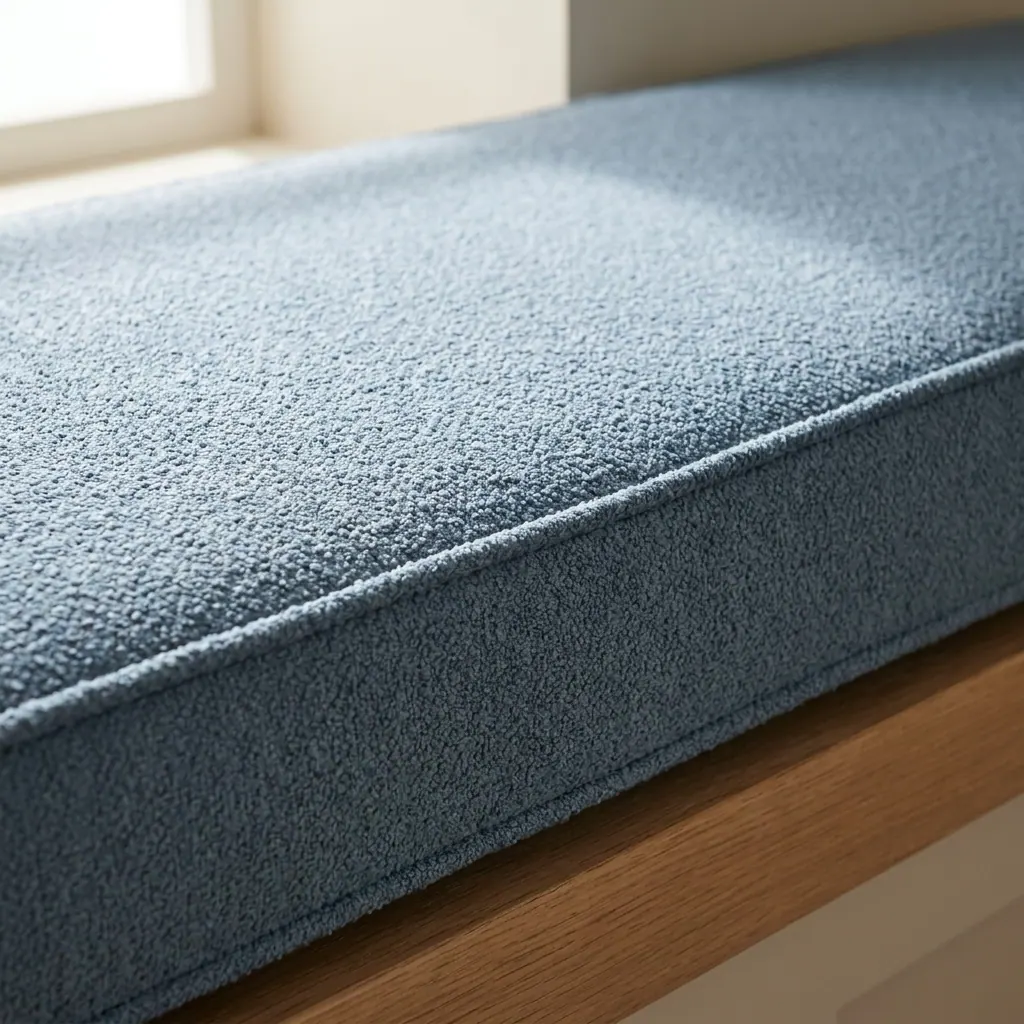
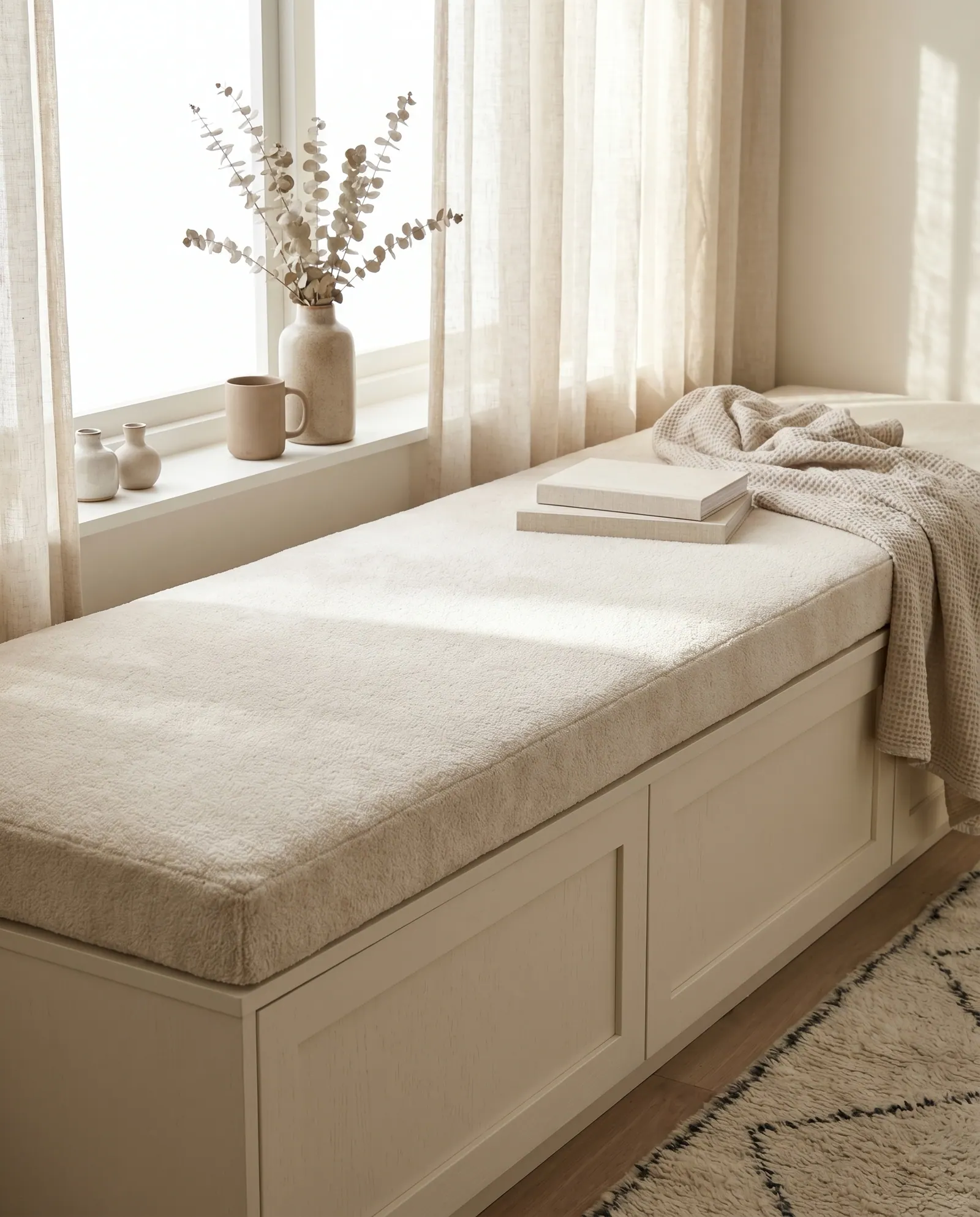
A dusty blue bouclé window seat cushion whose piping shows only when the light rakes
Folks ask me about contrast piping all the time. This window seat is my favorite answer to the opposite question: what happens when the piping matches?

 Save
The quick answer
Self piping on a dusty blue window seat cushion gives a tailored edge that disappears from across the room and shows only when side light rakes across it. For a window seat you look at as much as sit on, that tonal line is the calmer choice; save contrast piping for benches that stand in the middle of a room.
Three questions that led to this window
- A common question
Could the piping be a different color from the cushion, say black on white?
The workshop's answerYes. Any fabric on the charts can be used for piping, for example an HM-08 body with HM-05 piping, or a white body with black piping. Using the same fabric for body and piping is just as fine, and the piping choice doesn't change the price.
- A common question
What foam goes inside, and do you know its ILD?
The workshop's answerThe standard is high-density foam at about 2.0 lb/ft³ (32 kg/m³), rated medium-firm and resistant to sagging, and some products use HR cold foam. ILD varies slightly from batch to batch, so the workshop describes the feel instead: close to a high-end cold foam. The fabrics come from OEKO-TEX Standard 100 certified mills.
- A common question
Do you quote metric sizes, like 19¾ x 63 in (50 x 160 cm) or 69 x 23½ in (175 x 60 cm)?
The workshop's answerYes. Metric sizes are quoted the same way as inches; ask the workshop to confirm the shipping cost in the quote. Past examples include a 19 3/4 x 63 in (50 x 160 cm) linen cushion, a 26 x 67 x 4 in (66 x 170 x 10 cm) seat, a 69 x 23 5/8 in (175 x 60 cm) bench, a 110 5/8 x 39 3/8 in (281 x 100 cm) linen piece and a velvet floor cushion with two bolster armrests.
Now, the reading
One long band of blue, seen from the sofa
Stand across the room and this window seat cushion is simply a band of dusty blue on an oak ledge. One long piece runs the whole length, so it reads as built in, as if the ledge grew a cushion.
Walk closer and the daylight from the left starts raking across the bouclé loops. That is when the self piping appears: a tailored line in the very same blue, traced along the box edge. It shows in side light and stays out of the way the rest of the time, so you look at the view instead of the seams.
The only warm note is the oak underneath. Everything else is cool: white window frame, blue cloth, pale daylight. There are no props at all, and the photograph doesn't need any.
If your window seat is mostly looked at from the sofa, neighbor, go tonal. Save contrast piping for a bench standing in the middle of a room, where the outline has to hold its own from every side. My notes on matching, contrast or no piping weigh all three.
Four spots I'd point to from the doorway
Four marks, from the window light down to the oak ledge.
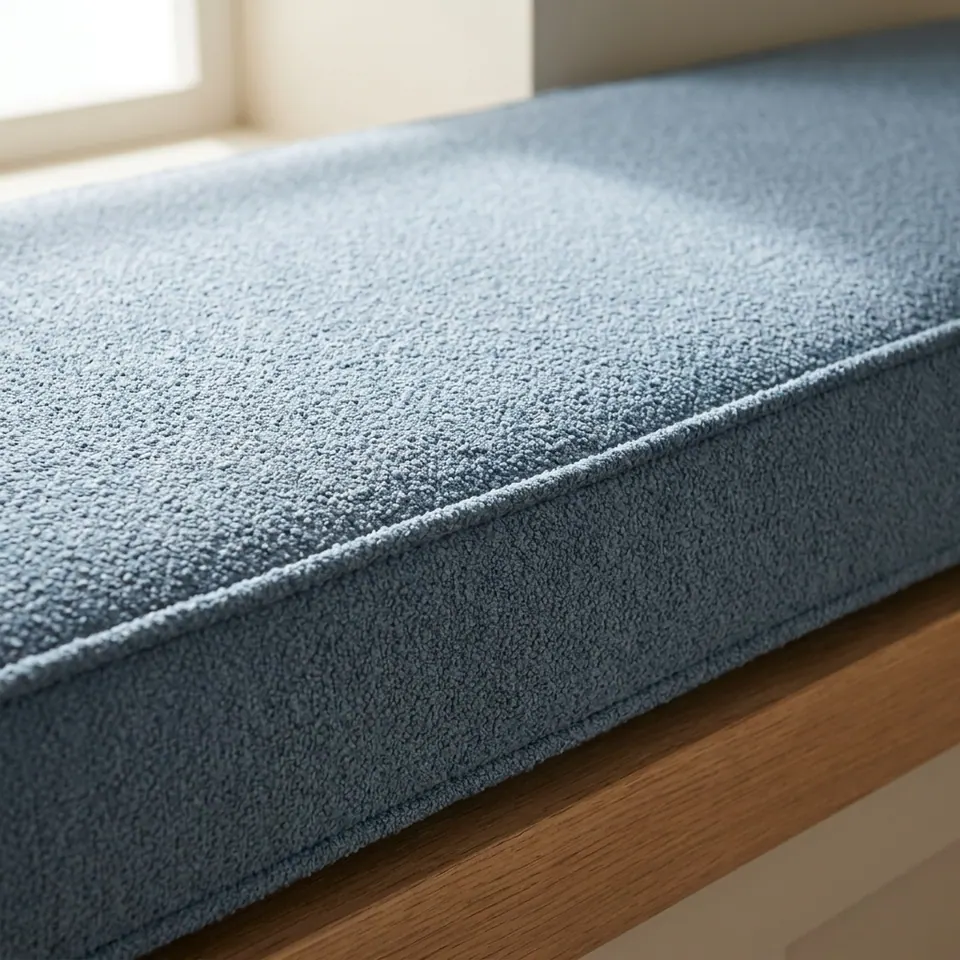
- Window daylight
Light from the side rakes across the loops and reveals the tonal piping.
- Dusty blue seat top
A long single piece runs the full ledge, so the seat reads as built in.
- Self-piped edge
Piping in the same blue gives a tailored line that only shows in raking light.
- Oak ledge
Oak beneath adds the only warm note to a cool-toned window.
- Window daylightLight from the side rakes across the loops and reveals the tonal piping.
- Dusty blue seat topA long single piece runs the full ledge, so the seat reads as built in.
- Self-piped edgePiping in the same blue gives a tailored line that only shows in raking light.
- Oak ledgeOak beneath adds the only warm note to a cool-toned window.
The same seat at ten feet and at arm's length
| Detail | From across the room | From the seat |
|---|---|---|
| Self piping | Invisible; one calm band of blue | A fine tailored line in side light |
| Bouclé loops | A soft, flat color | Texture you can see and feel |
| One long piece | Reads as built in | No seam across the middle to sit on |
| Oak ledge | A thin warm line under the blue | Wood grain along the front edge |
| Length | Looks right even when short | A 1 3/8 in gap shows at the wall |
The 77-inch rectangle that came up short
A buyer ordered two cushions at the same thickness: an inverted T-shape and a long rectangle, with a sketch showing how they met. The rectangle should have been 77 1/8 in (196 cm). It arrived at 75 3/4 in (192.5 cm).
From the doorway nobody would have noticed. Sitting on it, you could see the gap at the wall. The buyer laid a tape along it, took a photo and sent it in. The workshop apologized and remade the rectangle at the right length.
So every piece gets a tape on arrival, again once the foam has had a few days to settle, and a photo if it's still off. That photo turns 'it looks short' into a remake.
- Sizes
- Rectangle ordered 77 1/8 in (196 cm), arrived 75 3/4 in (192.5 cm)
- Fabric
- Not stated
The lesson: Measure every piece on arrival and photograph a tape along it if it's off.
Self piping on a dusty blue window seat cushion only shows when side light rakes across it, so it reads calm from ten feet and tailored from the seat.
Rosa
On the cutting table
| Cushion | Window seat cushion, one long piece |
|---|---|
| Fabric | Dusty blue bouclé (T65) |
| Edge | Box edge |
| Piping | Self piping in the same blue |
| Sits on | Oak ledge under a white-framed window |
| Light | Side daylight from the left |
| Check on arrival | Tape along every piece, photo if short |
| Best for | Reading nooks seen from across the room |

Have it made
Have this made — ask Rosa’s workshop
Swings sway, rockers rock, dogs circle three times. Tell the workshop what your seat goes through, and they will plan for it. — Rosa
Leave your details and the workshop will call you to confirm measurements, fabric, foam and piping. No prices, dates or payment on this page: it is a request, not an order.
Questions buyers ask next
Does self piping show on a bouclé cushion?
Only in the right light. On bouclé, piping in the same color shows when daylight rakes across the loops from the side, and otherwise blends into the body. It gives a tailored finish without pulling the eye from the window.
When is contrast piping a better choice than tonal piping?
When the cushion is seen from every side, such as a bench in the middle of a room, or when you want the outline to be a design feature. For a window seat you mostly look past, tonal piping stays calmer.
How does dusty blue behave in a window with cool light?
Dusty blue in cool side light reads quiet and airy. Add one warm material close by, such as an oak ledge or a wood side table, so the corner doesn't turn chilly on gray days.
Porch light's on — Rosa
Other bouclé seats, near and far
 Save
 Save
 Save
 Save
 Save
 Save