A Reading by ÉlodieWindow Seat Cushions
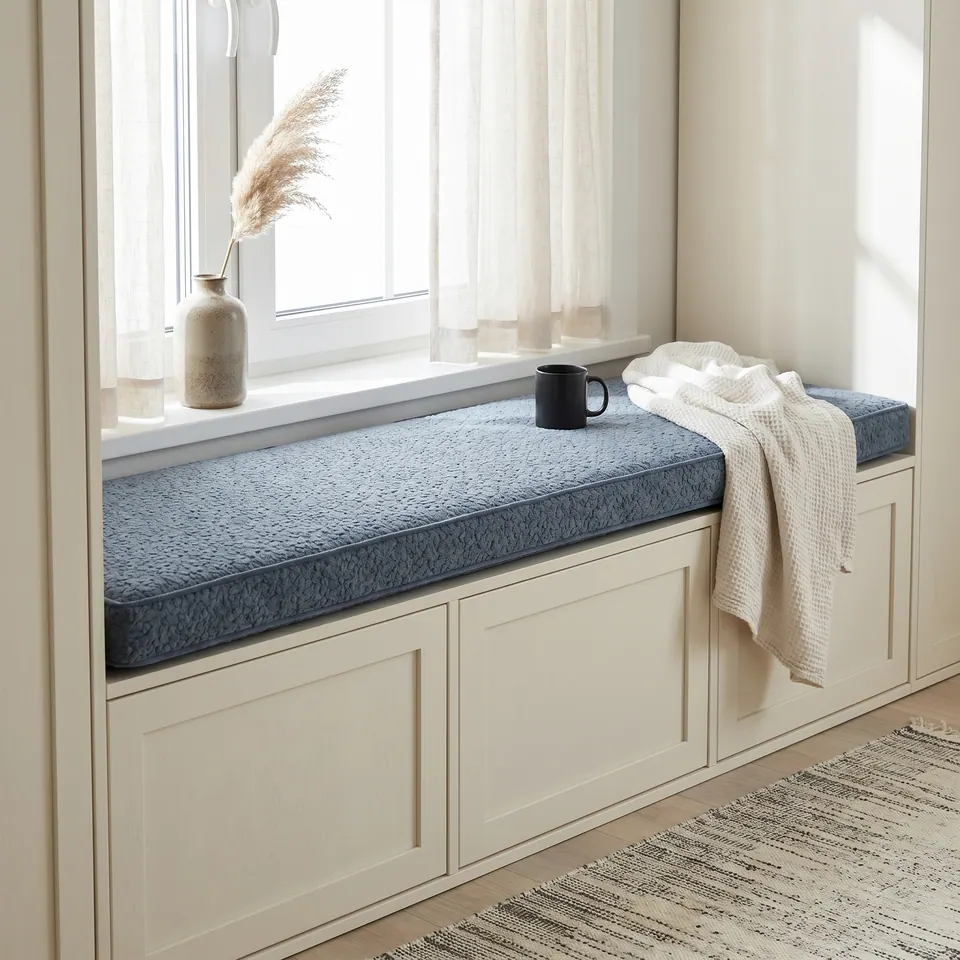
Measuring a dusty blue bouclé window seat cushion, notebook open
Before I speak of the caramel, a confession: this seat is a measuring lesson dressed in a pretty color. The oak lip decides everything.

 Save
The quick answer
To measure a built-in window seat for a cushion, take the width wall to wall at the back and again at the front, and the depth from the wall to the outer edge of the top, then decide whether the cushion stops at the lip or runs past it. Between two walls, round down slightly, never up.
Caramel on dusty blue, and the lip beneath
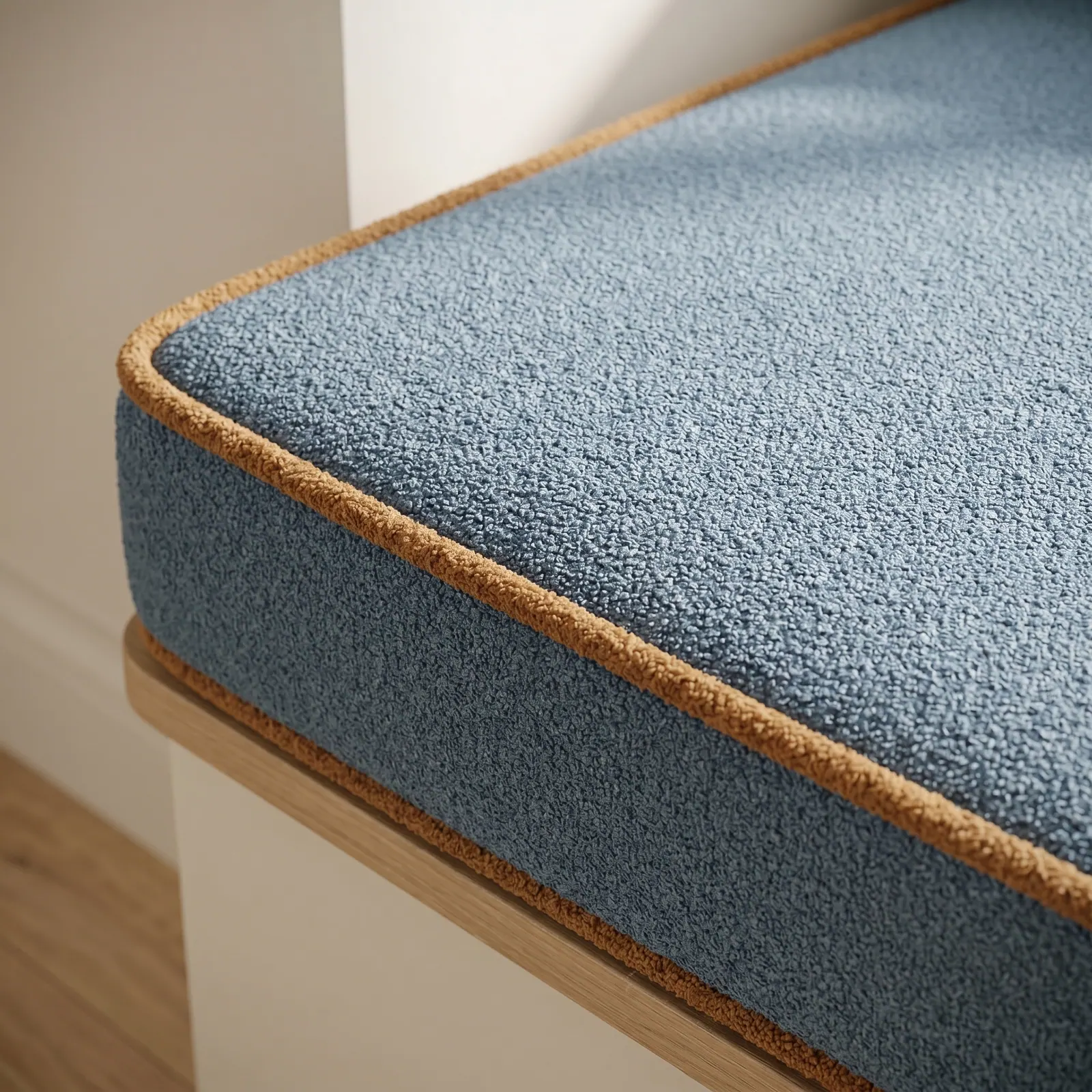
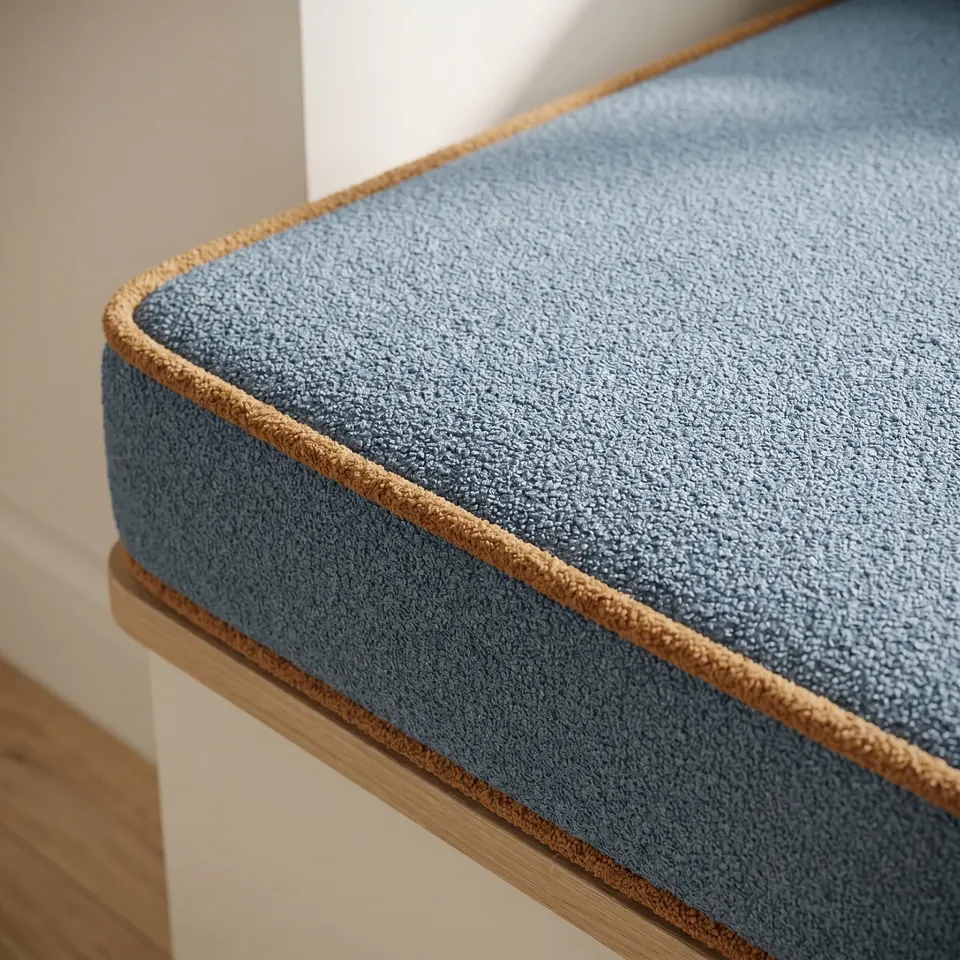
Look closely, my friends. A dusty blue bouclé box cushion, looped and soft, sits on a white built-in whose top ends in a strip of pale oak. Around the top and bottom edges runs a welt in caramel, the warm brown of toffee held up to a window. The light is soft and fresh.
Blue and caramel sit across the color wheel from each other, so one thin line of caramel warms a wide field of cool blue. No caramel pillow was needed. The welt matches the oak lip under the cushion, which is why it looks as though the joinery chose it. Does your seat have a strip of wood trim? Take your piping color from it.
The lower welt matters as much as the upper one. With piping on both edges, the cushion can be turned over when the face toward the glass begins to fade. And a mid-tone blue like this shows less fading and fewer marks than a pale seat would in the same spot. The eye sits down first, and here it sits down calm.
The cloth lives in the bouclé and teddy library; bouclé care and snags covers loops and paws, and more seats wait in window seat cushions.
The notebook page: five measurements for this seat
Width at the back
Wall to wall where the seat meets the window wall. Built-ins are seldom perfectly square.
Width at the front
Again along the oak lip. Keep the smaller of the two numbers.
Depth to the lip
From the back wall to the outer edge of the oak. Decide now whether the cushion stops at the lip or covers it.
Thickness
Choose it with the finished seat height in mind: the cushion adds its full thickness to the built-in top.
Round down, then label
Between two walls, round down slightly, never up. Label the front, the back and each side on your drawing.
Pinned by Élodie: four notes on the blue seat
Four pins, from the caramel welt at the corner to the lower welt that lets the cushion turn over.
- Caramel welt corner
Caramel on dusty blue is a warm-cool pairing that keeps a blue seat from feeling chilly.
- Dusty blue bouclé top
A mid-tone blue shows less fading and fewer marks than a pale seat by a window.
- Oak top lip
The caramel welt echoes the oak lip under the cushion, tying the fabric to the joinery.
- Lower caramel welt
Piping on the bottom edge as well as the top means the cushion can be flipped.
- Caramel welt cornerCaramel on dusty blue is a warm-cool pairing that keeps a blue seat from feeling chilly.
- Dusty blue bouclé topA mid-tone blue shows less fading and fewer marks than a pale seat by a window.
- Oak top lipThe caramel welt echoes the oak lip under the cushion, tying the fabric to the joinery.
- Lower caramel weltPiping on the bottom edge as well as the top means the cushion can be flipped.
The side called D on a trapezoid seat cushion
A buyer wrote in wanting a set of 3 in (7.5 cm) trapezoid seat cushions in a pale linen with black piping. The request was clear about feel: hard-wearing fabric and a high-density foam that wouldn't go lumpy. The shop confirmed a 32-density foam, about 2 lb/ft³ (32 kg/m³), and a hard-wearing linen.
Then it asked one question before quoting: the length of side D. The drawing had lettered sides, and D was the blank one. The answer came back as 16 1/2 in (42 cm), the same on every piece, and only then did the quote go out.
This is where people go wrong. A drawing with one blank side is a guess waiting to happen, and a shop that cares will stop and ask. Label every side, even the one that seems obvious. The window seat measuring guide shows the letters, size tolerance explains the small margins, and the trapezoid calculator checks the sides.
Buyer questions: olive linen, backrest depth and a bench that slides
- A common question
I love olive green, but in cotton or linen rather than velvet. What do you have?
The workshop's answerThe olive in the photo is a linen, not a velvet. A single listing shows only one color chart, so the full run of colors and materials is in the fabric-samples listing.
- A common question
How thick is the backrest cushion that sits against the wall on the floor sofa?
The workshop's answerAbout 4 in (10 cm) as standard. It can be made to a custom thickness, for example about 4 3/4 in (12 cm).
- A common question
Could you add heavy-duty hook-and-loop strips so the cushions stay put on my bench?
The workshop's answerFor a banquette, the shop suggested ties, or a cushion base made from non-slip fabric so it won't slide, and asked for a photo of the bench to choose between them.
On the cutting table: the dusty blue window seat cushion
| Product | Window seat box cushion, rectangle |
|---|---|
| Fabric | Dusty blue bouclé |
| Welt | Caramel contrast on top and bottom edges |
| Why both edges | The cushion can be flipped when one face fades |
| Seat | White built-in with an oak top lip |
| Measure | Width at back and front, depth to the lip's outer edge |
| Enclosed fit | Round down slightly, never up |
| Best for | Sunny living room window seats with wood trim |

Have it made
Have this made — ask Élodie’s workshop
A fabric reads one way at noon and another at dusk. Mention your light, and the workshop will weigh it with you. — Élodie
Leave your details and the workshop will call you to confirm measurements, fabric, foam and piping. No prices, dates or payment on this page: it is a request, not an order.
A window seat cushion with welts on both the top and bottom edges can be flipped over when the face toward the glass starts to fade.
Élodie
Questions buyers ask next
Should a window seat cushion cover the wood lip or stop short of it?
Either works, but decide before you measure. Stopping at the lip shows off the wood and pairs well with a matching welt; running over it hides the joint. Measure the depth to the exact point where you want the cushion to end.
Why measure a built-in seat in more than one place?
Walls in a built-in are seldom perfectly parallel, so the width at the back can differ from the width at the front. Measure both, order from the smaller, and round down slightly for a cushion that fits between walls.
Is bouclé practical on a sunny window seat?
In a mid-tone, yes. Dusty blue shows fewer marks and less fading than a pale shade, and welts on both edges let you flip the cushion. Loops can catch on claws, so read the care notes if you share the seat with pets.
What piping color warms up a blue cushion?
A warm brown such as caramel. It sits across the color wheel from dusty blue, so a thin welt is enough to change the mood. Take the exact shade from any wood trim nearby and the piping will look built in.
With color and care — Élodie