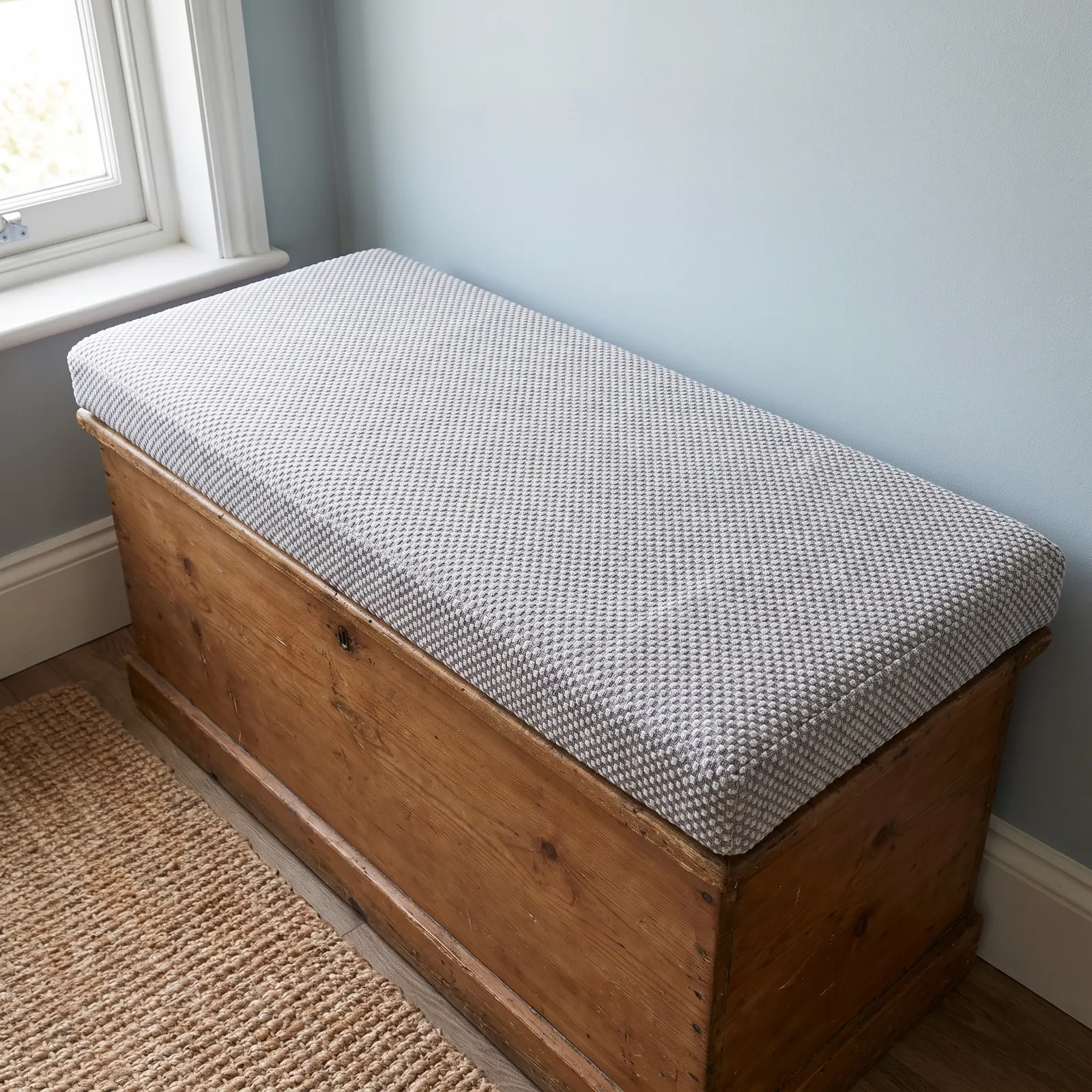
 Save
- Chest keyhole
The original keyhole stays on show because the cushion sits exactly on the lid.
- Gray basketweave top
A small-scale gray and white weave looks crisp against the blue wall.
- Plain boxed edge
Cut exactly to the lid, the cushion lifts off in one move when you need the storage below.
- Pine grain
Warm, knotty pine keeps a cool gray cushion from looking chilly.
- Jute rug
Jute adds a third natural texture between the pine and the woven cushion.
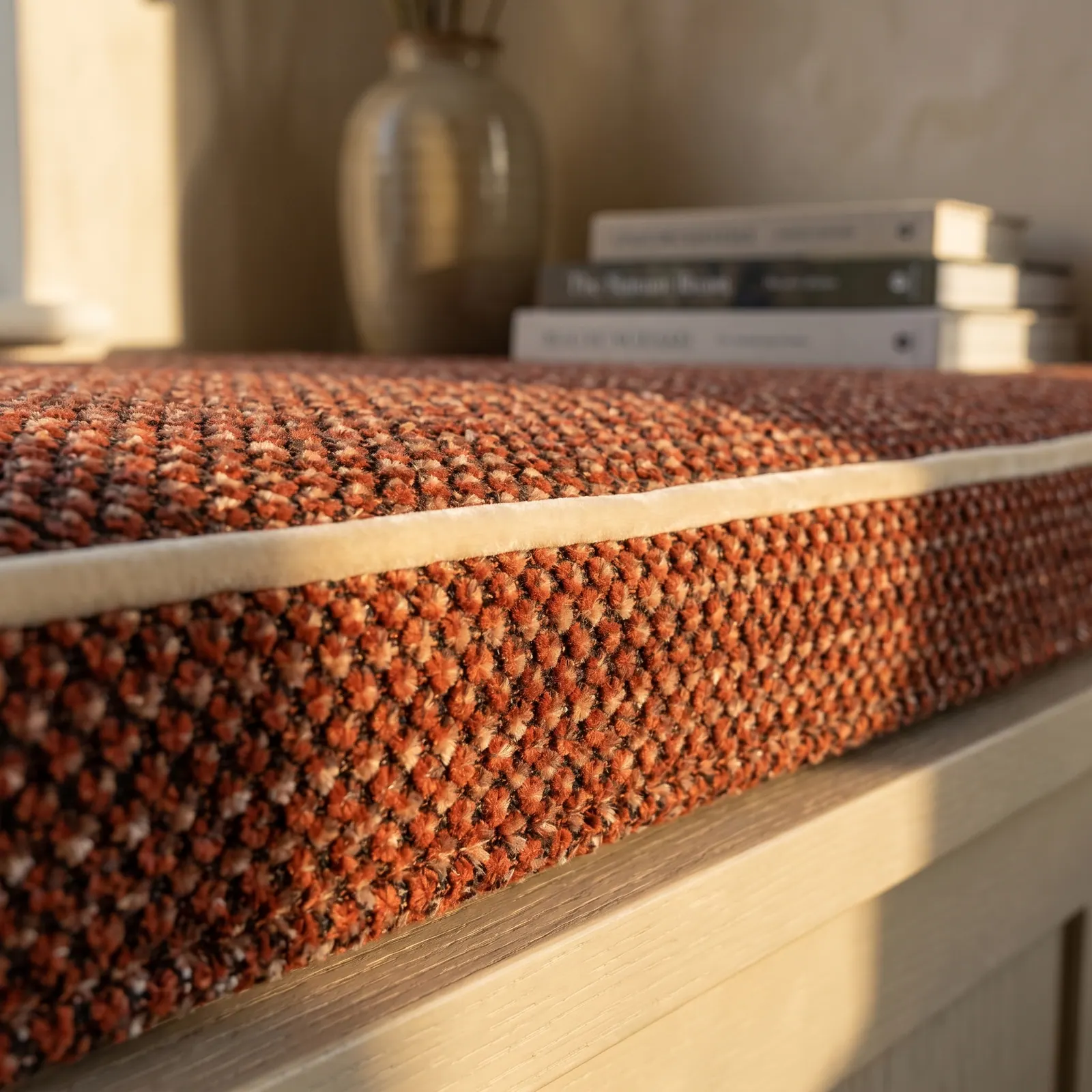
Plate Dove-gray weave on an antique pine blanket chest
A dove gray cushion cut to the lid turns an old pine blanket chest into a window seat. Blue wall, pine and jute do the rest.
A Reading by MaggieBench Cushions
A custom bench cushion on a blanket chest, read at ten feet and up close
Most people choose cushion fabric from six inches away and live with it from ten feet. This dove gray cushion on an old pine chest works at both distances.

The quick answer
A custom bench cushion on a blanket chest should be cut to the exact lid size and left loose, so it lifts off whenever you need the storage below. From across a room, the fit and the color are what people see; the weave and any piping show only up close. Pick the fabric for the ten-foot view first.
Five things pinned on the chest
Five pins, from the keyhole to the rug, each one visible from the bedroom door.
The numbers match the pins on the plate.
- Chest keyholeThe original keyhole stays on show because the cushion sits exactly on the lid.
- Gray basketweave topA small-scale gray and white weave looks crisp against the blue wall.
- Plain boxed edgeCut exactly to the lid, the cushion lifts off in one move when you need the storage below.
- Pine grainWarm, knotty pine keeps a cool gray cushion from looking chilly.
- Jute rugJute adds a third natural texture between the pine and the woven cushion.
From the doorway, it is all about where the cushion stops
Stand ten feet back and the cushion stops being a fabric. It becomes a band of dove gray on warm pine, and the only line that matters is its edge. Here it stops exactly at the lid on all four sides, so the chest still reads as furniture.
That is why there is no piping. A contrast welt would draw a second outline just inside the lid's own edge, and from the doorway two outlines look like a mistake. A straight welt is a kind of honesty, but so is knowing when to leave it off.
Cool north light through the sash pulls the room toward blue; the knotty pine and the jute rug put the warmth back, so the gray never turns chilly.
Up close, the top is a small gray and white basketweave, woven in rather than printed, which is the point of the woven-pattern family: the pattern cannot rub off where people sit. Nothing sits on the lid, because a blanket chest cushion has to let the lid lift. What does yours measure, edge to edge?
Ten feet versus ten inches
| What you notice | From the doorway | At arm's length |
|---|---|---|
| The fit | One gray block that stops at the lid edge | Square box corners, no overhang |
| The color | A calm middle between blue wall and pine | Gray and white yarns side by side |
| The weave | Invisible; it blends to one soft gray | A small basketweave, woven in |
| The props | Warm pine, jute, a white sash | The keyhole, left on show |
A 104 1/2 inch dining bench with no seam, by request
A buyer in the US ordered two dining bench cushions, 104 x 18 in (264 x 46 cm) and 59 x 18 in (150 x 46 cm), in emerald velvet with double piping in pale pink velvet, plus four matching 18 x 18 in pillow covers. Built to be seen across a dining room, that set is where a double line of piping earns its keep.
The workshop suggested making the long cushion in two pieces. She wanted no seam, so it was made in one piece, lengthened to 104 1/2 in (265 cm), and arrived just right. If a center seam would bother you, say so before anyone cuts; the one piece or two Pattern has the rules.
- Sizes
- 104 1/2 x 18 in and 59 x 18 in
- Fabric
- Emerald velvet, double piping in pale pink velvet
The lesson: On a long bench, ask for one-piece construction if a center seam would bother you.
Three bench-cushion questions: piping, pillows and price
- A common question
Can I pick a contrasting piping color, and does it have to come from the same fabric chart as the cushion?
The workshop's answerYes. Any color on the fabric charts works for piping, and contrast piping can come from a different chart than the cushion, with more than 150 options. Write the cushion code and the piping code separately when you order.
- A common question
Can you make a seat cushion with matching arm bolsters, back pillows and a lumbar pillow?
The workshop's answerYes. Send the seat size as length x depth x thickness and say how many bolsters and back pillows you want; the workshop sizes them to match. Sets ship filled unless you ask for covers only.
- A common question
The quote came in higher than I expected. Is there any room on the price?
The workshop's answerThe prices shown are already discounted, but the workshop often lowers a custom quote for a first order or a bulk order, or when you share your budget up front.
A cushion on a blanket chest should stop exactly where the lid stops. From ten feet away, the fit is the detail people see, not the fabric.
Maggie
On the cutting table: the chest-lid cushion
| Cushion | Box cushion cut to the chest lid, loose so the lid opens |
|---|---|
| Fabric | Dove gray and white chenille basketweave |
| Piping | None; the lid's edge draws the outline |
| Edge | Plain boxed edge, square corners |
| Fit | Flush with the lid, no overhang |
| Cover | Zippered and removable |
| Best for | Blanket chests, storage benches, bedroom window seats |

Have it made
Have this made — ask Maggie’s workshop
Numbers first, fabric second, piping last. Jot down what you have, and the workshop will go down the list with you, item by item. — Maggie
Leave your details and the workshop will call you to confirm measurements, fabric, foam and piping. No prices, dates or payment on this page: it is a request, not an order.
Questions buyers ask next
Should a blanket chest cushion be fixed to the lid?
Usually not. Keep it loose and cut to the lid so it lifts off in one move. If it must ride up with the lid, ties or a grip base on the hinge side do the job.
Is piping included, or does a contrast color cost extra?
Piping is included at no extra charge, whether it is cut from the cushion fabric or from a contrast code. It sits on the seam line, so it does not change the finished size you ordered.
How long can a bench cushion be made in one piece?
Fabric rolls are about 55 in (140 cm) wide, so a split is usually suggested past 79 to 90 in (200 to 230 cm). Longer single pieces are made on request, like the 104 1/2 in bench above.
Stitch straight — Maggie
More photographs to read
 Save
 Save
 Save
 Save
 Save
 Save