 Save
- Solid teal top
A fine dobby weave gives a plain color some texture, so it doesn't look flat outdoors.
- Self-piped edge
Matching piping keeps the outline clean against busy water reflections.
- Coiled rope
Natural rope says jetty at once and repeats the weathered wood tones.
- Black lantern
One dark object on the left balances the strong block of teal on the right.
- Weathered bench frame
Silver-gray timber is why a saturated teal works; a pale cushion would disappear here.
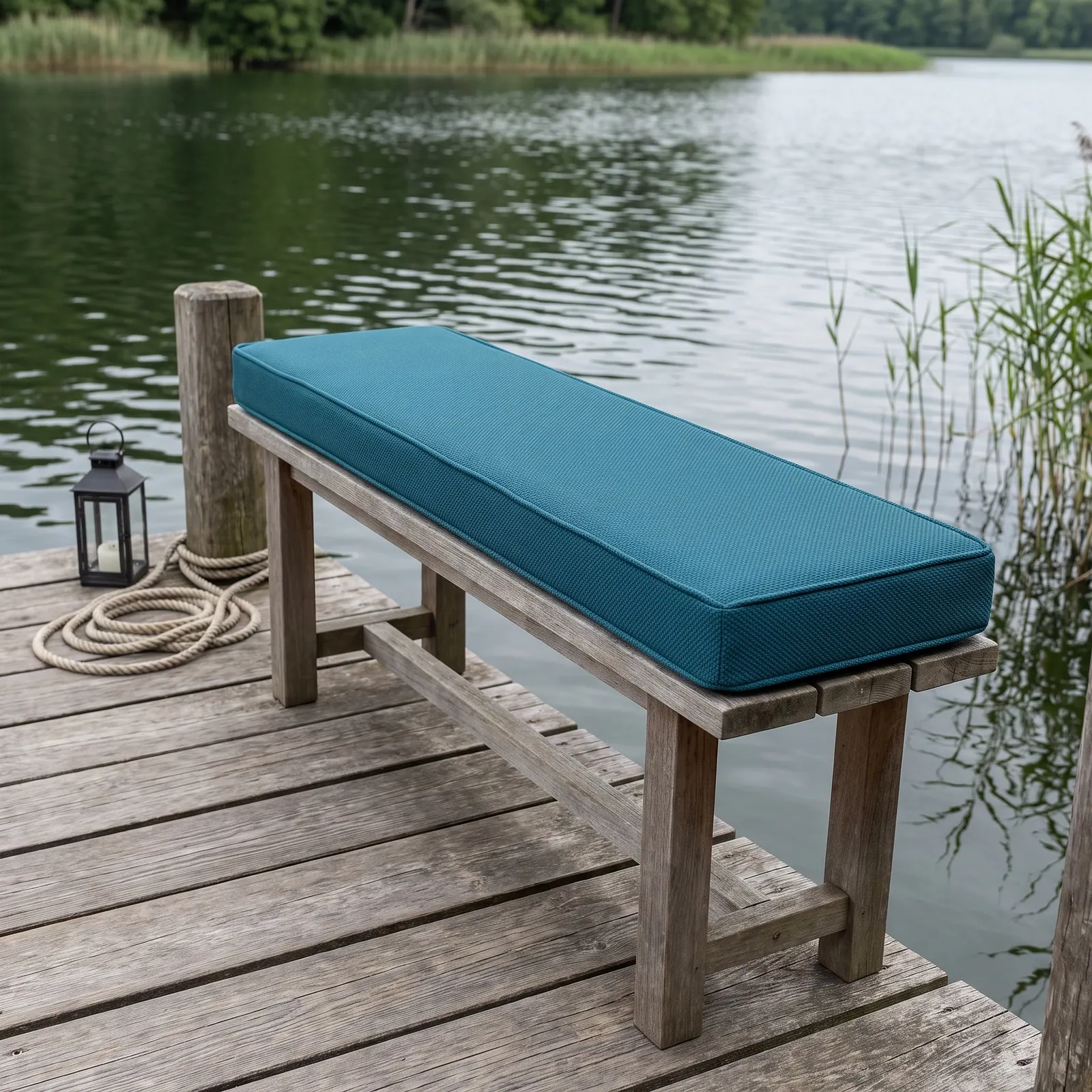
Plate Deep Teal Bench Cushion on a Weathered Lake Jetty
A single block of deep teal on silvered timber, set against lake water of almost the same color. The rope and lantern are the only props.
A Reading by CallumBench Cushions
A deep teal outdoor bench cushion on a lake jetty, and why its piping matches
Water moves. Wood grain runs. On a jetty everything is already pattern, so the outline of the cushion has to stay quiet or it starts an argument with the lake.

The quick answer
Beside water, self piping is usually the right call for an outdoor bench cushion: a cord in the cushion's own fabric sharpens the box edge without drawing another line against ripples and wood grain. Contrast piping suits a calm, plain setting, and no piping softens the shape. Piping choice doesn't change the price, so decide by the view.
Pinned by Callum at the water's edge
Five pins, from the dobby-woven top and its self-piped edge to the rope and lantern that bracket it.
The numbers match the pins on the plate.
- Solid teal topA fine dobby weave gives a plain color some texture, so it doesn't look flat outdoors.
- Self-piped edgeMatching piping keeps the outline clean against busy water reflections.
- Coiled ropeNatural rope says jetty at once and repeats the weathered wood tones.
- Black lanternOne dark object on the left balances the strong block of teal on the right.
- Weathered bench frameSilver-gray timber is why a saturated teal works; a pale cushion would disappear here.
Teal taken straight out of the lake
A weathered gray bench stands on a timber jetty. Reeds on one side, still water beyond, a line of trees on the far shore. On the bench, one long block of deep teal, the color of the lake under a flat overcast sky.
That's the whole trick. The color came from the water, so this outdoor bench cushion looks like part of the view instead of something parked on top of it. A pale cushion would vanish against silvered timber. A saturated teal holds its ground.
Lean in and the plain isn't flat. A fine dobby weave gives the teal some texture, so it doesn't read like a sheet of vinyl under gray sky. The cloth is from the outdoor acrylic family, and the cushion runs the full bench top, thick enough to bridge the gaps between slats.
The props are few. Coiled natural rope on the left says jetty before you've read a word and repeats the weathered wood. A black metal lantern with a candle is the one dark object, balancing the heavy teal on the right. The mooring post keeps your eye at the waterline.
Then the edge. It's self-piped, and out here that matters. A matching cord keeps the outline clean where a white or black one would draw yet another line across a view already full of them. What's behind your bench: water, a hedge, a painted wall?
Self, contrast or none: piping on a lakeside bench
Piping costs the same either way, so this is purely a decision about the line. Any chart fabric can be the cord.
| Piping | What it does to the line | On this jetty |
|---|---|---|
| Self piping | Sharpens the box edge in the body color | Clean outline against busy reflections |
| Contrast piping | Draws the outline as a separate stripe | Competes with ripples and wood grain |
| No piping | Softens the edge so the cloth reads first | Calm, but the box shape looks less crisp |
A futon frame and the back height that lost four inches
A buyer wrote to the workshop about a futon frame and got tangled between length and width. Fair enough. Everyone does once.
The workshop sorted it: one seat at 67 x 23 in (170 x 58 cm) and two backrests, each 33 in (84 cm) wide. Then the part people skip. The workshop asked for the total back height measured on the frame, and reminded them the 4 in (10 cm) seat cushion would take up part of it. The backs came out at 24 in (61 cm).
The set went out in green khaki with side pillows, vacuum-packed. The buyer said the cushions turned out exactly as hoped. Measure back height from the frame and take the seat thickness off before ordering backrests; the full method is in back cushion height.
Buyer questions: foam, creases and contrast cord
- A common question
Does a custom bench cushion come with the foam, or just the cover?
The workshop's answerThe foam comes with it. Cushions ship complete, filled with high-density comfort foam, not as empty covers. You can ask for covers only instead, and every cover comes off with a zipper and is machine washable.
- A common question
My cushion showed up creased, rippled and a little short. Is something wrong with it?
The workshop's answerUsually not. Vacuum compression causes creases, ripples and a slightly short length. The foam needs about 3 to 5 days to regain its full shape and can arrive about 3/4 in (2 cm) short while it keeps expanding. If it still doesn't fit after that, send tape-measure photos or one continuous video with the numbers readable, and message the workshop so it can check the numbers against your order.
- A common question
I'd like contrast piping on my bench cushion. Is that possible, and does it cost more?
The workshop's answerYes, and no. Any fabric from the charts can be the piping, such as a light body with a darker cord, or a white body with black piping. Using the same fabric for body and piping is fine too, and the piping choice doesn't change the price.
On the cutting table, lakeside
| Cushion | Full-length bench cushion, rectangle, box edge |
|---|---|
| Fabric | Deep teal outdoor acrylic in a fine dobby weave |
| Piping | Self piping in the body fabric |
| Color source | Taken from the lake water |
| Fit | Covers the whole bench top and bridges the slats |
| Fill | High-density comfort foam, shipped inside the cover |
| Cover | Removable with a zipper, machine washable |
| Best for | Jetties, docks, lakeside and garden benches |

Have it made
Have this made — ask Callum’s workshop
Sun, rain, salt. Say which of them your cushion will meet, and the workshop will plan around it. — Callum
Leave your details and the workshop will call you to confirm measurements, fabric, foam and piping. No prices, dates or payment on this page: it is a request, not an order.
Beside water, take the bench cushion color from the lake and pipe it in its own fabric. Ripples and wood grain already draw enough lines.
Callum
Questions buyers ask next
Why does self piping suit a waterside bench?
Water and timber are full of moving lines. A cord in the cushion's own color outlines the box edge without adding another line, so the cushion reads as one calm block against ripples and grain.
When is contrast piping the better choice outdoors?
When the setting is plain, such as a smooth painted wall or clean stone paving, a contrast cord gives the cushion a drawn outline. Against a busy view it competes with everything around it.
How do I pick a color for a lakeside bench cushion?
Take it from the water or the far shore and keep the fabric plain. A deep teal on silvered wood reads as part of the view, while a pale cushion tends to disappear against weathered gray timber.
How thick should a cushion be on a slatted bench?
Thick enough to bridge the gaps between the slats so you don't feel them. About 4 in (10 cm) is the standard thickness, and 3 in (7.5 cm) works where space above the seat is tight.
Fair winds — Callum