 Save
A Reading by RosaWindow Seat Cushions
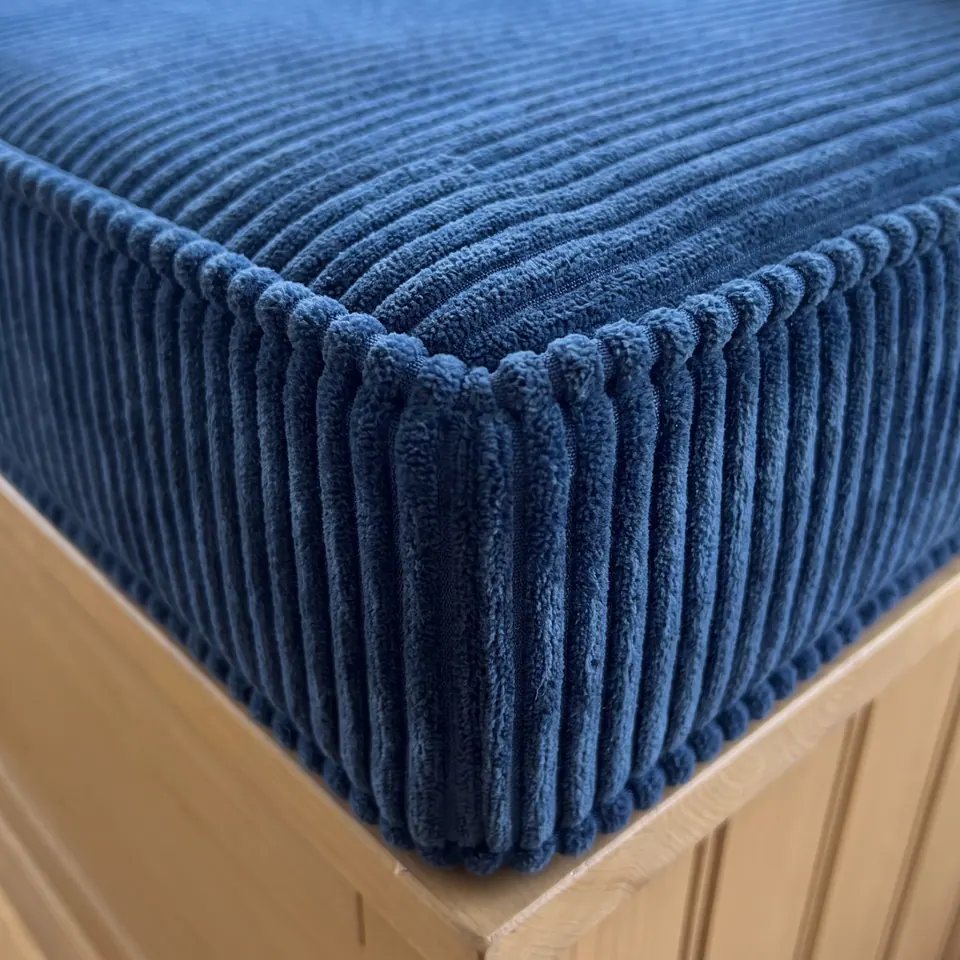
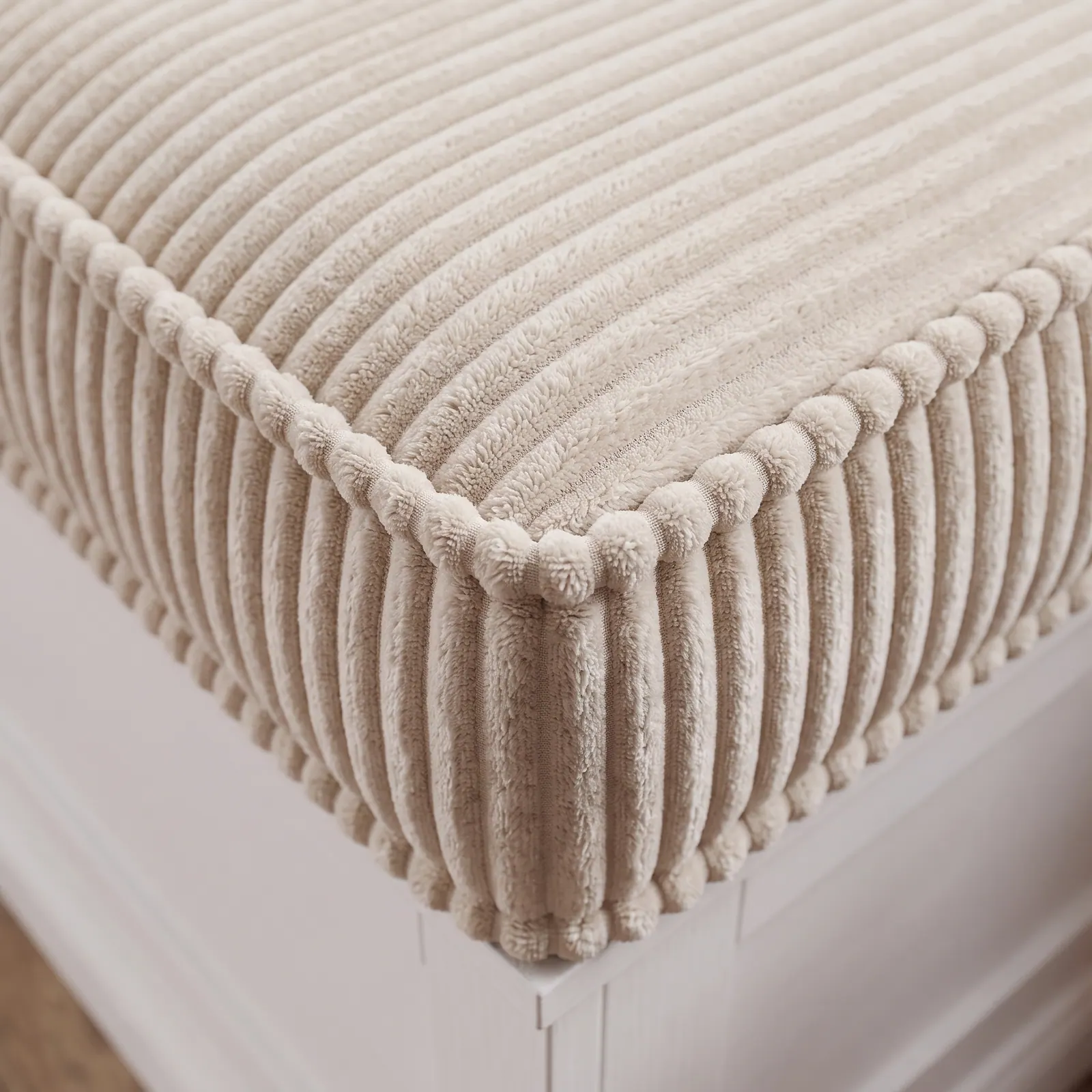
Cream corduroy window seat cushion, read from the corner out
Rosa gets down to eye level with one corner of a cream corduroy seat and explains why a ribbed fabric counts as a stripe once you start adding pillows.
Up close, the wide wales and corduroy-covered piping show why this fabric feels plush without any tufting.
The quick answer
Jumbo-wale corduroy behaves like a quiet stripe, so on a window seat cushion treat it as your pattern, not your plain. Here the wales run lengthwise on top and upright on the boxing, meeting self piping at right angles. Pair it with one clearly finer stripe pillow and one smooth plain, and keep all three in a cream-to-oat family.
A corner tells you more than a room shot
The most honest photograph of a cushion I've seen this year shows no room at all. Just one corner of a cream corduroy window seat cushion, resting on a white painted chest, square as a church pew.
Look where the three parts meet. On the top panel the jumbo wales run the long way. On the boxing band they stand straight up. So every rib meets the self piping at a right angle, and the corner doesn't twist. The cord is covered in the same corduroy, which gives the edge a soft, beaded outline instead of a hard pencil line.
Here's the part that matters when you start adding pillows. Those wales are a stripe. A tone-on-tone stripe made of shadow instead of dye, but a stripe all the same. Set a ticking pillow on this seat and you've got two stripes talking at once, and one of them has to lead.
On my grandmother's porch every chair wore a different cushion, and somehow it worked. It took me years to see why: scale. A wide stripe sat beside a small check, never beside another wide stripe. Corduroy follows the same porch rule, neighbor. With jumbo wales, pick a stripe pillow that's clearly finer, like a narrow ticking stripe, then add one plain with no texture at all, so the eye has somewhere to rest.
Keep the colors in one family: cream, oat and one darker note is plenty. The corduroy wale and nap Pattern explains which way ribs should run, and the whole corduroy family waits in the Swatch Library. What's already sitting on your window seat? Start there, and let it pick the leader.
Jumbo corduroy on a window seat is already a stripe: pair it with one finer ticking pillow and one flat plain, never a second wide stripe.
Rosa
Pinned by Rosa: four marks on one corner
Four pins on one corner: the piping, the wales on top, the ribs on the band and the chest edge below.
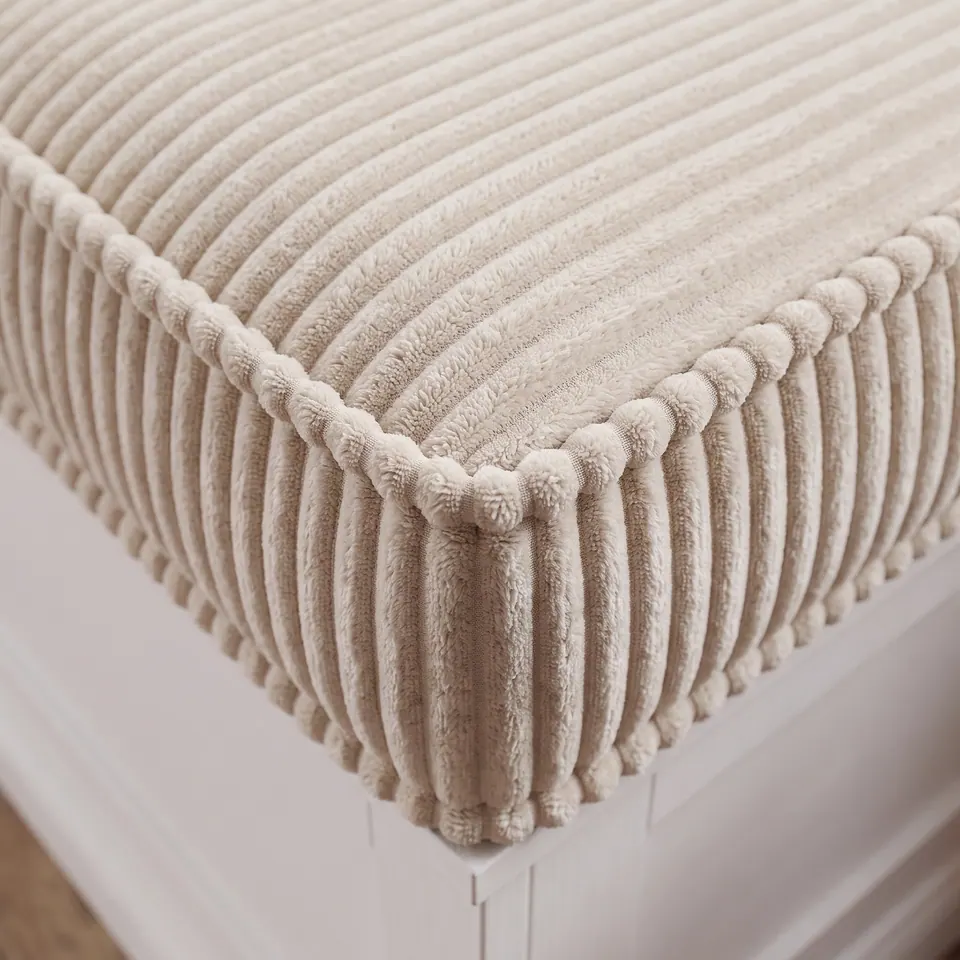
- Self piping at the corner
Corduroy-covered cord gives a beaded, soft outline instead of a hard line.
- Wide wales on top
Jumbo ribs on the top panel run lengthwise for a plush, even surface.
- Vertical ribs on band
Ribs on the boxing stand upright, meeting the piping at a right angle.
- Chest edge
The cushion sits square on the lid with no sagging at the corner.
- Self piping at the cornerCorduroy-covered cord gives a beaded, soft outline instead of a hard line.
- Wide wales on topJumbo ribs on the top panel run lengthwise for a plush, even surface.
- Vertical ribs on bandRibs on the boxing stand upright, meeting the piping at a right angle.
- Chest edgeThe cushion sits square on the lid with no sagging at the corner.
Stripe, wale or plain: who leads on a cream seat
| Piece | What it brings | How to pair it with jumbo corduroy |
|---|---|---|
| Jumbo corduroy seat | Texture that reads as a soft stripe | Wales lengthwise on top, upright on the band |
| Ticking or pinstripe pillow | A crisp printed line | Choose a stripe clearly finer than the wale, never the same width |
| Smooth plain pillow | A resting place for the eye | One flat weave in cream or oat |
| Knit or boucle throw | A third texture | Only if the stripe pillow is small; three busy surfaces make a crowd |
One angled window seat, two quotes
A buyer wrote to the workshop wanting a single corduroy cushion to fill a mostly square window seat whose sides angled outward. The workshop asked for a drawing and got most of it: 47 1/4 in (120 cm) on sides A and B. Side D was missing, so the workshop asked, and it came back at 25 in (63.5 cm).
The full angled shape came in over budget. So the buyer asked about a plain rectangle, 47 1/4 x 25 in (120 x 63.5 cm), and that priced at roughly half.
I pass that lesson along on every porch I visit: an angled cushion can cost about twice a rectangle. Price both before you commit to filling every last inch. The trapezoid cushion calculator sketches the shape for you, and more straight-sided seats live under window seat cushions and living room cushions.
Buyer questions: notches, little kids and backrests
- A common question
My window seat has little notches at each end. How do I send the measurements?
The workshop's answerDraw the cushion shape on paper and measure every edge, including each notch's width, depth and position along the edge. The workshop then draws its own diagram for you to confirm before cutting, thickness included. One seat came back as 87 in (221 cm) along the window, 84 1/2 in (215 cm) on the opposite edge, 1 1/4 x 2 in (3 x 5 cm) notches at both ends, and the depth dropping to 16 in (41 cm) at the ends.
- A common question
We have messy little kids. Which fabric is easiest to keep clean?
The workshop's answerFor wipe-clean bench cushions there's a faux (vegan) leather chart, and there are easy-care washable fabrics in light tones. One family with a kitchen bench chose a light beige linen-look that machine-washes at 86°F (30°C) or lower, after the workshop sent close-up photos and videos of the swatches so they could compare tones.
- A common question
Can a backrest stay under 15 inches tall, or run 63 inches long?
The workshop's answerYes. Backrests 14 to 15 in (36 to 38 cm) high are no problem; write the height in the personalization box. A 63 in (160 cm) backrest can be made in one piece or split to match the seat cushion lengths, and a 3 in (7.5 cm) back over a 2 in (5 cm) seat is fine.
On the cutting table: the cream corduroy corner
| Cushion | Box-edge window seat cushion |
|---|---|
| Fabric | Jumbo-wale corduroy in cream |
| Wale direction | Lengthwise on the top panel, upright on the boxing band |
| Piping | Self piping, cord covered in the same corduroy |
| Corner | Square, no twist where top, band and piping meet |
| Base | White painted paneled chest |
| Mixing partners | One finer stripe pillow and one smooth plain |
| Best for | Window seats and chest tops in a living room |

Have it made
Have this made — ask Rosa’s workshop
Every good cushion I know started with a long porch chat. This is the short version: leave your number and the workshop will call. — Rosa
Leave your details and the workshop will call you to confirm measurements, fabric, foam and piping. No prices, dates or payment on this page: it is a request, not an order.
Questions buyers ask next
Which way should corduroy wales run on a window seat cushion?
Lengthwise on the top panel and upright on the boxing band is the neat choice, as in this photo. Every rib then meets the piping at a right angle and the corner stays square. Ask the workshop to confirm the wale direction on your order.
Can a ticking stripe pillow sit on a corduroy seat?
Yes, as long as the scales differ. Jumbo wales already read as a soft stripe, so choose a ticking or pinstripe that is clearly finer, then add one flat plain pillow so the eye has a place to rest between the two lines.
Is an angled window seat cushion much pricier than a rectangle?
It can be. In one real quote the full angled shape came to about twice the price of a plain rectangle for the same seat. Price both versions, then decide whether filling the last few angled inches is worth the difference.
Porch light's on — Rosa