CushionGuide

A Reading by HanaModular Floor Sofas & Teddy Couches

Measuring a cream and dusty rose velvet floor sofa, piece by piece

Four pieces of foam, two colors of velvet, one sunny corner. Most floor sofa measuring goes wrong by treating it as one object.

The quick answer

To measure a modular floor sofa, measure each piece rather than the wall: the base length and depth, each backrest's height and length, and the bolster against the base depth. This cream and dusty rose velvet sofa is four pieces, a long base, two upright backrests and a short bolster, so it needs four sets of labeled numbers.
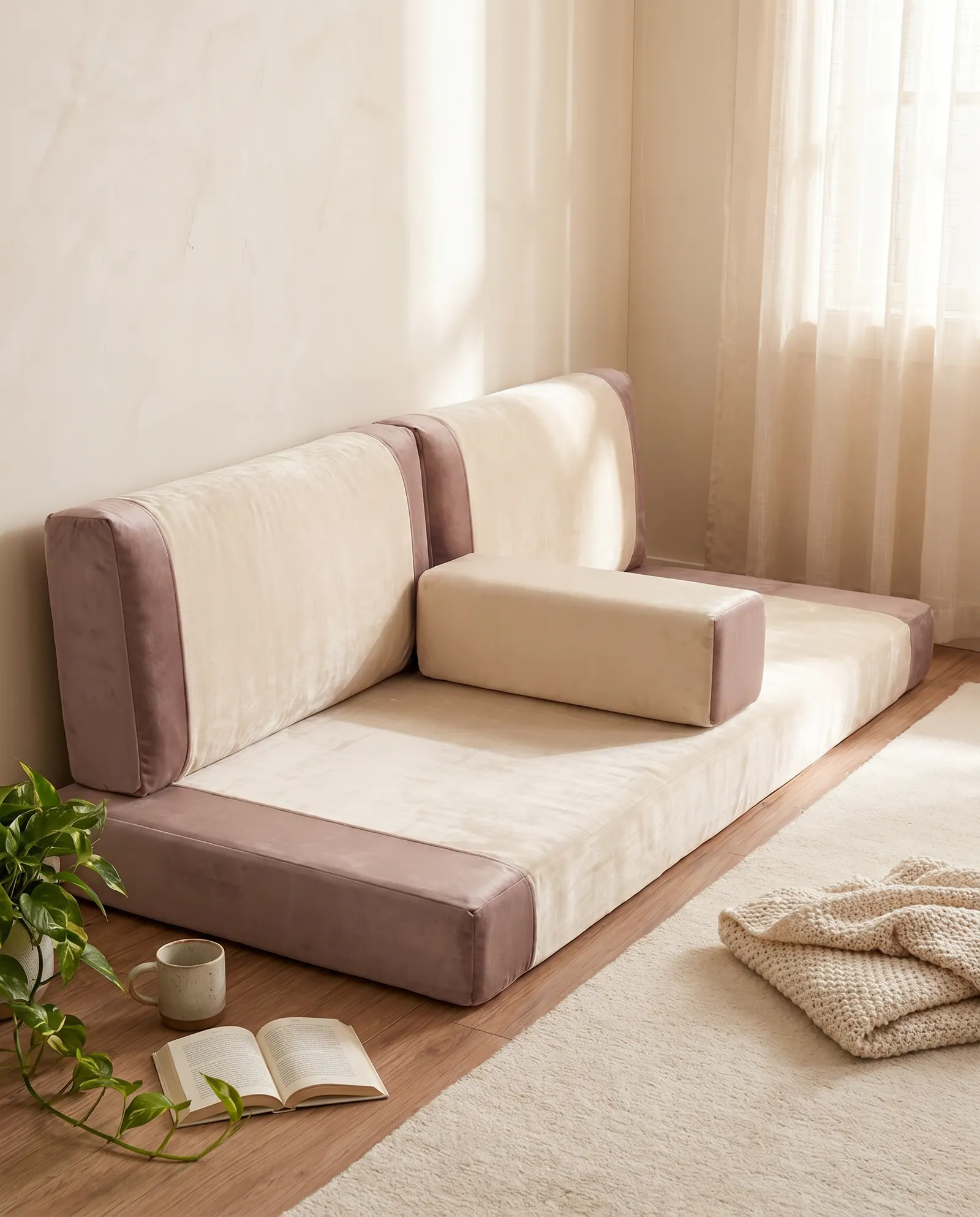
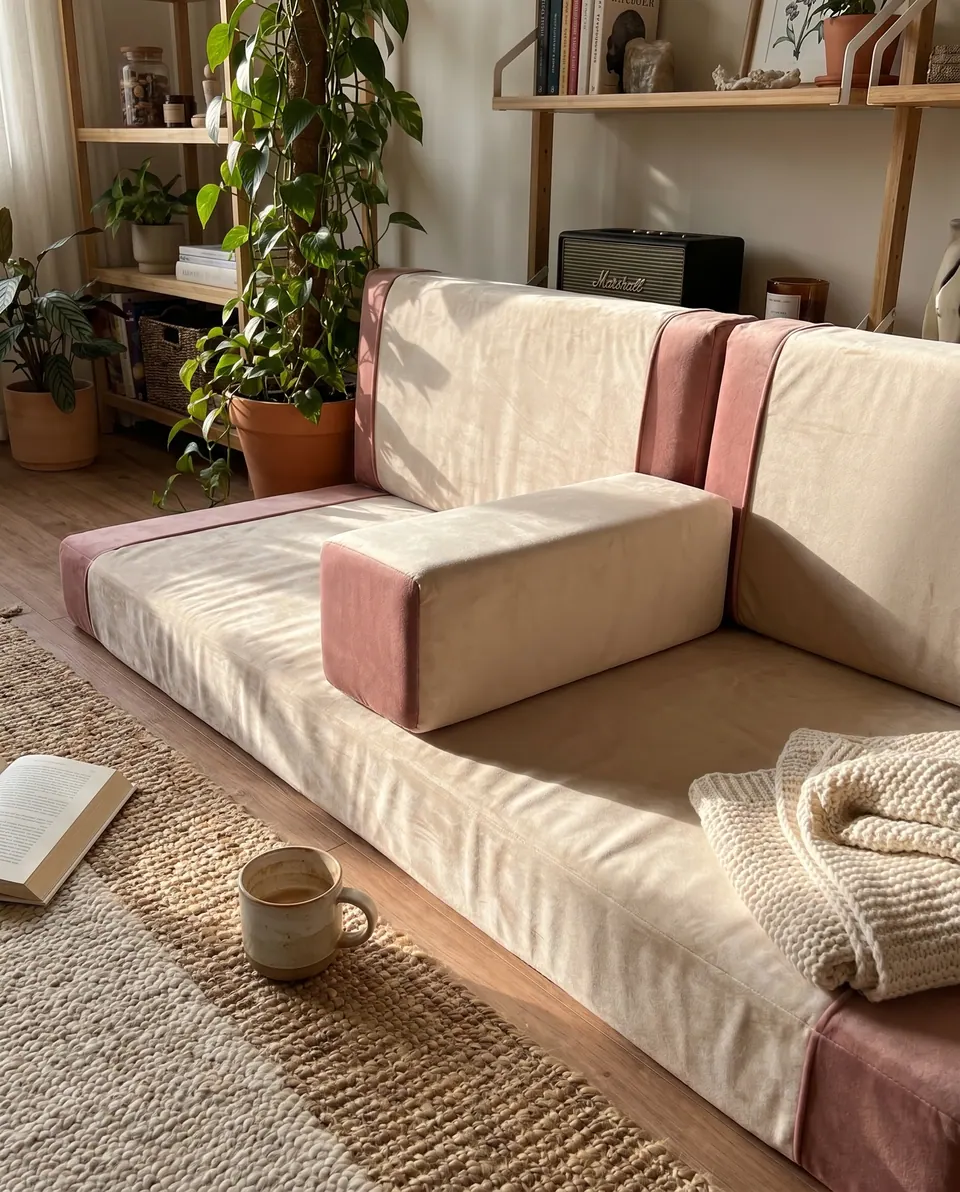
Low cream velvet floor sofa with dusty rose end panels, two backrests and a bolster arm on oak floor by sheer curtainsSave
A floor sofa built from a base cushion, two backrests and a bolster, color-blocked in cream and dusty rose velvet.

Four pieces of foam, one low line

This sofa is four pieces of foam. A long base. Two upright backrests. A short bolster laid across one end as an arm.

Each piece is cream velvet in the middle and dusty rose at the ends. The rose goes where hands and heels land. At floor level the end blocks take the knocks, so the darker color sits there. The cream center keeps the whole modular floor sofa light against a warm plaster wall.

Nothing in the corner rises above the seat. The trailing pothos, the open paperback, the ceramic mug and the chunky cream knit all stay on the floor. The eye settles low, where the sitting happens.

Late sun comes through sheer linen. The rose in the velvet repeats that warmth, and that is the idea worth copying: let the end color appear once more in the room.

What will your floor sofa sit against: a wall, a window, or open floor?

Pinned by Hana in the sunny corner

Five marks on the photograph, from the color-blocked backrest to the book on the floor.
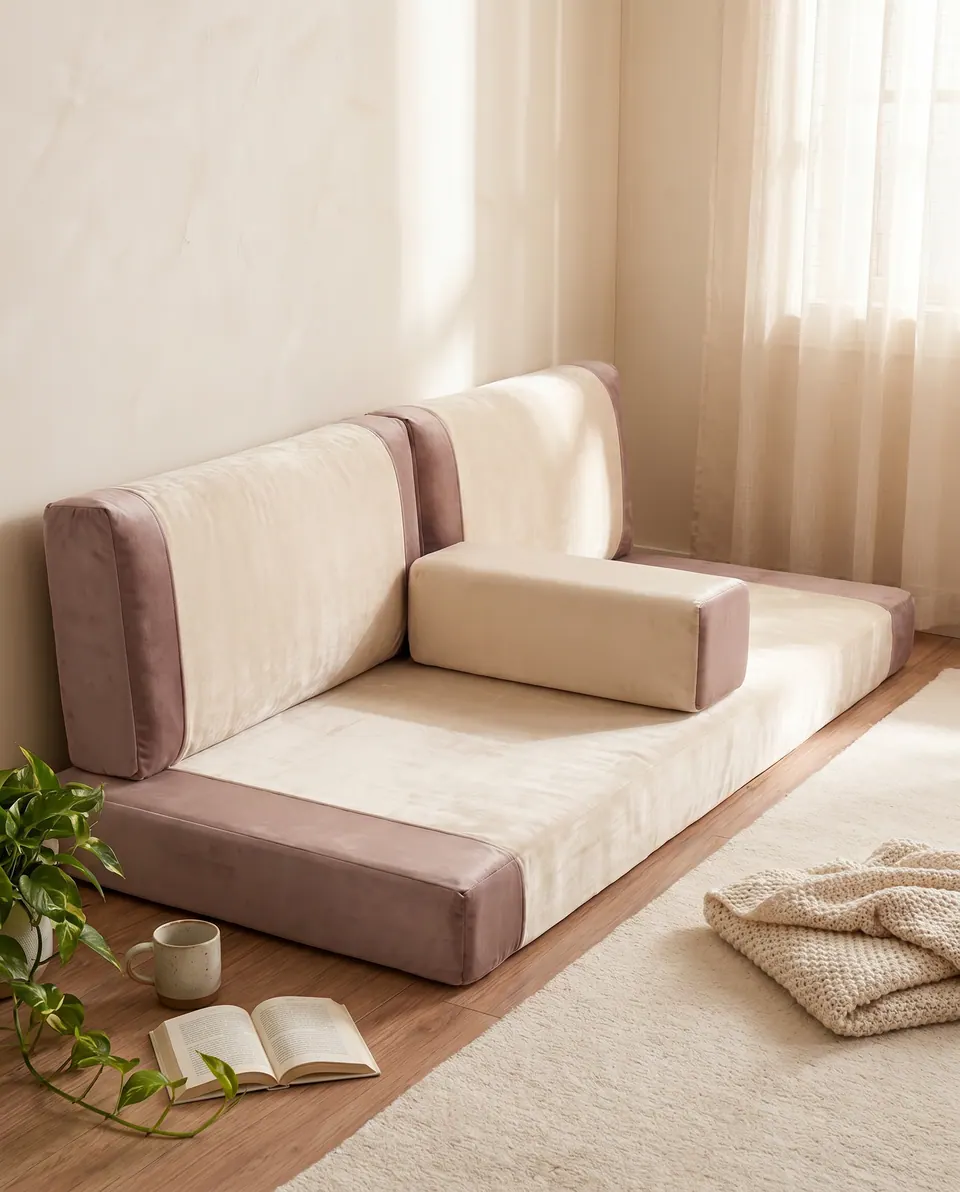
Pinned: Low cream velvet floor sofa with dusty rose end panels, two backrests and a bolster arm on oak floor by sheer curtains
  1. Color-blocked backrest

    Rose side panels on a cream center hide the edges hands touch most.

  2. Bolster armrest

    A short bolster laid across the base doubles as an arm and a lumbar rest.

  3. Dusty rose base end

    The end blocks take the knocks at floor level, so the darker color goes there.

  4. Chunky knit throw

    A heavy knit adds texture next to the smooth velvet.

  5. Book and mug

    Props kept on the floor keep the eye at the sofa's low height.

  1. Color-blocked backrestRose side panels on a cream center hide the edges hands touch most.
  2. Bolster armrestA short bolster laid across the base doubles as an arm and a lumbar rest.
  3. Dusty rose base endThe end blocks take the knocks at floor level, so the darker color goes there.
  4. Chunky knit throwA heavy knit adds texture next to the smooth velvet.
  5. Book and mugProps kept on the floor keep the eye at the sofa's low height.

What to measure, and where it goes wrong

  1. Start at the floor

    Measure the wall or window the sofa will sit against, then mark what must stay clear: a door swing, a radiator, a floor vent. Where it goes wrong: expecting a hole cut for a vent. The workshop makes the seat in pieces around it instead.

  2. Measure the base

    Length along the wall, depth front to back, thickness last. Where it goes wrong: sending two bare numbers. Label each one so nobody has to guess which is the depth.

  3. Measure each backrest

    Height and length for each one. On the floor-couch style, backrests run 4 to 5 in (10 to 13 cm) thick. Where it goes wrong: sizing backrests to the wall. Two backrests side by side should add up to the base length.

  4. Size the bolster to the base

    Laid across the base as an arm, the bolster's length follows the base depth. Where it goes wrong: ordering it long, so it pokes past the front edge.

  5. Mark the color split

    Note where the second velvet starts on every piece. Here the dusty rose sits on the backrest sides and the base ends, where hands and heels land.

A real project

The teddy sofa with extras, and the one quote that sorted it

A buyer wanted a two-seater teddy floor sofa in corduroy, plus the square ottoman, two extra metal frames and a corner back cushion. Before checkout they asked for the total.

The workshop quoted the whole set as one figure. Then it split the order the sensible way: the sofa with its ottoman from the main listing, and the corner backrest through a separate backrest-only link.

Add-ons are where floor sofa orders drift. A backrest here, a support bar there, and nobody holds the full list. Ask for one combined quote before any of it goes in the cart. More on straight, L and U layouts if your set is growing.

Sizes
Two-seater with square ottoman, two extra frames, one corner backrest

The lesson: Ask for a combined quote when adding backrests and bars to a modular set.

Floor sofa questions

  1. A common question

    Can I buy extra or replacement pieces for my floor couch?

    The workshop's answer

    Yes. Pieces are sold separately: an extra straight backrest, an L-shaped backrest, a single cushion, or a covers-only set for the whole sofa. Ask for a quote on the exact pieces you need.

  2. A common question

    Is your linen 100% linen?

    The workshop's answer

    No. The workshop describes its linen fabric as 100% cotton sold under the linen name, and there are several linen types to choose from.

  3. A common question

    Can you cut holes in a floor mat for the vents in my floor?

    The workshop's answer

    No, cut-outs for small round floor vents can't be made. The workaround is to make the mat in pieces, for example an L-shaped cushion plus a separate piece between the vents, so the vents stay uncovered.

A modular floor sofa is measured piece by piece, not wall by wall: two backrests side by side should add up to the base length.

Hana

On the cutting table

CushionModular floor sofa in four pieces
PiecesLong base, two upright backrests, one short bolster as an arm
FabricVelvet in two colors: cream centers, dusty rose ends (codes T301, T307)
EdgeBox edge, no piping
Color-blockingDarker ends where hands and heels land
RoomSunlit cream plaster corner, sheer linen curtains, warm oak floor
PropsPothos, paperback, mug and chunky knit throw, all at floor level
Best forLiving rooms with low, quiet corners

Order this cushion

Have it made

Have this made — ask Hana’s workshop

A good size is a quiet thing. You notice it only when it is wrong. Let the workshop check yours first. — Hana

Leave your details and the workshop will call you to confirm measurements, fabric, foam and piping. No prices, dates or payment on this page: it is a request, not an order.

Fabric · Foam · Pipingwhat the workshop will confirm with you

Fabric
Velvet in two colors: cream centers, dusty rose ends (codes T301, T307)
Foam
The core: its density and thickness set the feel.
Piping
No piping
Only for this request: no marketing calls or texts. Outside the US, add the country code.
In inches: length × depth × thickness, plus any angles or cut corners.

* Required. A member of the workshop team will call you to talk it through; nothing is charged and nothing is made until you have agreed on every detail with them.

We use these details only to answer this request and make your cushion: your name and contact details, the cushion details and photos you send, the page you came from and the ad or link that brought you, if any. The workshop that makes the cushions receives them. We don't sell them or share them for advertising, and we delete requests after 24 months. Privacy notice for requests.

Nothing is made or charged until you approve the details.

Want to pick the shape and add photos? Use the full quote form

Questions buyers ask next

How long should a bolster armrest be on a floor sofa base?

When the bolster lies across the base as an arm, measure it against the base depth, front to back. A bolster longer than the base is deep pokes past the front edge; one much shorter leaves a gap behind it.

Why color-block the ends of a velvet floor sofa?

Velvet shows handling. Putting the darker color, here dusty rose, on the ends and side panels hides the edges hands and heels touch most, while a cream center keeps a low sofa from looking heavy in a small room.

Should styling props stay on the floor next to a floor sofa?

Keeping the book, mug, plant and throw at floor level holds the eye at the sofa's height. A tall lamp or side table beside a low seat pulls attention upward and makes the sofa look smaller than it is.

— Hana