A Reading by ÉlodieBench Cushions
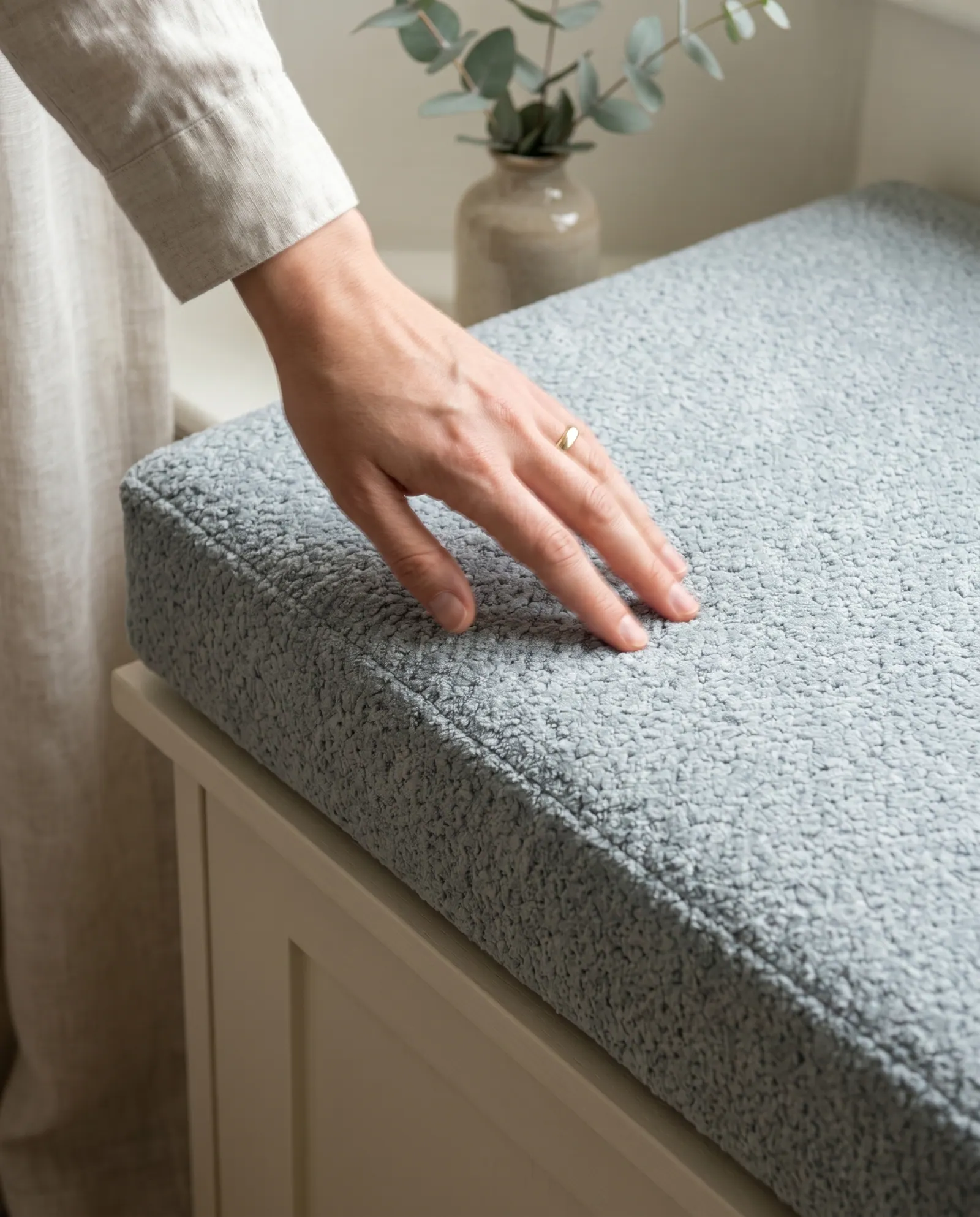
The edge of a blue-gray bouclé bench cushion, read under a pressing hand
One hand, four fingers, the front third of a cushion. It is the best photograph I know for explaining what an edge is for.

 Save
The quick answer
Choose a box edge for a bench cushion that must stay square and hold a sitter's weight at the front; a knife edge, with no side band, suits thin pads and throw pillows. On this blue-gray bouclé seat, a box edge with self piping holds its line under a fingertip press, and 3 in (7.5 cm) is the thickness the workshop recommends for benches.
The cushion, cut open
Cover fabric. A removable, zippered cover. Machine wash at 86°F (30°C) on a gentle cycle and air dry.
Piping. A fabric-covered cord sewn into the seams. It sits on the seam line, so it does not change the size.
Fiber wrap. Polyester fiber (Dacron) batting around the foam: it fills the cover out and softens the edges.
Foam core. About 2.0 lb/ft³ (32 kg/m³) high-resilience foam, firm to medium-firm, cut to the ordered size.
Zipper. Along the back band, as hidden as possible. The zipper side faces down or toward the wall.
Base panel. The underside of the cover. A non-slip fabric backing can cover the whole of it instead.
Anatomy of an edge, read from a fingertip
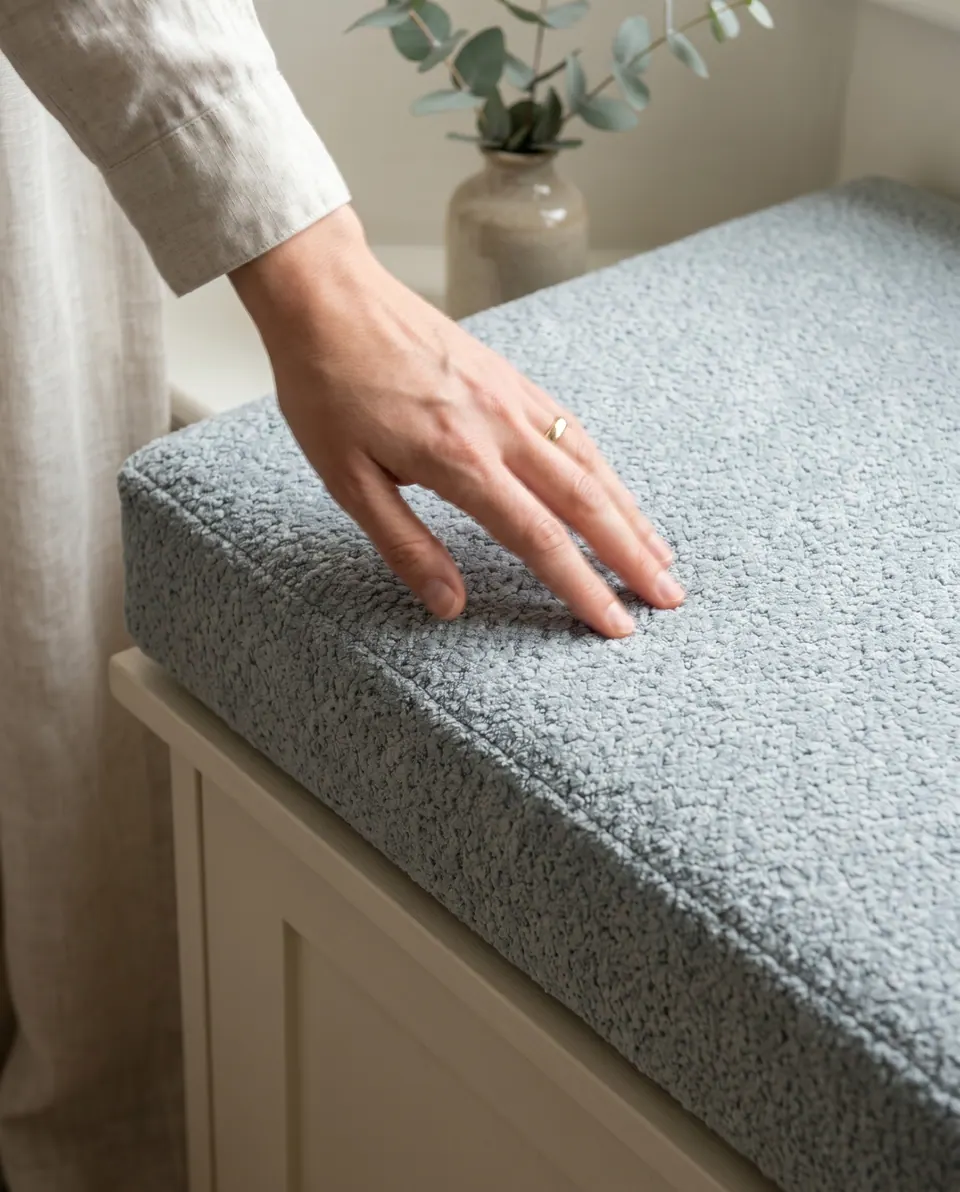
Look where the hand is. The fingers press the front third of the cushion, because that is where everyone lands when they sit, and where buyers worry most: will it sink, or will it hold? Here it holds. The loops of the bouclé give under the fingertips, but the edge beside them stays square.
Read the cushion from the outside in, as you would a cross-section, my friends:
- The cover. Blue-gray bouclé, a looped weave that gives softly under the hand and throws tiny shadows in side light.
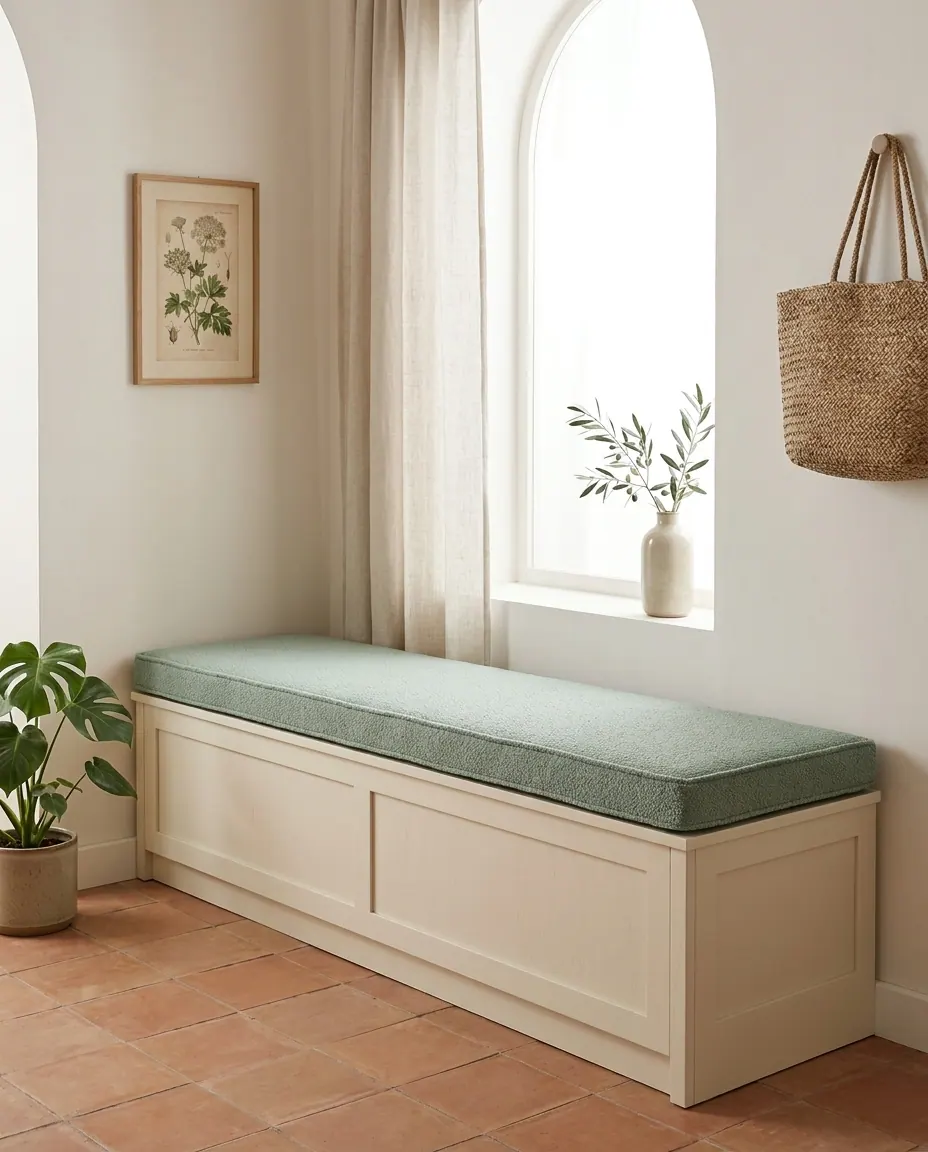
- The piping. Self piping in the same blue-gray runs along the seam. It stiffens the edge and draws the line without drawing attention; a contrast cord would cut a stripe across the cream cabinet.
- The side band. This is what makes a box edge a box. The band, the gusset, sets the thickness and keeps the front upright under weight.
- The core. High-density polyurethane foam, about 2.0 lb/ft³ (32 kg/m³), wrapped in polyester fiber and cut a little larger than its cover so the corners fill out.
The styling is minimal on purpose. Eucalyptus in a stoneware vase repeats the cool gray cast of the loops, and the pale painted bench lets a mid-tone seat read clearly as the seat. Daylight never lies; your screen sometimes does. A foam sample can come with your swatches on request, so press its edge like this, in window light, before you decide.
Pinned by Élodie
Four pins: the press, the seam, the eucalyptus and the painted bench.
- Fingertip press test
This is where people press first when they sit, so the foam has to spring back here before anywhere else.
- Self piping top seam
Blue-gray piping in the body fabric keeps the edge square without drawing a line across the cream cabinet.
- Eucalyptus in stoneware
The gray-green leaves repeat the cool cast of the bouclé so the palette stays quiet.
- Cream panel bench
A pale painted base lets a mid-tone cushion read clearly as the seat.
- Fingertip press testThis is where people press first when they sit, so the foam has to spring back here before anywhere else.
- Self piping top seamBlue-gray piping in the body fabric keeps the edge square without drawing a line across the cream cabinet.
- Eucalyptus in stonewareThe gray-green leaves repeat the cool cast of the bouclé so the palette stays quiet.
- Cream panel benchA pale painted base lets a mid-tone cushion read clearly as the seat.
Four edges, side by side
| Edge | What you see | Where it works |
|---|---|---|
| Box edge | Flat top and bottom joined by a side band; square corners | Bench and window seats that take daily sitting |
| Knife edge | Two panels sewn at the rim; full in the middle, thin at the edge | Throw pillows and thin pads |
| Rounded corners | A box cushion with curved corners or ends | Benches with rounded ends; seats beside a walkway |
| Angled corners | Straight cuts across one or more corners | Clipped seats, bay benches and L-shaped runs |
Three light blues and one small bolster
A buyer got in touch who could not choose between three light blues. On a screen they looked almost alike, so the buyer asked for side-by-side photos of all three. The workshop took them as soon as the team was back in the studio after the weekend, and with the fabrics lying next to each other, the choice was easy.
Then came a small addition I love: a matching end bolster, 17 in (43 cm) long and 5 in (13 cm) in diameter, piped to match the bench cushion. A round shape at the end of a square box is a pleasing contrast of edges, and matching piping makes them one family. See how bench shapes are ordered under bench cushions.
Grip, L-shapes and thickness:
- A common question
Does a non-slip bottom cost extra, and can I still put the cover in the washing machine?
The workshop's answerIt is an add-on, charged per cushion. The older grip backing stopped covers from being machine washed, so the workshop sourced a new washable non-slip material that keeps covers washable at 86°F (30°C). It takes about a week to reach the workshop, which adds a little time to the order.
- A common question
Can you make L-shaped cushions to my own sizes?
The workshop's answerYes. For benches the workshop suggests making the L in two pieces and asks for the bench width. One custom order was two mirror-image L-shaped backrests of 55 x 39 3/8 in (140 x 100 cm), plus two corduroy covers for 78 3/4 x 55 x 11 3/4 in (200 x 140 x 30 cm) mattresses.
- A common question
What thickness do you recommend for a bench or banquette seat, 2 or 3 inches?
The workshop's answerFor an L-shaped bench the workshop recommended 3 in (7.5 cm) over 2 in. Thickness runs from 2 to 5 in (5 to 12.5 cm): 2 in is the minimum, and 5 in is a standard option for deep, lounge-style seats.
On the cutting table
| Cushion in the photo | Box-edge bench cushion on a cream shaker-panel storage bench |
|---|---|
| Fabric | Blue-gray bouclé, a looped weave |
| Edge | Box edge with a side band (gusset) |
| Piping | Self piping on the top and bottom seams |
| Foam | High-density polyurethane, about 2.0 lb/ft³ (32 kg/m³), fiber-wrapped |
| Thickness | 2 to 5 in (5 to 12.5 cm); 3 in (7.5 cm) recommended for benches |
| Shaped corners | Rounded or clipped, on the custom-shape listing from a measured drawing |
| Non-slip base | Optional washable grip bottom; adds about a week |

Have it made
Have this made — ask Élodie’s workshop
A fabric reads one way at noon and another at dusk. Mention your light, and the workshop will weigh it with you. — Élodie
Leave your details and the workshop will call you to confirm measurements, fabric, foam and piping. No prices, dates or payment on this page: it is a request, not an order.
A box-edge bench cushion keeps its front square under weight because the side band sets the thickness; a knife edge has no side band and rounds off.
Élodie
Questions buyers ask next
What is the difference between a box edge and a knife edge?
A box edge has a flat top and bottom joined by a side band, so the cushion keeps its thickness right to the corners. A knife edge joins two panels at the rim, so it is fullest in the middle and thin at the edges.
Can a bench cushion have rounded corners?
Yes. Rounded ends, clipped corners, notches and curves are made on the custom-shape listing. Upload a drawing with every edge measured and a photo of the bench, and the workshop checks it before cutting.
Is self piping or contrast piping better on bouclé?
Either is included at no extra charge. Self piping keeps the edge crisp without adding a line, which suits a narrow bench against pale paint; contrast piping outlines the shape and suits a cushion you want to stand out.
With color and care — Élodie
Bouclé seats in bays, nooks and landings
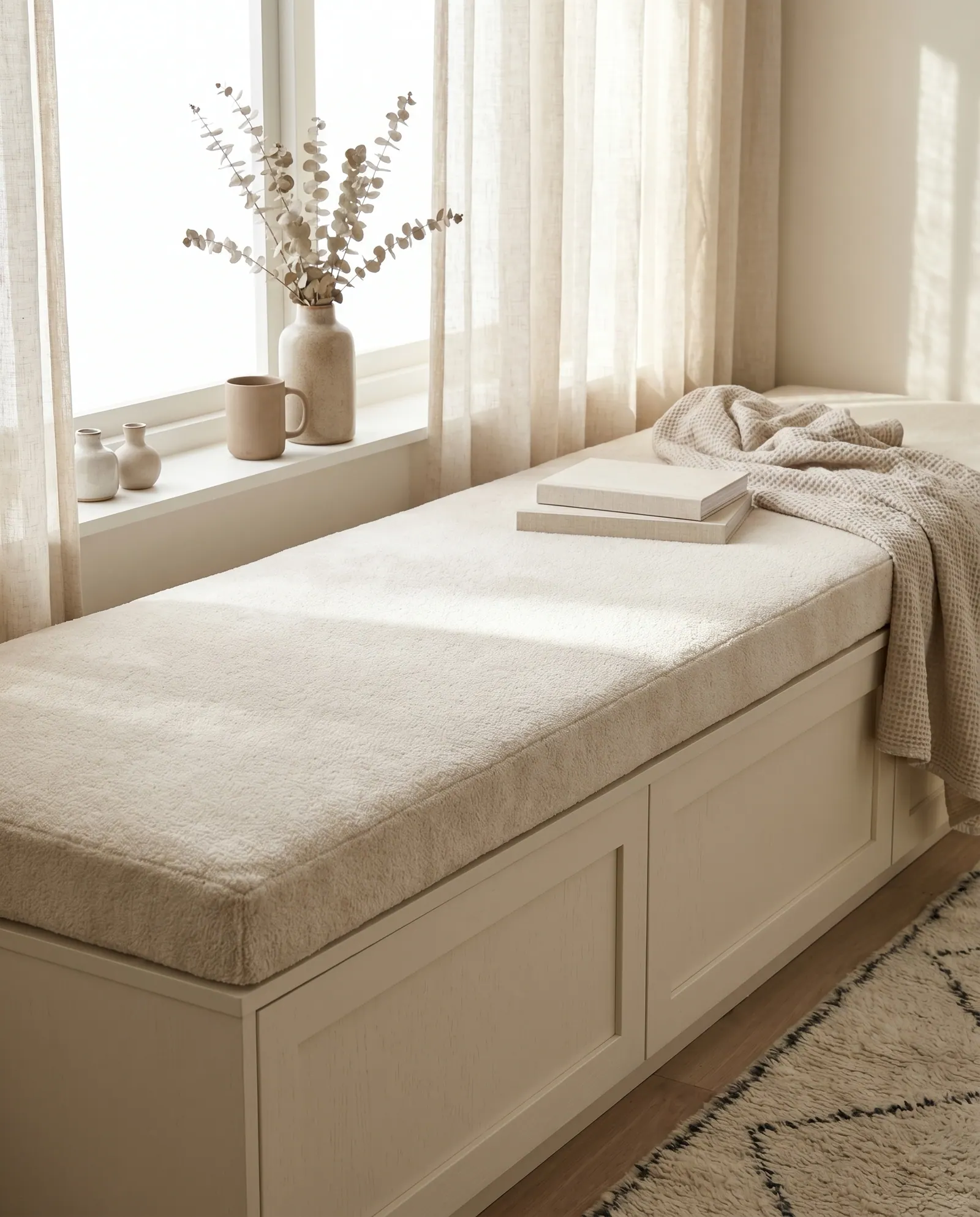 Save
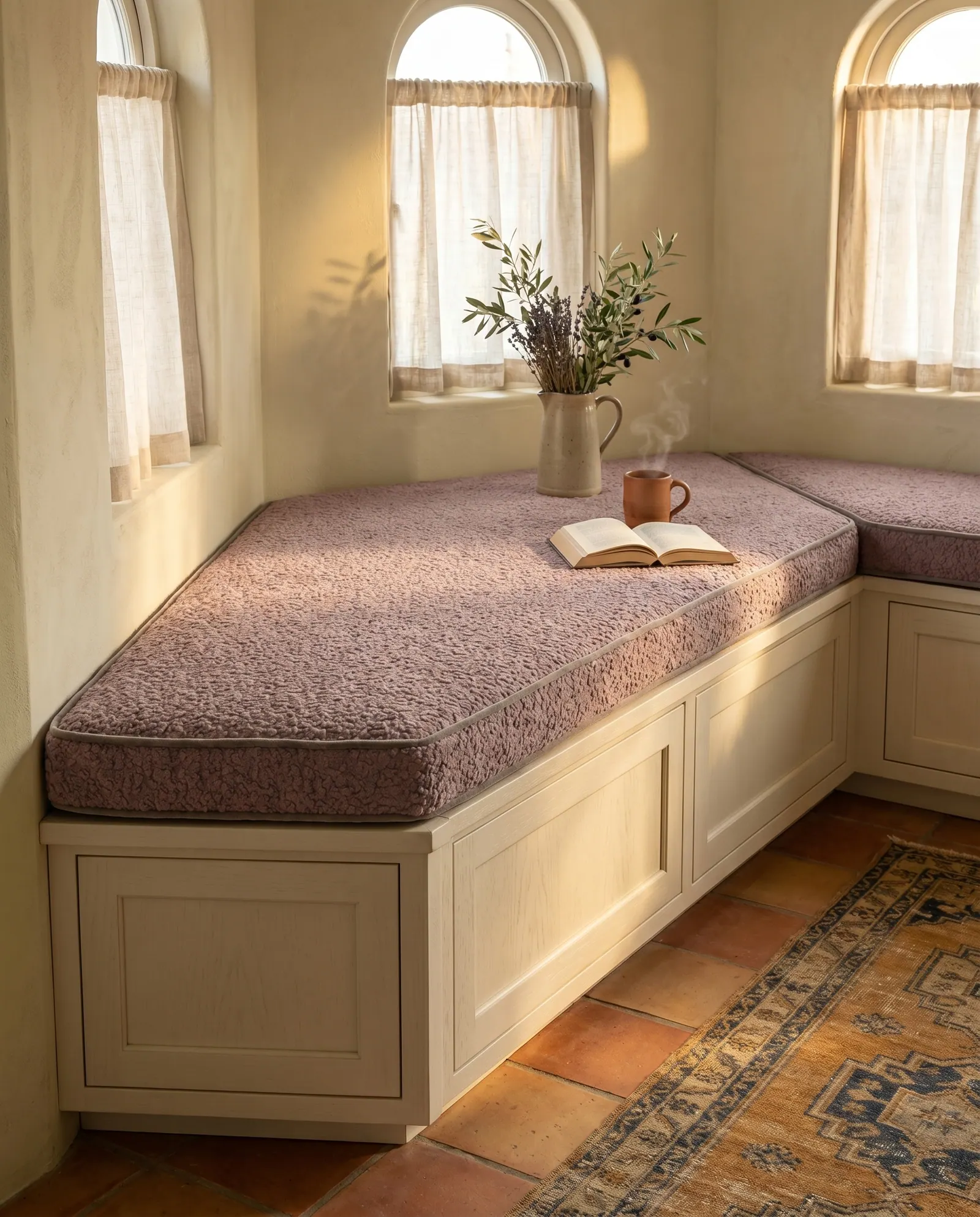 Save
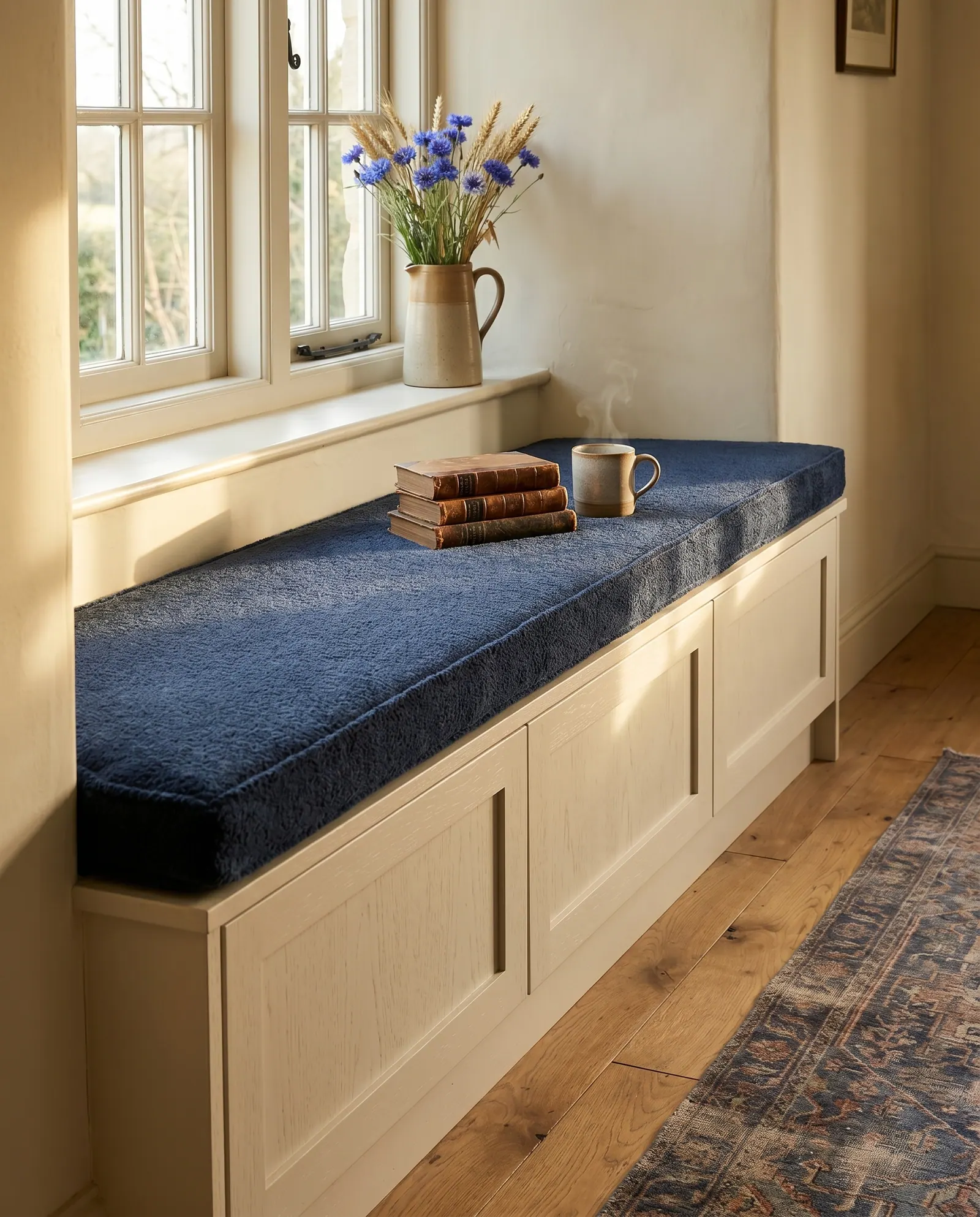 Save
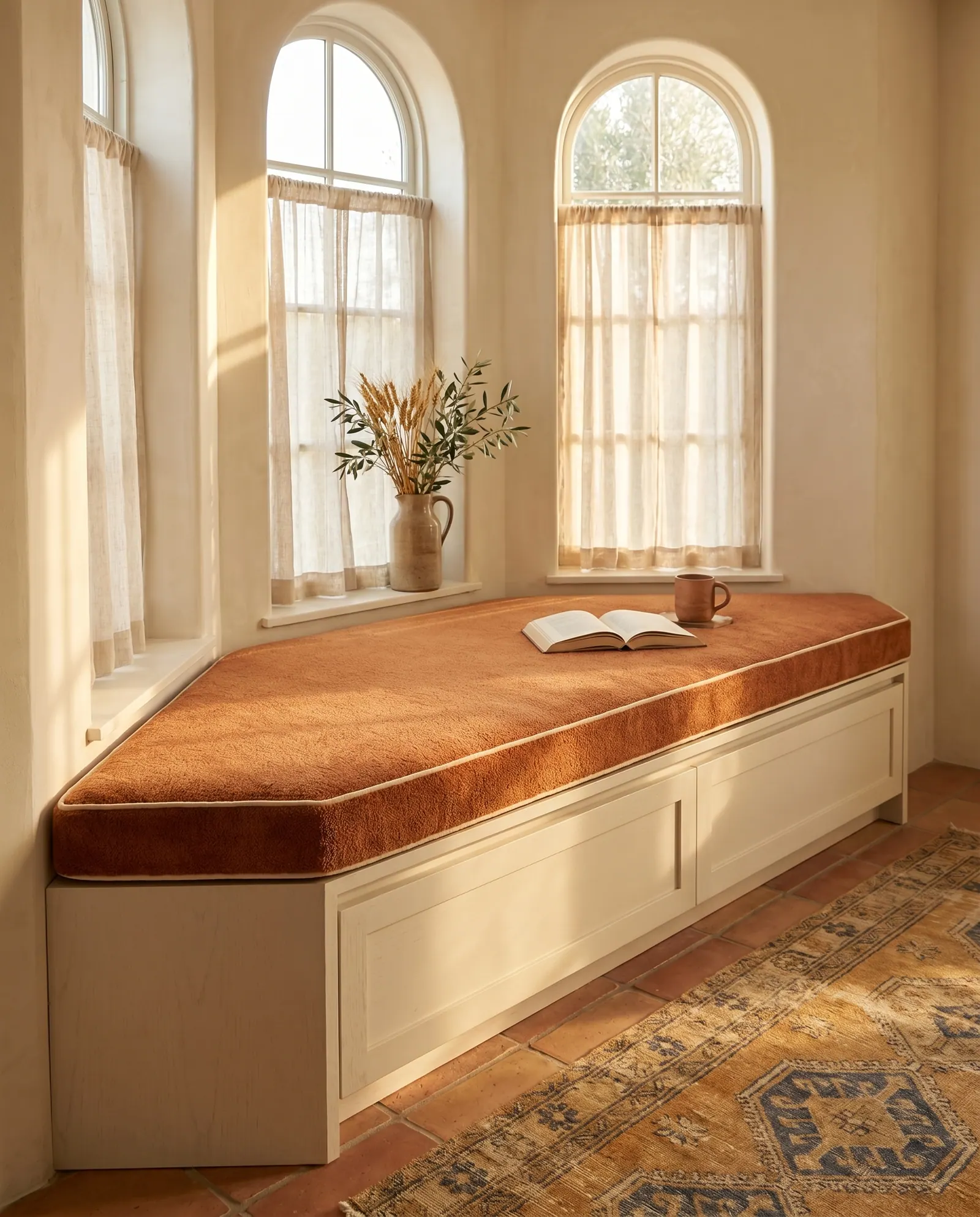 Save
 Save
 Save