 Save
A Reading by MaggieBench Cushions
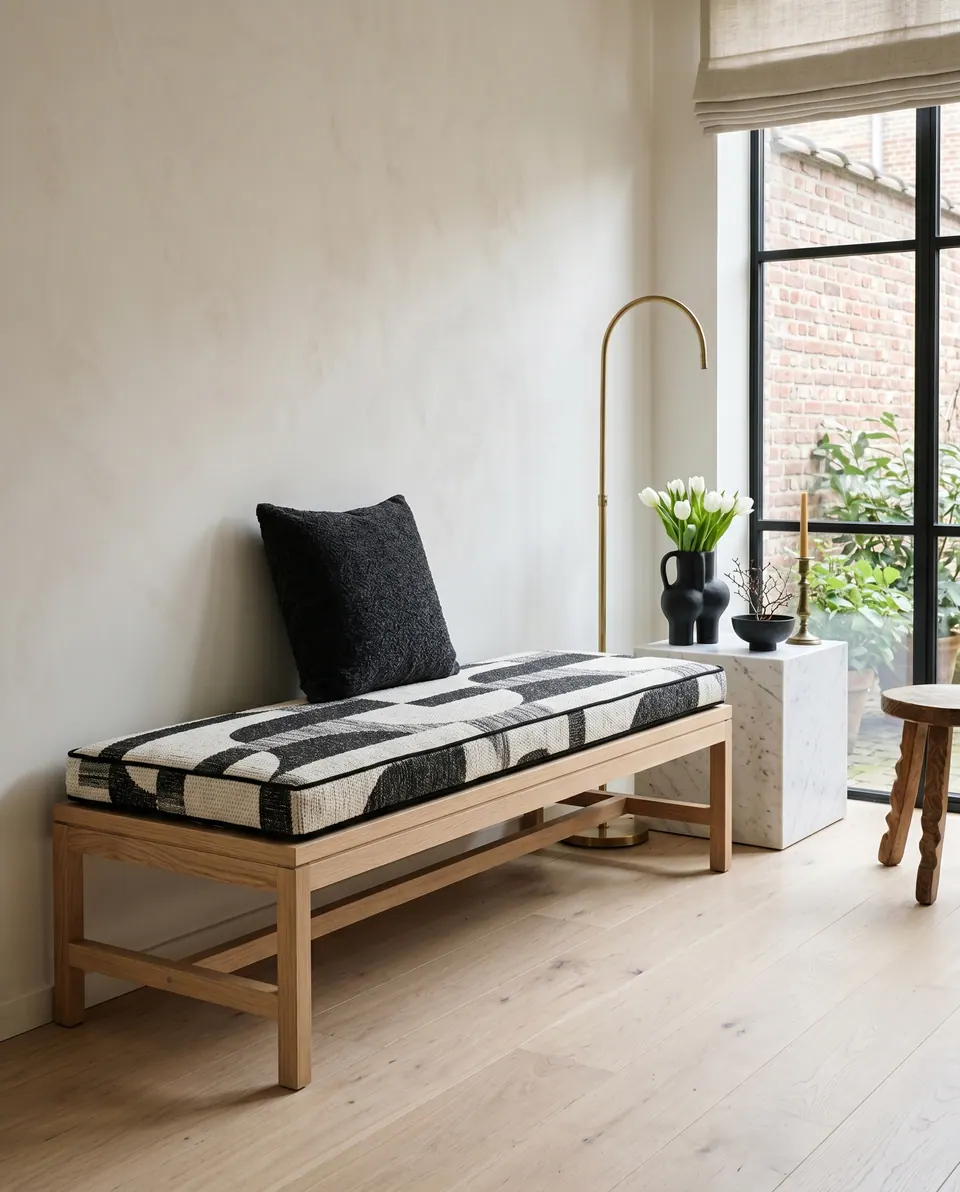
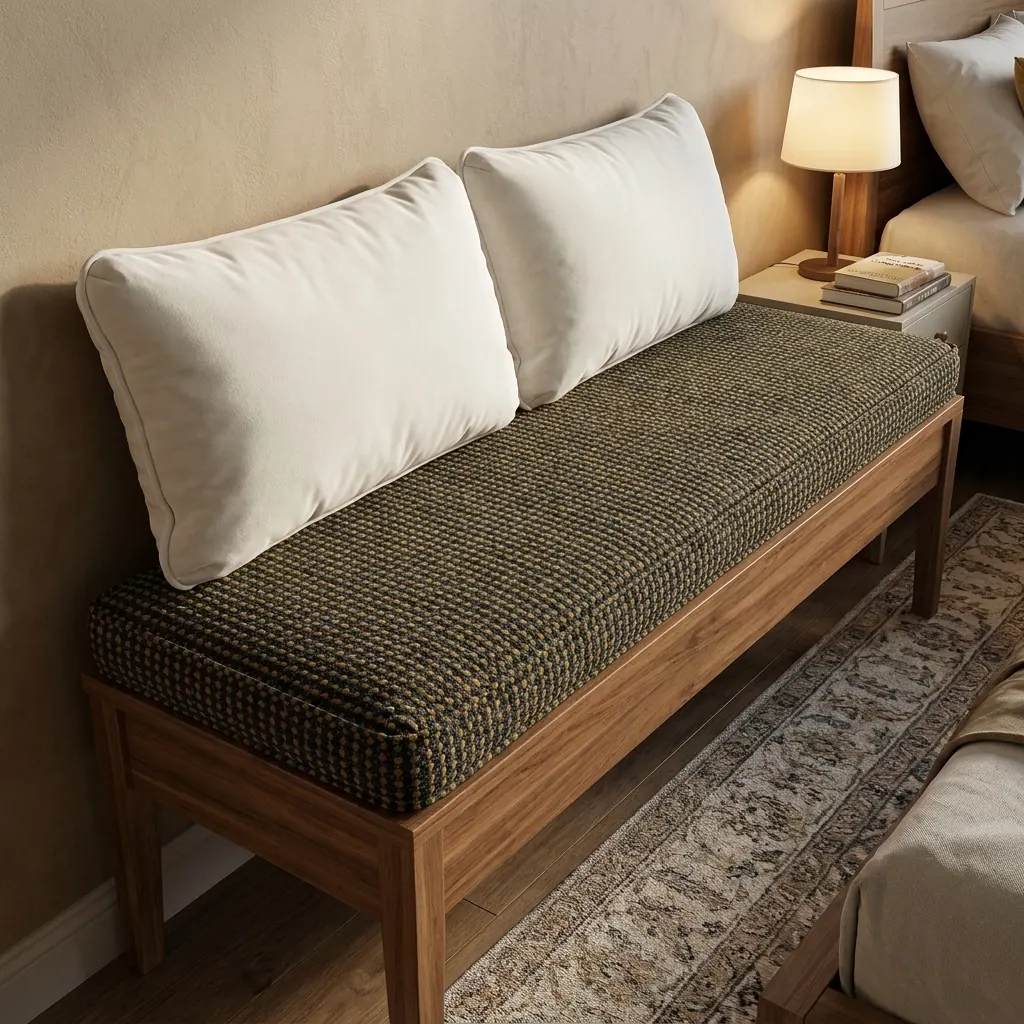
A black and cream block weave bench cushion that makes a narrow settee look generous
The Piping Queen is about to recommend no piping. Write down the date.
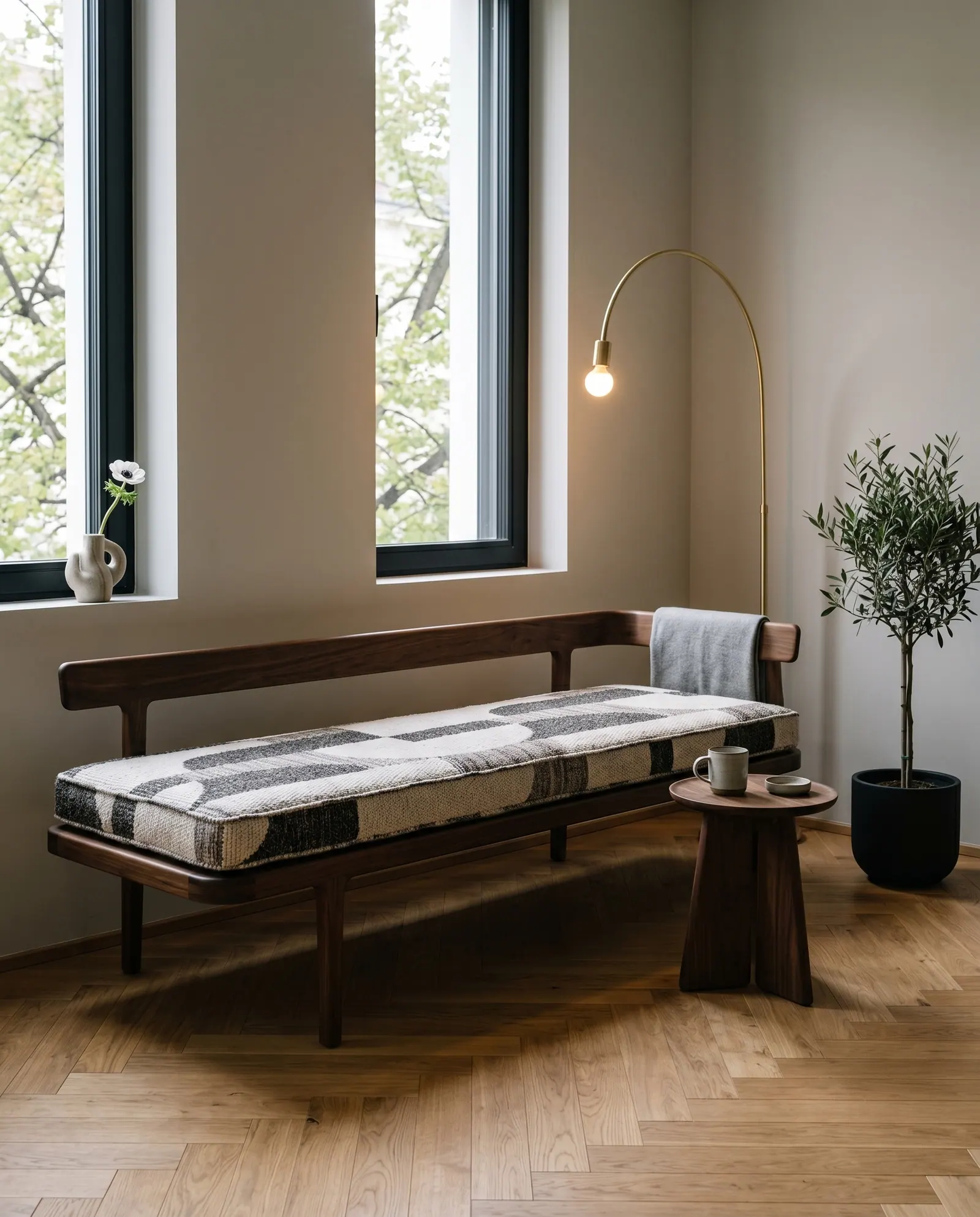
An unpiped block weave wraps round the edge of a walnut loveseat, lit by a single bare-bulb arc lamp.

The quick answer
A custom bench cushion for a narrow settee looks more generous when a bold pattern runs unbroken over the edge, so skip piping on a strong weave. On a dark wood frame, choose a fabric with plenty of cream so the seat doesn't look heavy, and measure the bench top itself, not the floor below, to the exact depth.
Why this narrow settee looks wider than it is
This walnut settee is narrow, its seat is shallow, and the room behind it is mostly window. By rights it should look like a waiting-room bench. It doesn't, and the reason is the edge of the cushion.
There is no piping. The black and cream block weave runs across the top, turns the corner and carries straight down the box edge without a seam line to stop it. The eye reads one continuous woven mat laid on the frame, not a pad with a border. On a small piece, a border is a fence. Take the fence away and the seat looks as deep as it is wide.
I say this as someone who has piped nearly everything that ever sat still long enough. A straight welt is a kind of honesty, and on a plain linen I'd insist on one. But a bold geometric weave already draws its own lines. A welt on top would only outline the smallness.
The second decision is color. Dark walnut, a black pot, a bare bulb: this room is moody by design. A cushion heavy in black would sink into the frame. This weave carries plenty of cream, so the seat glows against the wood, and the late light from the tall windows rakes across the texture.
Pinned by Maggie: five things in the raking light
Five pins, from the unpiped block weave on the seat to the olive tree in its black pot at the far end.
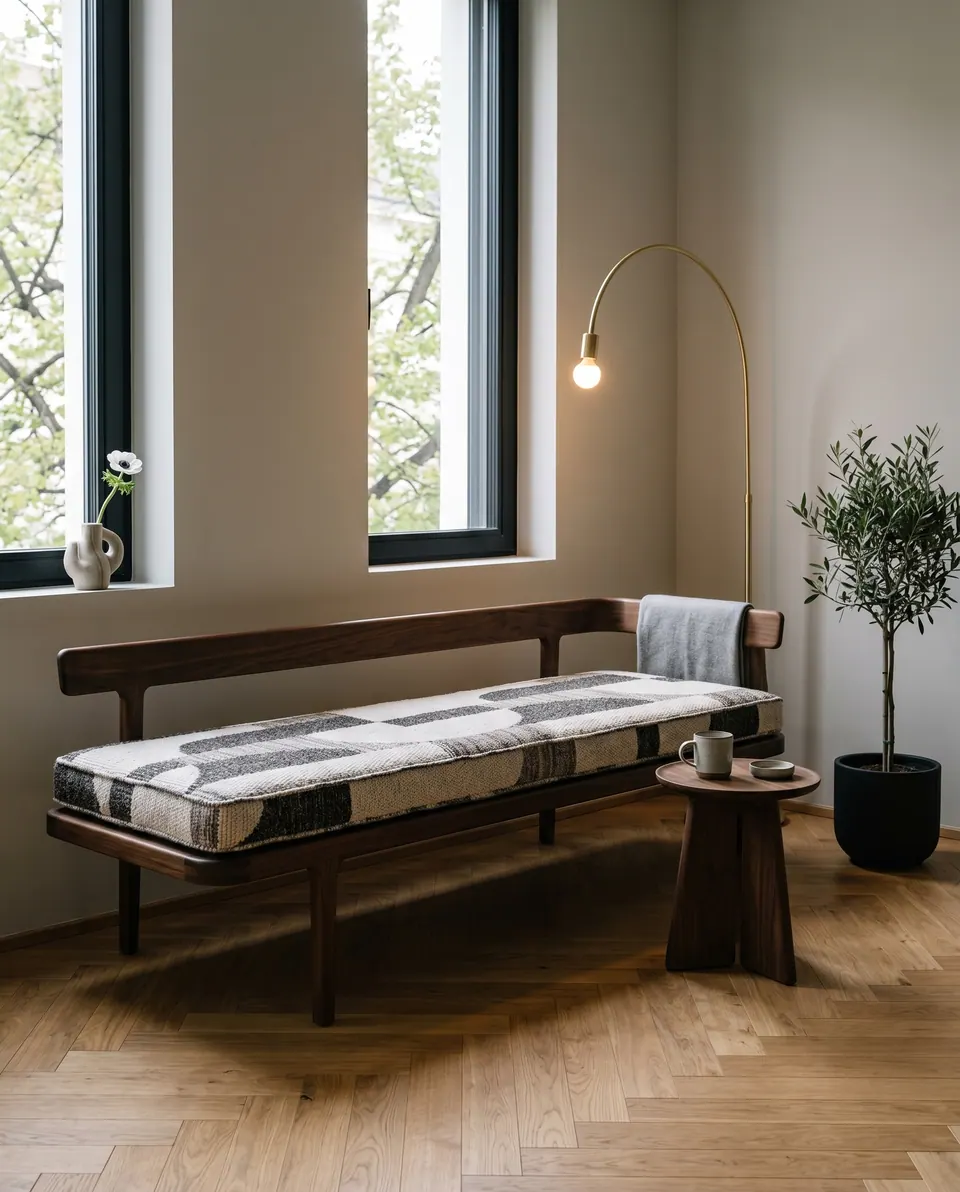
- Unpiped block weave
Without piping the pattern wraps the edge unbroken, like a woven mat on the frame.
- Walnut backrest
Dark wood makes the cream in the weave glow; a darker cushion would look heavy here.
- Bare-bulb arc lamp
A single bulb on a brass arm adds warm light without covering the window.
- Walnut side table
A round table in the same walnut keeps the vignette to one wood tone.
- Olive in black pot
The black pot repeats the black of the pattern at the far end.
- Unpiped block weaveWithout piping the pattern wraps the edge unbroken, like a woven mat on the frame.
- Walnut backrestDark wood makes the cream in the weave glow; a darker cushion would look heavy here.
- Bare-bulb arc lampA single bulb on a brass arm adds warm light without covering the window.
- Walnut side tableA round table in the same walnut keeps the vignette to one wood tone.
- Olive in black potThe black pot repeats the black of the pattern at the far end.
Small-space tricks you can lift from the photograph
Everything else in the vignette follows the same rule: fewer interruptions.
- One wood tone. The round pedestal side table is the same walnut as the settee, so the eye doesn't stop at a second finish.
- Light from above, not beside. A bare bulb on a brass arc arm lights the seat without a lamp base eating floor or blocking the window.
- Black repeated, not added. The black pot at the far end echoes the black in the weave, so the color looks planned.
- Softness on the hard part. The gray throw goes over the walnut backrest, not the seat, softening the darkest surface in the room.
- One flower, one tree. A white anemone on the sill and an olive in the corner. Two living things, no clutter.
If your spot is narrow, which of those could you borrow this weekend? Most cost nothing but rearranging. For the seat itself, start with our bench cushions and browse the jacquard and damask weaves. The piping guide covers when to leave the welt off.
The 16⅛ in slants that couldn't all be right
A buyer sent a sketch of a trapezoid seat: 65 3/8 in (166 cm) along the top, 70 1/4 in (178.5 cm) along the bottom, slanted sides of 16 1/8 in (41 cm) and a straight depth of 17 3/4 in (45 cm).
The shop caught it before cutting. On a trapezoid, a slanted side is always longer than the straight depth, because it crosses the same gap at an angle. So those numbers couldn't all be true. Which one was certain? If the 16 1/8 in slants were right, the depth would be about 16 in (40.5 cm). If the 17 3/4 in depth was right, the slants would be about 17 7/8 in (45.5 cm).
The buyer re-measured: 17 3/4 in deep, 17 7/8 in slants. The order went to production. I once learned the same lesson on a bay seat in a very drafty Colonial, dear, and it was not the cheap way. Measure a slanted edge along the edge itself. Our trapezoid measuring guide walks through it.
On the cutting table: the walnut settee pad
| Product | Custom bench cushion for a settee with a backrest |
|---|---|
| Fabric | Black, cream and gray block weave, code 15 |
| Piping | None, so the pattern wraps the edge |
| Edge | Box edge |
| Frame | Walnut, with a matching walnut side table |
| Color rule | Plenty of cream on dark wood |
| Measuring | Bench top, not floor; depth to the exact figure |
| Best for | Narrow living room settees, window walls, small rooms |

Have it made
Have this made — ask Maggie’s workshop
Have the tape measure handy when they call. Old cushions shrink and sag; the seat underneath does not. — Maggie
Leave your details and the workshop will call you to confirm measurements, fabric, foam and piping. No prices, dates or payment on this page: it is a request, not an order.
Buyer questions: thin cushions, built-in benches, stubborn listings
- A common question
Can you make a very thin cushion, around 2 or 3 inches?
The workshop's answerYes. A windowsill cushion was quoted at exactly 2 in (5 cm) high so the window above could still close. Thinner cushions can also cost less than thicker ones of the same length and depth, which is worth asking about on a long bench.
- A common question
What's the best way to send measurements for a built-in window seat or bench?
The workshop's answerDraw the seat on paper with every dimension written on it, and send that. On a built-in bench, measure the bench top itself, not the floor area below, because the two can differ. And be exact about depth: 20 1/8 in (51 cm) is not 19 3/4 in (50 cm).
- A common question
The listing won't let me select my sizes. What's wrong?
The workshop's answerSome size options were temporarily out of stock. The workshop updated the stock so the order could go through, and confirmed the right size blocks had been picked.
On a narrow bench, skip the piping on a bold weave: an unbroken pattern over the box edge reads as one deep mat instead of a small pad with a border.
Maggie
Questions buyers ask next
Should a bench cushion on a small settee have piping?
On a plain fabric, piping gives a crisp outline. On a bold geometric weave, leaving it off lets the pattern wrap the box edge unbroken, so the seat reads as one deep mat and a small frame looks more generous.
What cushion color works on a dark walnut bench?
Pick a fabric with plenty of cream or another light ground. A cushion that is mostly black or deep brown sinks into dark wood and makes the piece look heavy; a light ground glows against it.
How do I measure the slanted sides of a trapezoid bench?
Lay the tape along the slanted edge itself, corner to corner. That number must be longer than the straight depth from front to back. In one sketch, 16 1/8 in slants against a 17 3/4 in depth gave the error away.
Stitch straight — Maggie
More photographs to read
 Save
 Save
 Save
 Save
 Save
 Save