A Reading by NateBench Cushions
A firm bench cushion under the stairs, and why the back stays soft
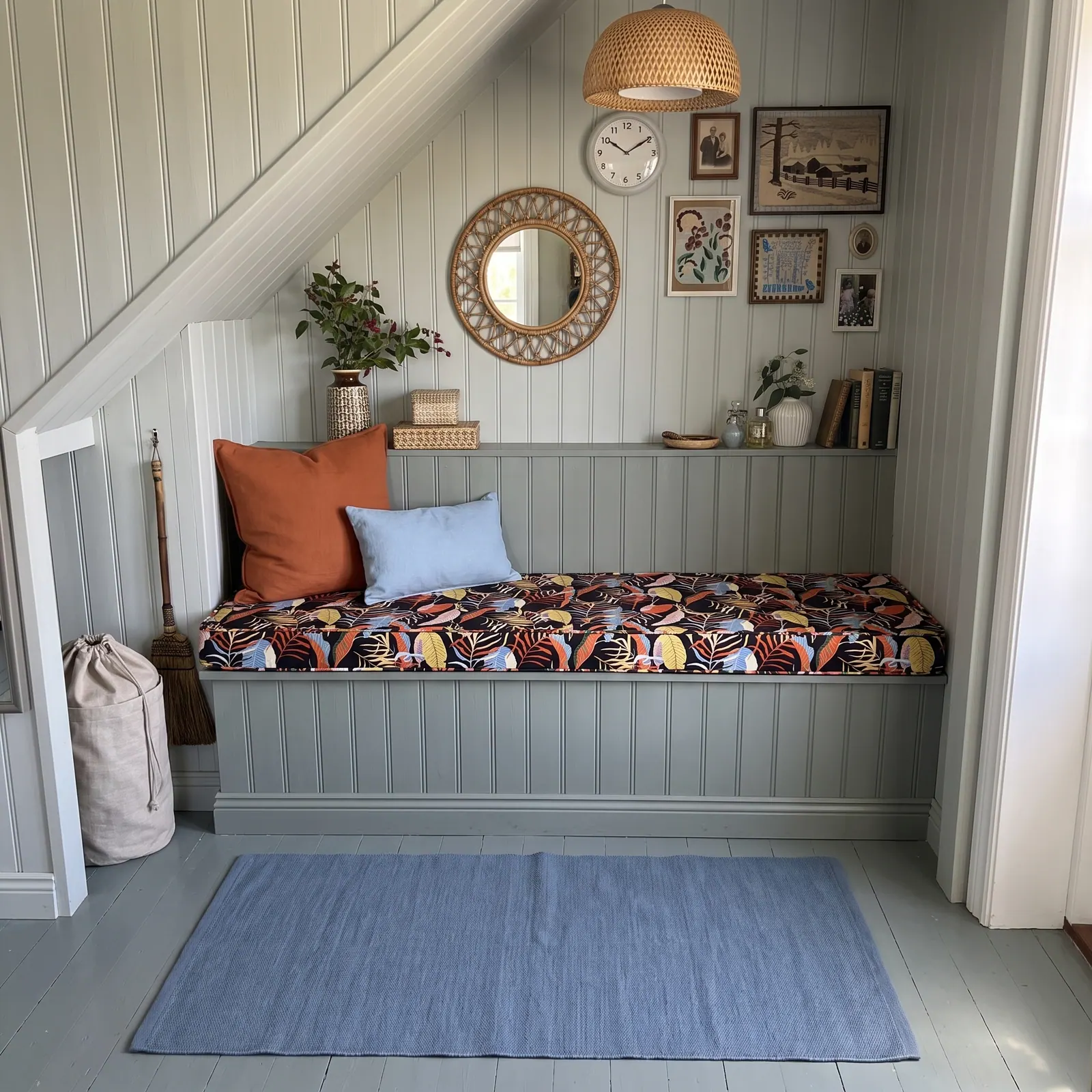
Nate opens with three common questions, then reads an autumn-leaf cushion fitted wall to wall in a gray-blue under-stairs nook for what its foam is doing.

 Save
The quick answer
For a bench cushion in an under-stairs nook, make the seat the firm, thick part and let the back stay softer, because a seat carries your full weight and a back only takes a lean. That is the workshop's default; you can ask for equal firmness. Add a non-slip base on a narrow bench and template the side walls.
Buyer questions: three questions about what goes inside
- A common question
Do the back cushions need to be the same as the seat cushions?
The workshop's answerNo, it's your call. Seat and back cushions are sold separately, so they can match or differ. Many buyers choose a thicker, firmer seat cushion with a slightly thinner or softer back.
- A common question
What happens if the fabric I pick turns out to be out of stock?
The workshop's answerPut a backup fabric code in your order note, for example a taupe velvet, and the workshop will use it if your first choice isn't available.
- A common question
Will the back cushion come out softer than the seat?
The workshop's answerYes. By default the backrest is filled softer than the seat. If you want both equally firm, ask, and they can be made that way.
Now, the reading
What the leaf print is sitting on
Everything under these stairs is painted one gray-blue except the cushion, which gives the cushion two jobs: hold the eye and hold a person. The print handles the first. The foam handles the second.
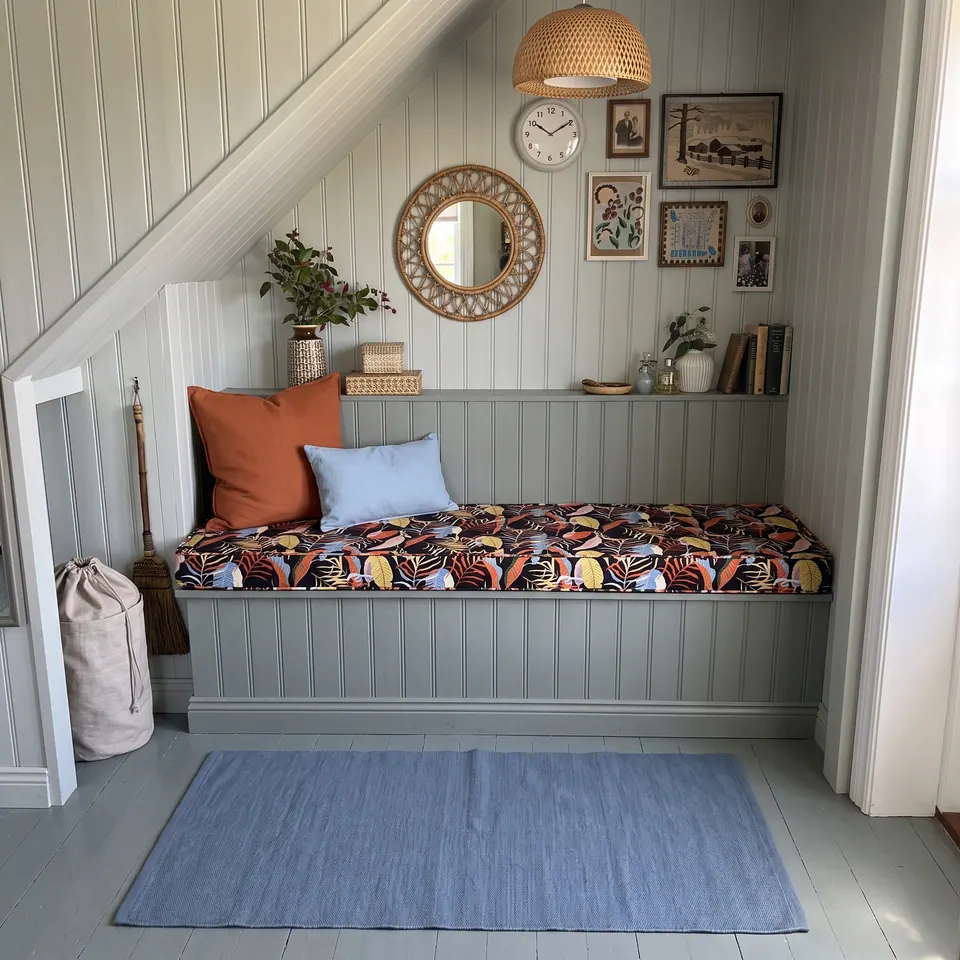
Here is the layout. A box-edge bench cushion runs wall to wall inside tongue-and-groove paneling, printed with orange, blue and yellow leaves on a navy ground and finished in self piping. Behind it, a rust pillow and a light blue lumbar lean on the paneling. The room arrived at the workshop's default split without trying: a firm seat that carries your full weight, and soft things behind you that only take a lean.
The props each borrow one color from the print. Rust takes the orange leaves. The pale blue lumbar repeats the cooler leaves and the paneling. The rattan mirror and pendant lift the ochre-yellow to eye level, and the blue flat-weave rug carries the nook's color onto the painted floor. The broom and the drawstring laundry bag tell you this is a working corner of a real house, which is exactly where a cushion gets sat on hardest.
Now the geometry. A cushion that fits wall to wall shows every error, and under-stairs side walls are rarely square. Trace the seat with a paper template instead of trusting two tape readings. Tolerance is kindness to your future self. More shapes like this one sit in understairs bench cushions and across the bench cushions range, and the foam firmness finder asks the right questions if you are unsure how firm to go.
What does the gap between your side walls measure at the back of the seat compared with the front, partner?
Pinned by Nate under the stairs
Five pins, from the leaf-print seat to the blue flat-weave rug that carries its color onto the painted floor.
- Leaf print cushion
The nook is painted one gray-blue throughout, so the cushion is the only strong color.
- Rust pillow
Rust takes the orange from the leaves.
- Light blue lumbar
Pale blue repeats the cooler leaves and the paneling.
- Rattan mirror
Rattan brings the ochre-yellow of the print up to eye level.
- Blue flat-weave rug
A plain blue rug extends the nook's color onto the floor.
- Leaf print cushionThe nook is painted one gray-blue throughout, so the cushion is the only strong color.
- Rust pillowRust takes the orange from the leaves.
- Light blue lumbarPale blue repeats the cooler leaves and the paneling.
- Rattan mirrorRattan brings the ochre-yellow of the print up to eye level.
- Blue flat-weave rugA plain blue rug extends the nook's color onto the floor.
Seat versus back: how the firmness is split
| Seat cushion | Back cushion or pillows | |
|---|---|---|
| Job | Carries your full weight | Takes a lean |
| Default firmness | Firmer | Softer |
| Usual thickness | The thicker piece | Slightly thinner |
| How it is sold | Separately | Separately |
| Same firmness? | Available on request | Available on request |
| In this nook | Box-edge cushion, wall to wall | Rust pillow and light blue lumbar on the paneling |
A 39 in bench cushion that kept sliding, and the cover that was remade
One buyer wrote in about a narrow bench where the cushion kept sliding. The order was 39 x 8 5/8 x 3 in (99 x 22 x 7.5 cm), with a non-slip base and a request for extra care on straight piping.
It arrived without the non-slip base; the workshop had refunded that part because of a material issue. After the full 72 hours of expansion, the piping still wandered. Rather than ask for a return, the workshop made a brand-new cover free of charge, in a more beige fabric, with the non-slip base, an extra quality check on the piping, and shipped it flat instead of vacuum-packed.
Run the numbers on that bench. At 3 in thick on a seat only 8 5/8 in deep, the cushion is more than a third as tall as it is deep: a narrow block with every reason to walk. The fixes are compared in ways to stop a bench cushion sliding.
- Sizes
- 39 x 8 5/8 x 3 in (99 x 22 x 7.5 cm)
The lesson: On a narrow bench a non-slip base is essential, and a remade cover shipped flat arrives with straighter piping.
On the cutting table: the under-stairs seat
| Cushion | Box-edge bench cushion, wall to wall inside the paneling |
|---|---|
| Fabric | Cotton canvas, navy ground with orange, blue and yellow leaves |
| Piping | Self piping |
| Seat firmness | Firm, the workshop default for a seat |
| Back | Softer pillows leaning on the paneling |
| Base | Non-slip base on any narrow bench |
| Measuring | Paper template pressed into both side walls |
| Unpacking | Allow the full 72 hours before judging foam or piping |
| Order note | Name a backup fabric code in case the first is out |

Have it made
Have this made — ask Nate’s workshop
Precision starts on the phone. Give the workshop your measurements and they will read them back to you, edge by edge. — Nate
Leave your details and the workshop will call you to confirm measurements, fabric, foam and piping. No prices, dates or payment on this page: it is a request, not an order.
Make the bench cushion the firm part and let the back pillows stay soft: a seat carries your full weight, a back only takes a lean.
Nate
Questions buyers ask next
Why wait 72 hours before judging a new foam cushion?
Foam cushions often travel vacuum-packed and need time to recover. Give them the full 72 hours before judging thickness, firmness or piping. The remade cover in this Reading was shipped flat, without vacuum packing, so its piping arrived straighter.
How do I stop a narrow bench cushion from sliding?
Order a non-slip base. On the 8 5/8 in (22 cm) deep bench in this Reading, the cushion kept sliding without one, and the replacement cover was made with it. Ties are the other common fix where there is something to tie to.
How do I measure an under-stairs nook with walls that aren't square?
Make a paper template of the seat and press it into both side walls instead of relying on two tape readings. A cushion that fits wall to wall shows every small error, and under-stairs walls are rarely square.
Does a busy leaf print need contrast piping?
No. This leaf print uses self piping, so the edge is defined without adding a fourth color, and the rust and light blue pillows pick colors out of the print instead of fighting it.
± 1/4 in — Nate
More photographs to read
 Save
 Save
 Save
 Save
 Save
 Save