 Save
A Reading by MaggieBench Cushions
Four corduroy bench cushions, four contrast welts, one foam inside
The welts get the compliments, but the foam keeps those box edges square, and it is the same foam in all four.
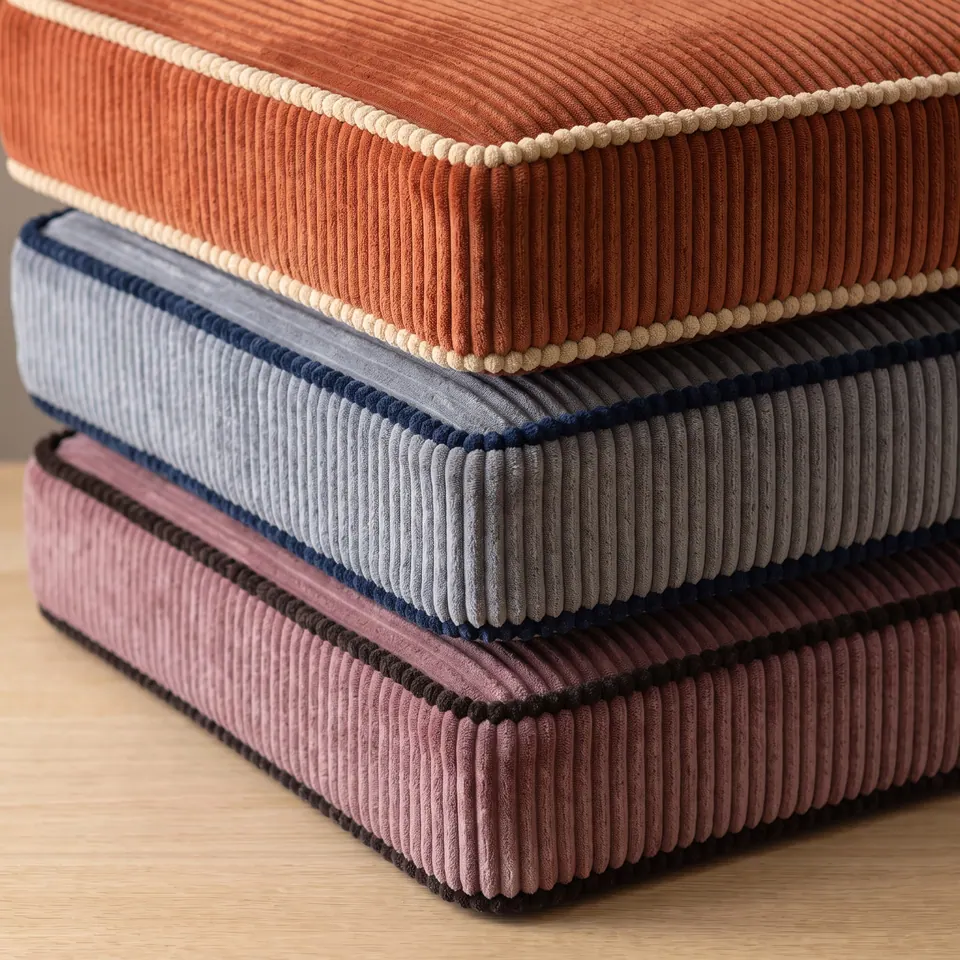
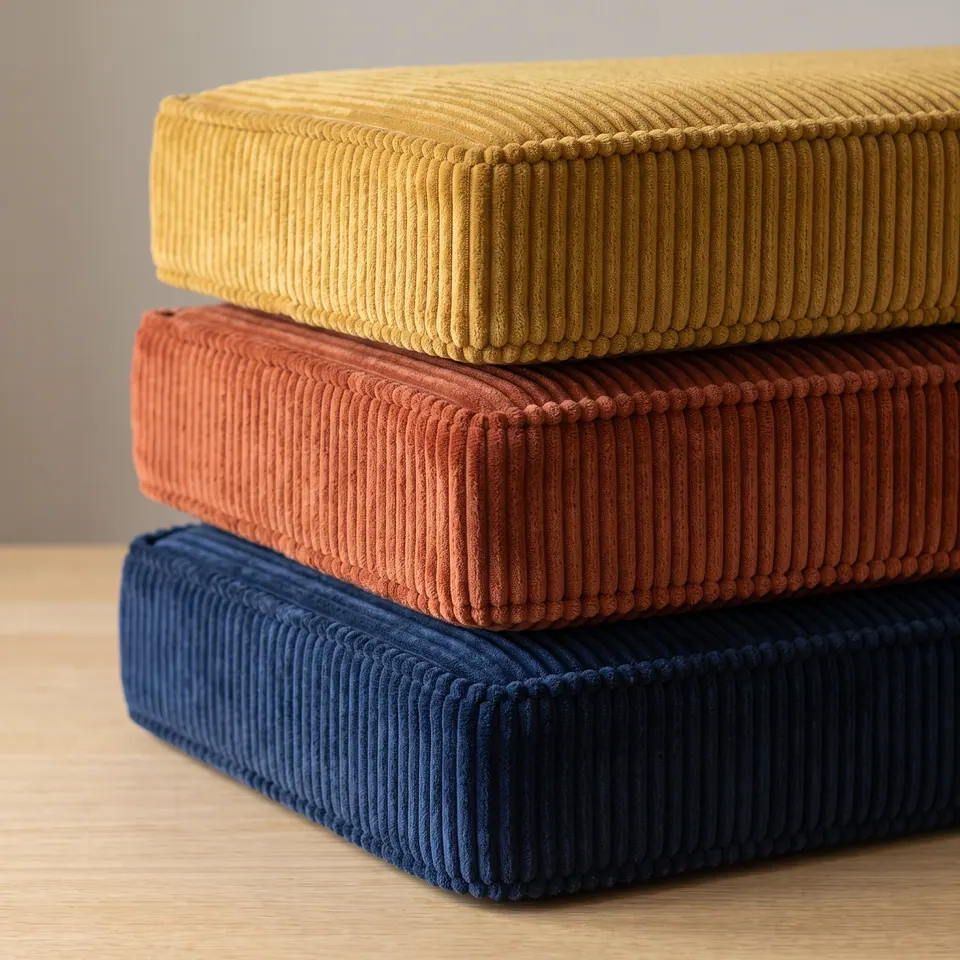
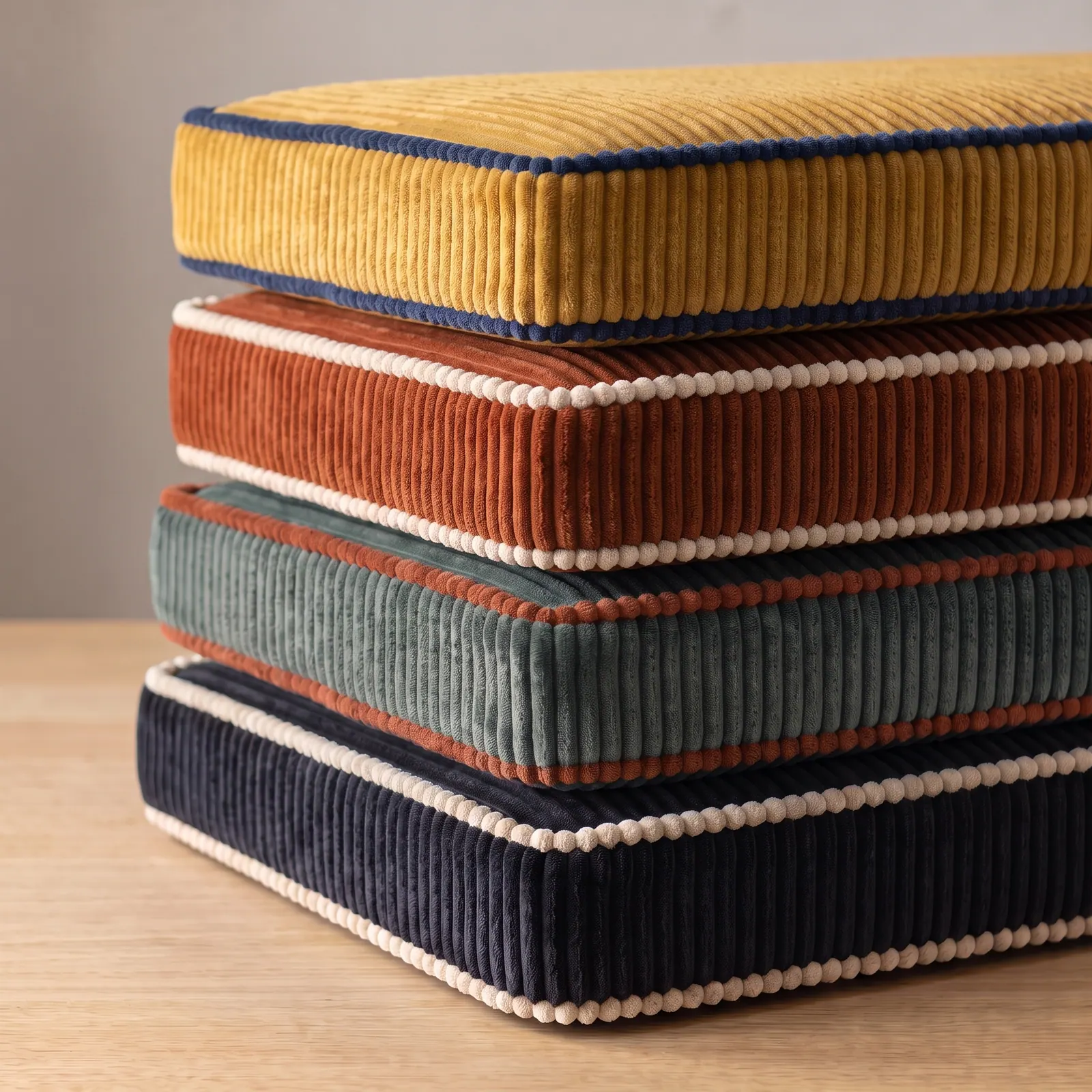
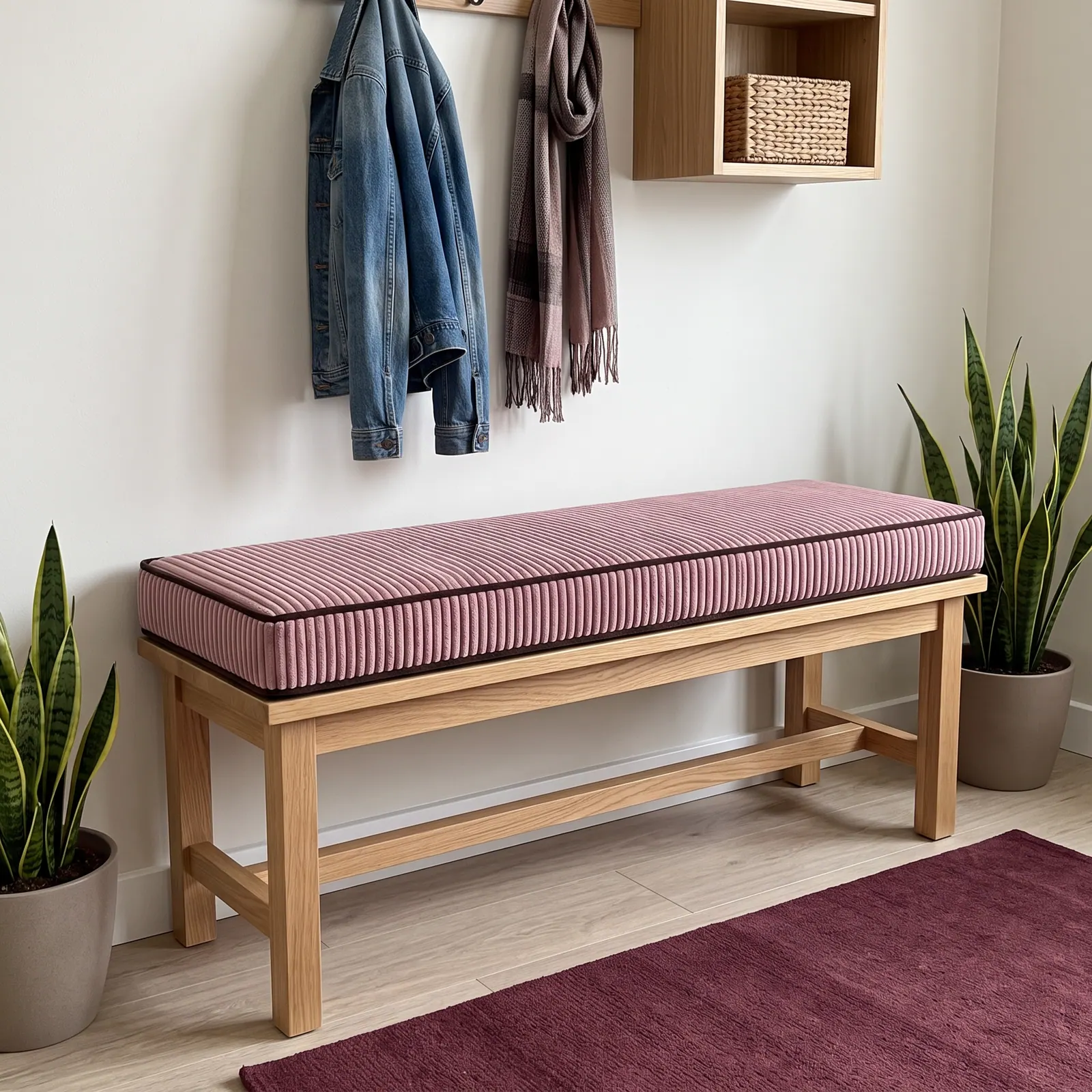
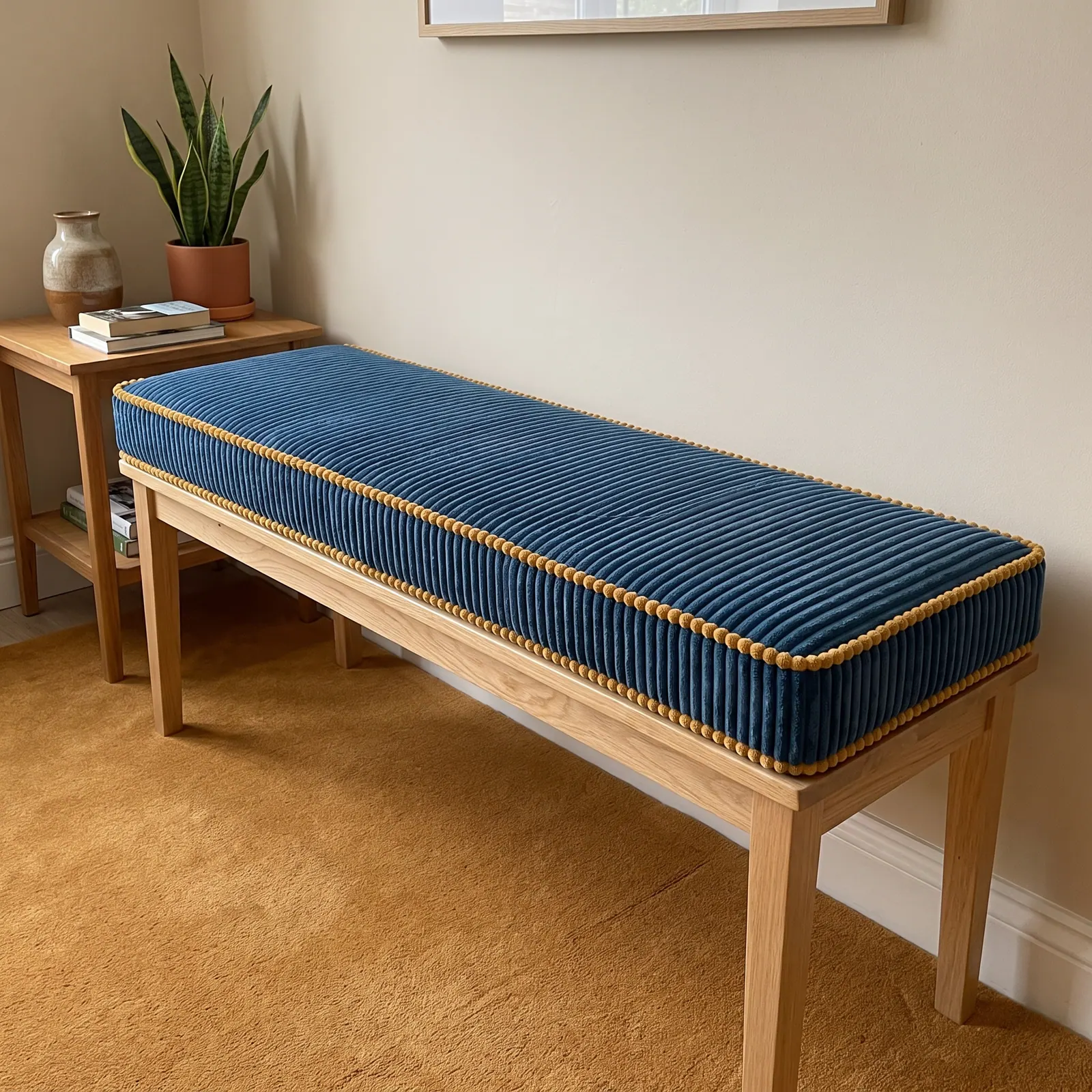
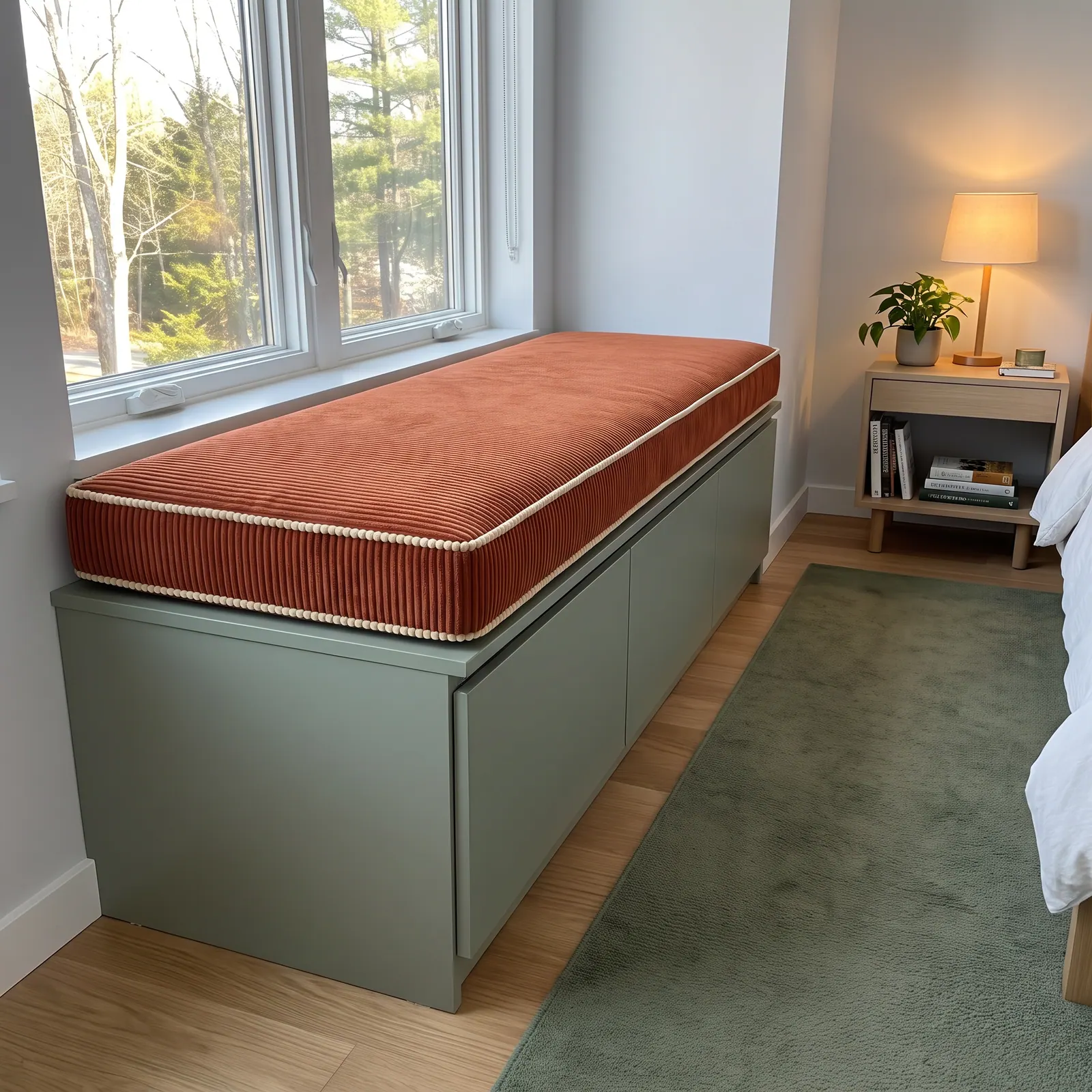
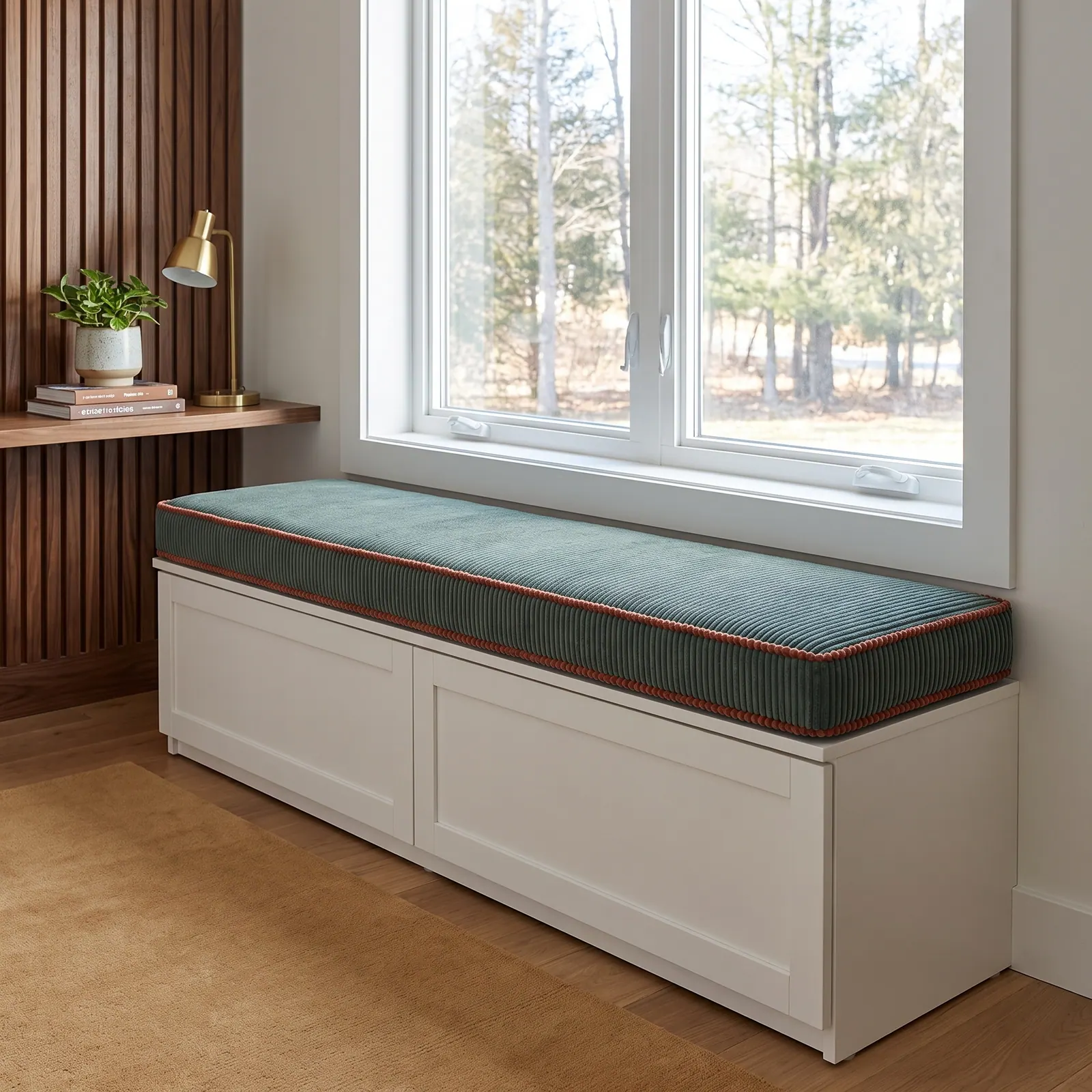
Mustard with navy, rust with cream, teal with rust, anthracite with cream: one stack shows how much the welt color changes a single fabric.

The quick answer
A custom bench cushion like these keeps its square box edge because the foam inside is firm: about 2.0 lb/ft³ (32 kg/m³) high-density polyurethane, rated around 6 to 7 out of 10 and wrapped in polyester fiber. Standard thickness is 4 in (10 cm), and 3 in gives a neater profile. For a softer seat, ask for softer foam, not more inches.
Four welts, borrowed from the neighbors
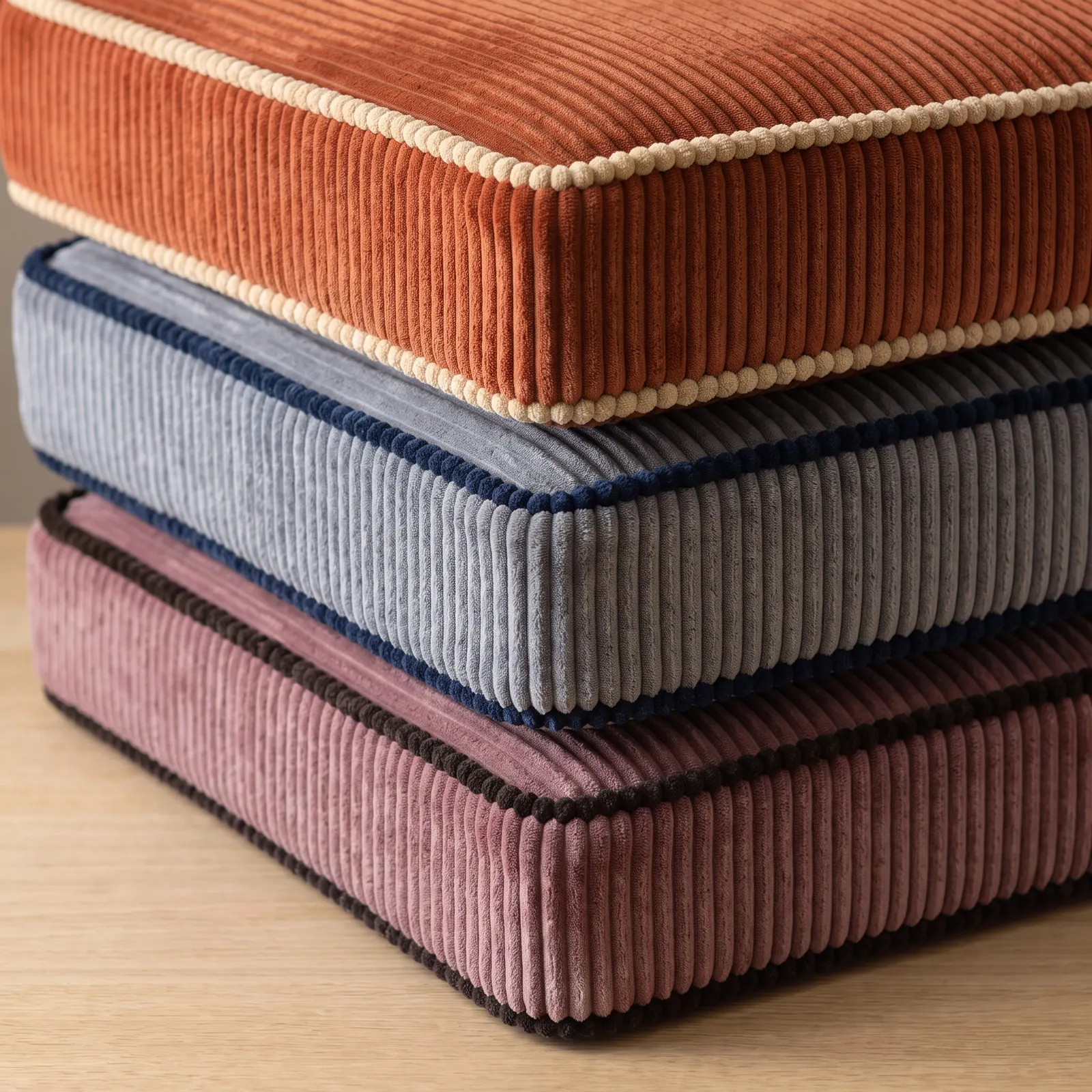
Four wide-wale corduroy cushions sit stacked on pale oak: mustard, rust, teal and anthracite. Navy welt on the mustard, cream on the rust, rust on the teal, cream again on the anthracite.
The welts are borrowed from the neighbors. Rust returns as the cord on the teal, cream repeats on the two darkest pieces, and four loud colors behave like one family. The gray wall and pale oak keep them clean.
The camera sits low, so the side bands fill the frame. On a box cushion that band is the thickness made visible, and the ribs stand upright on it, which makes the boxing look taller. A straight welt is a kind of honesty. It is also evidence: piping only runs straight around foam that holds its shape.
Pinned by Maggie
Four pins, one for each welt, from the top of the stack down.
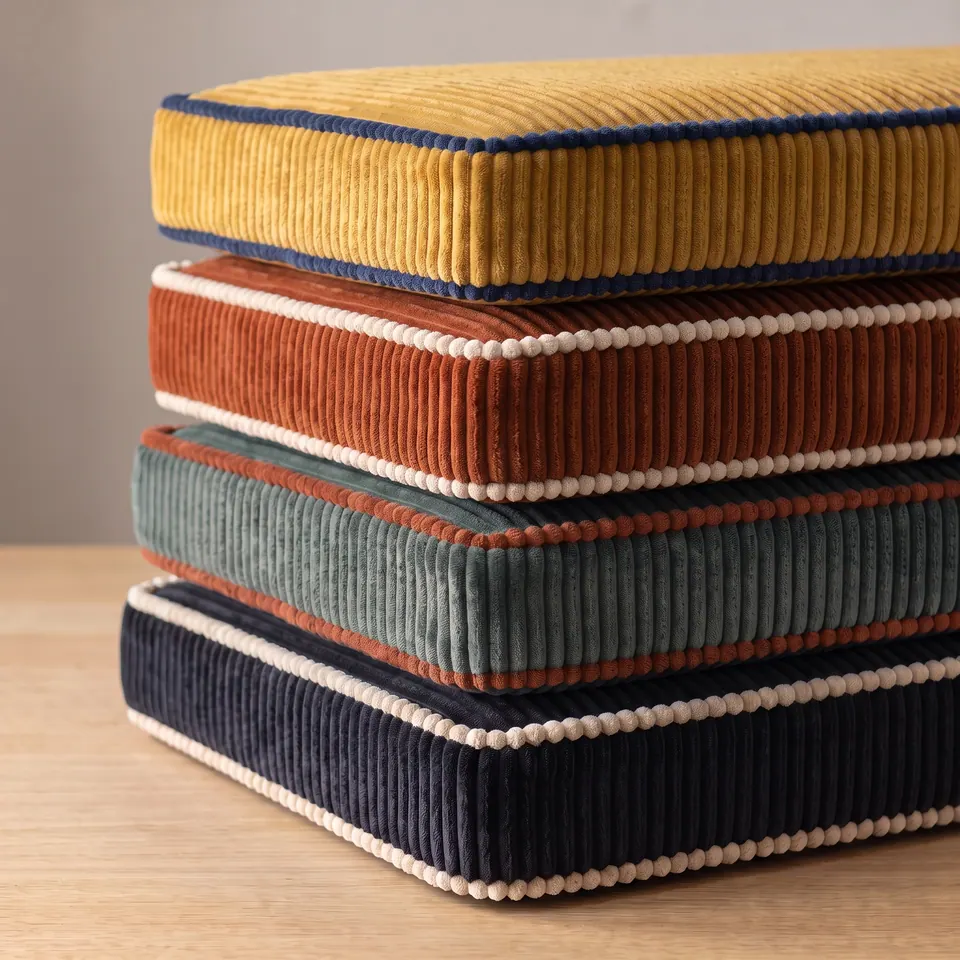
- Navy welt on mustard
A dark cord around the lightest cushion keeps its box edge crisp even from across the room.
- Wide-wale rust border
The ribs stand upright on the border, which makes the boxing look taller and more tailored.
- Rust cord on teal
Rust against teal is a complementary pair; the warm welt stops the cool body from feeling flat.
- Cream cord on anthracite
A pale piping traces the darkest cushion so it never reads as a solid black slab.
- Navy welt on mustardA dark cord around the lightest cushion keeps its box edge crisp even from across the room.
- Wide-wale rust borderThe ribs stand upright on the border, which makes the boxing look taller and more tailored.
- Rust cord on tealRust against teal is a complementary pair; the warm welt stops the cool body from feeling flat.
- Cream cord on anthraciteA pale piping traces the darkest cushion so it never reads as a solid black slab.
What the side band is hiding
Inside every cushion here is the same core: high-density polyurethane foam of about 2.0 lb/ft³ (32 kg/m³). It is not memory foam. On a 1 to 10 scale it sits around 6 to 7, so you sit on it, not in it. That suits a bench, where people perch, shift and get up again. What is under your bench cushion now?
The foam is wrapped in polyester fiber (Dacron) before it goes into the cover, which softens the edges just enough. It is also cut slightly larger than its cover, so the cover looks full and the welt pulls taut.
Thickness is a separate decision, and the table below lists the four standard ones.
I once ordered an extra inch on my own hall bench because I wanted it softer, dear. It was not softer. It was taller. Softness comes from lower density: a 28-density foam, about 1.75 lb/ft³, written into the order note. Try the foam firmness finder first, and see the range under bench cushions.
French cleat or ties: a backrest question
A buyer ordered three shaped seat cushions and wanted a padded backrest on the wall. French cleat mounting was the plan.
The answer that time was plain. Its cushions carry no rigid board, so it could not make cleat panels. It could sew ties onto the top corners so a backrest hangs from hooks or a rail, filled with shredded foam about 4 in (10 cm) thick or built on a fiber-wrapped foam core. The buyer built the backrest at home and ordered matching corduroy instead: one 106 1/4 x 23 5/8 in (270 x 60 cm) piece.
- Sizes
- Backrest fabric 106 1/4 x 23 5/8 in (270 x 60 cm)
- Fabric
- Corduroy, matching fabric supplied
The lesson: For a rigid wall panel, buy matching fabric and upholster it locally; cushion makers hang backrests with ties.
Long seats, buttons and corners: three common questions
- A common question
Could one long bench cushion replace the three seat cushions on my sofa? I don't like the seams.
The workshop's answerYes. One long cushion instead of three gives a clean, seamless look, and many buyers do it. Send the length, depth, thickness and fabric code for a quote.
- A common question
Can you tuft a bench or daybed cushion with buttons, maybe in a diagonal pattern? Can the cover still be washed?
The workshop's answerYes, to a custom size, with flat piped sides and even a diagonal button pattern. The buttons are sewn through the whole cushion, so the cover does not come off: spot clean only.
- A common question
How do I work out the lengths at the corner of an L-shaped bench so the cushions don't overlap?
The workshop's answerOne seat runs its full wall; the other is shorter by the first one's depth. With 74 in and 180 in walls and a 19 in depth, the seats were 74 in and 161 in. Send both wall-to-wall sizes and the workshop does the math.
Thickness changes how high a bench cushion sits; foam density changes how it feels. For a softer seat, ask for softer foam, not an extra inch.
Maggie
On the cutting table
| Cushions in the photo | Four box cushions in wide-wale corduroy, contrast piped |
|---|---|
| Foam | About 2.0 lb/ft³ (32 kg/m³) high-density polyurethane, 6 to 7 out of 10 |
| Wrap | Polyester fiber (Dacron); an extra 3/4 in (2 cm) layer on request |
| Piping | Contrast from any chart; sits on the seam, no change to size |
| Thickness | 2, 3, 4 or 5 in (5 to 12.5 cm); 4 in is standard |
| Care | Zipped cover, 86°F (30°C) gentle cycle, air dry |

Have it made
Have this made — ask Maggie’s workshop
Numbers first, fabric second, piping last. Jot down what you have, and the workshop will go down the list with you, item by item. — Maggie
Leave your details and the workshop will call you to confirm measurements, fabric, foam and piping. No prices, dates or payment on this page: it is a request, not an order.
Questions buyers ask next
Is the foam in a bench cushion memory foam?
No. Seat and bench cushions use high-density polyurethane foam, medium-firm to firm, which keeps a flat, tailored shape. Memory foam can be requested for custom inserts, but it is not the standard.
Can a bench cushion be softer without getting thicker?
Yes. Write the softer 28-density foam into the order note. Thickness changes height; density changes feel.
Can a bench cushion hang over the front edge of the seat?
By up to about 2 in (5 cm), when an inner support wrap is added to the foam.
Stitch straight — Maggie
One corduroy, many welts
 Save
 Save
 Save
 Save
 Save
 Save