 Save
A Reading by MaggieBench Cushions
A sea green woven bench cushion, corner first: how it is finished and how it stays on the bench
One corner of one cushion, in a nubby green weave that forgives nothing at the seams. Here is what to check, and how to keep the whole thing from wandering off the bench.
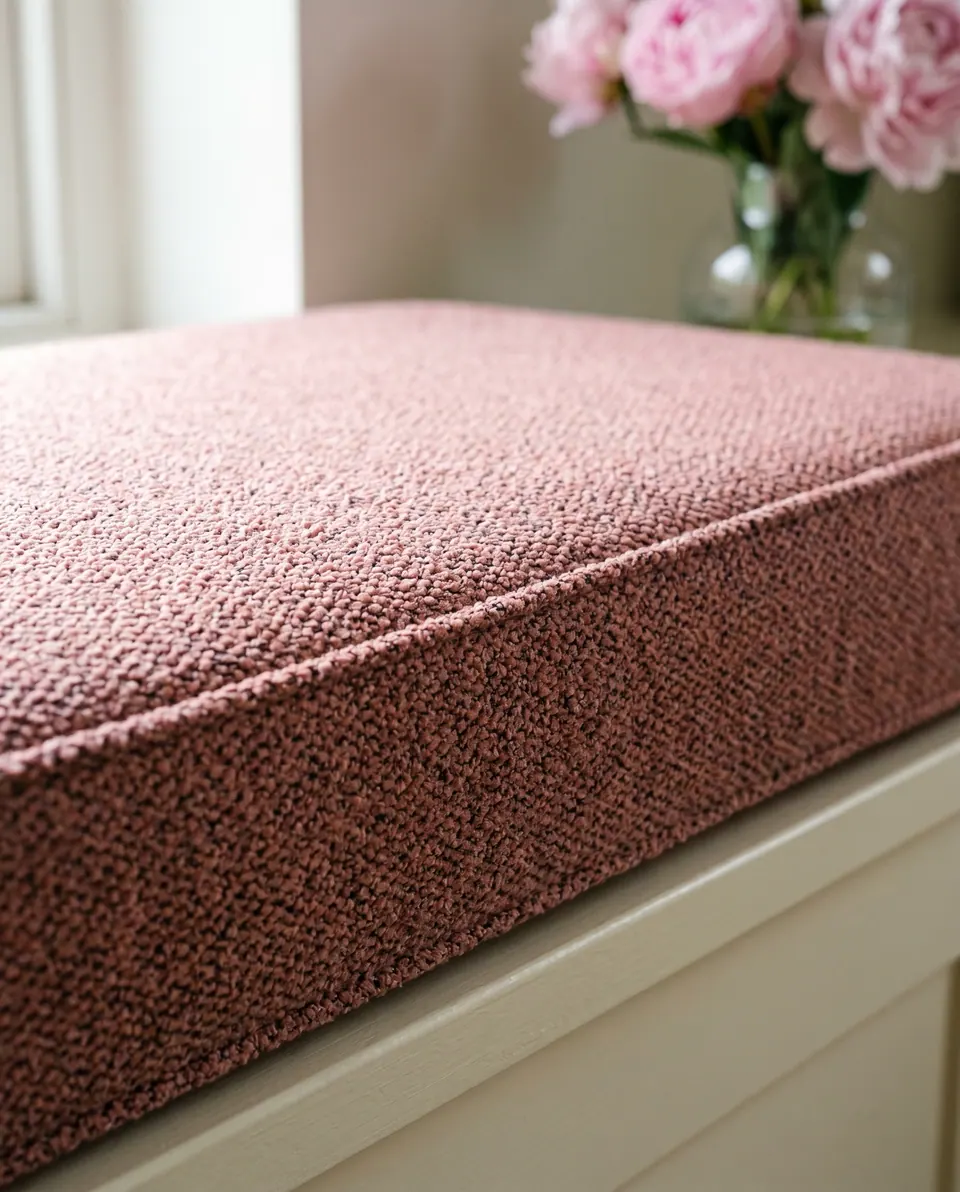
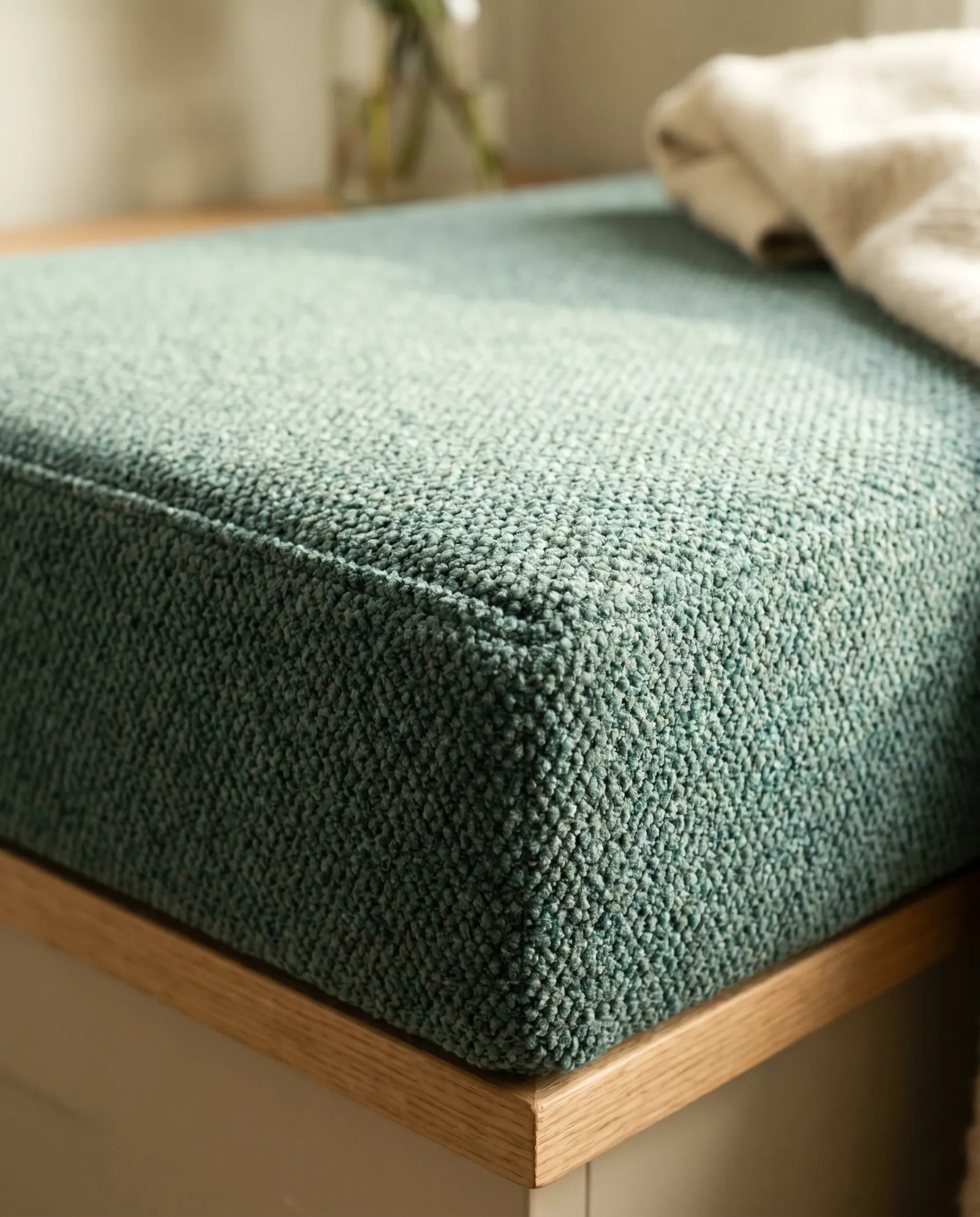
The sea green weave has a pebbly surface, and the corner is sewn square so the cushion keeps its shape.

The quick answer
A custom bench cushion stays put with corner ties, an anti-slip bottom fabric, or a non-slip pad underneath, and its zipper belongs on the back side, facing down. Pick ties where there is a frame to tie to, and a grip base or pad where ties would show. About 4 in (10 cm) is the standard thickness; 3 in (7.5 cm) is the best seller.
The corner is where a weave shows its manners
A thick, loopy weave is honest about its seams. Every wobble shows. So the first place to look on this sea green bench cushion is the front corner, and it is sewn square.
The boxing strip meets the top panel at a neat welt, self piping in the same green. A straight welt is a kind of honesty, and this one keeps the edge crisp even where the loops want to spread.
Soft side light rakes across the top. Each loop throws a small shadow, so the green looks layered rather than flat. That is the charm of a pebbly performance weave, and why a photo taken head-on under a ceiling light never does it justice.
The props are few and well chosen. A folded cream throw brings a lighter, smoother texture. The oak bench top warms the cool green. A glass vase sits back, out of focus, minding its own business.
Pinned by Maggie: five checks on one corner
Five pins, from the pebbly top surface down to the oak bench edge.
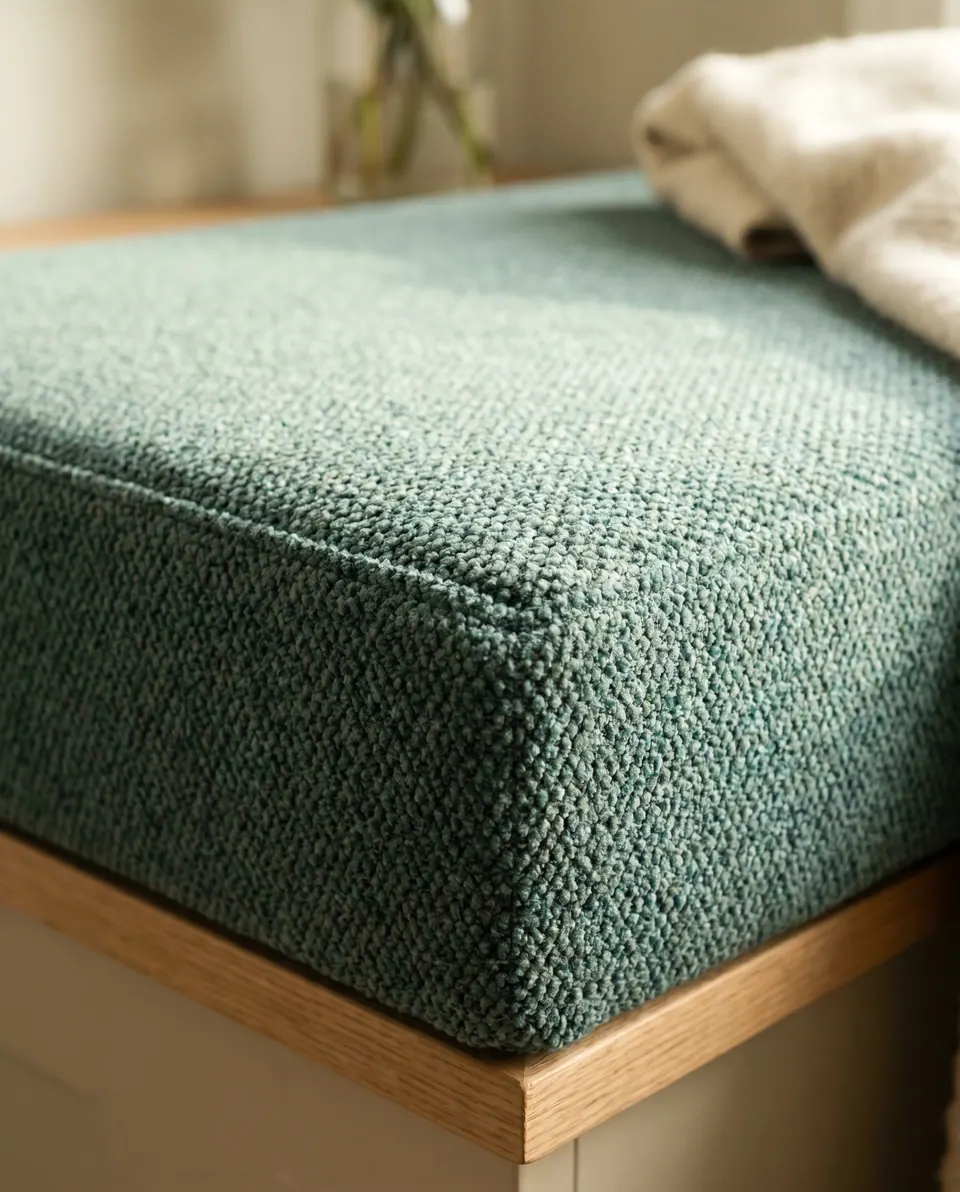
- Pebbly top surface
Side light shows every loop, so the green looks layered.
- Welted top seam
A neat welt keeps the edge crisp even in a thick weave.
- Square front corner
The corner is sewn square so the cushion keeps its shape.
- Cream throw
A lighter, softer texture beside the nubby weave.
- Oak bench edge
Warm oak sets off the cool green.
- Pebbly top surfaceSide light shows every loop, so the green looks layered.
- Welted top seamA neat welt keeps the edge crisp even in a thick weave.
- Square front cornerThe corner is sewn square so the cushion keeps its shape.
- Cream throwA lighter, softer texture beside the nubby weave.
- Oak bench edgeWarm oak sets off the cool green.
Ties, grip or a pad: the fastening checklist
A cushion that slides ends up on the floor, usually with somebody on it. There are three honest ways to stop it, and one place the zipper must go.
- Corner ties. Sewn at the corners and tied to the bench frame or legs. Best where there is something to tie to.
- Anti-slip bottom fabric. A grippy underside in place of the plain base. Nothing shows from the room.
- A non-slip pad. Laid under the cushion. No sewing, and it moves to the next bench with you.
- The zipper. Every cover has one, on the back side, as hidden as possible. That side faces down and toward the wall. If you can see the zipper, dear, the cushion is upside down.
Tufted cushions generally stay where they are put; the workshop has had no complaints about them sliding. My own confession: years ago I sewed ties onto a cushion for a bench with a solid plinth and nothing to tie them to. Read ties or a non-slip base before you choose, and learn from me.
A 103 in bench, and one cushion instead of two
A buyer wrote to the workshop about a single extra-long bench, about 103 in (262 cm). One cushion, or two pieces of about 51.5 in (131 cm)? The workshop recommended two. The buyer chose one long cushion, 15.75 in (40 cm) deep, and moved the length to 103.5 in (263 cm) before production.
It worked well enough that they came back. Next came four seat cushions and six softer back cushions at 21.75 x 25.5 in (55 x 65 cm), plus an L-shaped chaise with six sides: 39.4, 19.7, 41.3, 11.8, 17.7 and 27.6 in (100, 50, 105, 30, 45 and 70 cm). The sketch arrived in millimeters. The workshop converted every figure to centimeters and sent it back as a clear side-by-side list for a yes before quoting.
That list is the lesson. Before anything is cut, see your numbers written back to you in one unit. How long is your bench, and where would you split it? The notes on one piece or two help you decide.
- Sizes
- 103.5 x 15.75 in (263 x 40 cm); seats and backs 21.75 x 25.5 in (55 x 65 cm); chaise sides 39.4/19.7/41.3/11.8/17.7/27.6 in (100/50/105/30/45/70 cm)
The lesson: Convert a customer's sketch into a clear side-by-side list before quoting.
On the cutting table: the sea green box cushion
| Cushion | Custom bench cushion, rectangular box |
|---|---|
| Fabric | Sea green nubby performance weave |
| Piping | Self welt in the same green |
| Corners | Sewn square so the box holds its shape |
| Thickness | About 4 in (10 cm) standard; 3 in (7.5 cm) the best seller |
| Fastening | Corner ties, anti-slip bottom fabric, or a non-slip pad |
| Zipper | Back side, facing down and toward the wall |
| Best for | Window and entry benches that see daily use |

Have it made
Have this made — ask Maggie’s workshop
Numbers first, fabric second, piping last. Jot down what you have, and the workshop will go down the list with you, item by item. — Maggie
Leave your details and the workshop will call you to confirm measurements, fabric, foam and piping. No prices, dates or payment on this page: it is a request, not an order.
Buyer questions: thickness, a corner sofa and piping in a second color
- A common question
What thickness would you suggest for my cushion?
The workshop's answerAbout 4 in (10 cm) is standard, and 3 in (7.5 cm) is the best seller, handy in tight spots such as a 15 in (38 cm) gap between a bench and a windowsill. The workshop suggests 3 to 4 in (8 to 10 cm) for outdoor chair seats and 2 to 3 in (5 to 8 cm) for curved benches. A 78 x 30.75 x 8 in (198 x 78 x 20 cm) seat pad has been made too.
- A common question
Could you make a corner floor sofa with custom backrests from my diagram?
The workshop's answerYes. One corner sofa drawn in a diagram was broken into two floor cushions, two backrests, four armrests and one corner backrest. One run of an L must be longer so it covers the corner. An L-shaped daybed with 6 in (15 cm) seats and 5 in (13 cm) backs was also made to order.
- A common question
Can the piping be a different color from the cushion?
The workshop's answerYes. Write both the fabric and the piping color in the personalization box, for example a linen with velvet piping, or a blue soft fabric with emerald piping. Matching piping is available too.
Keep a bench cushion from sliding with corner ties, an anti-slip bottom fabric, or a non-slip pad underneath. The zipper goes on the back side, facing down.
Maggie
Questions buyers ask next
Is a nubby woven fabric hard to sew neatly?
Thick, loopy weaves show every seam, so corners and welts need care. On this sea green cushion the boxing strip meets the top at a neat welt and the corner is square. Ask for a sample corner if you are unsure how a textured fabric will finish.
Should a very long bench get one cushion or two?
Either can work. For a bench of about 103 in (262 cm) the workshop suggested two pieces; the buyer chose one, made at 103.5 in (263 cm). Two pieces are easier to lift, carry and wash; one piece gives an unbroken seat.
Do ties show on a bench cushion?
Corner ties are visible where they wrap the frame, which suits cottage and farmhouse benches. For a clean look, an anti-slip bottom fabric or a separate non-slip pad holds the cushion with nothing on show.
What does self piping mean on a bench cushion?
Self piping is cord covered in the same fabric as the cushion and sewn into the edge seam. It gives a crisp outline without adding a second color, which keeps a textured green weave calm.
Stitch straight — Maggie
More photographs to read
 Save
 Save
 Save
 Save
 Save
 Save