A Reading by MaggieBench Cushions
Inside an oatmeal custom bench cushion at the end of the bed, layer by layer
Maggie takes an end-of-bed bench apart on paper: the slubbed cover, the brown tweed welt, the foam block that makes the box side stand up, and why a seat you perch on to pull on socks wants firmness.

 Save
The quick answer
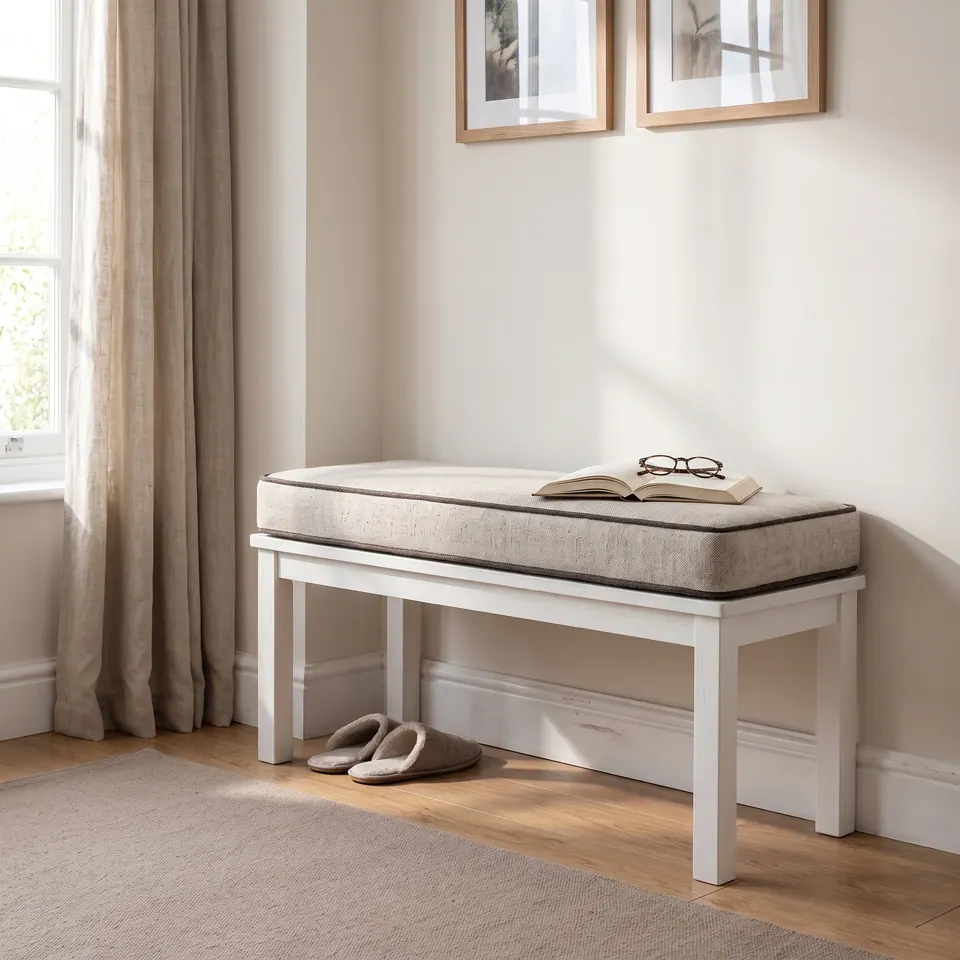
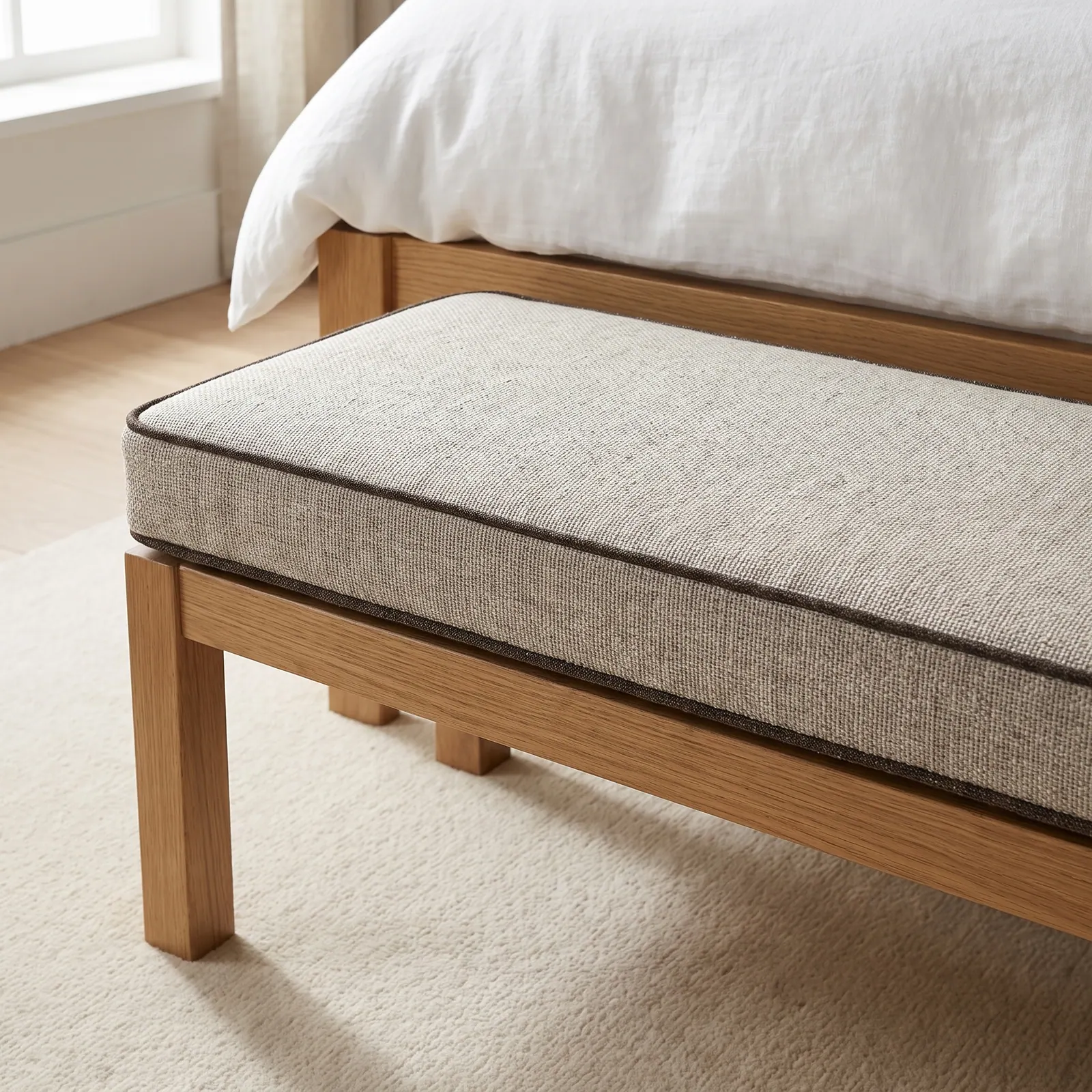
An end-of-bed custom bench cushion works best as a box cushion with a firm foam core that fills the frame and keeps its square edge. Here an oatmeal linen-look cover with brown tweed piping sits inside a solid oak bench, its side almost as tall as the rail. Measure inside the frame, and use the foam firmness finder before choosing.
The cushion, cut open
Cover fabric. A removable, zippered cover. Machine wash at 86°F (30°C) on a gentle cycle and air dry.
Piping. A fabric-covered cord sewn into the seams. It sits on the seam line, so it does not change the size.
Fiber wrap. Polyester fiber (Dacron) batting around the foam: it fills the cover out and softens the edges.
Foam core. About 2.0 lb/ft³ (32 kg/m³) high-resilience foam, firm to medium-firm, cut to the ordered size.
Zipper. Along the back band, as hidden as possible. The zipper side faces down or toward the wall.
Base panel. The underside of the cover. A non-slip fabric backing can cover the whole of it instead.
An end-of-bed cushion in cross-section, top to bottom
Slice an end-of-bed cushion in half and there are four things to read: the cover, the welt, the core and the fit. Get those right and a plain oatmeal box looks built in. Get one wrong and it looks like a camping pad on good furniture.
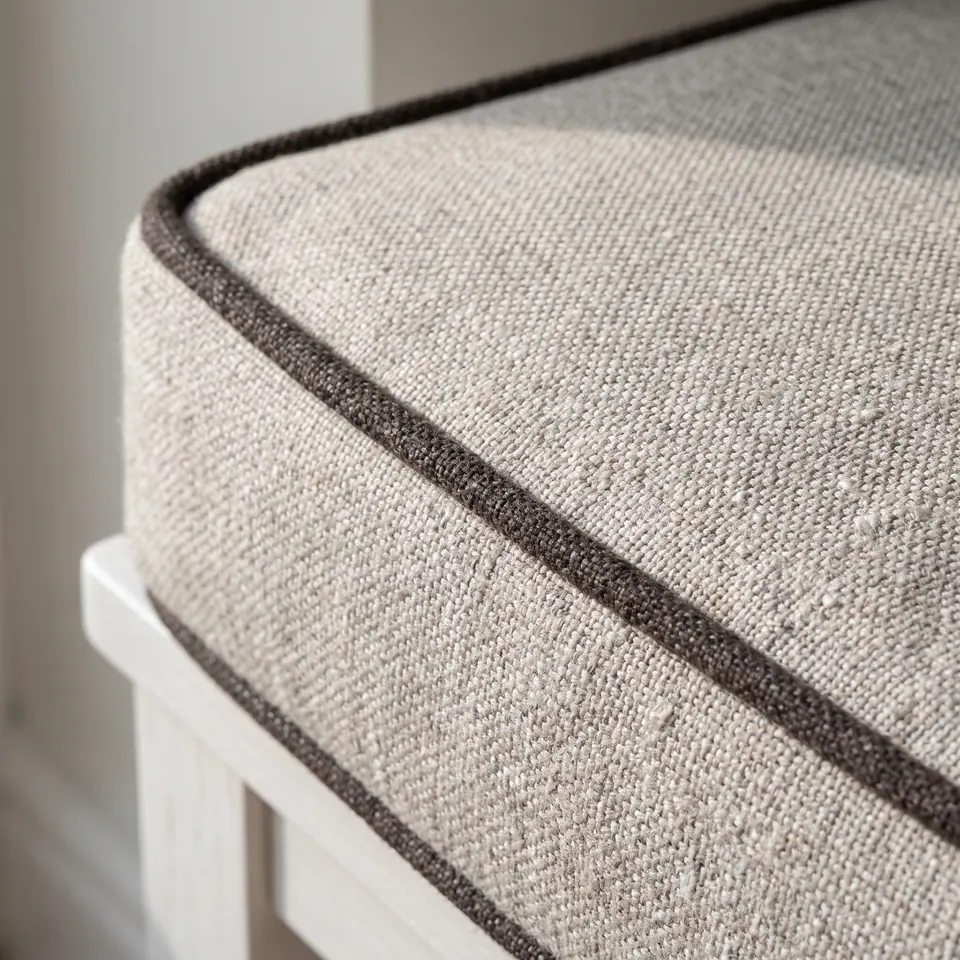
The cover. An oatmeal greige linen-look cloth, code L-06, with visible slubs. Texture is what keeps a single neutral from going flat under soft side light. It sits between white linen bedding and honey oak and belongs to both.
The welt. Brown tweed piping runs around the top and bottom seams. It takes its color from the darker grain in the oak, so the cushion gets an edge without a new color entering the room.
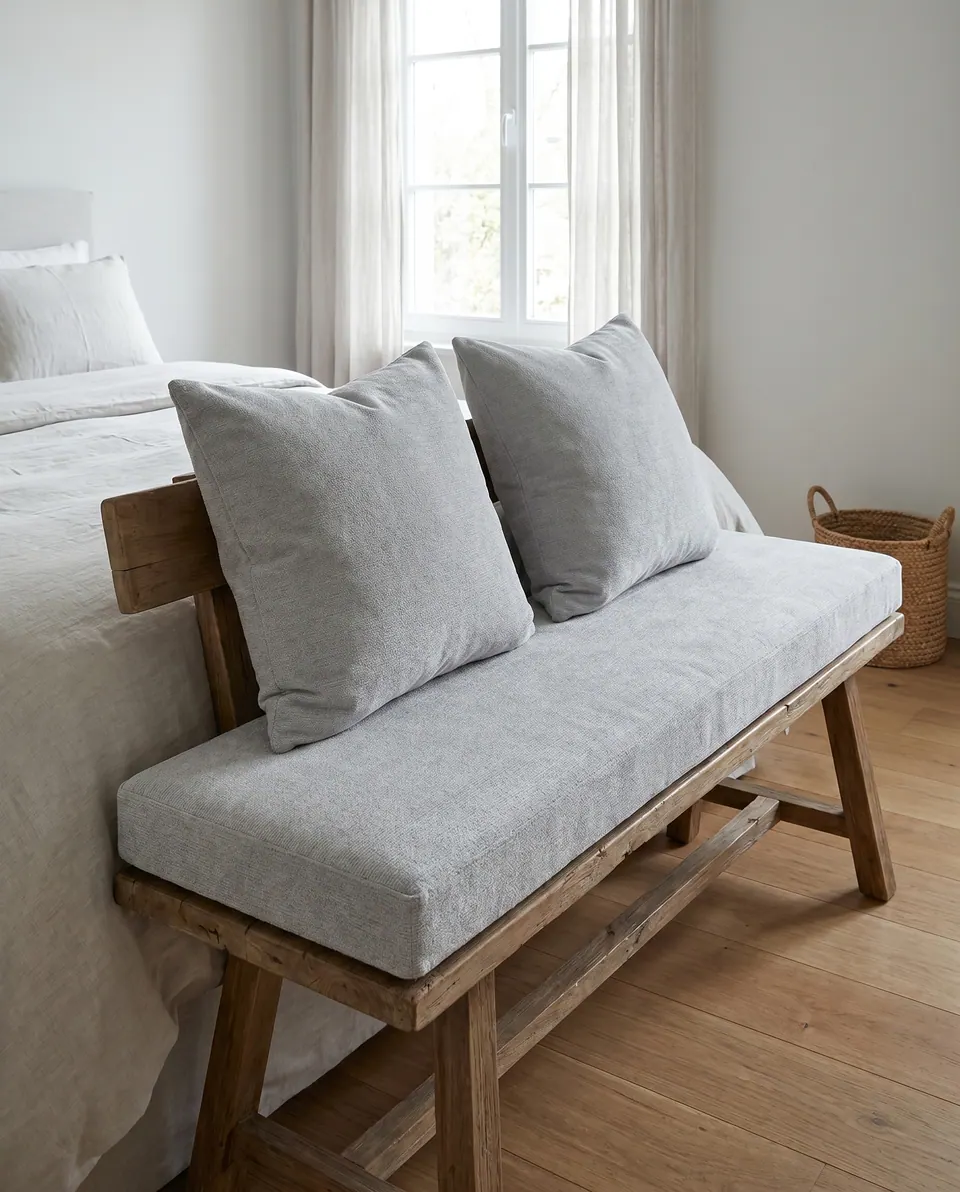
The core. The box side is nearly as tall as the bench rail, which tells you there is a proper block of foam in there, not a thin topper. At the foot of a bed people perch rather than lounge: a quick sit to pull on socks, a pile of folded laundry, a suitcase on Sunday night. That asks for a firm core that holds a square edge and doesn't dip in the middle. Softer foam belongs on a reading seat where you settle in for an hour.
The fit. The cushion sits inside the oak frame rather than across it, so measure between the rails, not over them.
I once made my own blanket bench a soft cushion because it felt lovely in the hand. By spring it looked like a tired soufflé. Right, then: firm for perching. The foam firmness finder and the Pattern on foam density vs firmness put numbers on it, and more seats live among our bedroom cushions.
Pinned by Maggie: the welt, the slub and the oak
Five pins at the foot of the bed, from the brown tweed corner to the linen duvet above it.
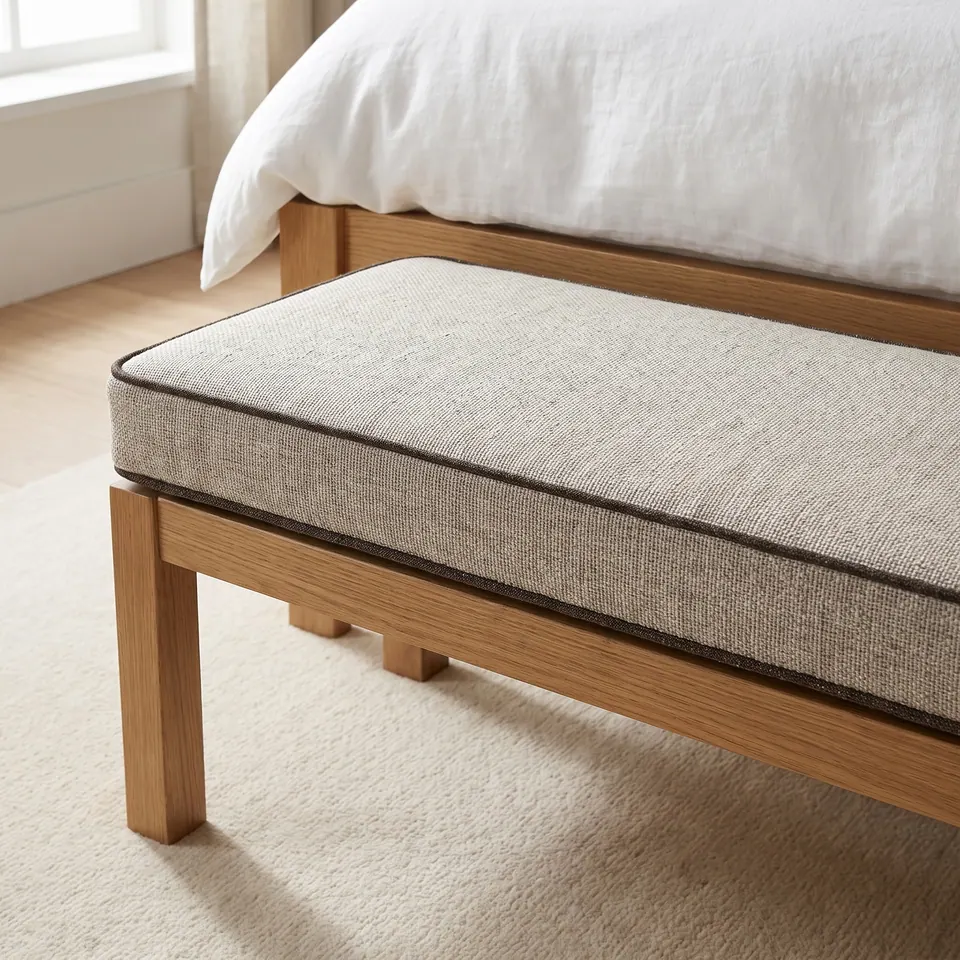
- Brown tweed piping
A tweedy brown welt at the corner echoes the oak and frames a quiet neutral.
- Slub linen-look top
Visible slubs give texture so a plain oatmeal never looks flat.
- Deep front gusset
A tall box side fills the bench frame and makes the seat comfortable for dressing.
- Oak bench leg
Honey oak and oatmeal fabric are the whole palette here.
- Linen duvet
White linen above keeps the corner light and soft.
- Brown tweed pipingA tweedy brown welt at the corner echoes the oak and frames a quiet neutral.
- Slub linen-look topVisible slubs give texture so a plain oatmeal never looks flat.
- Deep front gussetA tall box side fills the bench frame and makes the seat comfortable for dressing.
- Oak bench legHoney oak and oatmeal fabric are the whole palette here.
- Linen duvetWhite linen above keeps the corner light and soft.
The layers, as I'd write them on the order
- Cover: linen-look, oatmeal greige, code L-06.
- Welt: contrast piping in brown tweed, top and bottom seams.
- Core: a firm foam block, deep enough that the box side nearly meets the rail.
- Edge: box, so the side reads as upholstery.
- Fit: inside the frame, measured rail to rail.
- Extras: none. The bed does the styling.
A window lever, 11 inches up
An interior designer in the US wrote to the workshop about a bench in a wellness studio: a 75 x 20 x 3 in (190 x 51 x 7.5 cm) seat cushion in linen with contrast piping, plus a matching back cushion leaning against the windowsill.
The trouble was above the seat. The window trim started 4 in (10 cm) above the seat cushion, and a lever sat 11 in (28 cm) up. The workshop suggested a back cushion 14 to 16 in (36 to 41 cm) tall and 3 to 4 in (7.5 to 10 cm) thick, so the lever stays hidden behind it, and left loose so the window can still be opened.
In the end the client chose freestanding benches, and the designer moved on to a banquette with a 45-degree corner, which went to the trapezoid listing. The lesson stands: size a back cushion around the window hardware, not just the wall.
On the cutting table: the end-of-bed bench
| Cushion | Box-edge bench cushion fitted inside an oak end-of-bed frame |
|---|---|
| Fabric | Linen-look slub weave, oatmeal greige, code L-06 |
| Piping | Contrast piping in brown tweed |
| Recommended core | A deep foam block in a firm grade, so the box side keeps its square |
| Use | Short sits, dressing, folded laundry |
| Measure | Inside the frame, rail to rail |
| Styling | None; white linen duvet and a cream wool rug |
| Best for | Bedroom benches and blanket chests |

Have it made
Have this made — ask Maggie’s workshop
Have the tape measure handy when they call. Old cushions shrink and sag; the seat underneath does not. — Maggie
Leave your details and the workshop will call you to confirm measurements, fabric, foam and piping. No prices, dates or payment on this page: it is a request, not an order.
Buyer questions: shapes, shades and the cost of piping
- A common question
Is an angled trapezoid cushion much more than a plain rectangle of about the same size?
The workshop's answerYes, noticeably. In one quote, a corduroy window seat of about 47 1/4 x 25 in (120 x 63.5 cm) came to roughly twice as much as a trapezoid as it did as a rectangle. One set of 3 in (7.5 cm) linen trapezoids with piping was discounted from its first quote.
- A common question
What neutral linen colors do you have, and can three odd sizes be quoted together?
The workshop's answerThe shop sends its natural linen series color chart. One buyer asked about 48 x 20, 41 x 18 3/4 and 14 x 9 in (122 x 51, 104 x 48 and 36 x 23 cm) and got one price for all three, then added a fourth cushion and picked two shades from the series.
- A common question
Do you charge extra for piping?
The workshop's answerNot when it matches the cushion. Same-color piping was added to a three-cushion order at no extra charge.
An end-of-bed bench cushion is for perching, not lounging, so choose a firm foam core that keeps its box edge square.
Maggie
Questions buyers ask next
How firm should a cushion be for an end-of-bed bench?
Firm enough to keep a square edge when someone perches for a minute or sets down a suitcase. End-of-bed seats see short, heavy sits rather than long lounging, so a firm foam block holds its shape better than a soft one.
Should a bench cushion sit inside the frame or on top of it?
If the bench has raised rails like this oak one, measure inside them and let the cushion drop in. A box side nearly as tall as the rail makes it look built in, while an overhanging cushion looks like an afterthought.
Why put contrast piping on a plain oatmeal cushion?
A contrast welt gives a quiet neutral an outline. Taking its color from the wood, here brown tweed from honey oak, adds definition without bringing a new color into a calm bedroom.
Stitch straight — Maggie