A Reading by ÉlodieBench Cushions
Navy corduroy between two bookcases: reading the edge of a custom bench cushion
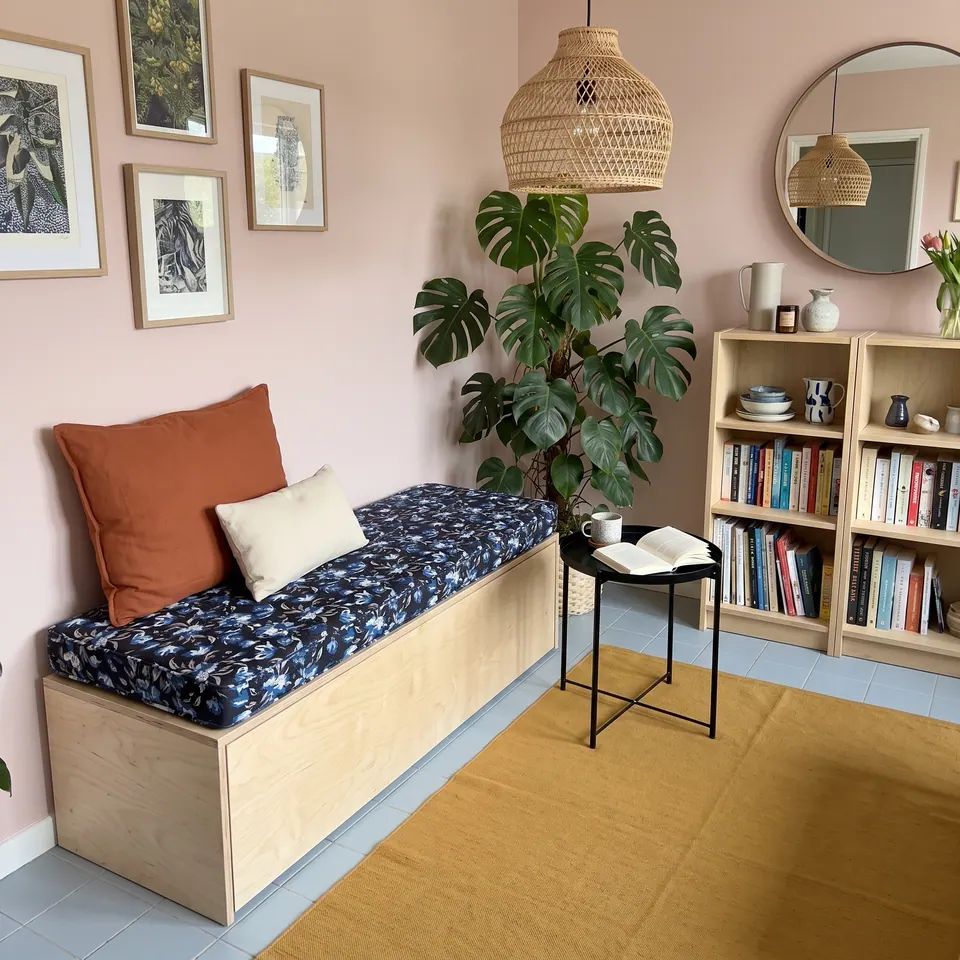
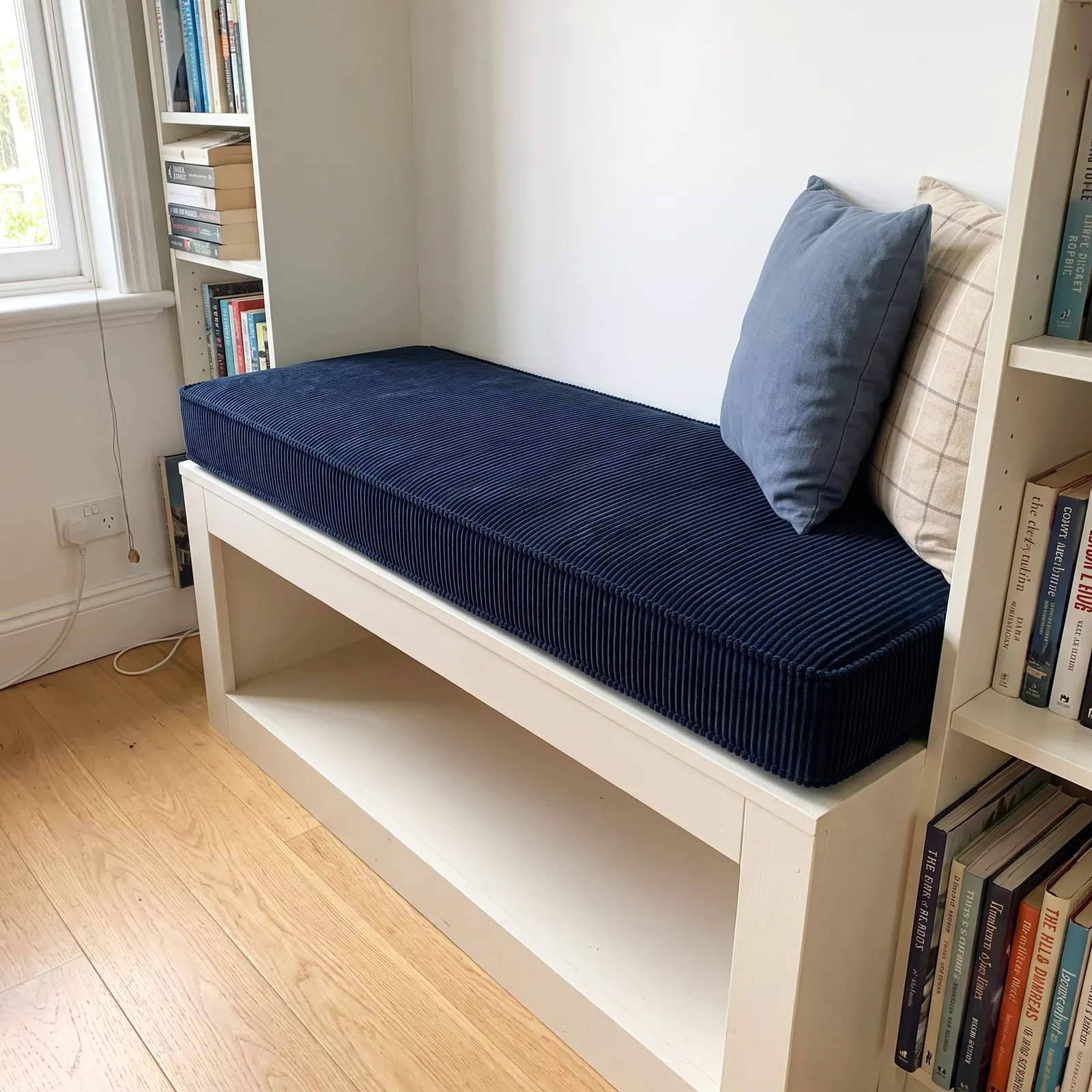
Two white bookcases, a sash window and a seat cut to the gap between them. Élodie reads the edge and shape of a navy corduroy reading bench.

 Save
The quick answer
A reading-nook bench cushion boxed in by bookcases should have a box edge, square corners and firm foam, and it should be cut to the gap between the cases rather than to the bench. In navy corduroy with self piping, the edge stays as crisp as the shelving, and firm foam keeps the seat from sagging into an open cube base.
The cushion, cut open
Cover fabric. A removable, zippered cover. Machine wash at 86°F (30°C) on a gentle cycle and air dry.
Piping. A fabric-covered cord sewn into the seams. It sits on the seam line, so it does not change the size.
Fiber wrap. Polyester fiber (Dacron) batting around the foam: it fills the cover out and softens the edges.
Foam core. About 2.0 lb/ft³ (32 kg/m³) high-resilience foam, firm to medium-firm, cut to the ordered size.
Zipper. Along the back band, as hidden as possible. The zipper side faces down or toward the wall.
Base panel. The underside of the cover. A non-slip fabric backing can cover the whole of it instead.
Pinned by Élodie: where the edge meets the shelves
Follow the pins from the navy seat to the two pillows, then down to the open cube and across to the bookcase that set the cushion's length.
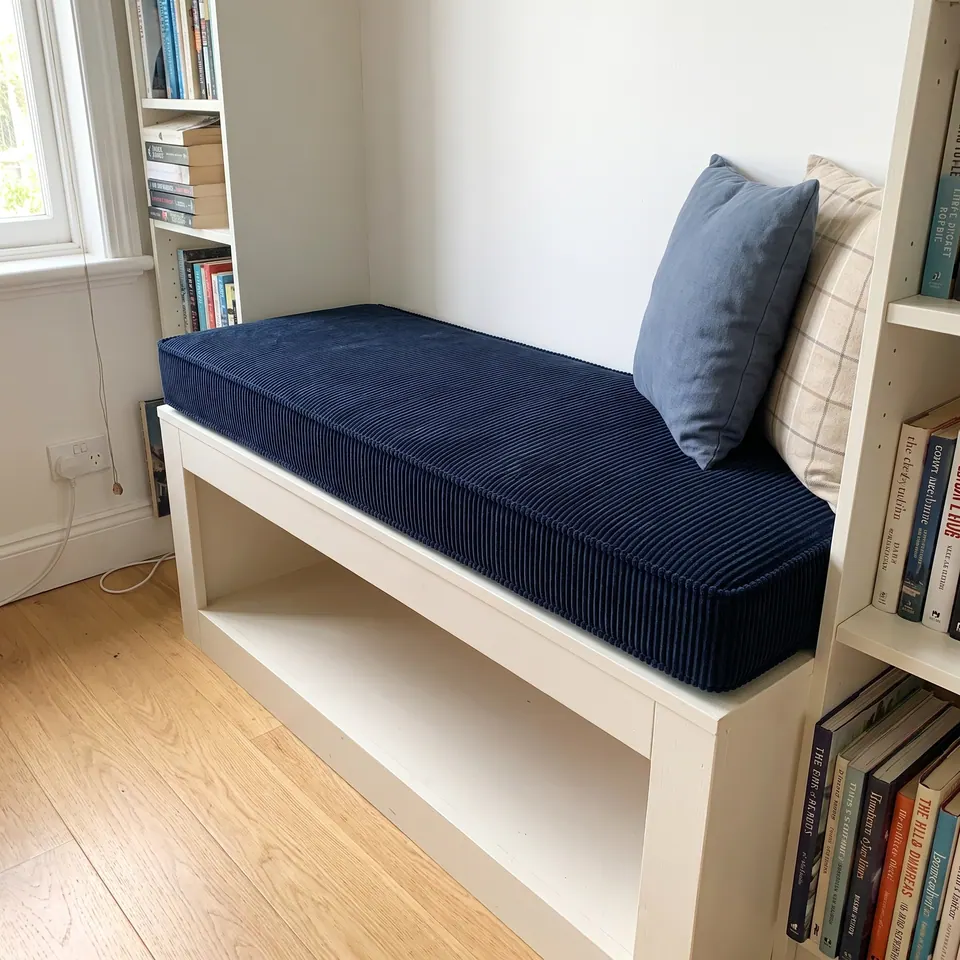
- Navy corduroy seat pad
Navy cord is forgiving in a nook used daily; it hides wear and pet hair better than pale linen.
- Dusty-blue pillow
A lighter blue steps the color down from navy to the white wall behind.
- Windowpane check pillow
The oatmeal check adds pattern without competing with the corduroy ribs.
- Open shelf under seat
Over an open cube the cushion needs firm foam so it will not sag into the gap.
- Flanking bookcase
With bookcases on both sides, the cushion was cut to the gap between them, not to the bench.
- Navy corduroy seat padNavy cord is forgiving in a nook used daily; it hides wear and pet hair better than pale linen.
- Dusty-blue pillowA lighter blue steps the color down from navy to the white wall behind.
- Windowpane check pillowThe oatmeal check adds pattern without competing with the corduroy ribs.
- Open shelf under seatOver an open cube the cushion needs firm foam so it will not sag into the gap.
- Flanking bookcaseWith bookcases on both sides, the cushion was cut to the gap between them, not to the bench.
Why a box edge, and why the corners stay square
Look at the front of this seat, my friends. It is a box edge: a flat top, a flat bottom and an upright side wall between them, with a self-piped line at each seam. Beside rows of hardbacks, that upright side reads like one more spine on the shelf.
A knife edge, two panels sewn straight together, would dome in the middle and thin to a lip at the front. Lovely on a throw pillow. Wrong here, where the eye expects the seat to line up with the shelving. The box edge vs knife edge Pattern has the long version.
The corners stay square because the space is square. Rounded corners would leave a small dark gap at each end, and gaps collect crumbs and charging cables. The length comes from the bookcases, not the bench: cut too long, the cushion bows up in the middle; cut too short, it slides.
Now the color. Navy corduroy gives the white joinery a dark anchor, and its ribs catch the window light in fine parallel lines, so the seat reads as deep ink rather than flat black. The eye sits down first, and here it sits on navy. In a nook used daily, navy cord also hides wear and pet hair better than a pale linen.
The pillows step the color down: dusty blue linen in front, an oatmeal windowpane check behind, then the white wall. The check brings pattern without fighting the ribs. More ribbed cloth waits on the corduroy shelf, and the bench cushion builder lets you try an edge before you order. What stands on either side of your bench?
Four edges, read in one nook
| Edge or corner | How it reads | Where it belongs |
|---|---|---|
| Box edge, square corners | Upright side wall, crisp as shelving | Seats boxed in by walls or cases |
| Knife edge | Domed center, thin front lip | Throw and lumbar pillows |
| Rounded corners | Soft outline, no points | Freestanding benches in a walkway |
| Angled corners | Cut to follow a slanted wall | Bay windows and trapezoid seats |
Side-by-side photos, then a second bench
A buyer in the US came to the workshop with two benches and a careful eye. Before choosing, she asked for photos of one linen laid beside several velvets. She settled on the linen with a contrasting piping, for cushions of 77 x 16.75 in (196 x 43 cm) and 44 x 15.5 in (112 x 39 cm).
They took five to seven days to make and three to five to arrive. She loved them, and she came back for a 20 x 78 in (51 x 198 cm) cushion in dark gray corduroy with dusty pink piping. Again she asked to see the two fabrics side by side before anything was cut.
That is the lesson I keep above my table. A color alone is half a decision; the piping beside it is the other half.
On the cutting table: the navy reading bench
| Piece | Custom bench cushion for a reading nook |
|---|---|
| Edge | Box edge with square corners |
| Fabric | Navy corduroy |
| Piping | Self piping in the same navy cord |
| Length | Case to case, with only a little ease |
| Foam | Firm, so it will not sag into the open cube below |
| Back support | Two stacked pillows, no fixed back cushion |
| Best for | Daily reading, pets, a nook with window light |

Have it made
Have this made — ask Élodie’s workshop
Describe the room at four in the afternoon: the floor, the wall, the one color you love. That is where a good fabric choice begins. — Élodie
Leave your details and the workshop will call you to confirm measurements, fabric, foam and piping. No prices, dates or payment on this page: it is a request, not an order.
Buyer questions: pairs, remakes and truer photos
- A common question
If I order two or more custom bench cushions, is there a discount?
The workshop's answerYes, the workshop discounts multiples. Two 98 x 17.5 x 3 in corduroy bench cushions came out cheaper each than a single one would, and four linen cushions of about 19.75 x 43.75 in (50 x 111 cm) were quoted as a set for less than four singles.
- A common question
My cushion came in the wrong size, or with the fabric and piping colors swapped. Can you fix it?
The workshop's answerSend the workshop a tape-measure photo. Past cases where the mistake was the workshop's include cushions made 24 x 40 in instead of 16 x 40 in, one cut 15 in (38 cm) long instead of 19.25 in (49 cm), and main and piping colors reversed; those were remade and sent with tracking.
- A common question
The swatches online are tiny. Could you send larger photos of the oatmeal, flax and greige linens?
The workshop's answerYes. The workshop sends close-up phone photos of any fabric code on request. In one comparison, two of the neutrals looked grayer while two others were lighter and warmer. The photos are not taken with a professional camera, so tones can shift with the light; some buyers ask for a shot beside a sheet of white paper.
A reading-nook bench cushion boxed in by bookcases is measured from case to case, never from the bench it happens to sit on.
Élodie
Questions buyers ask next
Box edge or knife edge for a bench cushion wedged between two bookcases?
A box edge. Its flat, upright side lines up with the shelving and keeps the seat depth even from end to end. A knife edge domes in the middle and thins at the front, which suits a throw pillow better than a fitted seat.
How snug should a cushion be when it sits between two fixed cases?
Snug, with only a little ease. Measure case to case at the front and at the back of the seat. Too long and the cushion bows up in the middle; too short and it slides and leaves gaps at the ends.
Why does a cushion over an open cube base need firmer foam?
The cushion spans the openings with nothing underneath to hold it up. Soft foam dips into each gap and the seat looks lumpy. Firm foam bridges the cubes and stays flat under a reader for hours.
With color and care — Élodie
More photographs to read
 Save
 Save
 Save
 Save
 Save
 Save