 Save
- Mustard bouclé pad
A bright plain on top shows the color at full strength.
- Taupe bouclé pad
A mid-tone plain buffers the bold solid from the busy print.
- Geometric jacquard pad
Cream piping traces the lightest yarn in the weave.
- Eucalyptus sprig
A single stem softens the hard stacked edges.
- Piping seam line
Straight welt lines on all three show consistent sewing.
Plate Mustard, Taupe and Geometric Seat Pads in a Tidy Stack
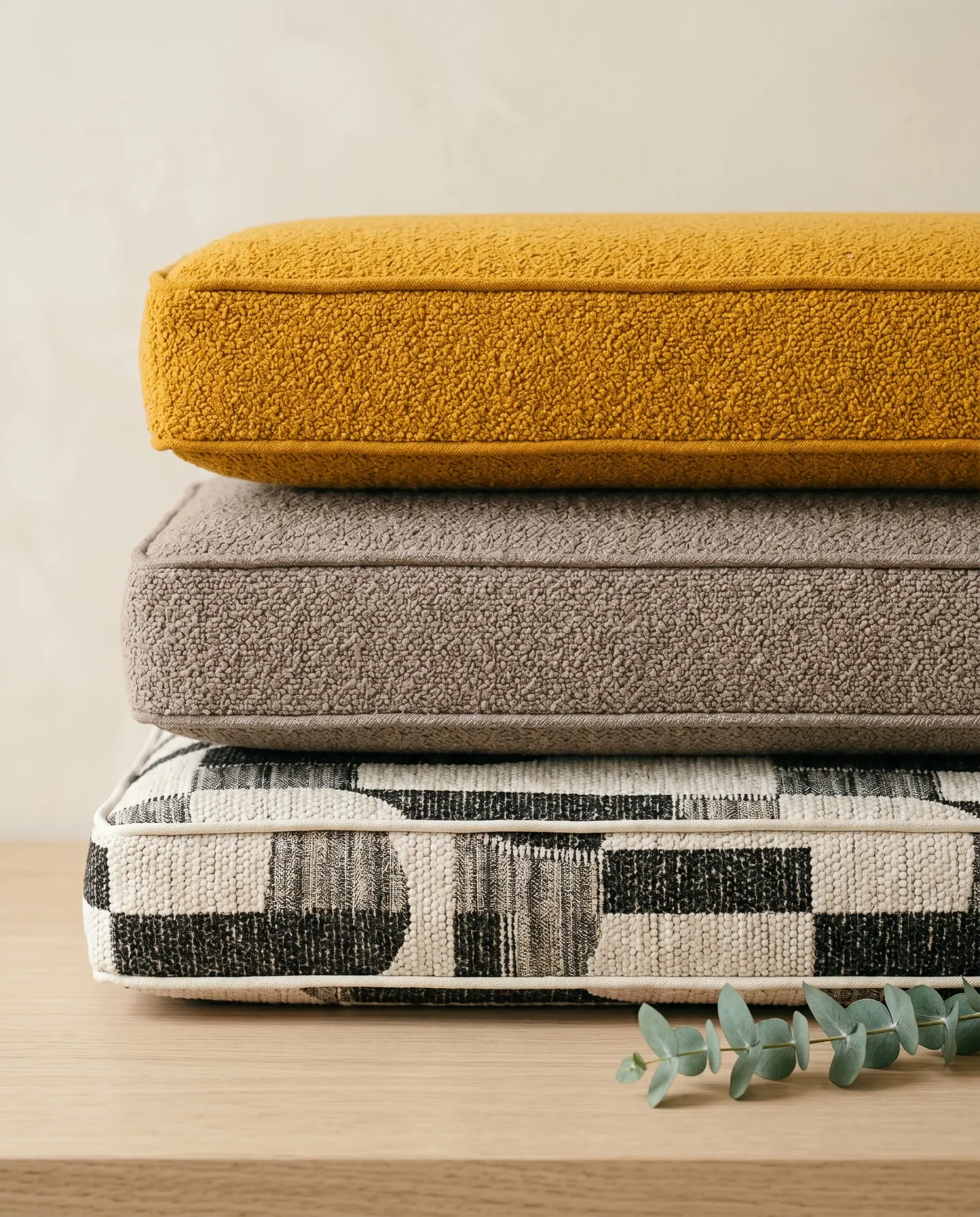
Mustard, taupe and a graphic jacquard, stacked warm to cool so the edges and depths can be compared at a glance.
A Reading by MaggieBench Cushions
Three stacked bench pads and the finishing details that give a maker away
Mustard, taupe and a black-and-cream geometric, stacked on an oak table like books on a shelf. Maggie reads the edges the way an old seamstress reads a hem: from the corners in.

The quick answer
You can judge a custom bench pad's hand finishing from its edges: the piping should run straight along every side, the box walls should match in height across a set, corners should turn crisp rather than puckered, and patterned pieces should take their piping color from the weave. In this stack of three, every one of those checks passes.
Read a cushion from the corners in
Right, then. Stack three cushions and the truth comes out. A stack is the cruelest test in upholstery, because every edge sits an inch or two from its neighbor and nothing can hide.
Mustard bouclé on top, taupe bouclé in the middle, a black-and-cream geometric jacquard at the base. Three cloths, one family. All three share the same thickness and the same box edge, so the side walls line up like the spines of a matched set of books. That is the first thing I check on any custom bench cushion set: do the walls agree?
Now the welts. There are six piping lines in this photograph, top and bottom of each pad, and not one of them wanders. A straight welt is a kind of honesty. A welt that drifts tells you the maker hurried a corner or stretched the cloth to cover a bad cut. These run true from corner to corner.
The corners themselves turn square and flat, with no bunching where the boxing strip bends. On bouclé that takes patience, because the loops push back against the needle and want to ride up the seam.
The jacquard carries the cleverest detail. Its piping is cream, lifted from the lightest yarn in the weave, so the outline reads as part of the pattern rather than a frame around it. Match your cord to the quietest color in a print and the print stays in charge. The Pattern on piping choices goes further.
The taupe earns its keep too. A mid-tone plain between a bold solid and a busy print lets both of them breathe, the same trick I use when a banquette mixes plain seats with patterned backs.
A finishing checklist for any bench pad
- Piping runs straight along every edge, with no wobble at the corners
- Box walls measure the same height on every piece in a set
- Corners turn square, with no pleats or bunching in the boxing strip
- Piping on a patterned pad picks up one color already in the weave
- The zipper sits on the back wall, where it disappears once the pad is down
- Firmness was written into the order, not left to chance
Pinned by Maggie: three pads, one welt line
Five pins run down the stack, from the mustard top and taupe buffer to the jacquard's cream cord, the seam line and one eucalyptus stem.
The numbers match the pins on the plate.
- Mustard bouclé padA bright plain on top shows the color at full strength.
- Taupe bouclé padA mid-tone plain buffers the bold solid from the busy print.
- Geometric jacquard padCream piping traces the lightest yarn in the weave.
- Eucalyptus sprigA single stem softens the hard stacked edges.
- Piping seam lineStraight welt lines on all three show consistent sewing.
Say firm, and say it in writing
A buyer messaged the workshop wanting two back cushions, 19 3/4 x 27 1/2 in (50 x 70 cm), in navy velvet to match a sofa they already loved. Then came a second request: two more at 35 1/2 x 11 3/4 in (90 x 30 cm), about 4 3/4 in (12 cm) thick, and those had to be firm.
The workshop confirmed firm foam for them before a single panel was cut. That is the whole lesson. I have made the opposite mistake myself, years back, assuming 'back cushion' meant soft.
If you want firm, dear, write firm in the order note, in plain words. Nobody can sew what nobody was told.
On the cutting table: the stacked trio
| Pieces | Three rectangular bench pads, box edge |
|---|---|
| Top | Mustard bouclé, self piping |
| Middle | Taupe bouclé, self piping |
| Base | Black-and-cream geometric jacquard, cream piping |
| Thickness | Equal on all three, so the set reads as one family |
| Firmness | Stated in the order note; firm foam when asked |
| Back cushion fill | Shredded foam about 4 in (10 cm) thick, or a fiber-wrapped solid core for a flatter panel |
| Best for | Banquettes and benches that mix plain seats with patterned backs |

Have it made
Have this made — ask Maggie’s workshop
Have the tape measure handy when they call. Old cushions shrink and sag; the seat underneath does not. — Maggie
Leave your details and the workshop will call you to confirm measurements, fabric, foam and piping. No prices, dates or payment on this page: it is a request, not an order.
Buyer questions: cleats, greens and uncompressed covers
- A common question
Could you build a headboard-style backrest that hangs on the wall with a French cleat?
The workshop's answerNo. The cushions have no rigid board inside, so a French cleat won't work. Ties can be sewn to the top corners instead, so the backrest hangs from hooks or a rail. It is built like the back pillows: a removable piped cover over shredded foam about 4 in (10 cm) thick, or a solid foam core wrapped in fiber for a firmer, flatter panel.
- A common question
Is L25 truly green, or does it drift toward blue?
The workshop's answerL25 is a dark, muted green with a slight cool undertone. Under warm indoor light it reads deep green; in cool daylight it can lean a little teal. It is not a blue fabric.
- A common question
Can the cover travel without being vacuum-compressed along with the cushion? I'm worried about the fabric.
The workshop's answerYes. The request goes to the packing team, and the cover ships in the same box without being compressed together with the backrest.
Three bench pads stacked together tell the truth: six piping lines, one thickness, and not a single welt wandering at the corners.
Maggie
Questions buyers ask next
How can I tell if cushion piping was sewn well?
Sight along the edge at eye level. Good piping runs straight and even from corner to corner, with the cord fully filled and no flat spots. Wobbles at the corners usually mean the cut or the turn was rushed.
Should every bench pad in a set be the same thickness?
When pieces sit side by side or stack, yes. Equal box walls make mixed fabrics read as one family. Different thicknesses make sense only where seat and back do different jobs, such as a firm seat under a softer back.
Why put a plain cushion between a bold solid and a print?
A mid-tone plain works as a buffer. It gives the eye a rest between two strong fabrics, so neither fights the other. On a banquette, that can be a taupe or oatmeal back cushion between mustard seats and a patterned lumbar pillow.
Stitch straight — Maggie