CushionGuide

A Reading by ÉlodieBench Cushions

Five bench cushions, five piping pairs: a color study in linen-look fabric

Élodie reads a stack of box cushions on cream paper as a palette: which pairs whisper, which one shouts, and how to carry the test home to your own wood and walls.

The quick answer

To choose piping for a custom bench cushion, borrow the piping color from something already in the room, then judge the pair from across the room in daylight. In this stack of five linen-look box cushions, sage with oatmeal is the quietest pairing and antique gold with denim blue the boldest, and every welt repeats another cushion's body color.

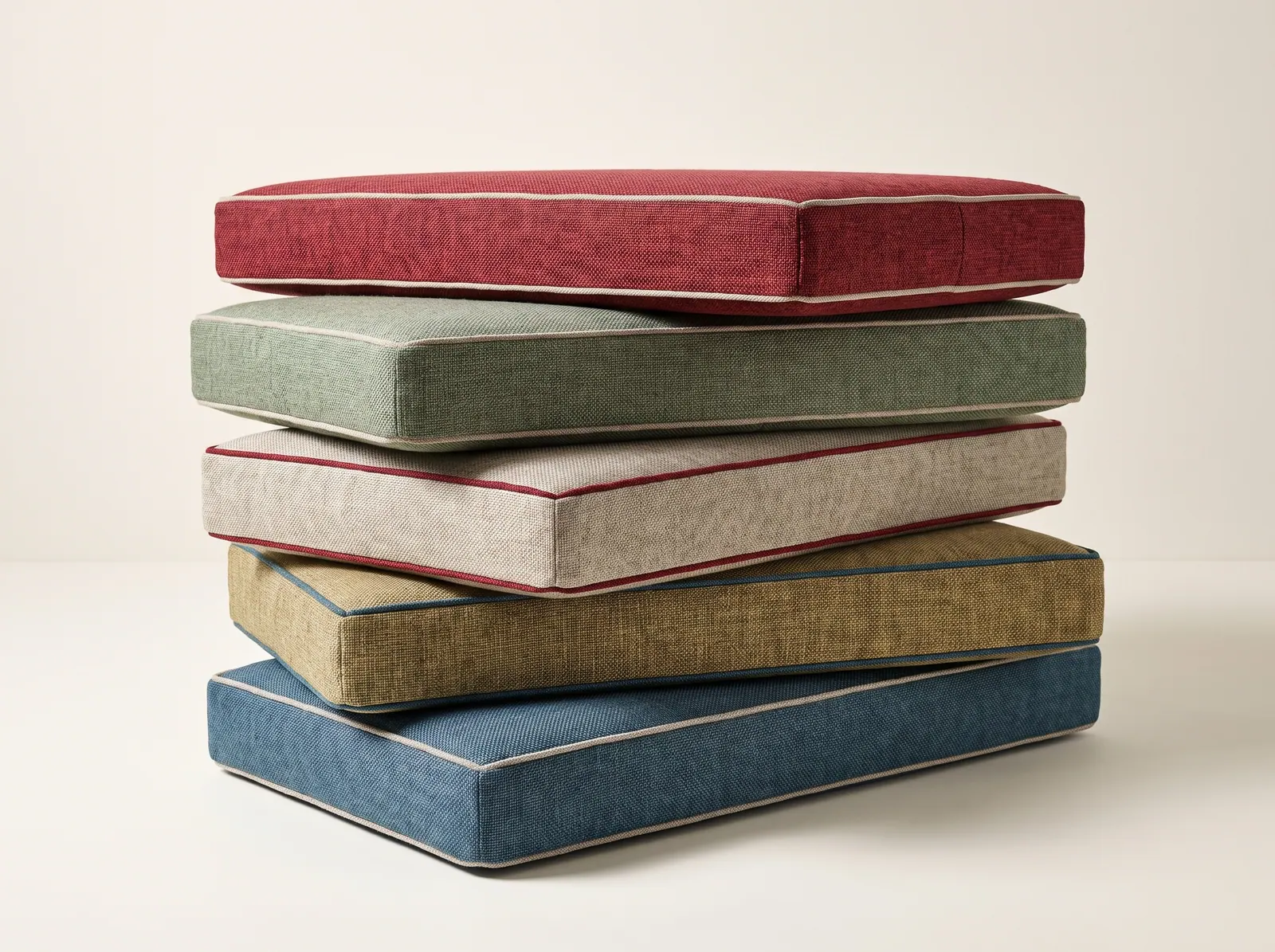
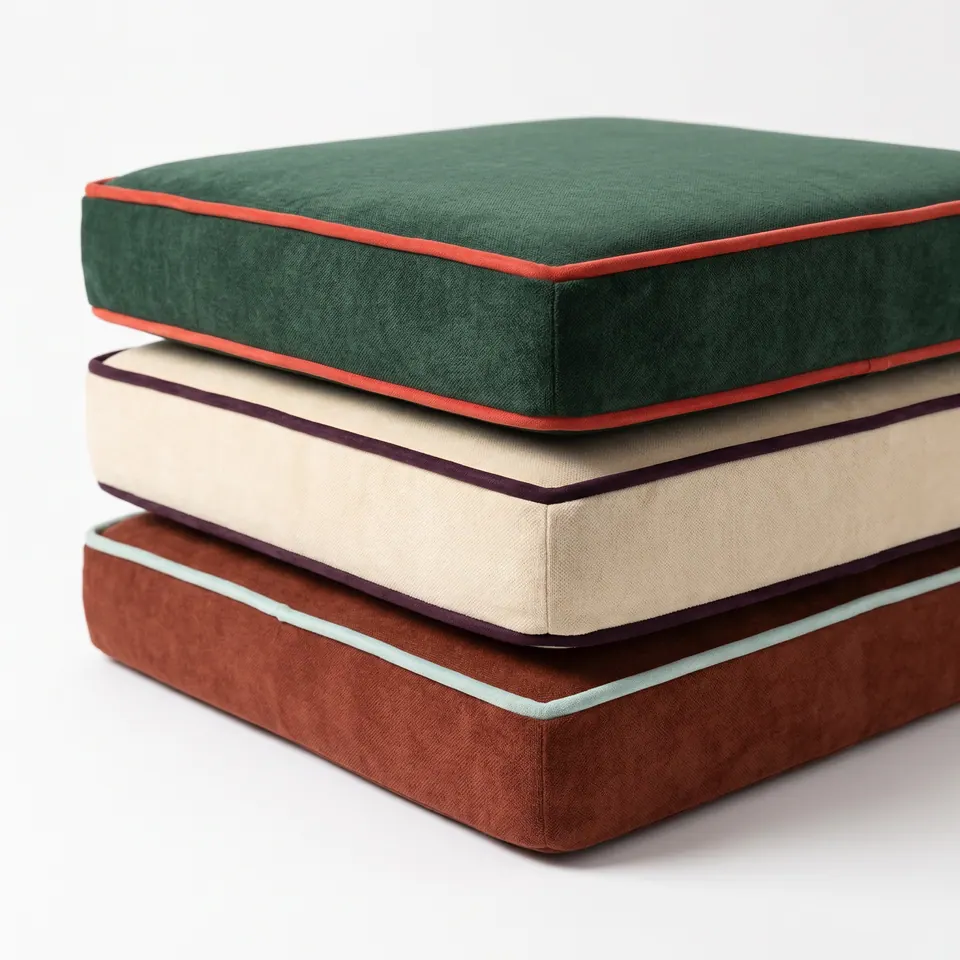
Stack of five piped box cushions in cherry red, sage, oatmeal, antique gold and denim blue on a cream backdropSave
Five box cushions stacked to compare body and piping pairs, from cherry red with oatmeal to gold with blue.

Pinned by Élodie

Read the pins from top to bottom, one body-and-welt pair at a time, ending on the denim blue base.
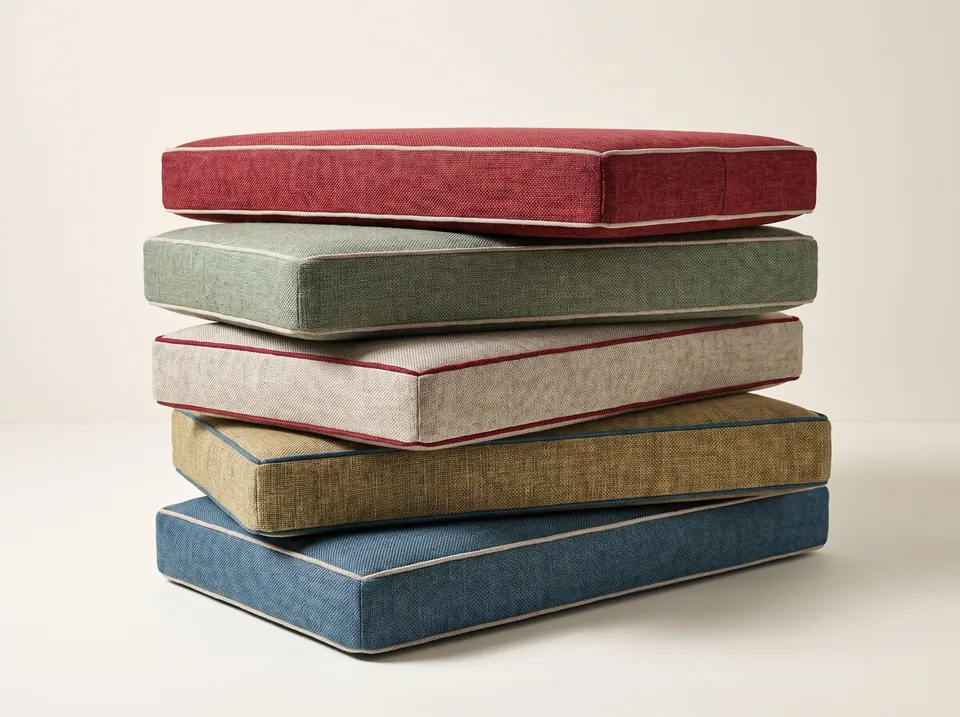
Pinned: Stack of five piped box cushions in cherry red, sage, oatmeal, antique gold and denim blue on a cream backdrop
  1. Red with oatmeal welt

    The top cushion pairs cherry red with a pale oatmeal piping.

  2. Sage with pale welt

    Sage and oatmeal are the softest pairing in the stack.

  3. Oatmeal with red welt

    The red and oatmeal pair is reversed here, with the piping in red.

  4. Gold with blue welt

    Antique gold piped in blue is the boldest contrast of the five.

  5. Denim blue base

    The darkest color sits at the bottom to steady the stack visually.

  1. Red with oatmeal weltThe top cushion pairs cherry red with a pale oatmeal piping.
  2. Sage with pale weltSage and oatmeal are the softest pairing in the stack.
  3. Oatmeal with red weltThe red and oatmeal pair is reversed here, with the piping in red.
  4. Gold with blue weltAntique gold piped in blue is the boldest contrast of the five.
  5. Denim blue baseThe darkest color sits at the bottom to steady the stack visually.

Swatch strip: five bodies, five welts

  • Cherry red, oatmeal welt#9B2D30Top of the stack: warm and confident, lightened by a pale line.
  • Sage, oatmeal welt#9DAA8EThe quietest pair; the welt nearly dissolves in daylight.
  • Oatmeal, cherry red welt#D8CCB2The first pair reversed, so the red line does the talking.
  • Antique gold, denim welt#B38D45The boldest contrast: a warm body with a cool cord.
  • Denim blue base#50698ADarkest at the bottom, so the stack stands steady.

Reading the stack, then reading your room

My friends, a stack like this is a color chart you can sit on. Five box cushions in linen-look fabric, each with its own body and its own welt, rest on warm cream paper in even studio light. Nothing in the frame argues with them.

Read from the top. Cherry red wears an oatmeal welt, and that pale line keeps a strong red from feeling heavy. Sage with oatmeal is the softest pairing; the piping almost melts. Then the red and oatmeal pair returns reversed, so you can ask yourself which you prefer: a pale line on red, or a red line on pale. Antique gold piped in denim blue is the loud one, warm against cool. Denim sits at the bottom because the darkest color steadies a stack, the way a dark rug steadies a room.

Notice the quiet trick. Every welt color is borrowed from another cushion in the stack, which is why these five could live in one house. Let one color speak and the others listen.

Your room is not cream paper. Honey oak pulls gold and red forward and makes sage look grayer; white walls and north light cool everything by a shade. So lay your body swatch beside two or three piping swatches on the actual bench, then walk to the doorway and look again. Close up you judge texture; from across the room you judge the pair.

The piping pattern covers matching versus contrast, the linen-look shelf holds the full range of these weaves, and the bench cushion builder lets you try a welt before you order. Which color already in your room would you borrow for the piping?

A real project

Seven back pillows in charcoal gray

A buyer got in touch needing only back pillows for a banquette she already had: seven of them, each 14 in (36 cm) tall and 3 in (7.5 cm) thick, in three widths. Three at 21 in (53 cm), three at 26 in (66 cm) and one at 27 in (69 cm), all in a charcoal gray linen-look with matching piping, and not tufted.

She looked at a standard floor-sofa style for a moment, but standard pieces cannot be resized, so she stayed with made-to-measure bench cushions. When the checkout total didn't look like the quote, the cure was simple: read the quote back line by line, piece by piece, before paying. Seven cushions in three widths is exactly where a number slips.

On the cutting table: the color stack

PiecesFive box cushions, photographed stacked
FabricLinen-look weave
ColorsCherry red, sage, oatmeal, antique gold, denim blue
PipingContrast welts on both seams, borrowed from within the set
EdgeBox edge with crisp sides
What's includedFull cushion with foam insert; covers alone are a separate listing
Backrest heightWall height minus seat thickness
Best forTesting color pairs before a bench or banquette order

Order this cushion

Have it made

Have this made — ask Élodie’s workshop

Color is easier to settle in a conversation than on a screen. Tell the workshop about the room and the light it gets, and the fabric choice follows. — Élodie

Leave your details and the workshop will call you to confirm measurements, fabric, foam and piping. No prices, dates or payment on this page: it is a request, not an order.

Fabric · Foam · Pipingwhat the workshop will confirm with you

Fabric
Linen-look weave
Foam
Full cushion with foam insert
Piping
Contrast welts on both seams, borrowed from within the set
Only for this request: no marketing calls or texts. Outside the US, add the country code.
In inches: length × depth × thickness, plus any angles or cut corners.

* Required. A member of the workshop team will call you to talk it through; nothing is charged and nothing is made until you have agreed on every detail with them.

We use these details only to answer this request and make your cushion: your name and contact details, the cushion details and photos you send, the page you came from and the ad or link that brought you, if any. The workshop that makes the cushions receives them. We don't sell them or share them for advertising, and we delete requests after 24 months. Privacy notice for requests.

Nothing is made or charged until you approve the details.

Want to pick the shape and add photos? Use the full quote form

Buyer questions: foam included, back heights and liners

  1. A common question

    When I order a bench cushion, do I get just the cover or the whole thing with foam?

    The workshop's answer

    The whole cushion, with the foam insert inside and ready to use. If you only need a cover, there is a separate zippered cover-only listing for that.

  2. A common question

    Measuring for a backrest, do I take the seat cushion's thickness off the wall height?

    The workshop's answer

    Yes, because the backrest sits on top of the seat. With a 4 in (10 cm) seat, a 21 in (53 cm) back area needs a 17 in (43 cm) backrest. One buyer with a 22½ in (57 cm) back area cut the backrest to 17¾ in (45 cm) after learning the seat would be 4 to 5 in thick.

  3. A common question

    If I buy backrest filling, does it go straight into my cover, or does it have its own liner?

    The workshop's answer

    It has its own inner liner. Slip the filled insert into the outer cover you already have, and the outer cover can come off for washing whenever you like.

Borrow the piping color for a bench cushion from something already in the room, and three or four colors will still read as one house.

Élodie

Questions buyers ask next

Should bench cushion piping be lighter or darker than the body?

Either works; what matters is how strong the contrast is. A pale welt on a dark body, like oatmeal on cherry red, lightens the cushion. A dark welt on a pale body, like red on oatmeal, sharpens the outline. Choose by whether the seat should recede or stand out.

How many piping colors can one room carry?

Usually two, three at most. Borrowing each welt from a cushion body or another textile already in the room, as this stack does, keeps several colors feeling related rather than scattered.

Why judge a piping swatch from across the room?

Piping is a thin line, and thin lines change with distance. Up close you see weave and texture; at ten feet you see only whether the line reads quiet or loud. A bench is mostly seen from the doorway, so judge it there.

With color and care — Élodie