 Save
A Reading by NateBench Cushions
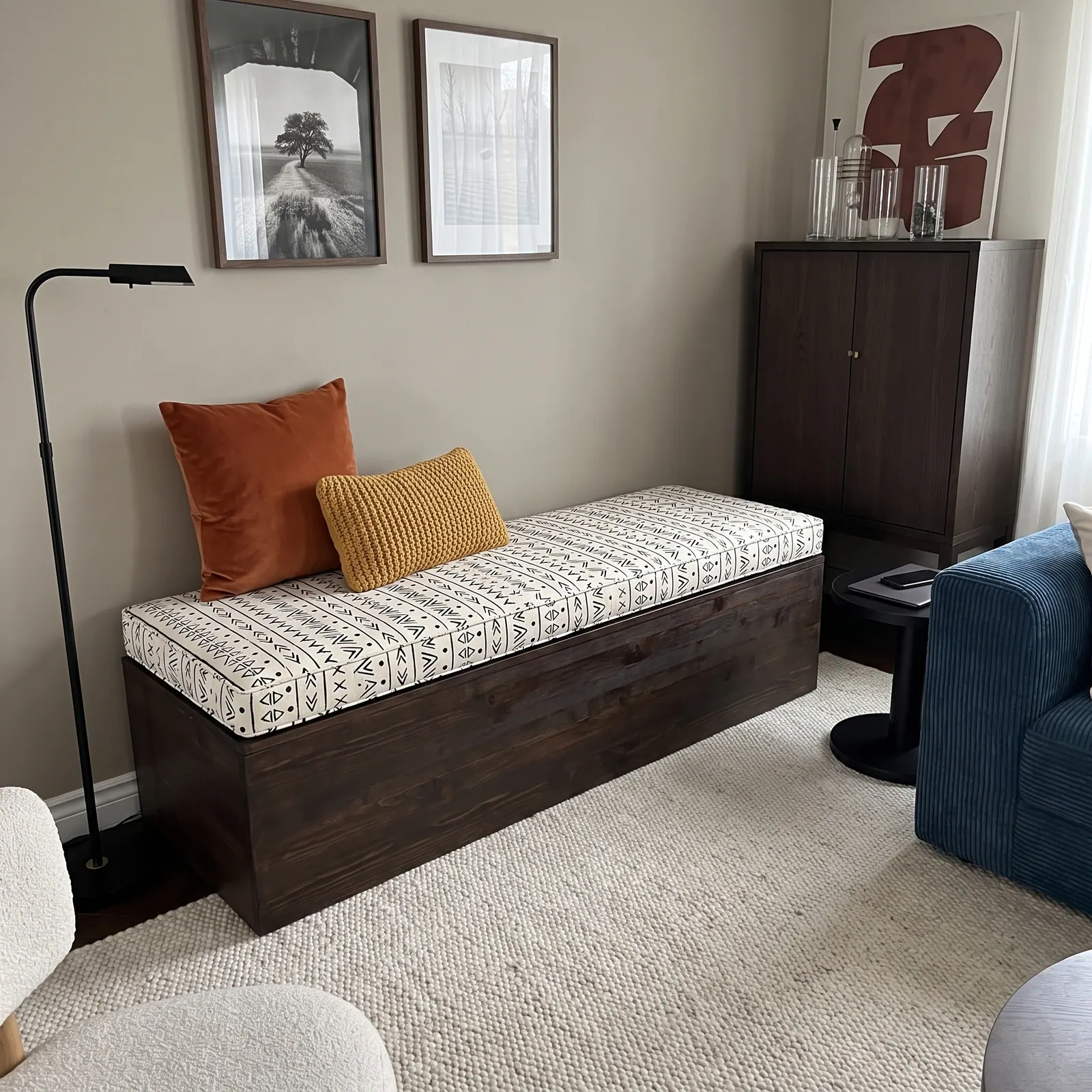
A cream mudcloth-style bench cushion on a dark box, measured for proportion
A dark box, a pale cushion, and the question I answer every week: how thick? The answer is a subtraction, and this photo shows the result.
A cream mudcloth-style cushion on a dark-stained box, warmed by rust velvet and a mustard knit lumbar. The black lamp and frames echo the print.

The quick answer
Choose bench cushion thickness by working back from seat height: box height plus cushion thickness should land near 18 in (46 cm), inside the usual 17 to 19 in range. A 4 in (10 cm) cushion is the everyday standard; choose 3 in (7.5 cm) on a taller box, and remember a back cushion takes about 3 in off the usable depth.
Light on dark, and the arithmetic underneath
Start with the silhouette. A dark-stained timber box, a cream cushion on top, a taupe wall behind. Light on dark lifts the seat visually, so the cushion reads as its own layer instead of melting into the wood. A dark print on this box would disappear; the photo has the polarity right.
Now proportion. If the box stands about 14 in (36 cm), a 4 in (10 cm) cushion puts the seat at 14 + 4 = 18 in (46 cm), the finished height most chairs and dining benches aim for. The cushion looks generous without looking like a mattress, and that ratio is the whole trick.
The self piping keeps the edge quiet, so the black marks in the print do the talking. The black swing-arm lamp and the two black-and-white photographs repeat those marks at eye level. A rust velvet pillow and a chunky mustard knit lumbar warm the taupe wall: two textures, one color family. The blue corduroy sofa stays out of the bench's palette entirely, so the room reads as two seats with separate jobs. The cream bouclé armchair and wool rug tie back to the cushion's ground.
One note on wear: a cream ground shows marks sooner than a darker print, so this custom bench cushion belongs in a living room rather than a mudroom.
So, what does your box measure, floor to lid?
Pinned by Nate
Five points where proportion and color were decided.
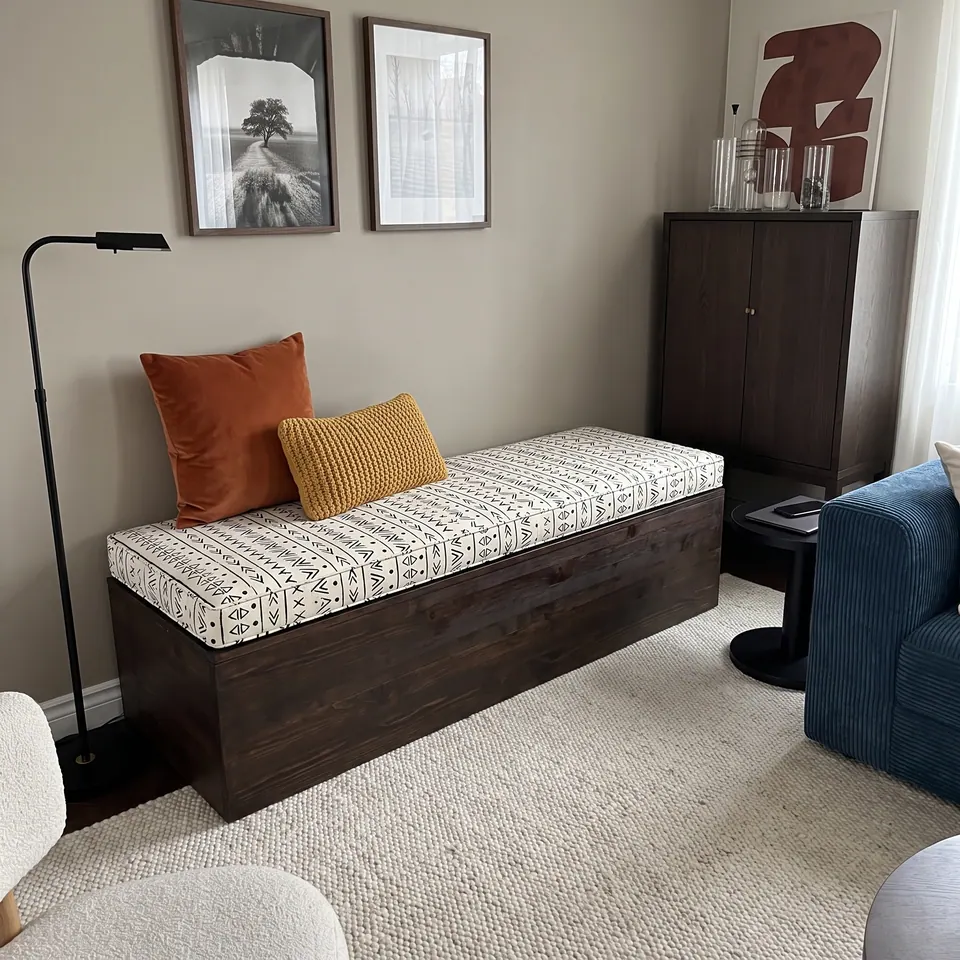
- Cream mudcloth-style cushion
A light print on a dark box makes the seat look lifted off the floor.
- Rust velvet pillow
Rust warms the gray-taupe wall and ties to the abstract print above the cabinet.
- Mustard knit lumbar
Knit next to velvet mixes two textures in one warm color family.
- Black reading lamp
The black lamp and frames repeat the black marks in the print.
- Dark stained box
Deep wood tones need a pale cushion; a dark print here would disappear.
- Cream mudcloth-style cushionA light print on a dark box makes the seat look lifted off the floor.
- Rust velvet pillowRust warms the gray-taupe wall and ties to the abstract print above the cabinet.
- Mustard knit lumbarKnit next to velvet mixes two textures in one warm color family.
- Black reading lampThe black lamp and frames repeat the black marks in the print.
- Dark stained boxDeep wood tones need a pale cushion; a dark print here would disappear.
Working back from 18 inches
Measure the platform
Floor to the top of the box lid, ± 1/4 in. Call it P. Measure twice; the fabric remembers.
Pick the target
Most dining and sitting seats finish at about 18 in (46 cm). The comfortable range is 17 to 19 in (43 to 48 cm).
Subtract
Target minus P gives the thickness T. A 14 in box wants 4 in; a 15 in box wants 3 in. Standard options are 2, 3, 4 and 5 in (5, 7.5, 10 and 12.5 cm), and in-between values like 4 1/2 in can be written into the order.
Allow for settling
Foam settles a little under use: 3 in can sit closer to 2 1/2 in. If you land between two sizes, take the thicker one.
Check the depth
Seat depth D runs front to back. A back cushion takes about 3 in (7.5 cm) of it, so a 22 1/2 in (57 cm) bench leaves roughly 19 1/2 in (50 cm) to sit on. The seat height calculator runs the same numbers.
Two built-ins, 219 inches of seat
A buyer in the US needed replacement cushions for two built-in benches in a community space: one 80 in (203 cm) long, the other 139 1/4 in (354 cm), both 22 1/2 in (57 cm) deep. The back cushions were sized as 23 1/2 in (60 cm) minus the seat cushion's thickness, because the seat cushion covers that much of the wall.
The long run could be split into two equal sections of 69 5/8 in (177 cm). In the end the buyer took a donated couch instead, with kind words for the work. The arithmetic still holds, partner: subtract the seat, then divide the run evenly.
- Sizes
- 80 x 22 1/2 in and 139 1/4 x 22 1/2 in; backs 23 1/2 in minus seat thickness
- Fabric
- Tufted velvet
The lesson: Subtract the seat thickness from the total back height, and split very long runs into equal sections.
Buyer questions: trade orders, tufting and L-benches
- A common question
I'm an interior designer. Do you have a trade or bulk discount?
The workshop's answerThere's no formal designer program, but a multi-piece project is quoted as one package, and larger orders have been quoted lower per piece. The workshop has still worked on price for a three-cushion project, and once took a little extra off when two cushions were ordered together.
- A common question
The tufted version has no zipper. How am I supposed to clean it?
The workshop's answerTufted cushions are cleaned in place with a damp cloth, and soft fabric in particular wipes clean easily by hand. If you want a cover that comes off for the washer, choose the non-tufted, foam-filled version, which has a zipper.
- A common question
For an L-shaped bench, should I get one L-shaped cushion or two separate ones?
The workshop's answerThe craftsmen recommend two separate seat cushions. A one-piece L makes the cover hard to take off, put back and keep snug, while two pieces are easier to handle, remove for washing and keep neat.
Bench cushion thickness is a subtraction: a finished seat height of about 18 in (46 cm) minus the box. A 14 in box wants a 4 in cushion.
Nate
The numbers on this bench
| Cushion | Box cushion for a dark-stained storage box |
|---|---|
| Fabric | Cream mudcloth-style print with black marks |
| Piping | Self piping |
| Thickness | 4 in (10 cm) standard; 2, 3 and 5 in (5, 7.5, 12.5 cm) also standard |
| Foam | about 2.0 lb/ft³ (32 kg/m³) high-density, medium-firm to firm |
| Seat height | Aim for about 18 in (46 cm); range 17 to 19 in |
| Depth | Allow about 3 in (7.5 cm) for any back cushion |
| Tolerance | Handmade, within about 1/2 to 1 in (1 to 2 cm) |
| Care | Zip-off cover, 86°F (30°C) gentle, air-dry |

Have it made
Have this made — ask Nate’s workshop
Send the numbers in inches: length × depth × thickness, plus any angle. The workshop checks them with you, because foam has no undo button. — Nate
Leave your details and the workshop will call you to confirm measurements, fabric, foam and piping. No prices, dates or payment on this page: it is a request, not an order.
Questions buyers ask next
Does a thicker cushion always make a bench more comfortable?
Only until the finished seat passes about 19 in (48 cm), the top of the usual 17 to 19 in range. On a tall box a 3 in (7.5 cm) cushion is the better proportion, and it is also the neater, lower profile often suggested for benches.
Should I take anything off my measurements before ordering?
No. Send the true length and depth of the bench top. The workshop adds its own seam and fit allowances and makes the cushion to the full size you give, within normal handmade tolerance.
How long can a single bench cushion be?
Very long cushions are usually suggested in two or more pieces for durability, handling and shipping, typically anything over about 75 in (190 cm). Equal sections look intentional and are easier to wash.
Is the standard bench foam memory foam?
No. Standard bench cushions use an about 2.0 lb/ft³ (32 kg/m³) high-density polyurethane foam, medium-firm to firm, wrapped in polyester fiber wadding. It holds its shape and resists sagging.
± 1/4 in — Nate
More photographs to read
 Save
 Save
 Save
 Save
 Save
 Save