 Save
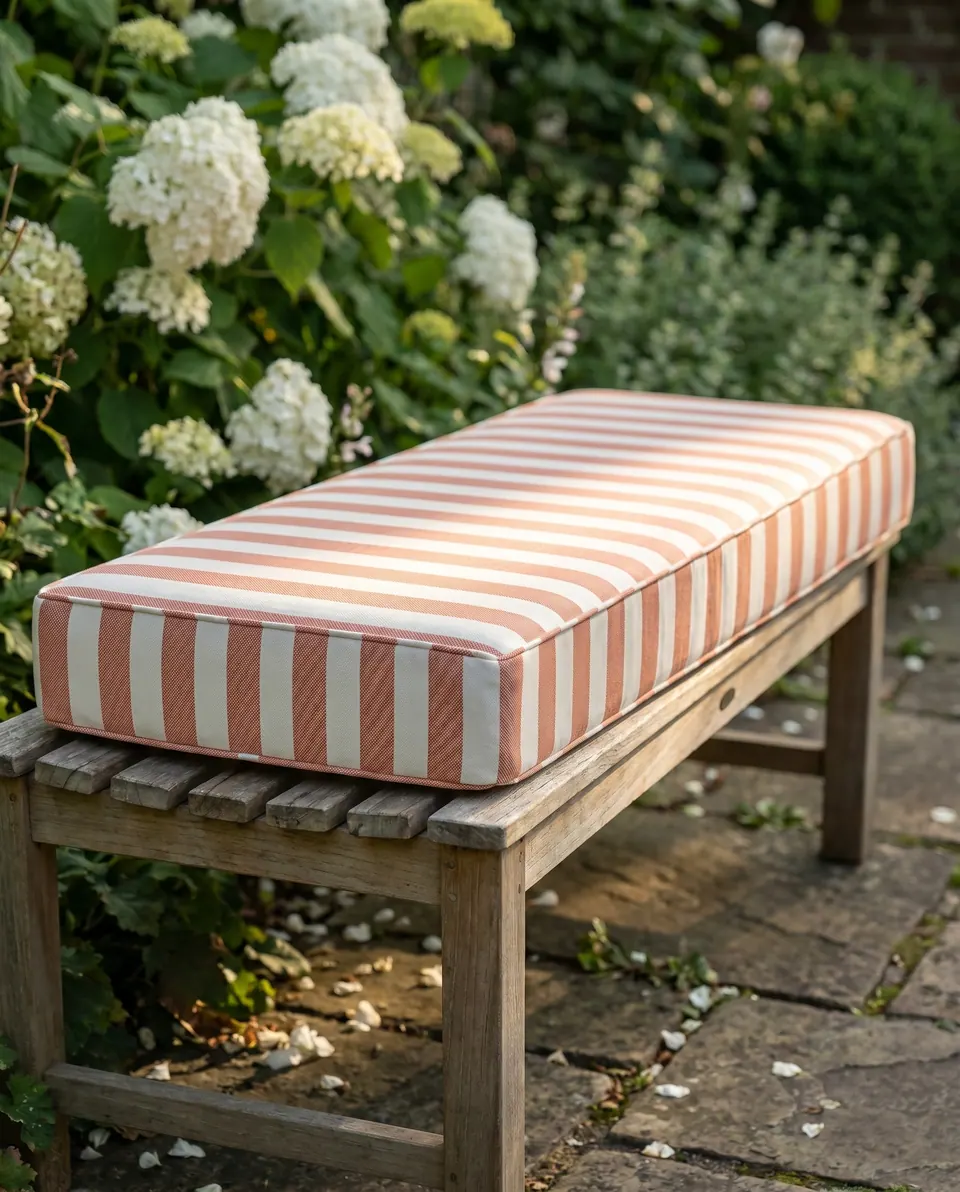
- Coral back pillow
The solid pillow repeats the stripe's coral exactly.
- Fuller pillow fill
A generous fill lets the pillow meet the uneven stone wall.
- Striped seat boxing
Self piping runs along the top and bottom of the striped boxing.
- Dahlias in terracotta
The pots share the warm coral note of the cushions.
- Pink geraniums
Softer pinks in the foreground keep the coral from shouting.
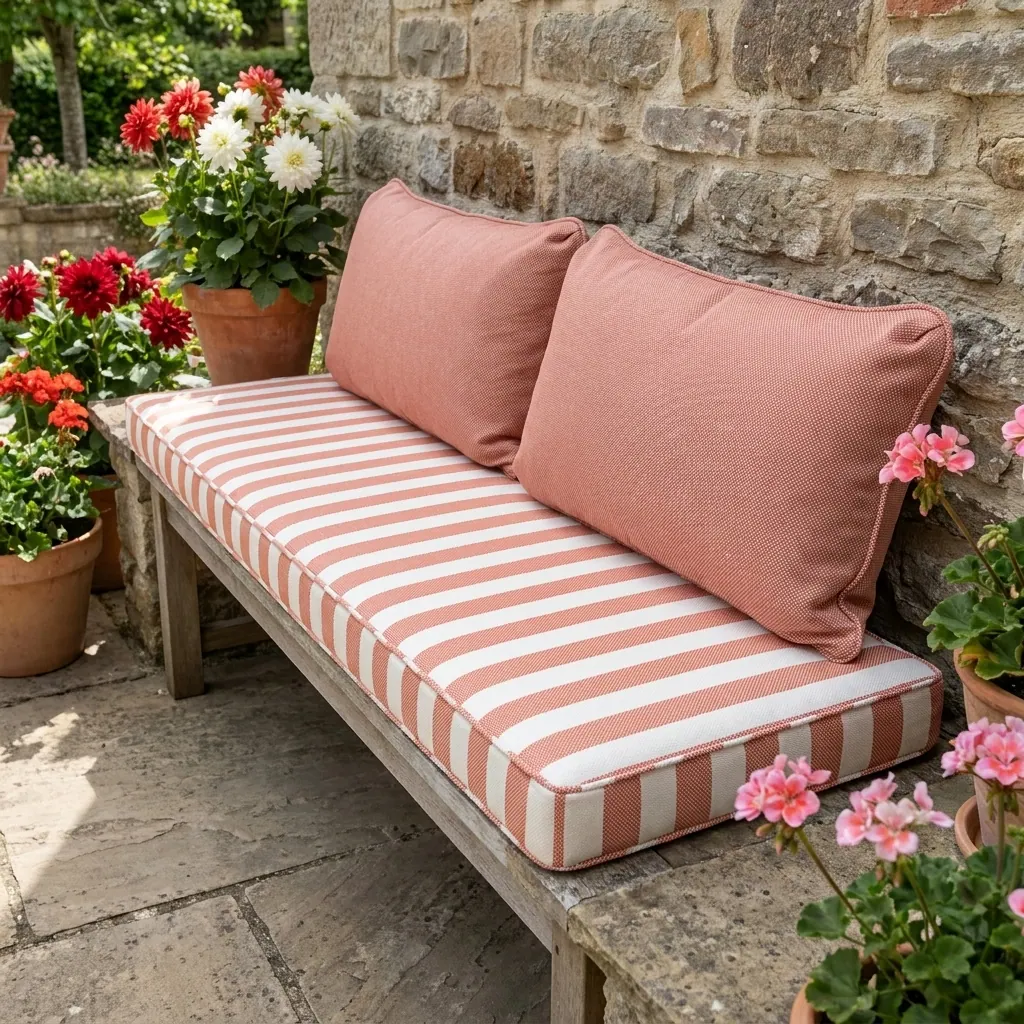
Plate Coral stripe bench cushion against a honey stone wall
Coral awning stripes and solid coral pillows bring warmth to a weathered bench set against old honey-colored stone, framed by dahlias and geraniums.
A Reading by CallumBench Cushions
Coral stripe garden bench cushion: firm underneath, soft behind
Callum reads a teak bench against old honey stone and explains what sits inside each piece: a firm box to sit on, and fuller pillows for a wall that was never straight.

The quick answer
A garden bench cushion used every day should be a firm box about 3 in (7.5 cm) thick, with softer back pillows. On this teak bench the coral-stripe seat holds a square edge to the end, while fuller pillows fill the gaps in an uneven stone wall. For heavy daily seating, the workshop recommends 3 or 4 in of firm 32-density foam.
Pinned by Callum: five marks on a sunny bench
Five pins, from the firm striped boxing to the pink geraniums that keep the coral from shouting.
The numbers match the pins on the plate.
- Coral back pillowThe solid pillow repeats the stripe's coral exactly.
- Fuller pillow fillA generous fill lets the pillow meet the uneven stone wall.
- Striped seat boxingSelf piping runs along the top and bottom of the striped boxing.
- Dahlias in terracottaThe pots share the warm coral note of the cushions.
- Pink geraniumsSofter pinks in the foreground keep the coral from shouting.
Firm under you, soft behind you: reading the fill
Three inches of firm foam under you, soft pillows behind you. That split is the whole design of this garden bench, and it's the part most people get backwards.
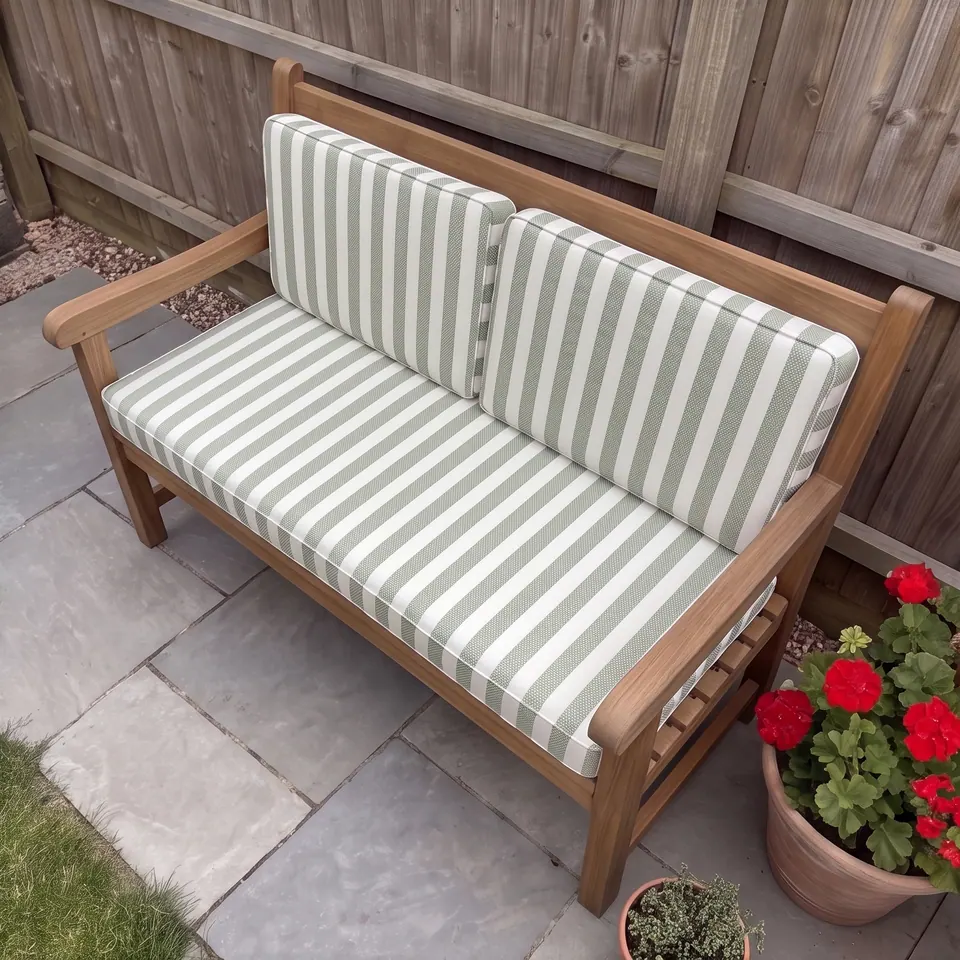
Start with the seat. It's a box-edge custom bench cushion in a coral and white awning stripe, with self piping along the top and bottom of the boxing. The front edge stays square right out to the end of the teak. That only happens when the core is firm foam that pushes back. A soft seat would crown in the middle and slump at the corners.
Now the back. Two solid coral knife-edge pillows lean on honey limestone, and dry stone is never flat. A firm foam back would touch the wall at two points and rock. A fuller, softer fill spreads out and meets every bump. So the rule runs one way: firm where you sit, soft where you lean. To put numbers on firm, try the foam density vs firmness Pattern and the foam firmness finder.
The cloth is a water-repellent membrane. Water beads and runs off the top. That's a surface promise, not a sealed core, so read water-repellent vs waterproof before you leave anything out overnight. Rain doesn't negotiate, friend.
The color came from the pots, not the flowers. Terracotta and old stone both carry coral, which is why the stripe looks as if it grew here. The pink geraniums in front soften it; without them the coral would shout. More seats like this sit under bench cushions and patio and porch cushions. What is your bench backed against: stone, siding or open air?
On the cutting table: seat and back, piece by piece
| Seat | Box-edge bench cushion, cut to the full length of the teak bench |
|---|---|
| Fabric | Coral and white awning stripe in a water-repellent membrane |
| Back pillows | Two knife-edge pillows in solid coral with a fuller, softer fill |
| Piping | Self piping, top and bottom of the striped boxing |
| Seat core | Firm foam, so the front edge stays square to the end |
| Daily-use thickness | 3 or 4 in (7.5 or 10 cm) of firm 32-density foam, about 2.0 lb/ft³ (32 kg/m³) |
| Setting | Weathered teak bench, honey limestone wall, flagstone paving |
| Best for | Garden, patio and porch benches sat on every day |

Have it made
Have this made — ask Callum’s workshop
Sun, rain, salt. Say which of them your cushion will meet, and the workshop will plan around it. — Callum
Leave your details and the workshop will call you to confirm measurements, fabric, foam and piping. No prices, dates or payment on this page: it is a request, not an order.
Three dining bench cushions and one thickness question
A buyer got in touch with a drawing for a dining bench that gets used every day: three cushions, two rectangles and one trapezoid for the angled end. Before choosing, she asked for close-up photos of four linen colors. We warned her that close-ups read darker than the cloth does in daylight, and she picked one linen for the body and a second for the piping.
Then came the real question. How thick should a seat be when it's sat on at every meal? The workshop recommended 3 or 4 in (7.5 or 10 cm) of its firm 32-density foam. She chose 3 in. The zippered covers machine-wash at 86°F (30°C).
Her bench lived indoors and this one lives by a wall of dahlias, but the reasoning travels. For a seat used daily, 3 in of firm foam holds you up without lifting you so high your feet dangle. Check your own numbers with the seat height calculator before you order.
Buyer questions: corners, piping and centimeters
- A common question
Can the cushions be made in an L shape to wrap around a corner bench?
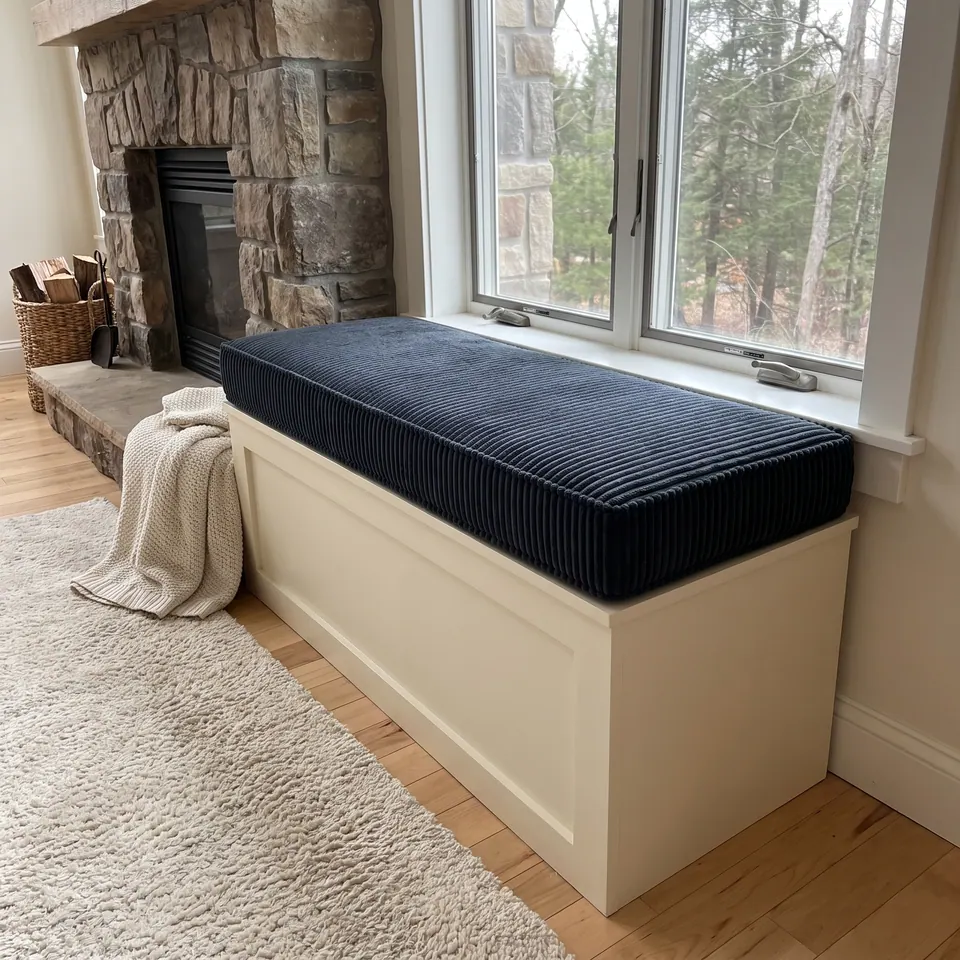
The workshop's answerYes. Send the end-to-end length of each side (a quick paper sketch helps) and say whether you want backrests. One buyer ordered two L-shaped sets that way, each leg running right to the edge of the bench.
- A common question
Could the piping be a different color from the cushion itself?
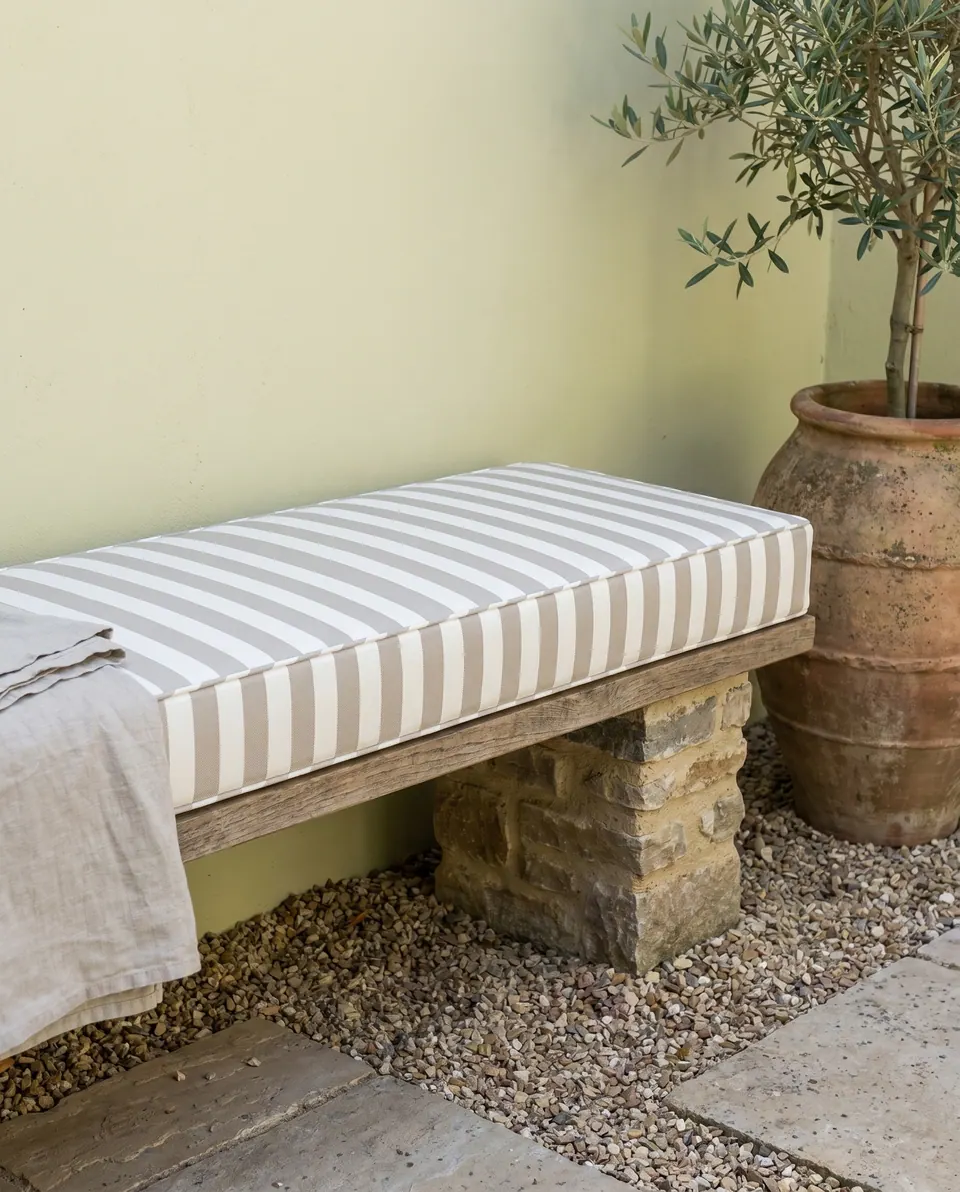
The workshop's answerYes, any combination can be made, for example a teal body with piping in a nearby blue. The workshop sends original photos of both fabrics so you can judge the two shades yourself rather than trusting a screen.
- A common question
My bench measurements are in centimeters. Can you make the cushion to those exact sizes?
The workshop's answerYes. Cushions are made to the exact depth, length and thickness you give, for example 27 1/2 in (70 cm) deep, 74 3/4 in (190 cm) long and 3 1/8 in (8 cm) thick, and you get a custom order link. Say clearly whether your figures are centimeters or inches, because a mix-up changes the quote.
A bench seat used every day wants 3 in (7.5 cm) of firm foam; back pillows against an uneven stone wall want a softer, fuller fill.
Callum
Questions buyers ask next
Should an outdoor bench seat be firmer than its back pillows?
Yes. The seat carries your full weight and needs firm foam to keep a square front edge. Back pillows only take a lean, so a softer, fuller fill lets them press into gaps against a stone wall or open slats. Firm seat, soft back is the usual pairing.
Is 3 inches thick enough for a garden bench cushion sat on daily?
For most benches, yes. For daily seating the workshop recommends 3 or 4 in (7.5 or 10 cm) of firm 32-density foam. Three inches supports well without raising the seat so much that shorter sitters lose contact with the ground.
Should a water-repellent garden bench cushion come in before a storm?
It's the safe habit. Water-repellent fabric makes rain bead and run off the surface, but it isn't a sealed, waterproof shell. In a long, soaking storm water can reach the core, so bring the cushion under cover when heavy rain is forecast.
Fair winds — Callum