 Save
A Reading by RosaWindow Seat Cushions
Five window seat cushion mistakes this cinnamon storage bench gets right
Rosa has fixed every one of these on somebody's porch or in somebody's parlor. Here is a white bench between two windows that dodges them all.
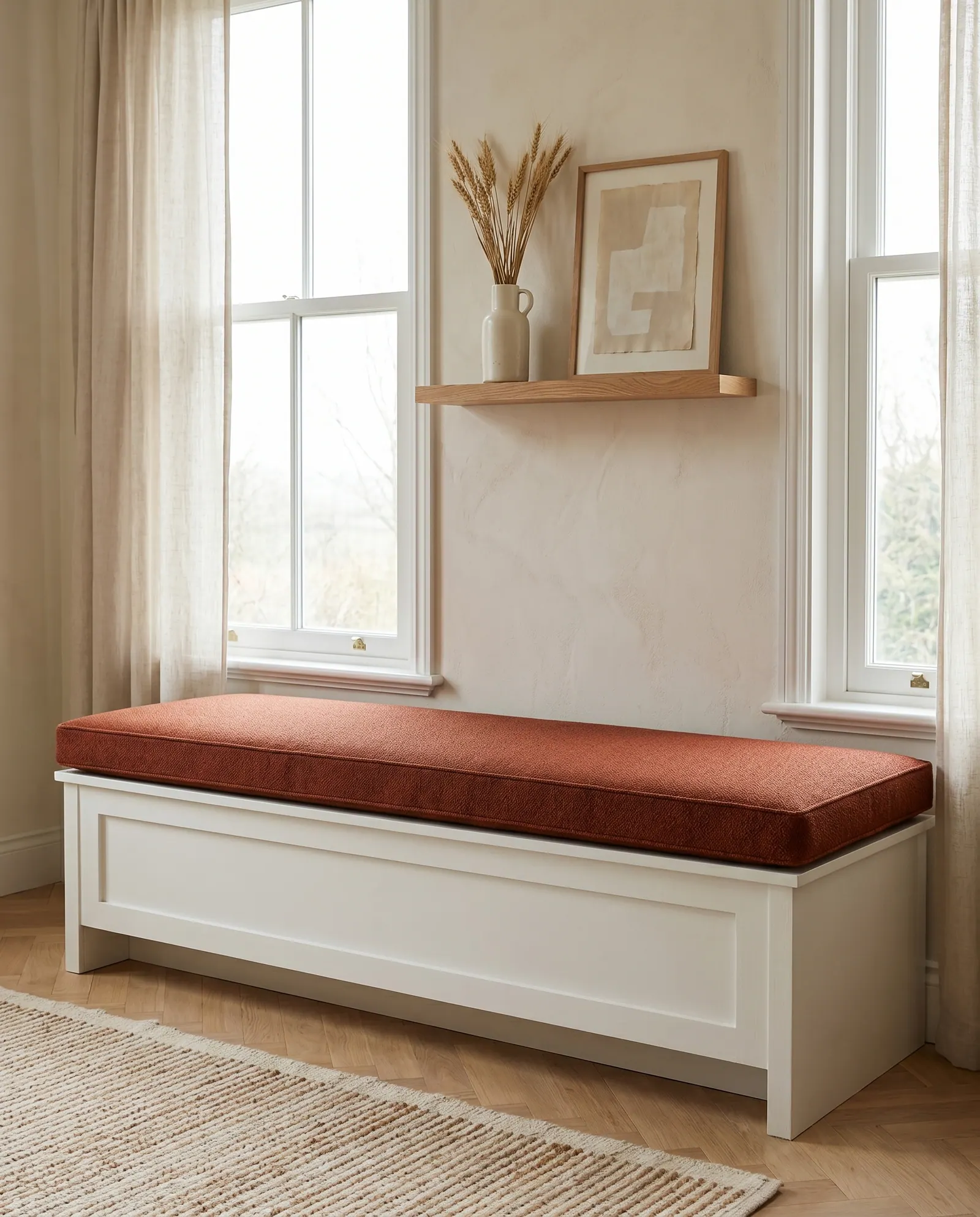
A cinnamon chenille cushion brings warmth to a white storage bench set between two windows. A shelf with a print and wheat completes the wall.

The quick answer
The most common window seat cushion mistakes are ordering the wrong size, making the cushion too thick for its base, piling on too many colors and leaving the wall above bare. This cinnamon chenille box cushion avoids them: it stands a little under half the base height, it is the only saturated color, and a print above repeats it once.
What the bench between the windows does right
The first thing I check on any storage bench is whether the cushion is bigger than the furniture it sits on. You would be amazed how often it is.
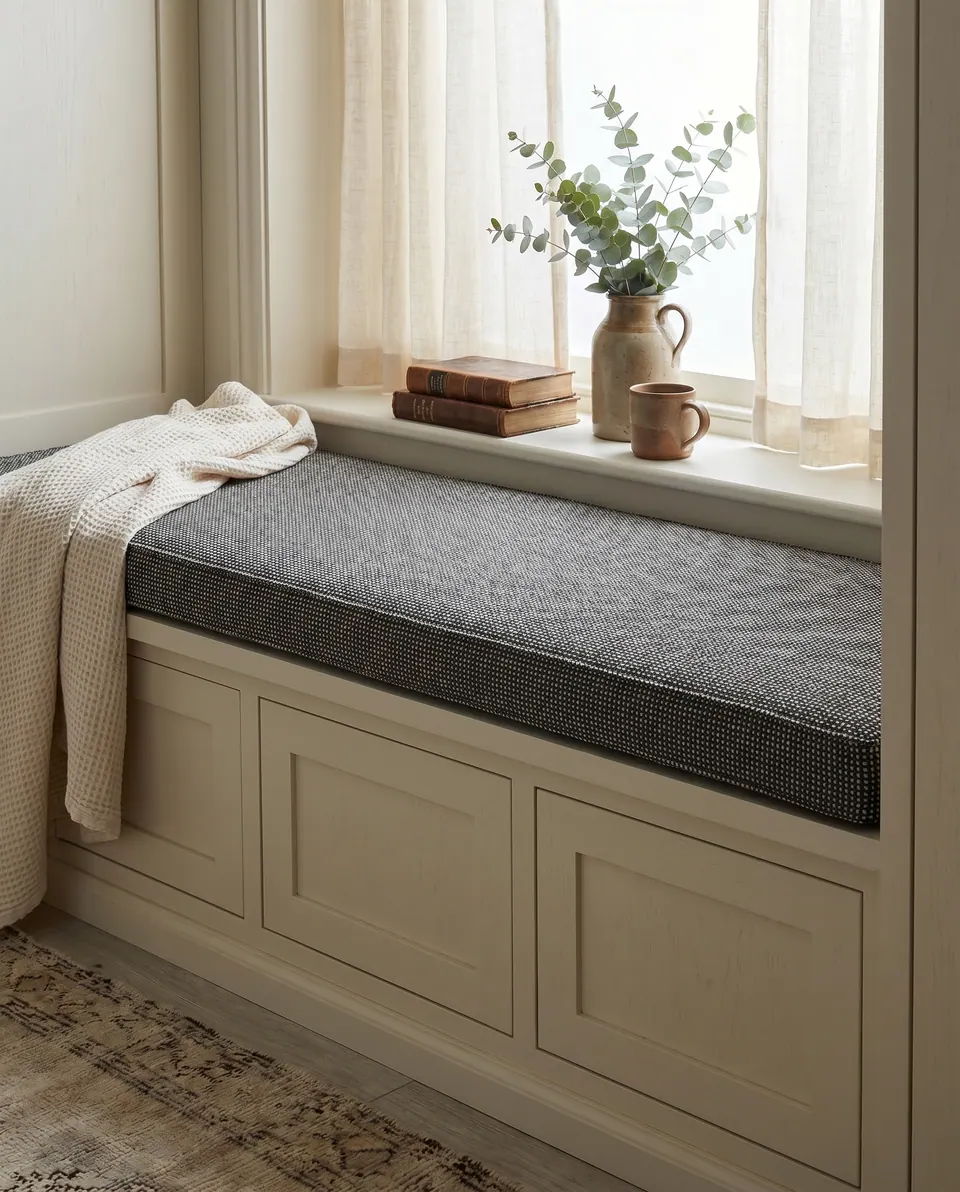
Not here. This cinnamon chenille box cushion stands a little under half the height of the paneled base below it: thick enough to look soft, never so thick it dwarfs the box. The self-piped front edge draws one tailored line where the cushion meets the lid, and the plain panel front stays out of the way so the cushion is the only color in the frame.
The bench sits in the pier between two sash windows, and whoever styled it treated that wall like a mantel. An oak floating shelf. A framed abstract print whose brown and cream blocks repeat the cushion at eye level. Dried wheat in a white jug, bridging the pale plaster and the rust seat. Sheer linen curtains soften the cool winter daylight on both sides, and underfoot a striped jute rug on a herringbone oak floor keeps the ground warm, so the wall can stay calm.
One warm solid on a white base, repeated once in the art above. That is the whole recipe, and you can copy it in an afternoon. See more window seat cushions, the woven chenilles and jacquards on the jacquard and damask shelf, and the storage bench cushion sketches.
Pinned by Rosa: five spots where this bench plays it right
Five pins, from the cinnamon chenille down to the paneled base and up to the wheat and the print.
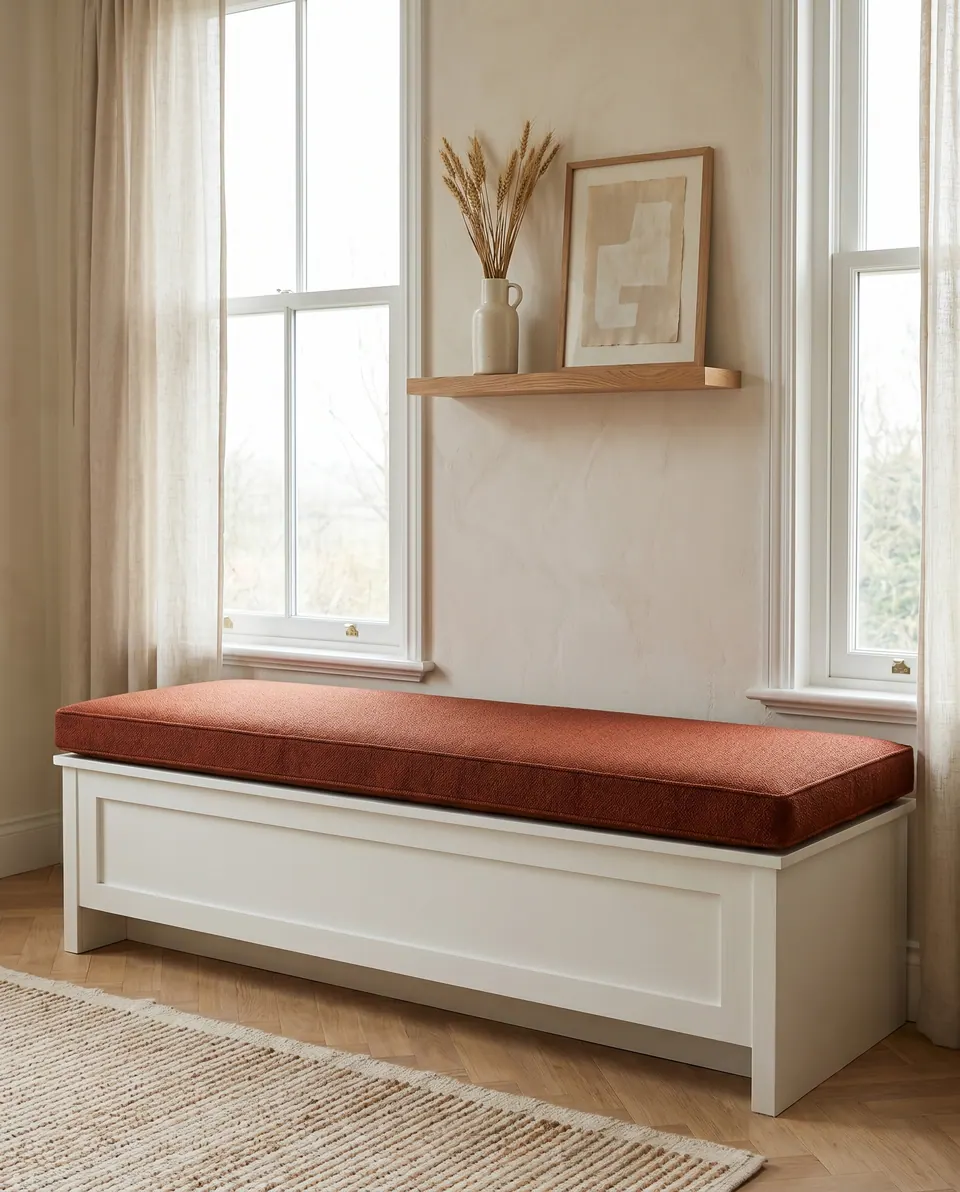
- Cinnamon chenille
A cinnamon tone warms a white bench and a cool plaster wall in one move.
- Piped front edge
Self piping gives a tailored line where the cushion sits over the lid.
- Abstract print
The print's brown and cream blocks repeat the cushion color at eye level.
- Wheat jug
Dried wheat is a soft prop that bridges the pale wall and the rust seat.
- Paneled storage base
A plain panel front lets the cushion be the only color in the frame.
- Cinnamon chenilleA cinnamon tone warms a white bench and a cool plaster wall in one move.
- Piped front edgeSelf piping gives a tailored line where the cushion sits over the lid.
- Abstract printThe print's brown and cream blocks repeat the cushion color at eye level.
- Wheat jugDried wheat is a soft prop that bridges the pale wall and the rust seat.
- Paneled storage baseA plain panel front lets the cushion be the only color in the frame.
The mistakes I see most, and how to dodge them
- Ordering from the old cushion instead of the bench. Measure the bench itself, and if you do order the wrong size, say so before production starts.
- Going too thick for the base. Here the cushion stays a little under half the height of the box and still looks generous.
- Piling on colors. One saturated color is plenty on a white bench; let everything else be wood, plaster and cream.
- Leaving the wall above bare. A shelf, a print and a jug turn a bench between two windows into a small mantel.
- Letting the front edge wander. A piped front edge gives the eye one straight line where the cushion meets the lid.
- Choosing cotton for a cover that will be washed often. The workshop steers hard-working rooms toward washable linen-look polyester or velvet.
Three angled cushions and a date on the calendar
Here is a mistake of a different kind. A buyer messaged the workshop with measurements in millimeters for three angled cushions on a corner sofa built from three pieces, all about 4 in (100 mm) thick. Depths of 20 1/8, 19 5/8 and 19 7/8 in (510, 498 and 505 mm). Top lengths of 32, 80 1/4 and 32 3/4 in (813, 2,040 and 832 mm). Bottom lengths of 23 5/8, 63 1/4 and 23 1/4 in (600, 1,608 and 590 mm).
None of those are rectangles. Every piece is longer at one edge than the other, so the workshop priced them as trapezoids, which is what angled sofa cushions are.
Then came the calendar. The buyer needed them by a set date, and the standard queue of more than 250 orders couldn't make it. The workshop offered paid priority, moved the order to the front and planned to hand it to the courier that Monday.
Two lessons, neighbor. Angled cushions are trapezoids, so measure all four sides. And if you have a date in mind, say so in the first message, not the last. The trapezoid cushion calculator checks the shape before you send it.
Buyer questions: trade pricing, a wrong size and a nursery bench
- A common question
I'm an interior designer ordering for a client. Do you offer trade pricing?
The workshop's answerCase by case. One designer was offered an extra reduction, with better terms discussed for ongoing work, and the workshop has also taken something off first orders.
- A common question
I ordered the wrong size for my bench. Can it still be changed?
The workshop's answerYes, as long as production hasn't started. The workshop makes the correct size and refunds the difference if the new size is smaller. If it is bigger, you pay the difference through an extra-fee listing.
- A common question
Is your linen fabric fine for a nursery bench, and can it go in the washer and on the line?
The workshop's answerYes. The linen-look fabric is polyester and can be machine washed and line dried. The workshop steers people away from cotton for a nursery, because it copes less well with repeated washing and daily furniture use. Velvet is a good alternative.
On the cutting table: the pier bench
| Product | Window seat cushion on a paneled storage bench |
|---|---|
| Fabric | Cinnamon chenille |
| Piping | Self piping on the front edge |
| Edge | Box edge |
| Thickness | A little under half the height of the base |
| Base | White paneled storage bench between two sash windows |
| Wall above | Oak shelf, abstract print, dried wheat in a white jug |
| Light | Cool winter daylight through sheer linen |
| Best for | A single warm accent in a pale living room |

Have it made
Have this made — ask Rosa’s workshop
Tell the workshop who sits there: grandkids, the dog, a cup of coffee at six. The right fabric and foam follow from the people. — Rosa
Leave your details and the workshop will call you to confirm measurements, fabric, foam and piping. No prices, dates or payment on this page: it is a request, not an order.
The most common window seat cushion mistake is thickness: on a storage bench, a cushion a little under half the base height looks soft without dwarfing the box.
Rosa
Questions buyers ask next
How thick should a cushion look on a white storage bench between two windows?
In this room the cushion stands a little under half the height of the paneled base, which reads soft without overwhelming the box. Use the base height as your guide, and keep the cushion clearly the smaller of the two.
How can one warm cushion color look intentional in a pale room?
Repeat it once elsewhere, ideally at eye level. Here a framed print with brown and cream blocks and a jug of dried wheat echo the cinnamon seat, so the color reads as a plan rather than an accident.
Why are angled corner sofa cushions priced as trapezoids?
Because each angled piece has a front and back edge of different lengths, which makes it a trapezoid rather than a rectangle. One three-piece corner sofa had top lengths of 32, 80 1/4 and 32 3/4 in and bottom lengths of 23 5/8, 63 1/4 and 23 1/4 in.
Porch light's on — Rosa