A Reading by MaggieBench Cushions
A black and sand graphic bench cushion, and the message that gets it right the first time
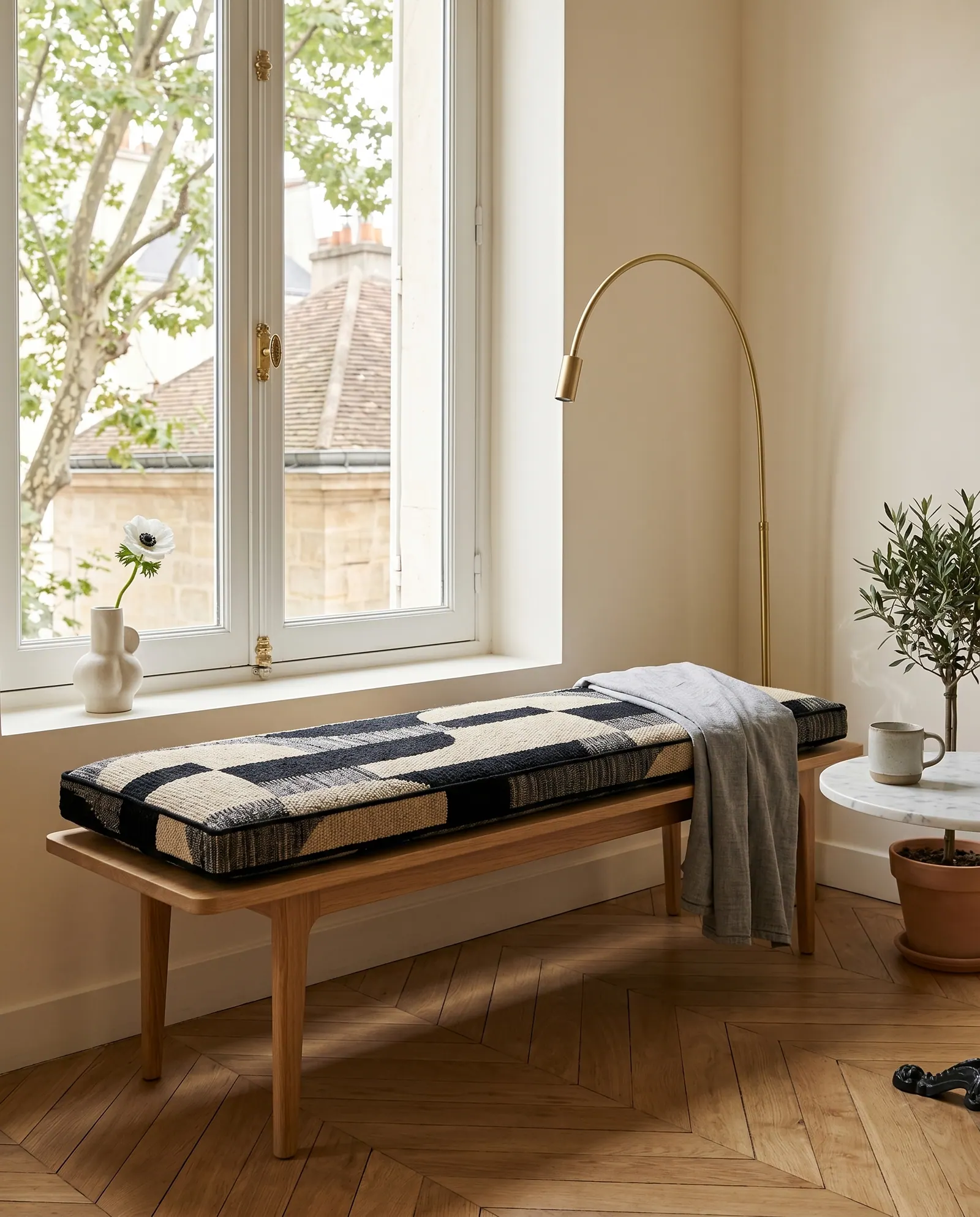
A low oak bench, a bold block weave, black piping like a picture frame. Maggie reads the photo, then the order: codes, swatches and the numbers worth typing twice.

 Save
The quick answer
To order a custom bench cushion right the first time, send the exact bench-top measurements, one fabric code for the cushion and a separate code for the piping, and say whether it should meet the edge or overhang. Ask for swatches of both codes. Cushions are made to the full dimensions you give, with no deduction.
Buyer questions: size and fill, exact fit, and backs sold on their own
- A common question
What would a 21 x 66.25 in window seat cushion come to, and how thick is the foam?
The workshop's answerThe workshop quoted that size on request. Standard thickness is 4 in (10 cm) and can be changed, and that cushion was filled with silicone fiber balls rather than foam.
- A common question
Do you make the cushion to my exact bench size, or a little smaller?
The workshop's answerTo the full dimensions you give, with no deduction. For a dining bench the workshop advised matching the actual seat surface closely rather than letting the cushion overhang.
- A common question
Can I buy custom back cushions on their own?
The workshop's answerYes. Back cushions are made separately, to any size and color you choose.
Now, the reading
Black piping, and why the darkest color frames best
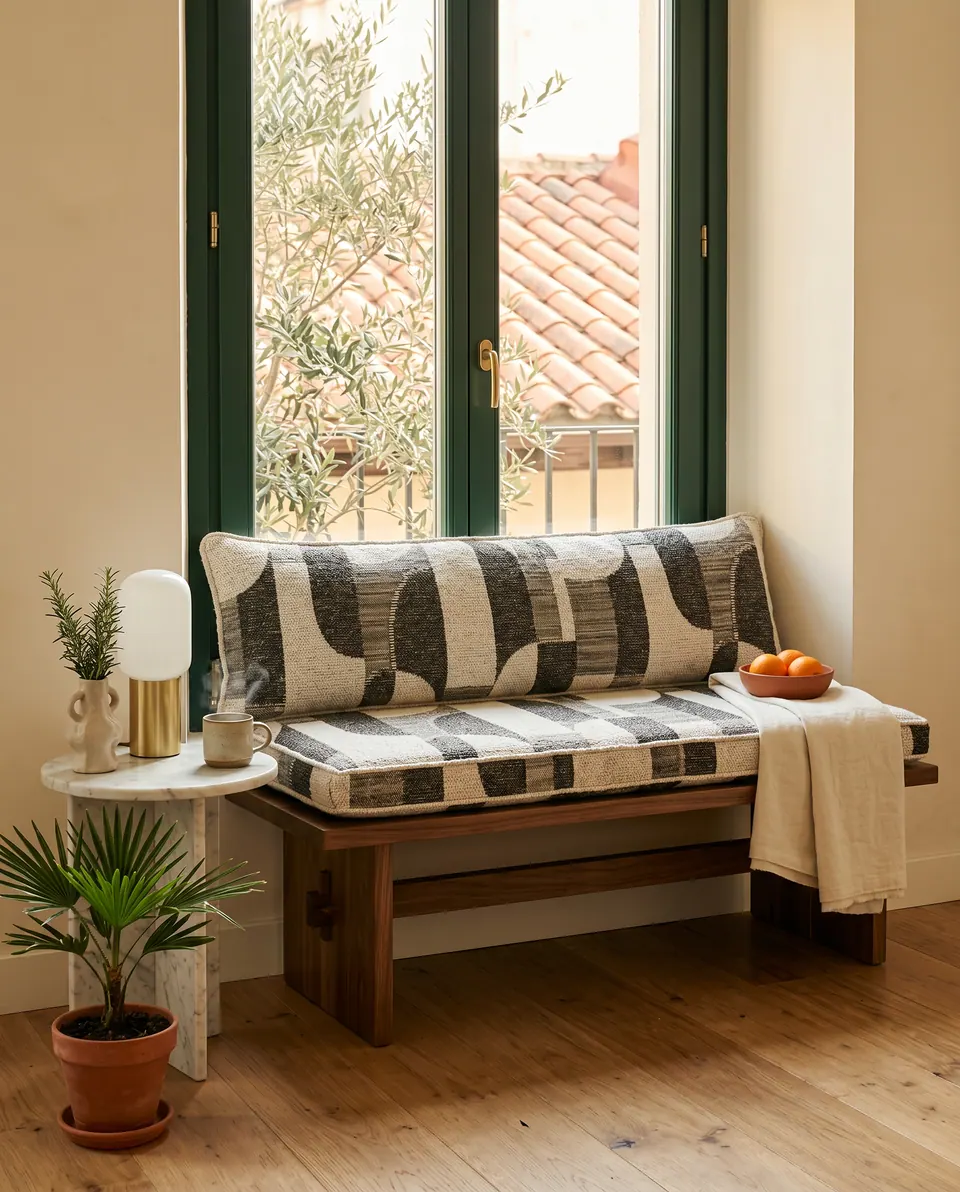
The weave does the talking. Bold black and sand blocks on a cream ground, laid as a slim bench cushion along a long, low oak bench. Everything else in the room keeps quiet so the pattern can speak.
Then the piping. It is black, the darkest color in the weave, and it runs the edge like the frame around a print. It ties the cushion to the black in the pattern and to the dark ironwork of the tall windows. A straight welt is a kind of honesty, and a black one shows you at once whether the cushion is square. Pipe a patterned cushion in its darkest color whenever you want it crisp and tailored.
The bench is mid-century, long and low, so the cushion stays slim to keep that profile. A brass arc lamp curves over the straight line. A gray linen throw, crumpled over one end, says the bench is for sitting. An olive tree adds soft gray-green height where the seat runs out, and a white anemone on the sill catches the morning. A jacquard or damask weave like this suits a living room bench that gets looked at as much as sat on.
Pinned by Maggie: weave, cord, lamp, throw and olive
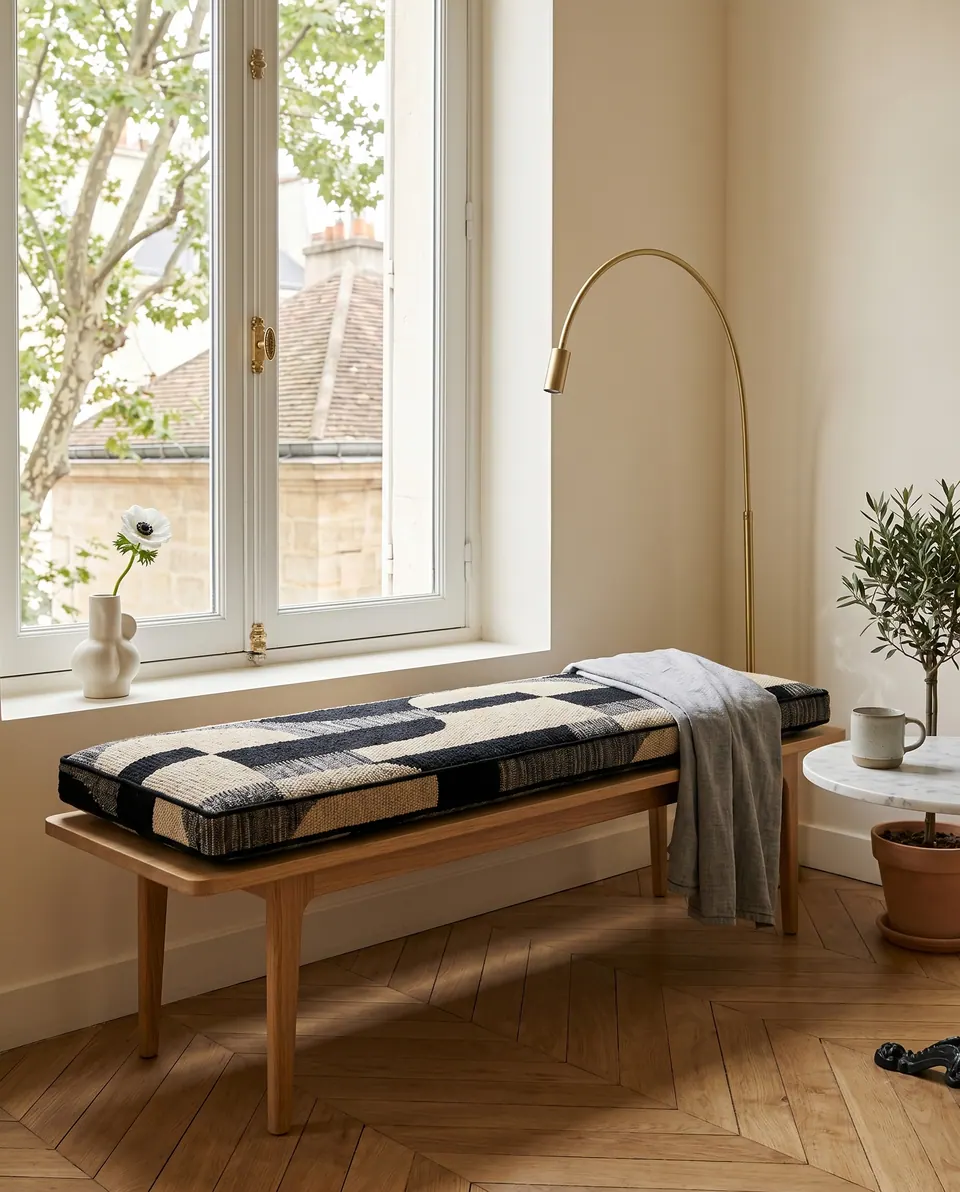
Five pins, from the block weave and its black cord to the brass lamp, the linen throw and the olive tree at the far end.
- Graphic block weave
Bold black and sand blocks do the talking, so the rest of the room stays plain.
- Black piping
A black cord frames the weave like the frame on a print.
- Brass arc lamp
The curve of the lamp softens the long straight line of the bench.
- Gray linen throw
Crumpled linen over one end signals that the bench is for sitting.
- Olive tree
Soft gray-green leaves add height at the end of a low seat.
- Graphic block weaveBold black and sand blocks do the talking, so the rest of the room stays plain.
- Black pipingA black cord frames the weave like the frame on a print.
- Brass arc lampThe curve of the lamp softens the long straight line of the bench.
- Gray linen throwCrumpled linen over one end signals that the bench is for sitting.
- Olive treeSoft gray-green leaves add height at the end of a low seat.
Two codes, a re-measure, and a sill that stuck out an inch
A buyer in the US asked for two 3 in (7.5 cm) velvet cushions for an L-shaped window nook, in fabric P-60 with piping in P-61. Two codes, clearly separated. Then they re-measured the nook and sent new sizes, 82 x 18 in and 29.25 x 18 in (208 x 46 and 74 x 46 cm), and the price held.
After living with the seats, they came back for backs. The window sill stuck out about an inch and dug into their backs. So the workshop made thin back cushions, 82 x 5.75 in and 45 x 5.75 in (208 x 14.5 and 114 x 14.5 cm), just 2 in (5 cm) thick, in P-61. A slim back brings the sitter forward past the sill. As returning buyers they paid less the second time, and the piping cost nothing extra. How far does your sill stick out?
What goes in the first message
- Bench-top length and depth, measured on the wood, in inches.
- Thickness, written last and labeled as thickness.
- One fabric code for the cushion and a separate code for the piping.
- Whether the cushion should meet the front edge or overhang it.
- Anything that sticks out over the seat: a sill, a lip, a post.
- A request for swatches of every code before cutting.
On the cutting table: the salon bench
| Product | Custom bench cushion, rectangle, slim box edge |
|---|---|
| Fabric | Graphic jacquard block weave in black, cream and sand |
| Fabric code in the photo | 09 |
| Piping | Contrast piping in black, the weave's darkest color |
| Fit | Made to the full given dimensions, no deduction |
| Standard thickness | 4 in (10 cm), adjustable |
| Back cushions | Made separately in any size and color |
| Best for | Living room benches, window nooks, entry benches |

Have it made
Have this made — ask Maggie’s workshop
I once cut a lovely cushion two inches short, and I have not forgotten it. That is why the workshop goes over your measurements with you on the phone. — Maggie
Leave your details and the workshop will call you to confirm measurements, fabric, foam and piping. No prices, dates or payment on this page: it is a request, not an order.
Pipe a patterned bench cushion in its darkest color: a black welt on a black and sand weave frames it like a print and shows at once if the edge runs square.
Maggie
Questions buyers ask next
Should a cushion overhang the front of a slim oak bench?
Generally no. The workshop advises matching the seat surface closely, and cushions are made to the full measurements you send. An overhang also thickens the look of a slim mid-century bench.
How do I specify contrast piping on a custom cushion order?
Give the piping its own fabric code, separate from the cushion fabric. One buyer ordered P-60 velvet with P-61 piping, then used P-61 alone for matching back cushions. Ask for a swatch of each code.
What can I do if a window sill juts out over my bench seat?
Measure how far it projects and consider a slim back cushion. One buyer's sill protruded about an inch, so 2 in (5 cm) thick back cushions brought them forward and kept the sill off their backs.
Why ask for a swatch of the piping color as well as the fabric?
Piping is a narrow line against a large field, and a color that looks right on a screen can read too light or too dark as a thin cord. Hold both swatches together on the bench in daylight.
Stitch straight — Maggie