 Save
A Reading by MaggieBench Cushions
A black and white dining bench cushion, and what a family table does to it
Toys on one side, a round table on the other, three mustards in between. This bench works for its living, and the cloth was chosen to keep up.
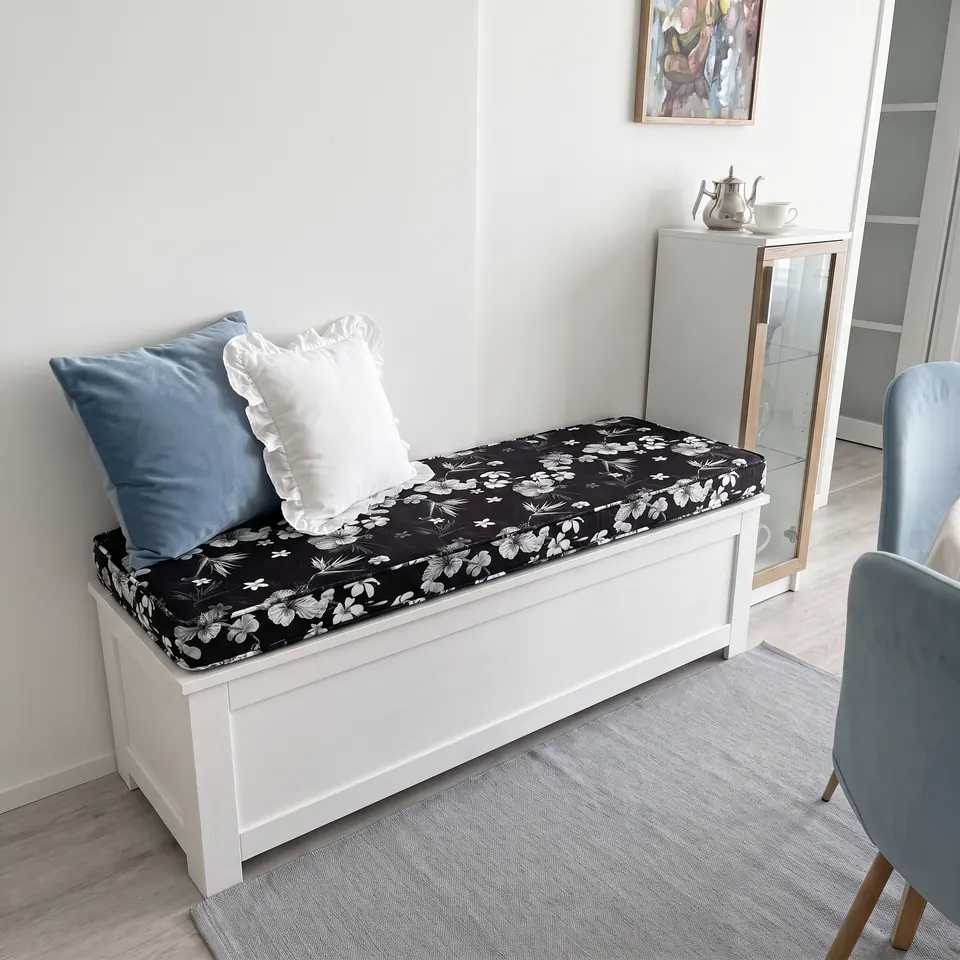
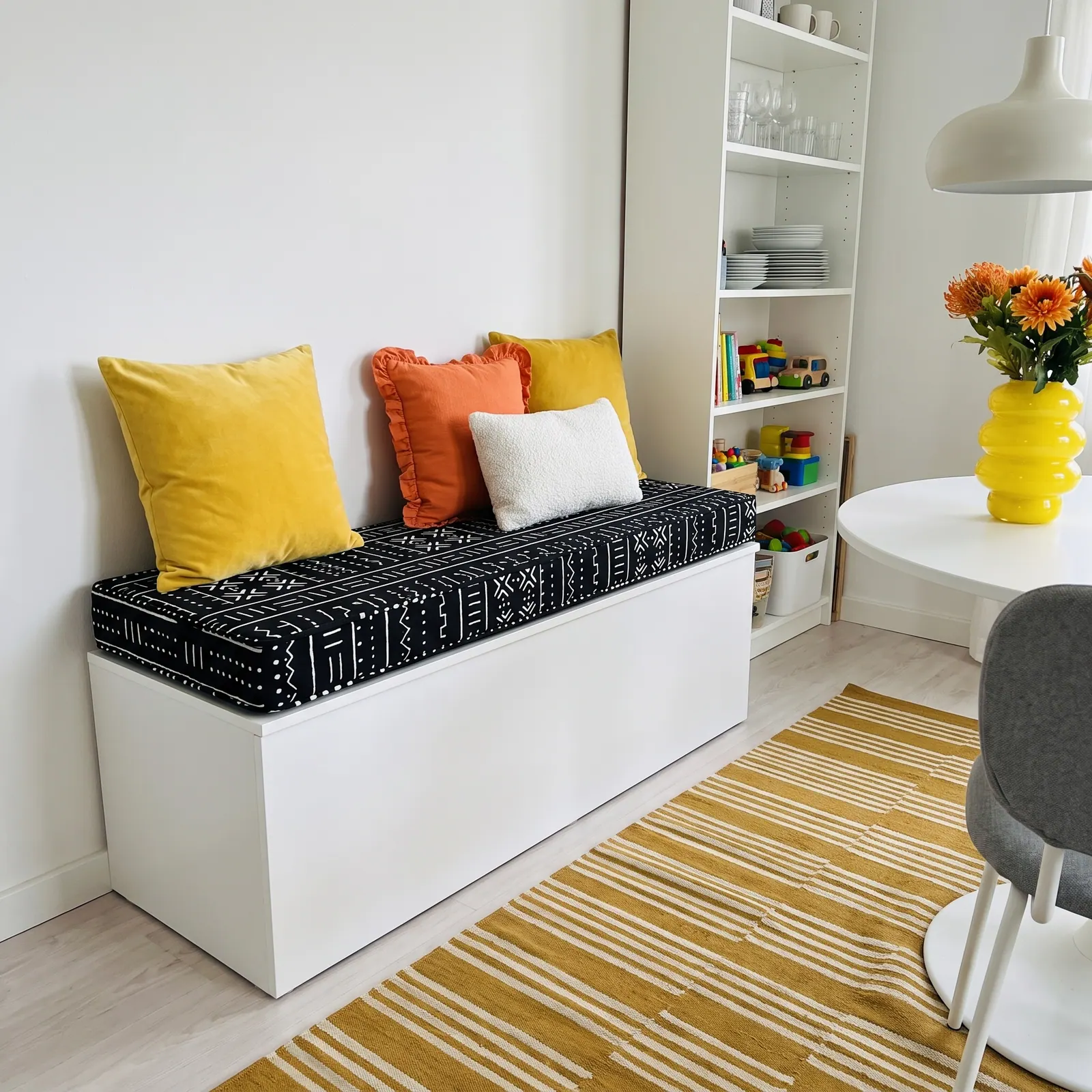
A black and white print cushion on a family storage bench, where mustard repeats in the pillows, the vase and the rug.

The quick answer
A black and white print is the practical choice for a family dining bench cushion: it hides sticky-finger marks far longer than plain cream, and the machine-washable, pre-shrunk cover can go through the wash without losing its fit. Expect the edge to relax a little with use and the finished size to land within about 1/2 in (1 cm).
Three mustards and a black print
Count the mustards, because somebody clearly did: two velvet pillows at the end of the bench, a ribbed vase of orange gerberas on the bookcase, and a striped flatweave rug under the table. Three repeats make a scheme; two would look like a coincidence. The orange ruffled pillow breaks the rhythm and matches the flowers, and a white bouclé lumbar gives the eye somewhere to rest.
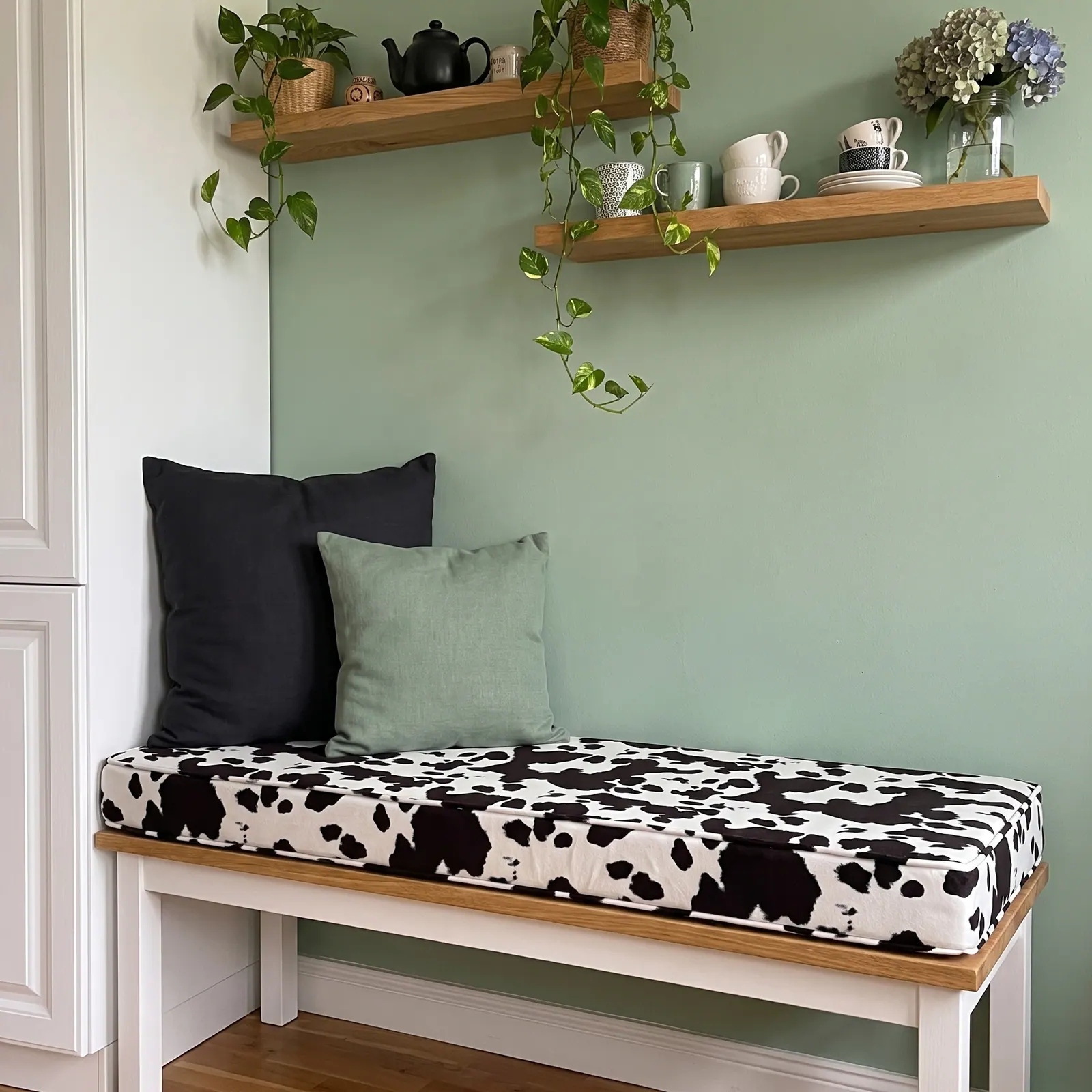
The bench is a white storage box between a bookcase of toys, plates and glasses and a round pedestal table, so it does double duty as a dining bench cushion and a picture-book corner. That is exactly why the cushion is a black and white mudcloth-style print and not the plain cream I would have picked at twenty-five. I have since learned that jam finds cream by Tuesday. A busy print keeps sticky-finger marks quiet far longer.
The piping is cut from the same print, so no contrast line outlines every smudge. The white pendant and the gray dining chair keep the upper half of the room cool, and all the warm color sits low, at child height.
What does your bench see between meals, dear: homework, crayons or the dog?
Pinned by Maggie: five spots on a family dining bench
Five spots where this family bench shows its planning.
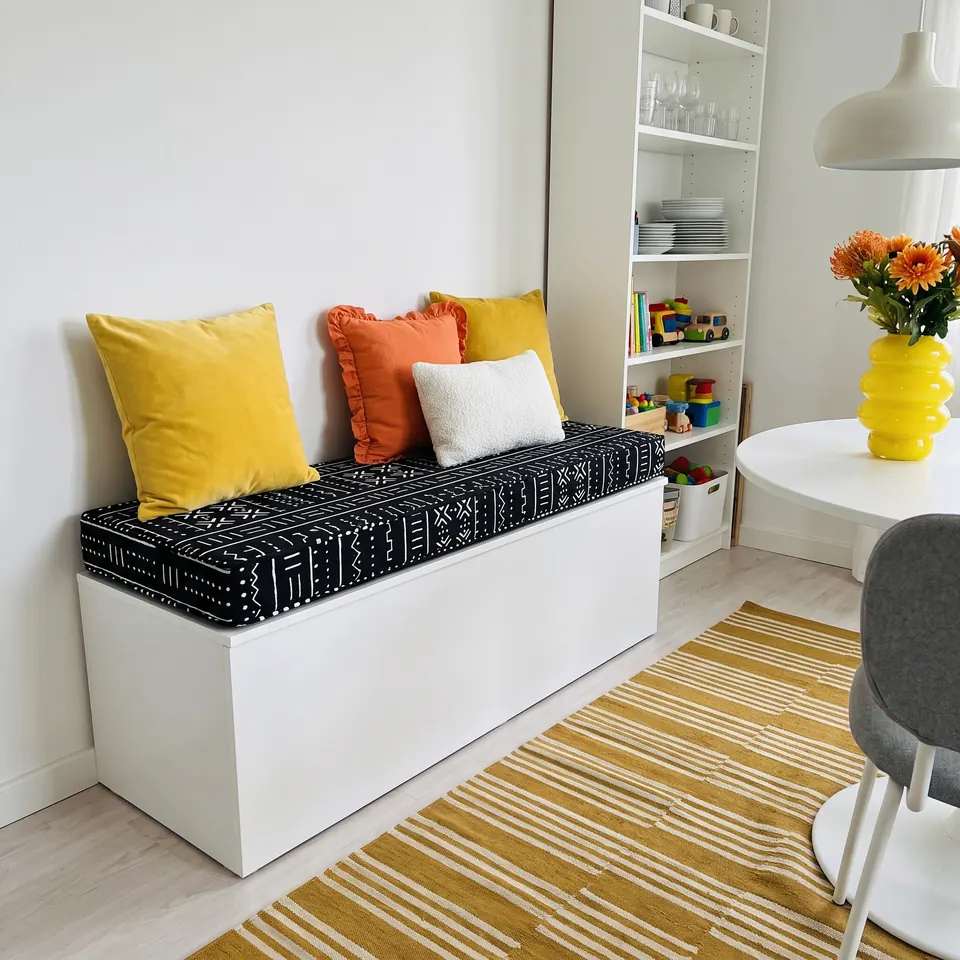
- Black mudcloth-style cushion
A dark print keeps sticky-finger marks less obvious than a plain cream.
- Mustard velvet pillows
Mustard appears three times in the room: pillows, vase and rug.
- Orange ruffle pillow
One orange breaks the mustard rhythm and matches the gerberas.
- Yellow vase of gerberas
A mid-height accent that carries the pillow color up the room.
- Mustard striped rug
The floor repeat grounds the color scheme.
- Black mudcloth-style cushionA dark print keeps sticky-finger marks less obvious than a plain cream.
- Mustard velvet pillowsMustard appears three times in the room: pillows, vase and rug.
- Orange ruffle pillowOne orange breaks the mustard rhythm and matches the gerberas.
- Yellow vase of gerberasA mid-height accent that carries the pillow color up the room.
- Mustard striped rugThe floor repeat grounds the color scheme.
How a kitchen bench cushion wears in, and what's normal
- The edge relaxes. Fabric settles and the side band softens a touch with use. That is a handmade cushion getting comfortable, not a fault.
- The size lands within tolerance. Inch orders are converted to the nearest centimeter, and handmade pieces vary by about ± 1/2 in (1 cm), most on long ones. More in handmade cushion tolerance.
- The print forgives. A black and white print hides crumbs and sticky fingers far longer than plain cream.
- The zipper faces down. If a cover only fits zipped side up, one measurement was off; tell the workshop rather than living with it.
- The cover goes in the machine. The fabrics are machine-washable and pre-shrunk, so a busy kitchen nook cushion can be washed at 86°F (30°C) and still fit.
Ninety inches, one piece, nothing drifting
A buyer in the US with a 90 x 24 in (229 x 61 cm) kitchen bench wanted one cushion rather than two, so nothing would shift apart between meals, and asked the sensible question: will a piece that long keep its shape? The workshop said yes, and quoted it in linen.
Ninety inches is past the length where the workshop often suggests splitting a cushion. On a family bench, though, one piece stays lined up, and lined up is most of what looks tidy. Measure the bench, not the cushion you used to have.
- Sizes
- 90 x 24 in (229 x 61 cm)
- Fabric
- Linen
The lesson: On a busy bench, a single-piece cushion stays aligned better than two.
Buyer questions: sizes, backs and washable cloth
- A common question
My new cushion is about half an inch wider than I ordered. Is that normal?
The workshop's answerYes. Inch orders are converted to the nearest centimeter, so 29 1/2 x 111 1/4 in became 29½ x 111½ in (75 x 283 cm). Handmade cushions have a tolerance of about ± 1/2 in (1 cm), especially long ones, where foam and fabric behave a little differently. The edge also relaxes slightly with use.
- A common question
Can you make back cushions for my banquette that I could hold in place with hook-and-loop tape?
The workshop's answerThe workshop suggested soft-filled pillow-style backs rather than foam, because they look better and are more comfortable. For an 88 in back with 27 1/2 in angled sides, 12 1/2 in tall, that meant four pillows: two 44 x 12 1/2 in for the back and two 26 x 12 1/2 in for the sides. The sides were cut shorter because plump pillows sit fuller than their flat size, and about 1 1/2 in of allowance lets them nest neatly into the corners.
- A common question
Do you have performance fabrics that are easy to wash?
The workshop's answerYes. The fabrics are machine-washable performance fabrics, and they are pre-shrunk, which suits high-use spots like a kitchen bench.
If a dining bench doubles as a kids' seat, choose a black and white print: it hides sticky-finger marks far longer than plain cream.
Maggie
The bench cushion, spec by spec
| Cushion | One-piece dining bench cushion on a storage box |
|---|---|
| Fabric | Black and white mudcloth-style print |
| Piping | Self piping |
| Edge | Box edge with a side band |
| Zipper | Hidden, on the underside or the back edge |
| Tolerance | About ± 1/2 in (1 cm); long pieces vary a little more |
| Back pillows | Soft-filled, cut about 1 1/2 in short where they meet a corner |
| Care | Machine-washable, pre-shrunk; 86°F (30°C) gentle, air-dry |
| Best for | Family kitchens, breakfast nooks, everyday dining |

Have it made
Have this made — ask Maggie’s workshop
I once cut a lovely cushion two inches short, and I have not forgotten it. That is why the workshop goes over your measurements with you on the phone. — Maggie
Leave your details and the workshop will call you to confirm measurements, fabric, foam and piping. No prices, dates or payment on this page: it is a request, not an order.
Questions buyers ask next
Can I wipe a spill instead of washing the whole cover?
Yes. Blot a fresh spill and wipe it with a damp cloth and a little mild soap before it sets. Save the machine for a full wash at 86°F (30°C) on a gentle cycle, inside out, with no bleach.
Can a kitchen bench cushion have a non-slip bottom?
Yes. An optional non-slip base replaces the whole bottom panel with a grippy fabric that holds by friction. It is not adhesive, leaves no residue and is safe on wood. Keep that panel out of the washer and dryer; wipe it instead.
Does self piping cost extra?
No. Piping is included whether it is cut from the same print or made in a contrast color, and a cushion with no piping costs the same. Self piping is the safe match on a busy print, because it always shares the dye.
Stitch straight — Maggie
More photographs to read
 Save
 Save
 Save
 Save
 Save
 Save