The Pattern Room · a measuring pattern
Boneless sofas and couches explained: foam, metal bars and the box they arrive in
No frame, no legs, no screws. A boneless sofa is foam, fabric and four metal bars, and it arrives rolled tight. Here are the build and the unboxing, in numbers you can check at the door.

 Save
The quick answer
A boneless sofa is a frameless couch built entirely from foam pieces. The standard modular one is two 79 x 39 x 6.5 in (200 x 100 x 17 cm) seat mattresses, two L-shaped backrests and four metal bars, with a seat about 14 in (36 cm) off the floor. It ships vacuum-rolled and takes about 36 to 48 hours to regain its shape.
Seventy-seven pounds, and nine of them are metal
A standard boneless sofa ships at about 77 lb (35 kg). Roughly 9 lb (4 kg) of that is one small box of metal bars. Everything else is foam and fabric.
That is what shoppers mean by a boneless sofa, or boneless couch: no wooden frame inside, no legs, no springs. Dense foam gives it its shape, which makes it lighter than a framed sofa and easy to rearrange. It also goes by compressed sofa, or sofa in a box, because it travels vacuum-rolled.
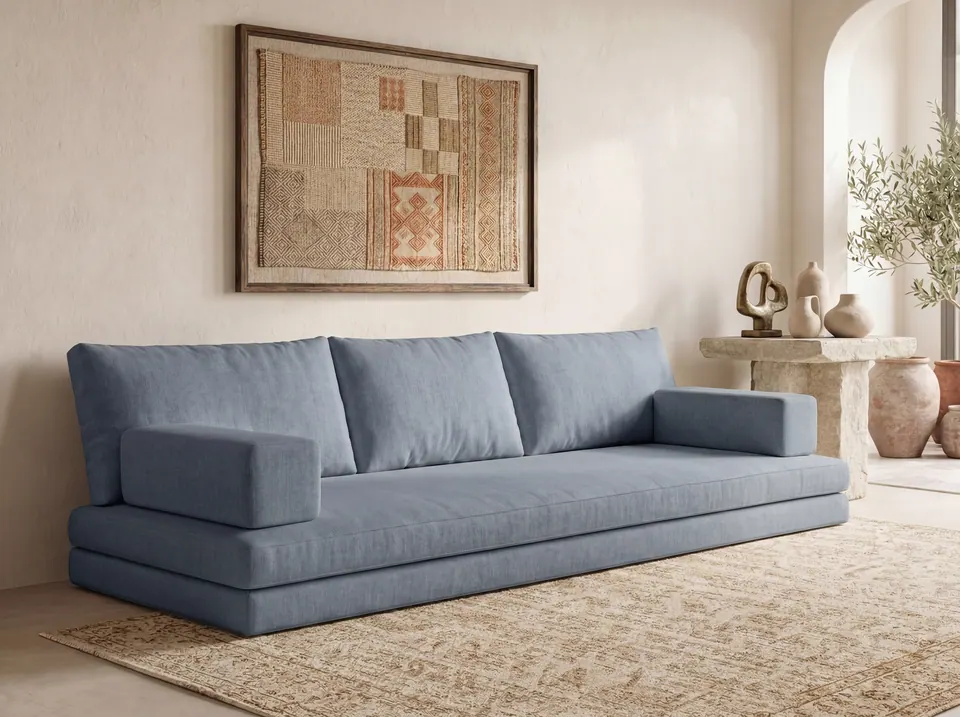
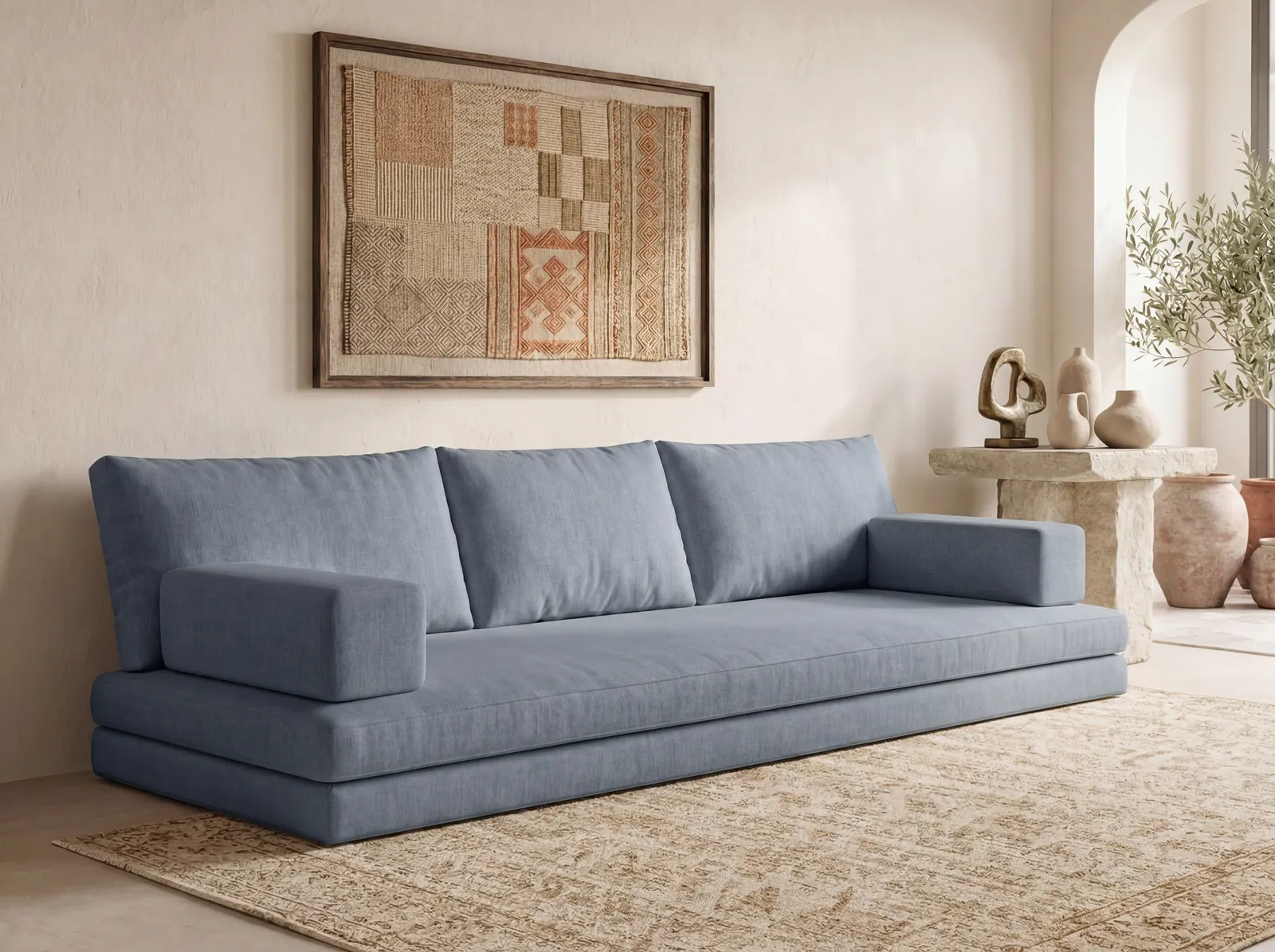
The slate blue sofa at the top of this page shows the principle: two stacked base layers, three back cushions, two block arms, and not a stick of wood. The workshop's own version is the modular floor sofa, the teddy floor sofa among them, most often in ribbed corduroy.
Only one part is rigid. Four metal bars stand beside and behind the backrests and stop them sliding back when you lean. They don't join the seat mattresses, and no piece is fastened to another. Weight, and a non-slip fabric sewn under each seat, keep the rest where you put it.
The build, measured
| Seat mattresses | Two, each 79 x 39 x 6.5 in (200 x 100 x 17 cm), stacked |
|---|---|
| Seat height | About 13.5 to 14.5 in (34 to 37 cm), fully expanded |
| Backrests | Two L-shaped, 39 x 39 in (100 x 100 cm) along the back and side, with a 15 x 15 in (39 x 39 cm) cross-section |
| Overall height | About 28 in (71 cm) with the backrests in place |
| Metal bars | Four free-standing frames: two at the sides, two behind the backrests; tube about 5/8 in (16 mm) thick |
| Between the pieces | No hook-and-loop; a non-slip fabric under each seat mattress holds it on the floor |
| Seat foam | Medium-hard, high-density cold foam, most often quoted as 28 density (T28, ILD 42); softens slightly with use |
| Backrest fill | Shredded foam or silicone-ball fiber |
| Covers | Zip off; machine wash at 86°F (30°C) max, gentle cycle; the white non-slip bottom stays out of the machine |
| Tolerance | Handmade sizes vary about 1 in (2.5 cm) either way |
Boneless or framed: the honest trade
| Boneless floor sofa | Framed sofa | |
|---|---|---|
| Seat height | About 14 in (36 cm) | Nearer 18 to 19 in (46 to 48 cm) |
| Inside | Foam and fiber only | A frame under the upholstery |
| Getting it indoors | Rolls of about 12 x 12 x 43 to 47 in (30 x 30 x 110 to 120 cm); a 25.5 in (65 cm) doorway is fine | One rigid shape that has to turn every corner |
| Rearranging | Straight, L, open or closed corner, or a bed, from the same pieces | One shape |
| When something fails | A bar or a single foam piece is replaced on its own | Frame, legs or springs |
| Back support | Bars behind the backrests; stands in open floor | Built in |
| Weak spots | Low seat; drifts on bare hardwood without a rug | Weight and bulk |
Unboxing a compressed sofa in eight moves
Count the parcels first
A standard sofa ships as three: one roll with the two backrests, one with the two seat mattresses, and a small box of bars. A corner set can be five; with a pouf chair, six. They leave together and often arrive a day or two apart. How many parcels does your tracking list?
Open it the week it arrives
Foam recovers well when it is opened within a few weeks. The workshop's limit is 2 to 3 weeks compressed, and recovery is never promised past a month.
Cut the plastic, never the cover
Keep blades away from the roll. The cover sits right under the wrap, so snip the plastic at an edge and peel it back by hand.
Unroll every piece and shake it
Lay each piece flat in a warm, ventilated room and shake the cushions by hand. They will look flat, folded and smaller than the photos. That is expected, not a wrong order. Each roll weighs about 22 to 33 lb (10 to 15 kg), so one person can carry it; the roll pack weights are listed piece by piece.
Give the foam 36 to 48 hours
Most pieces fill out in 24 to 36 hours and reach their photographed shape in about 36 to 48. Corners and L-shaped pieces can take up to 72. Full firmness comes in 3 to 5 days, sometimes a week, and you can sit on the sofa meanwhile.
Build the bars, then stand the backs
Twist and push each joint until the spring dots click. The U-piece with the black plastic fitting goes at the bottom, on the floor. Use every bar in the box. On hardwood, put felt pads under the bars and a rug under the seat.
Brush the pile, don't press it
Packing creases fade in about a week, a deep center crease in 7 to 10 days. Corduroy pile can take about 10 days to lie flat: smooth it by hand along the ribs, with the nap. To hurry it, hold a low-heat steamer a little away from the cloth.
Measure on day four, not day one
Tape flush against a wall. The seat should read about 13.5 to 14.5 in, and handmade sizes vary about 1 in either way. Tolerance is kindness to your future self.

Have it made
Measured it? Have Nate’s workshop make it
Precision starts on the phone. Give the workshop your measurements and they will read them back to you, edge by edge. — Nate
Leave your details and the workshop will call you to confirm measurements, fabric, foam and piping. No prices, dates or payment on this page: it is a request, not an order.
Key facts
- A boneless sofa has no internal frame; dense foam gives it its shape.
- Standard build: two 79 x 39 x 6.5 in (200 x 100 x 17 cm) seat mattresses, two L-shaped backrests and four metal bars.
- The seat sits about 13.5 to 14.5 in (34 to 37 cm) off the floor.
- A standard sofa ships as three parcels, about 77 lb (35 kg) in all.
- Foam reaches its photographed shape in about 36 to 48 hours and full firmness in 3 to 5 days.
- Keep it compressed no longer than 2 to 3 weeks.
- Covers zip off and machine wash at 86°F (30°C) max on a gentle cycle.
One corner that stayed down
A buyer in the US unrolled a corduroy boneless sofa, and every piece came up but one. A seat mattress, 78 x 39 x 6.5 in, stayed flat in one corner.
The workshop asked for a few more days. That is the normal answer; foam rolled that tight takes its time. After about a week the corner was still down, and on that side a foot sank right through to the floor. Slow foam doesn't do that. A faulty piece does.
The buyer sent photos from several angles, and a replacement foam insert shipped for that one mattress. The cover moved from the old foam to the new. Nothing else in the set was touched.
So keep a timetable. Day two: shape. Day five: firmness. Day seven, one spot still flat while everything around it has recovered: photograph it from several sides and ask.
How long a sofa can wait in its box
Two to three weeks, partner. Not a season.
A family in the US bought a floor sofa and a matching chair, kept the rolls sealed in storage for over a year, then opened them. The foam was crumbly and would not expand. Foam held compressed that long can be damaged for good, and long vacuum storage sets heavy creases as well, deepest in velvet.
Other foam-furniture makers publish in-box limits between 2 and 8 weeks, depending on the model, and 1 to 2 weeks for full recovery. The workshop's number sits at the short end: open within 2 to 3 weeks. Moving house? Put the earliest delivery date in the order note, or unpack, let it expand, and store it uncompressed.
The first days out of the plastic are laid out in the first 72 hours of a vacuum-packed cushion, and the bars in floor sofa metal bars: assembly and stopping the slide.
Where compressed sofas go wrong
- Reading one 'delivered' scan as the whole order. Count the parcels.
- Leaving the rolls sealed until moving day, a month later.
- Judging the size or the firmness in the first hour.
- Throwing a blanket over a creased sofa for weeks. One corduroy set still showed its packing creases after four weeks.
- Standing the backrests up without their bars, or with only some of them.
- Leaving bare metal bars on a hardwood floor.
- Putting the white non-slip bottom piece in the washing machine.
A boneless sofa is only as upright as its bars: every backrest gets one, and none of them holds the seat together.
Nate Kowalski
Buyer questions: rolls, bars and the first week
- A common question
Our floor sofa came out of the plastic flat and folded. How long before it looks like the photos?
The workshop's answerThat's expected, not a wrong product. Unwrap every piece and shake the cushions by hand. Most fill out in 24 to 36 hours and reach the photographed shape in about 36 to 48 hours; full firmness takes 3 to 5 days, occasionally a week. You can sit on it meanwhile. If a piece is still flat after another 4 to 5 days, photograph it and ask the workshop about a replacement insert.
- A common question
Are the metal bars included, and how many should be in the box?
The workshop's answerYes, and the backrests and armrests need them. A single teddy sofa comes with 4 bars, a 3-seater uses 5 pieces, the L-shape with ottoman 6, and a full corner set 8 large and 8 small. A plain ottoman needs none. Bars may travel in their own parcel; if a piece is missing, photograph what arrived, message the workshop and keep its written reply.
- A common question
Tracking says delivered, but only one box is here. Is the rest of the sofa coming?
The workshop's answerAlmost certainly. A sofa ships as several parcels, roll packs of cushions plus a small box of bars, up to 5 or 6 for large sets. Carriers often split them in local sorting, so they arrive a day or two apart, under one tracking number or several. Check next door, the package room and the garage; if a box stalls, message the workshop with the tracking numbers so the box can be traced with the carrier.
- A common question
Can I keep the sofa sealed in its vacuum pack until after our move?
The workshop's answerNot for long. Open it as soon as it arrives: foam recovers fine within a few weeks, but keep it compressed no more than 2 to 3 weeks, and never past a month. Foam sealed for over a year has come out crumbly. Unpack it, let it expand and store it uncompressed, or order closer to the date you need it.
- A common question
The covers are full of creases from the packing. Should I iron them?
The workshop's answerThere's no need. Vacuum creases relax on their own as the foam expands and the sofa is used, usually within a week, or 7 to 10 days for a deep center crease. A warm, ventilated room helps. To speed it up, hold a low-heat steamer a little away from the fabric, and smooth corduroy by hand along the ribs. Unpack promptly: sealed boxes set deeper wrinkles.
Boneless sofa questions, measured briefly
Is a boneless sofa firm enough for adults to sit on every day?
Yes. The seat mattresses are a medium-hard, high-density cold foam, most often quoted as 28 density (T28, ILD 42), and they soften slightly with use. The seat is low, about 14 in (36 cm), so sit at that height for a while before you order.
Can a boneless sofa turn into a bed?
Yes. Lay the two seat mattresses side by side and you get about 79 x 79 in (200 x 200 cm), roughly king size. Each mattress on its own is 39 x 79 in, close to a twin XL, which helps when you're shopping for sheets.
What if the seat measures lower than 14 inches after unpacking?
Wait out the full recovery first, then measure against a wall. One buyer still read 11.5 to 12 in after 48 hours; the workshop replaced a rusty, wobbly set of bars and added a foam layer, an 8 in mattress paired with the existing 6 in one, plus a matching ottoman layer.
Does a boneless sofa need a wall behind it?
Not the modular kind. Metal bars at the sides and behind the backrests make it freestanding, and the back is covered in the same fabric as the front. A tufted floor couch set is different: it has no back frame and leans on a wall.
How heavy are the rolls to carry up stairs?
Each roll pack weighs about 22 to 33 lb (10 to 15 kg), so one person can carry one. A standard sofa ships at about 77 lb (35 kg) in all, bar box included. With no rigid frame to turn corners, walk-up apartments and narrow halls are fine.