A Reading by RosaWindow Seat Cushions
A taupe corduroy window seat cushion, and the inch that decides how it sits
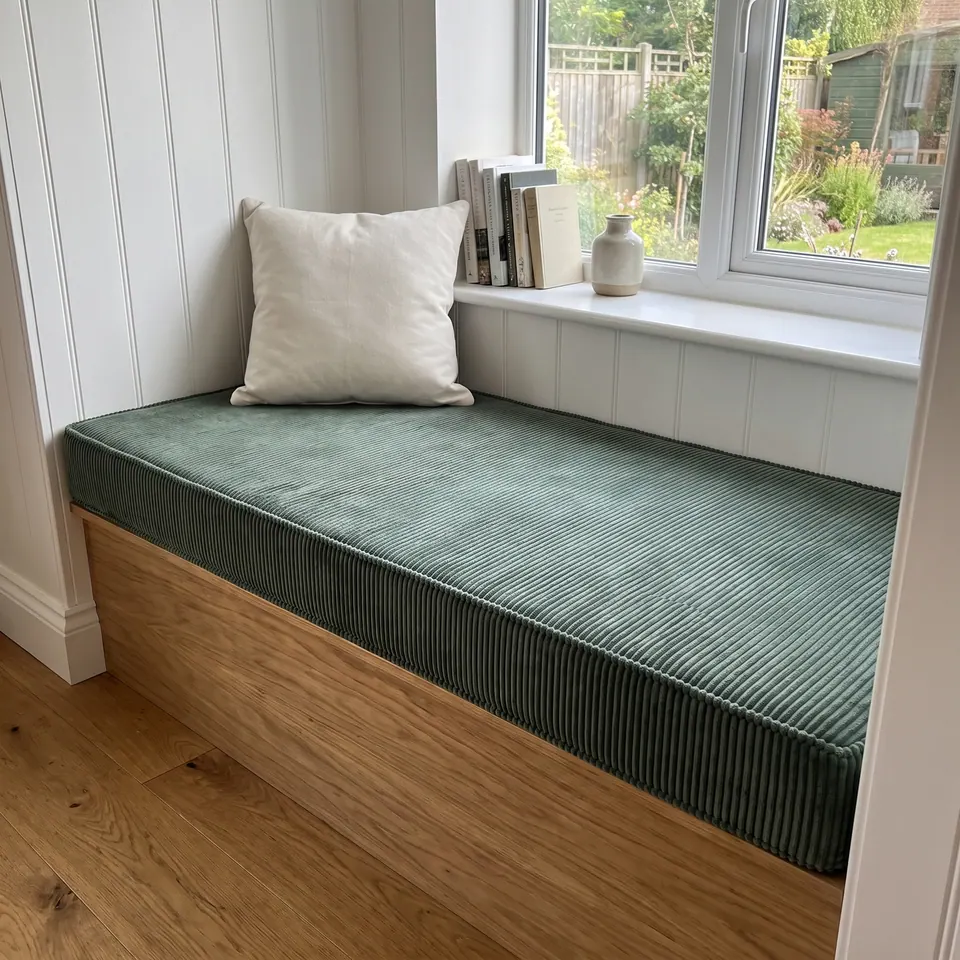
Rosa writes a letter about a mushroom-colored cord seat in a deep white window, and the inch that decides whether it sits right.

 Save
The quick answer
A window seat cushion should be thick enough to soften the bench but not so thick that it lifts your elbows onto the sill. Most seat cushions run 2 to 5 in (5 to 12.5 cm) thick, and 2 in is the thinnest foam the workshop cuts, so measure bench height, sill height and seat depth before you choose.
Savannah ·
Dear neighbor,
A letter from the window seat
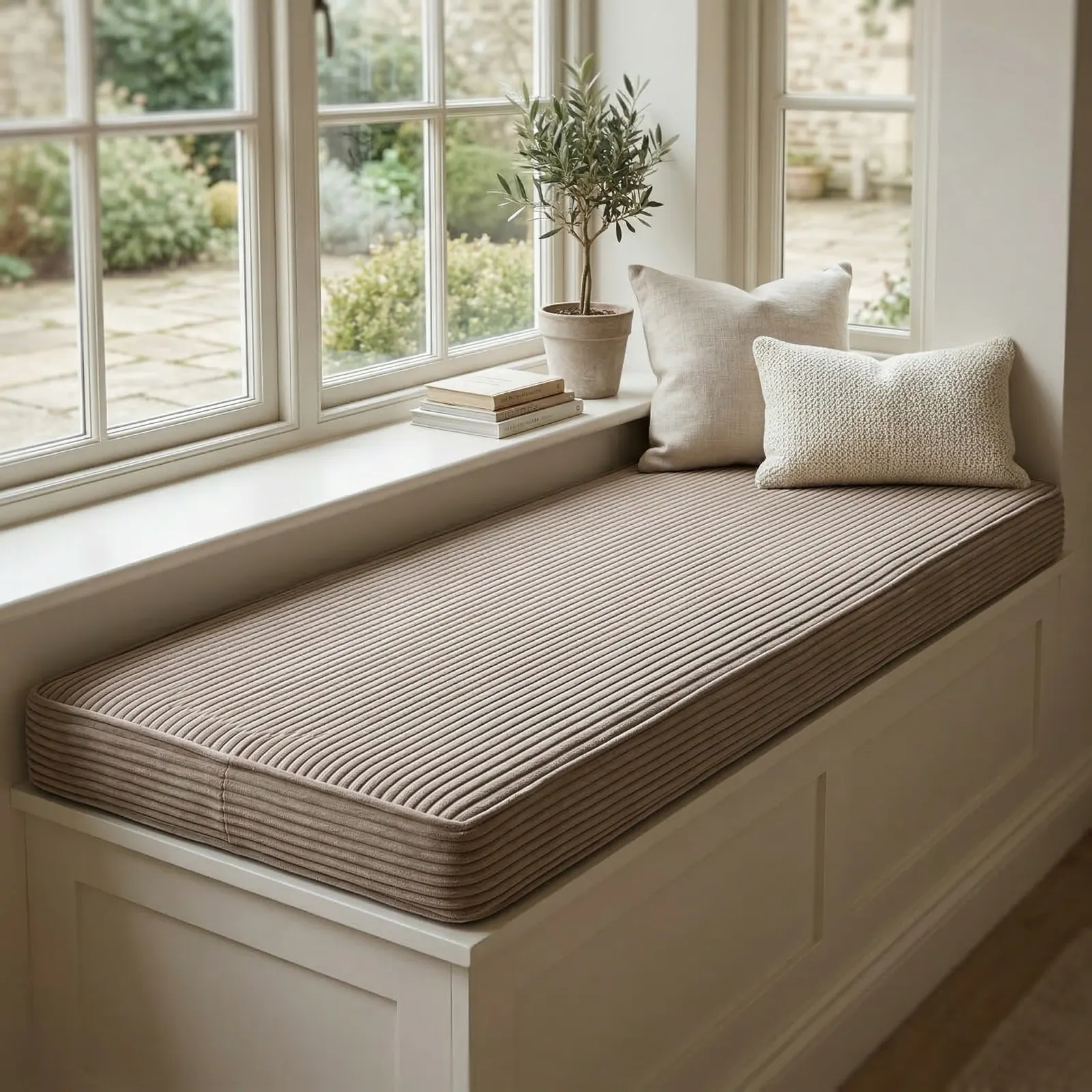
I chose the color of this cushion by looking out the window. The taupe corduroy matches the stone paving in the courtyard beyond the glass. Seat and view share one palette, so the eye travels from one to the other without tripping.
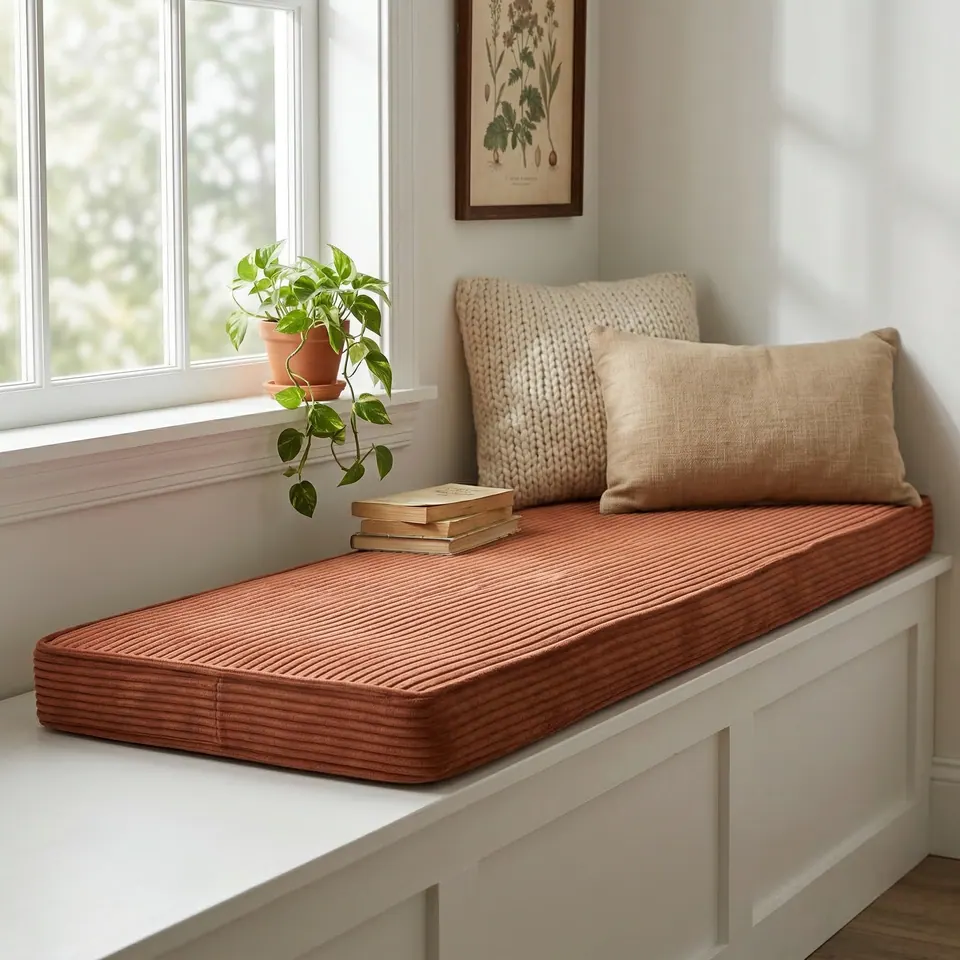
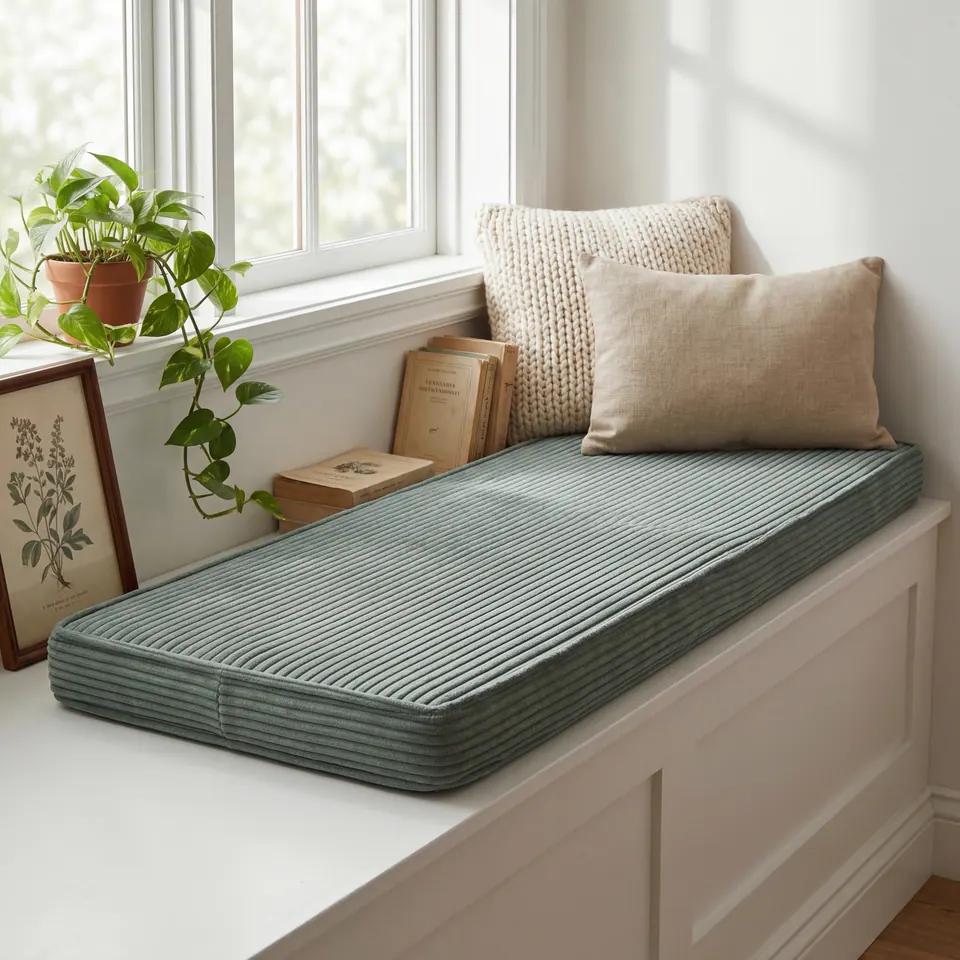
Everything else stays quiet. Two pillows are pushed into the far corner and kept pale: an ivory linen square and a cream waffle-knit lumbar whose little grid repeats the window panes. That leaves most of the seat free for sitting, which is the whole point of a window seat.
The olive tree in its stone pot gives the only height and the only green, and the pot repeats the cushion's mushroom tone. A small stack of books waits on the sill. Soft overcast light flattens the cord's sheen, so the ribs read as a matte, warm texture instead of a shine.
The piping is self piping, same cord, same taupe. It keeps the box edge crisp without drawing a line of a second color across a calm room. When a window frames a strong view, take your cushion color from the stone, brick or paving out there, not from the plants. Plants change with the seasons. Paving stays put.
Pinned by Rosa: the courtyard window
Start at the courtyard beyond the casements, then follow the pins to the olive tree, the two pale pillows and the taupe seat itself.
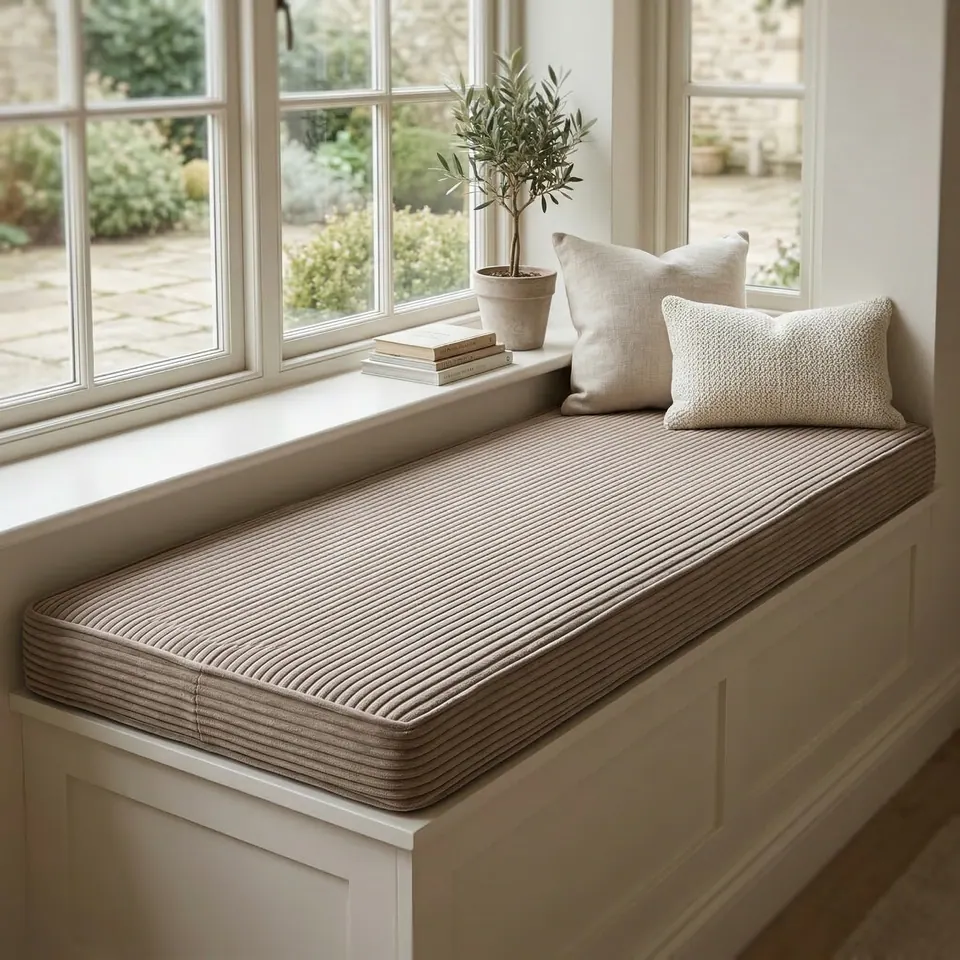
- Taupe cord seat
Color matched to the stone paving so view and seat share one palette.
- Olive tree
The only height and the only green, its pot repeating the cushion tone.
- Ivory linen pillow
Pale pillows pushed to the corner leave most of the seat free.
- Waffle-knit lumbar
A small grid texture echoes the window panes behind it.
- Courtyard view
Hardscape outside was the color reference for the cushion.
- Taupe cord seatColor matched to the stone paving so view and seat share one palette.
- Olive treeThe only height and the only green, its pot repeating the cushion tone.
- Ivory linen pillowPale pillows pushed to the corner leave most of the seat free.
- Waffle-knit lumbarA small grid texture echoes the window panes behind it.
- Courtyard viewHardscape outside was the color reference for the cushion.
Thickness against height and depth
Pull up a chair and let me tell you about the inch that ruins window seats.
Every inch of cushion lifts you closer to the sill. Add too much and your elbows land on the ledge instead of your lap, and your knees rise past a comfortable bend. Finished seat height is simply the bench height plus the cushion's thickness, less a little settling when you sit.
So measure three things before you pick a thickness: - Bench height, from the floor to the top of the seat board. - Bench to sill, the gap a cushion will eat into. - Seat depth, from the wall to the front edge, because pillows along the back take some of it.
The foam matters too. The workshop cuts its cushions from high-resilience foam of about 2.0 lb/ft³ (32 kg/m³), firm enough that you do not sink. That is good news for planning: the thickness you order is close to the height you will actually sit at.
The seat height calculator does the sums, the window seat thickness pattern shows the usual choices, and the window seat cushion atlas and the corduroy shelf fill in the rest. How many inches sit between your bench top and your sill?
The buyer who wanted one inch
A buyer in the US wrote to the workshop with a trapezoid window seat: 70 in (178 cm) across the front, 44 in (112 cm) across the back, 20.5 in (52 cm) deep, with 2.5 in (6.4 cm) notches at the back corners. They wanted the cushion 1 in (2.5 cm) thick.
The workshop's thinnest option is 2 in (5 cm). It quoted that through the trapezoid listing, with the drawing uploaded, and the buyer thought it over. In the end they felt 2 in would sit too high for their window.
Nobody was wrong. They simply found the limit late. Check the minimum foam thickness before you design a seat around a thin pad, and if the sill is tight, the inch has to come out of the bench. The trapezoid measuring pattern shows how to draw a seat like theirs.
On the cutting table: the courtyard seat
| Piece | Window seat cushion for a deep paneled recess |
|---|---|
| Fabric | Corduroy in taupe mushroom |
| Edge | Box edge |
| Piping | Self piping in the same cord |
| Foam | About 2.0 lb/ft³ (32 kg/m³) HR foam in polyester batting |
| Thickness | 2 in (5 cm) minimum; most seats run 2 to 5 in (5 to 12.5 cm) |
| Pillows | Ivory linen square and cream waffle-knit lumbar, both at the far end |
| Color source | The stone paving outside the window |
| Best for | Reading nooks and deep window recesses |

Have it made
Have this made — ask Rosa’s workshop
Swings sway, rockers rock, dogs circle three times. Tell the workshop what your seat goes through, and they will plan for it. — Rosa
Leave your details and the workshop will call you to confirm measurements, fabric, foam and piping. No prices, dates or payment on this page: it is a request, not an order.
Buyer questions: drawings, quotes and foam
- A common question
What measurements do you need for a trapezoid or bay window seat cushion?
The workshop's answerA simple hand-drawn sketch with every side labeled: the back or wall length, the front length, both angled sides, and the depth from front to back, marked E. On the trapezoid chart, A is often the thickness. For a bay with several windows, measure every line between the breaking points plus the depth at each one, and add a photo of the space. If the numbers cannot close into a shape, the workshop asks you to recheck.
- A common question
How is a custom window seat cushion priced? Mine is a long, unusual size.
The workshop's answerEach size is quoted on its own, from seats around 16 x 63 in (40 x 160 cm) to long runs of 15 x 117 in (38 x 298 cm). Fabric moves the number as much as size does: a 26 x 83 in (66 x 211 cm) cushion in velvet was quoted above a larger 24 x 97 in (61 x 246 cm) cushion in another fabric.
- A common question
What foam do you use, how firm is it, and is it wrapped in Dacron?
The workshop's answerThe cushions use high-resilience foam of 32 kg/m³, about 2.0 lb/ft³, described as firm or medium-hard and long-lasting, so you do not sink in. The foam is wrapped in polyester fiber (Dacron) batting before it goes into the cover, which fills the cover out and gives fuller, softer edges.
Two inches is the thinnest foam a window seat cushion is cut from, so measure the gap between bench top and sill before falling for a thin pad.
Rosa
Questions buyers ask next
Can a window seat cushion be cut thinner than 2 inches?
Not from this workshop. Two inches (5 cm) is the thinnest foam it cuts. If 2 in would lift you too close to the sill, the inch usually has to come out of the bench height rather than the cushion.
Why does taupe corduroy look flatter on a cloudy day?
Corduroy is a pile fabric, and its ribs shine most when light rakes across them. Soft overcast light falls on the pile evenly, so taupe cord reads matte and warm. Low side sun brings the sheen back along the ribs.
Do throw pillows steal seat depth on a window seat?
Yes. Every pillow lined up along the back pushes you forward on the seat. Push them to one end, as in this recess, and choose a lumbar, which adds support without taking much of the depth.
Porch light's on — Rosa