 Save
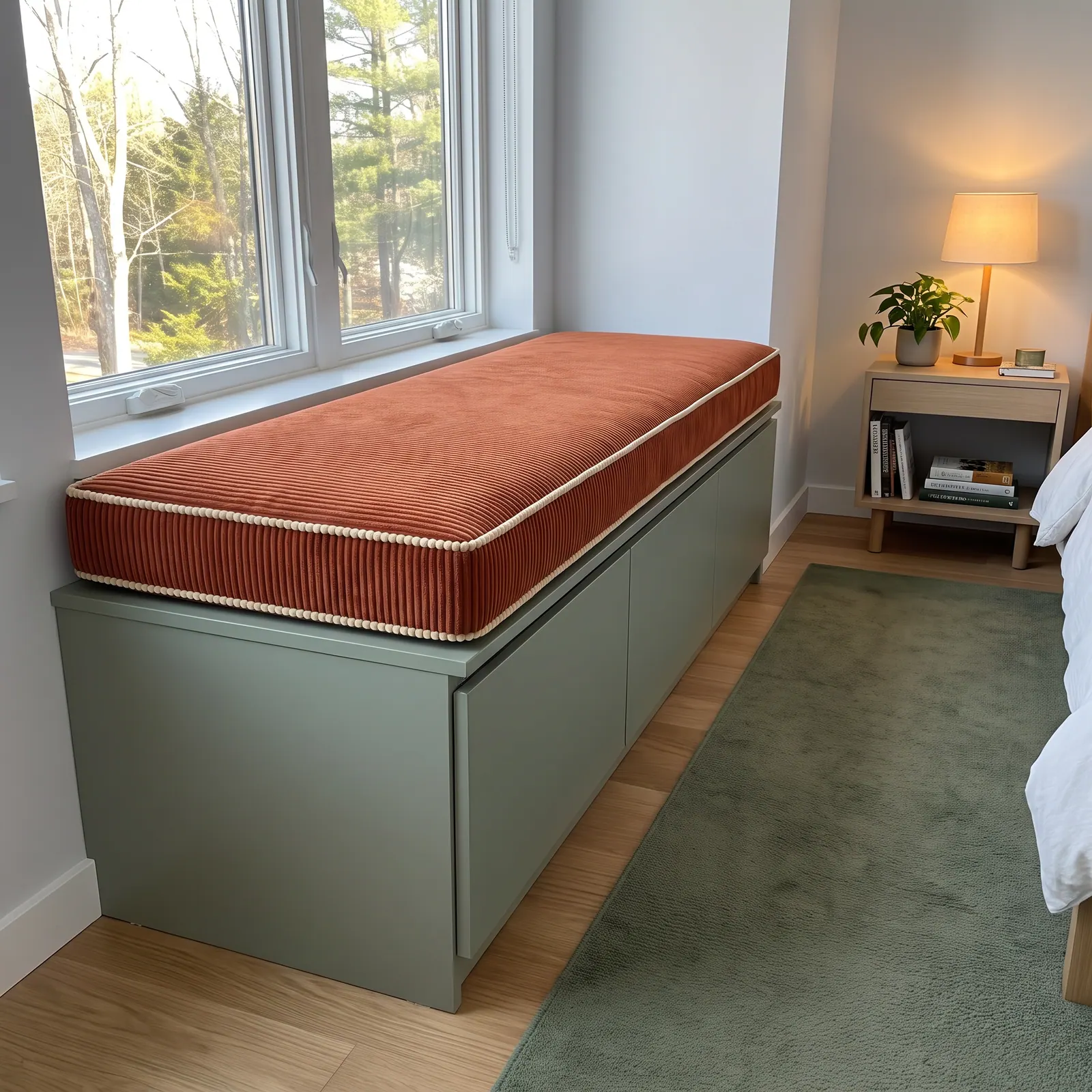
- Cream contrast piping
A pale cord separates rust from sage and repeats the white bedding and window frame.
- Rust corduroy top
The one warm note in a cool room, matched only by the lamp's glow.
- Table lamp
Warm lamplight echoes the rust and makes the seat inviting at dusk.
- Pothos plant
Trailing green ties the nightstand to the sage bench.
- Sage rug
The rug extends the bench color across the floor.
Plate Rust Corduroy Cushion With Cream Piping on a Sage Bedroom Bench
Rust and sage make each other richer, and the cream piping draws a clean line between the two.
A Reading by RosaWindow Seat Cushions
A rust corduroy window seat cushion that turned a sage bedroom bench warm
One cushion, one lamp, one painted bench. The bedroom was restful before; now it has the seat everybody fights over.

The quick answer
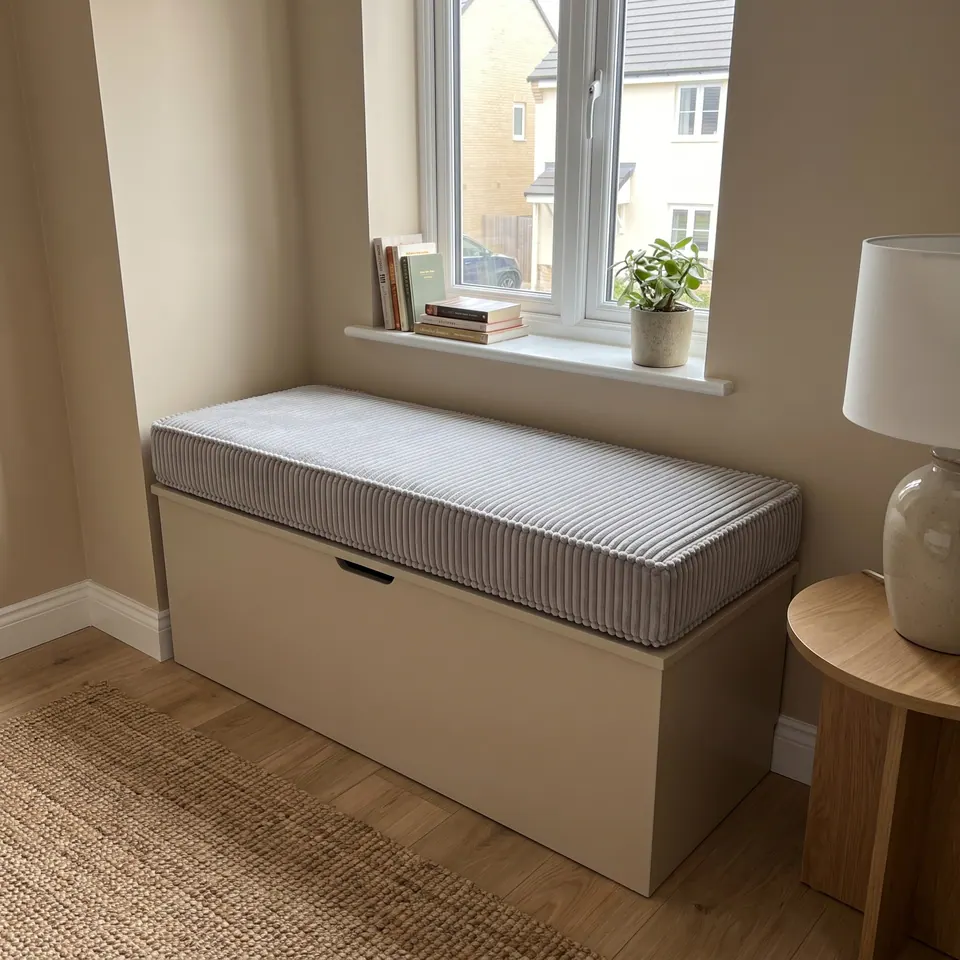
If your storage bench is painted, choose the cushion color from the opposite side of the color wheel and tie it back with a neutral piping. On this sage green bedroom bench, a rust corduroy window seat cushion with cream piping becomes the one warm note, matched only by the lamp, while a sage rug carries the bench color across the floor.
Pinned by Rosa: the warm note and its echoes
Five pins trace how one rust cushion found partners in a lamp, a plant and a rug.
The numbers match the pins on the plate.
- Cream contrast pipingA pale cord separates rust from sage and repeats the white bedding and window frame.
- Rust corduroy topThe one warm note in a cool room, matched only by the lamp's glow.
- Table lampWarm lamplight echoes the rust and makes the seat inviting at dusk.
- Pothos plantTrailing green ties the nightstand to the sage bench.
- Sage rugThe rug extends the bench color across the floor.
Before the cushion, after the cushion
Picture the bench bare first. A sage green storage bench under a wide window, a sage rug, white bedding, an oak nightstand, woods beyond the glass. Restful, and a little cool.
Now add one cushion. The top is rust corduroy, and the whole room tips warm. Rust and sage sit nearly opposite on the color wheel, so each makes the other look richer. Nothing else in the room is that warm except the glow of the table lamp, and at golden hour the two answer each other across the bed.
Between rust and sage runs a cream cord of piping. It does the tidy work: it separates the two colors cleanly and repeats the white bedding and the window frame. Without it, rust sitting straight on sage could look heavy at the edge.
The rest is there for a reason. A pothos trails green from the nightstand and ties it to the bench. Stacked books say somebody reads here before sleep. The sage rug carries the bench color across the floor, which leaves the cushion free to be the single warm note.
That's the makeover in one line: paint the bench, then choose its window seat cushion from the far side of the wheel. The Pattern on piping choices covers the cord, and there are more bedroom cushions to compare.
What color is your bench painted, neighbor?
The plate's four colors
- Rust corduroy#A64B2AThe single warm note; the lamp is its only echo
- Cream piping#EFE6D2Repeats the white bedding and the window frame
- Sage bench#8FA388Near-complement to rust; the rug carries it across the floor
- Oak nightstand#B98A58Warm wood that sits between rust and sage
Two columns, six pieces, no T shapes
A buyer in the US wrote to the workshop about a window seat split by two columns, each 7.75 in (20 cm) wide, to be covered in a vintage patchwork fabric. They planned three T-shaped French cushions. Two measured 72.25 in (184 cm) across the top and 63.75 in (162 cm) at the bottom; the third, 77.75 in (197 cm) and 70 in (178 cm). The depth was given as 53 3/8 in plus 20.5 in (136 + 52 cm).
The workshop wouldn't sew T shapes. Instead it drew a six-piece layout of simpler pieces that butt together. The buyer asked for a contrasting fabric on the front edges, and that cost nothing extra.
Big, odd windows get easier when you break them into rectangles and trapezoids. The trapezoid cushion calculator helps with the sums.
Buyer questions: your own fabric, daily use, the right brown
- A common question
Would you make my cushion from fabric I buy somewhere else, and how much should I buy?
The workshop's answerYes, you can send your own fabric to the workshop, though shipping it in can slow things down, and the shop can also suggest similar in-house fabrics. For a 60 x 14 in (152 x 36 cm) cushion with piping, cut from 45 in (114 cm) wide fabric, about 2 3/4 yards (2.5 m) is enough.
- A common question
Our kitchen bench gets sat on all day. Will these cushions hold their shape?
The workshop's answerYes. The tufted cushions keep their shape under heavy use, and a single long cushion, for example 90 x 24 in (229 x 61 cm), can be made so separate pieces don't shift around.
- A common question
Which of your linens is the most chocolate brown?
The workshop's answerThe shop sent real photos of three browns to compare side by side: L38, L77 and L19. That buyer was planning L38 as the piping color with L-62.
On the cutting table: the sage bedroom bench
| Cushion | Window seat box cushion on a storage bench |
|---|---|
| Fabric | Rust corduroy top (V05) |
| Piping | Cream contrast cord (V01) |
| Edge | Box edge |
| Bench | Sage green painted storage bench |
| Room | Bedroom with oak nightstand, lamp, pothos and sage rug |
| Light | Golden hour through a wide window |
| Best for | A cool-toned bedroom that needs one warm spot |

Have it made
Have this made — ask Rosa’s workshop
Every good cushion I know started with a long porch chat. This is the short version: leave your number and the workshop will call. — Rosa
Leave your details and the workshop will call you to confirm measurements, fabric, foam and piping. No prices, dates or payment on this page: it is a request, not an order.
Paint a storage bench sage, then top it with a rust corduroy cushion: near-complements make each other richer, and cream piping draws the line between.
Rosa
Questions buyers ask next
What cushion color suits a sage green bench?
A warm color from the far side of the color wheel, such as rust or terracotta. On this bedroom bench, rust corduroy makes the sage look deeper, and the cushion reads as the room's warm focus.
Why put cream piping between a rust cushion and a sage bench?
A neutral cord separates two strong colors at the edge and ties the cushion back to the room. Here the cream repeats the white bedding and the window frame, so the contrast looks planned.
Does a contrasting front edge on a window seat cushion cost more?
On one six-piece window seat order, a contrasting fabric on the front edges was added at no extra cost. Ask about it when you request your quote, since each custom project is priced on its own.
Porch light's on — Rosa
More photographs to read
 Save
 Save
 Save
 Save
 Save
 Save