A Reading by HarlanStar Poufs & Giant Star Floor Cushions
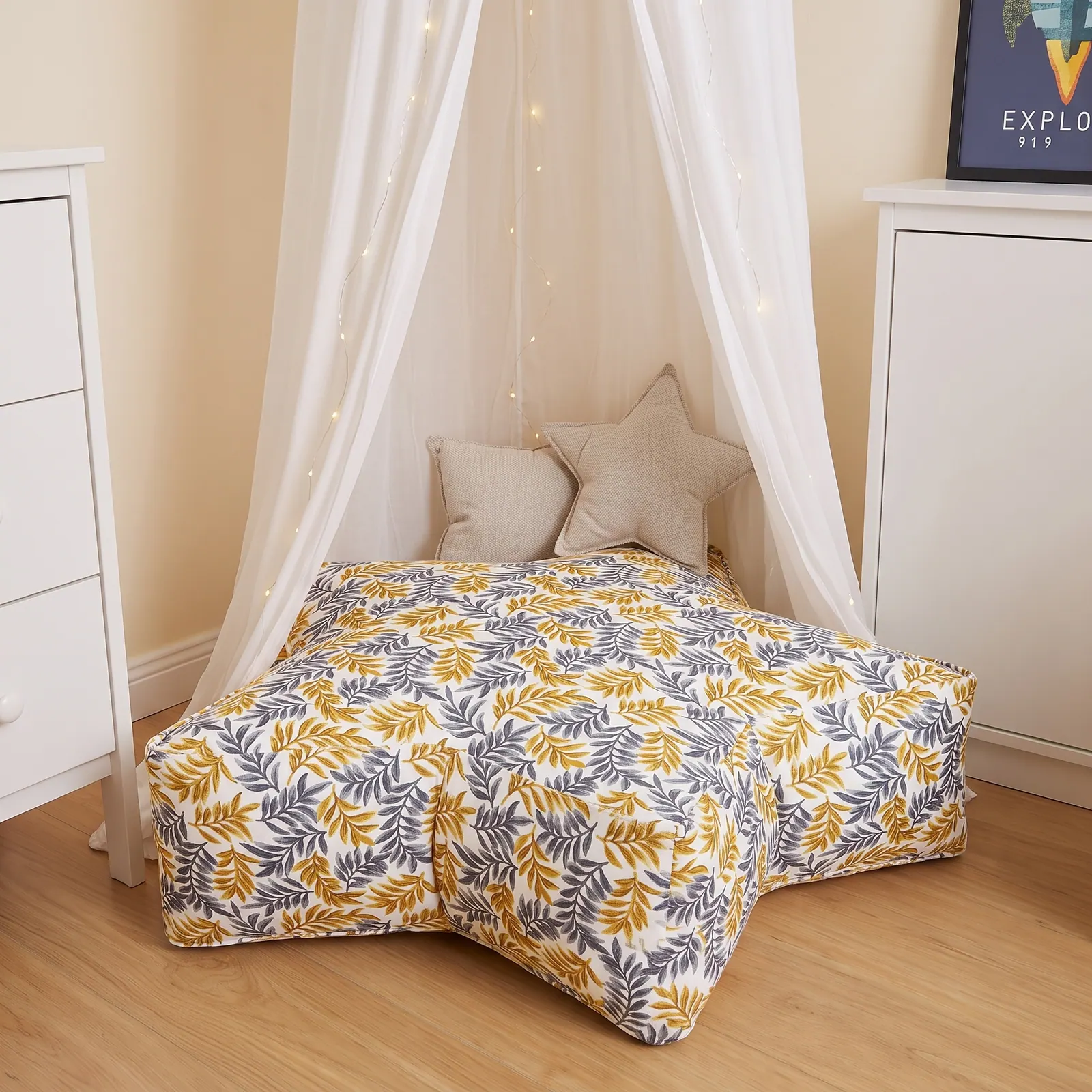
A mustard and gray leaf-print star floor cushion, measured to fit between two dressers
Harlan kneels in the gap between two white dressers and reads a star by its points, its sides and the inches it has to live in.
 Save
The quick answer
Size a star floor cushion from the gap it will fill: measure at floor level, then choose a star narrower than that space. Stars have been quoted at 35½ in (90 cm) and 50 in (127 cm) across, and the smaller one suits a slot between two dressers. On the floor, the cushion's thickness is the seat height.
The cushion, cut open
Cover fabric. A removable, zippered cover. Machine wash at 86°F (30°C) on a gentle cycle and air dry.
Piping. A fabric-covered cord sewn into the seams. It sits on the seam line, so it does not change the size.
Fiber wrap. Polyester fiber (Dacron) batting around the foam: it fills the cover out and softens the edges.
Foam core. About 2.0 lb/ft³ (32 kg/m³) high-resilience foam, firm to medium-firm, cut to the ordered size.
Zipper. Along the back band, as hidden as possible. The zipper side faces down or toward the wall.
Base panel. The underside of the cover. A non-slip fabric backing can cover the whole of it instead.
A star floor cushion, taken apart on paper
A star is five points and five valleys, and the valleys are where you find out who made it.
This one is a cream cloth printed with mustard and slate gray leaves, box edge, self piping. Read it from the outside in: - Top and bottom panels. Two stars cut from the same print. The leaves are scattered, so there's no stripe to match, but the print still has to sit square on both faces. - The gusset. A band of fabric running all the way round, giving the star its depth. It turns ten times: out to a point, back into a valley. - The piping. Self piping traces every one of those turns. At a point it must come to a clean tip; in a valley it must turn tight without a pucker. That's hand work, and it's the first thing a careful eye catches. - The fill. Whatever is inside has to reach the tips, or the points go limp.
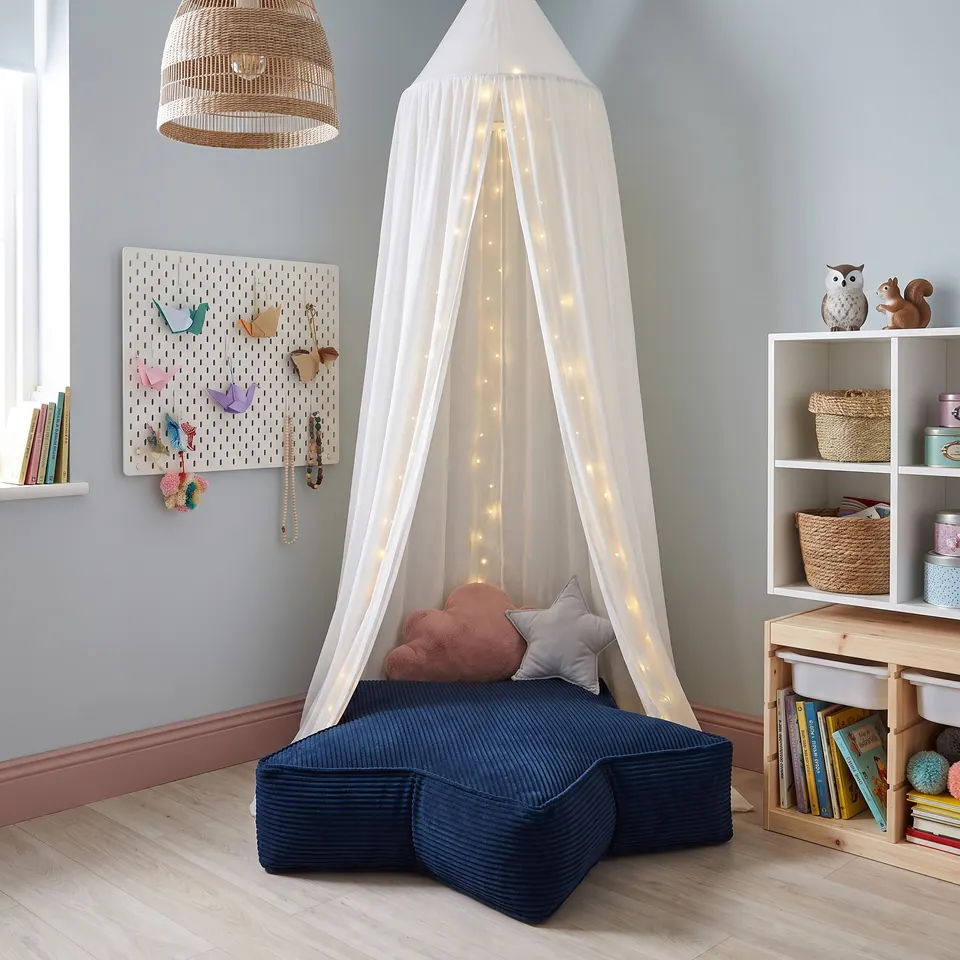
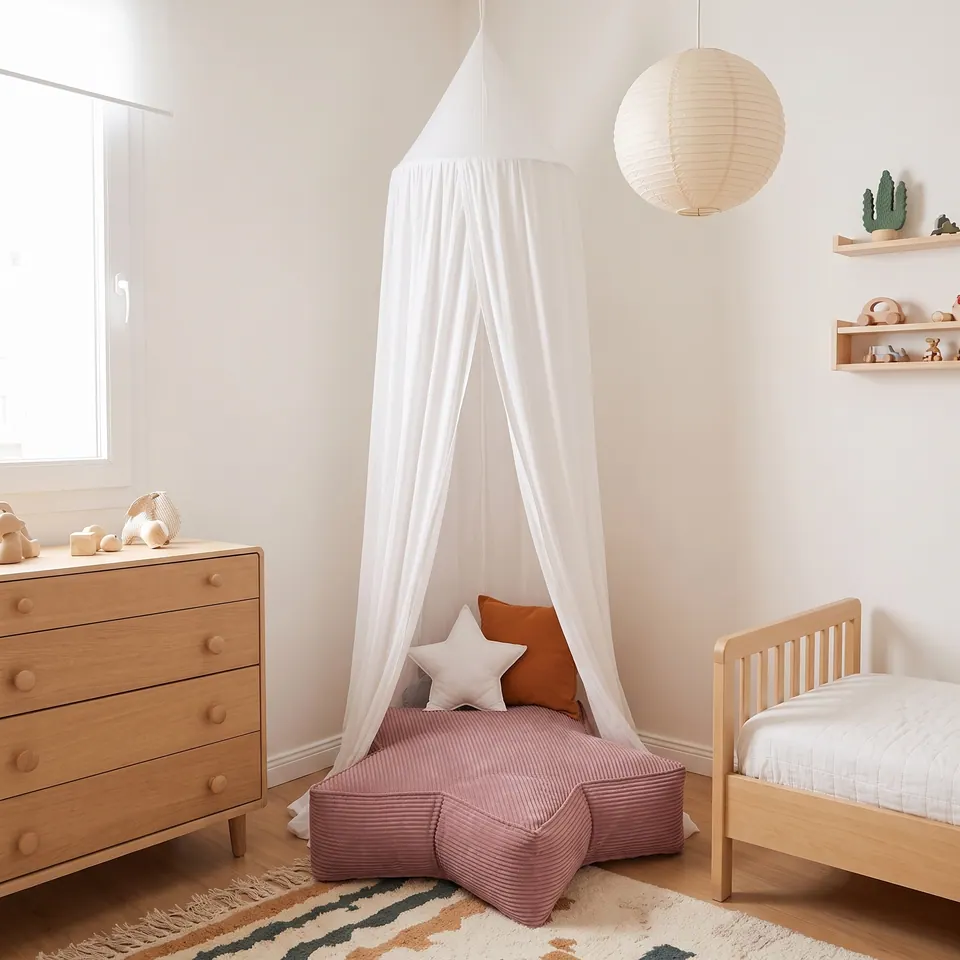
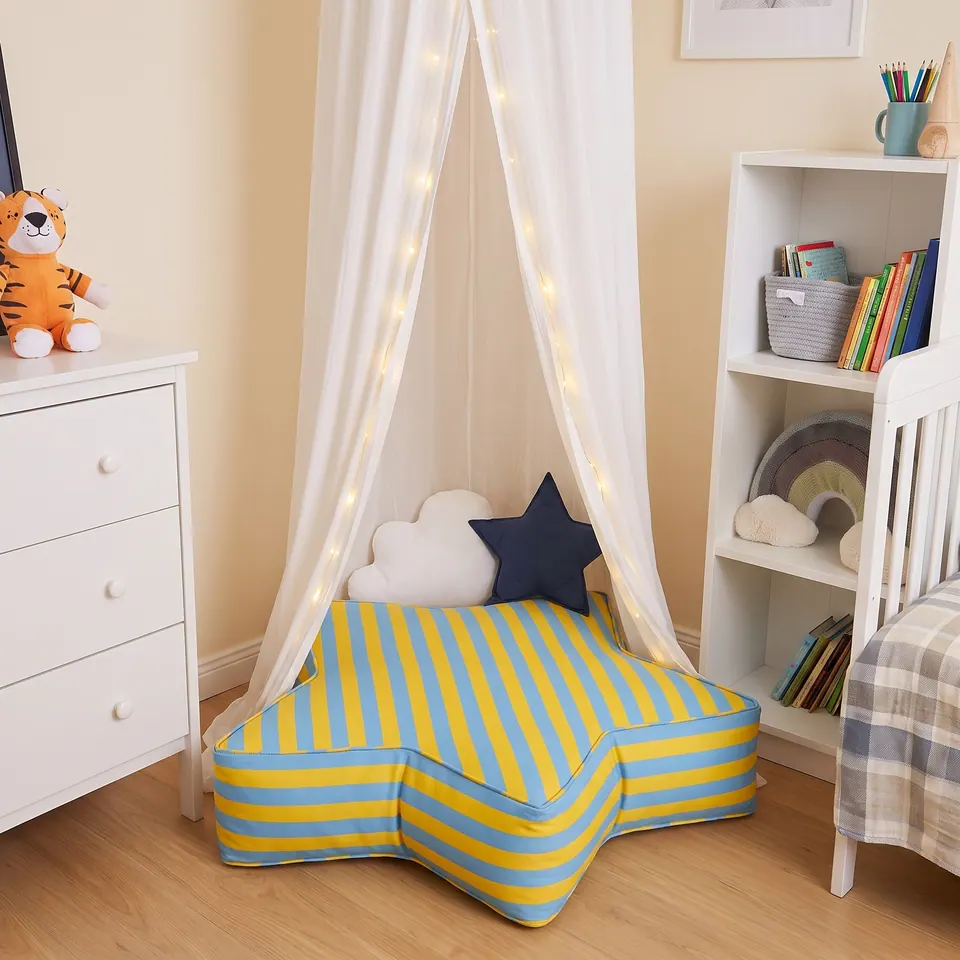
Now the room. The star is wedged into a narrow gap between two white chests of drawers, a dead space that would otherwise collect toys. A white voile canopy strung with fairy lights hangs above and turns leftover space into a nook. A beige square pillow and a small beige star pillow sit on top: plain, so the leaf print stays in charge, and the little star repeats the big one without adding a color. The mustard leaves pick up the honey oak floor; the slate gray ones pick up the frame of a space poster on the wall. Warm lamplight, one child, one book. That's the whole idea, my friend.
Pinned by Harlan: five marks in the dresser gap
Five pins, from the leaf-print star on the floor up to the voile canopy that claims the gap.
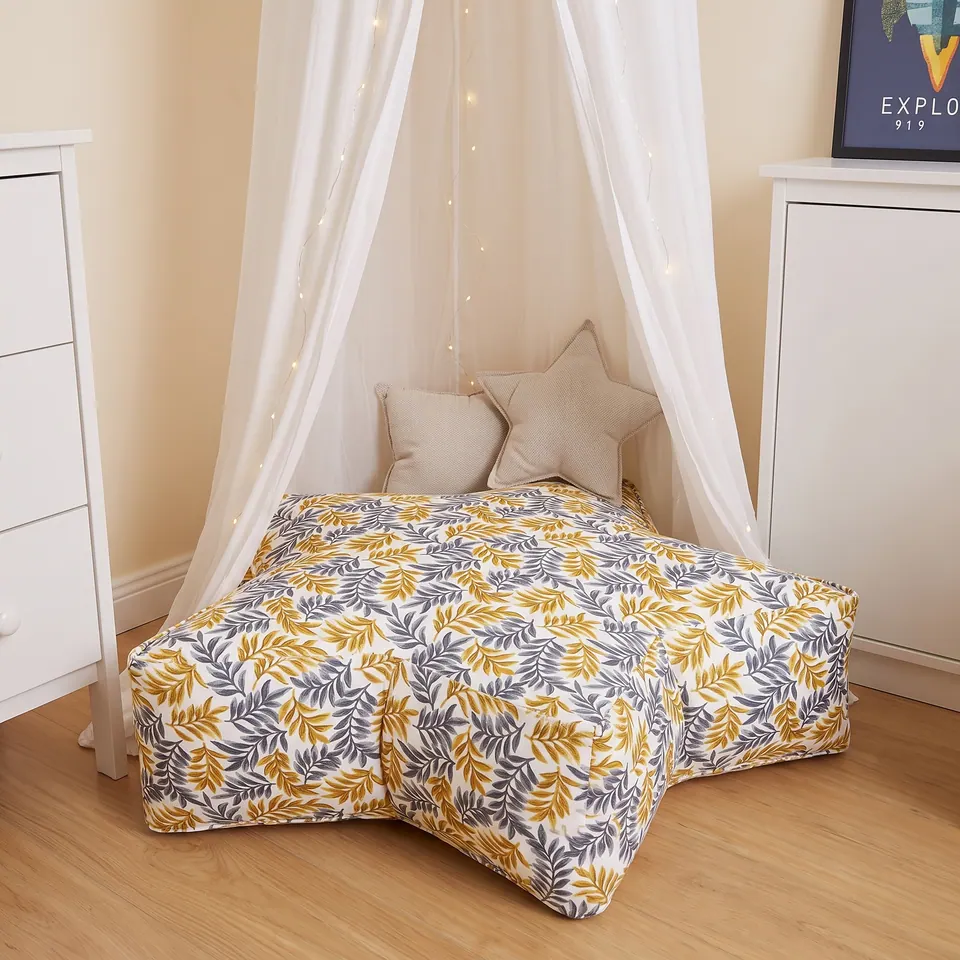
- Leaf-print star
Mustard leaves tie to the honey floor, gray leaves to the poster frame.
- Beige square pillow
Plain beige pillows let the pattern stay in charge.
- Beige star pillow
A small star repeats the big one without adding a color.
- White dresser
The star fills a dead gap that would otherwise collect toys.
- Voile canopy
The canopy claims the gap as a nook rather than leftover space.
- Leaf-print starMustard leaves tie to the honey floor, gray leaves to the poster frame.
- Beige square pillowPlain beige pillows let the pattern stay in charge.
- Beige star pillowA small star repeats the big one without adding a color.
- White dresserThe star fills a dead gap that would otherwise collect toys.
- Voile canopyThe canopy claims the gap as a nook rather than leftover space.
Proportion in four measurements
Measure the gap at floor level
Dresser to dresser, down where baseboards and knobs narrow it. That number is the most the star can be across.
Choose a star narrower than the gap
A jammed star sits crooked. Of the sizes quoted to buyers, 35½ in (90 cm) across suits a slot like this one; 50 in (127 cm) belongs on open floor.
Treat thickness as seat height
On the floor there are no legs, so the cushion's thickness is how high a child sits. Small children like it low; a grown-up reading a bedtime story wants more under them.
Find something to lean on
A star has no backrest. If someone will read there for long, the dresser side or the wall does that job, and a square pillow fills the space between.
An 18 x 48 in floor set that needed its wall
A buyer in the US ordered an 18 x 48 in (46 x 122 cm) floor seating set, received one piece, and assumed they'd bought a mat with no back support.
The set was a seat, a backrest and two armrests, and it isn't freestanding: the backrest leans against a wall. One parcel had gone missing, so the workshop remade the missing pieces and shipped them.
The proportion lesson is plain. Seat depth is only half the story; what holds the back up is the other half. Before ordering a floor set, find the wall it will lean on. The seat height calculator and the Pattern on floor cushion thickness cover the height side, and more stars live under star poufs and kids' room cushions. How wide is the gap in your child's room?
Buyer questions: pile marks and the bars behind a backrest
- A common question
Where we sit, the sofa fabric looks washed out. Is that normal?
The workshop's answerYes. Pile shifts when you sit on it and settles back to its normal look after a few days of use. If you still don't like the color after that, covers in a different color can be bought at cost instead of returning the whole sofa.
- A common question
How do the metal bars on a modular floor sofa fit together, and can I buy spares?
The workshop's answerThe bars sit behind the backrest cushions and stop them sliding backward when you lean. They twist and push together: a metal insert grips each joint and small dots click in. A stiff corner joint loosens after clicking in and out a few times. They come with the sofa and aren't sold separately.
On the cutting table: the leaf-print star
| Product | Star floor cushion, five points |
|---|---|
| Fabric | Cream print with mustard and slate gray leaves |
| Edge | Box edge; the gusset turns at every point |
| Piping | Self piping traced into each point and valley |
| Sizes quoted | 35½ in (90 cm) and 50 in (127 cm) across |
| Fit rule | Narrower than the gap, measured at floor level, allowing for about 0.5-1 in (1-2 cm) handmade tolerance |
| Seat height | Equal to the cushion's thickness |
| Best for | Dead corners and dresser gaps in shared kids' rooms |
Have it made
Have this made — ask Harlan’s workshop
The best cushions I have known began with somebody asking one more question. Ask yours here. — Harlan
Leave your details and the workshop will call you to confirm measurements, fabric, foam and piping. No prices, dates or payment on this page: it is a request, not an order.
Size a star floor cushion from the gap, not the catalog: a 35½ in (90 cm) star suits a dresser slot, while a 50 in (127 cm) one needs open floor.
Harlan
Questions buyers ask next
How big should a star floor cushion be for a small bedroom?
Measure the floor space first. Stars have been quoted at 35½ in (90 cm) and 50 in (127 cm) across; the smaller suits a gap between furniture or a corner of a shared room, and the larger works as a centerpiece on open floor.
Can a child lean back on a star pouf?
Not on its own. A star is freestanding with no backrest, so it suits sitting upright, lying across or curling up. Set it against a wall or a dresser side and add a square pillow if someone will read there for a long stretch.
Why do plain pillows suit a patterned star cushion?
They let the print lead. On this leaf-print star, a beige square pillow and a small beige star add softness without a new color, and the little star repeats the shape of the big one so the corner feels planned.
Sit well. — Harlan