A Reading by MaggieBench Cushions
One long custom bench cushion, and how a narrow café bench learned to feel generous
Maggie answers three quick questions first, then reads an oak sidewalk bench where a single aqua pad does more for a tight strip of pavement than any extra furniture could.

 Save
The quick answer
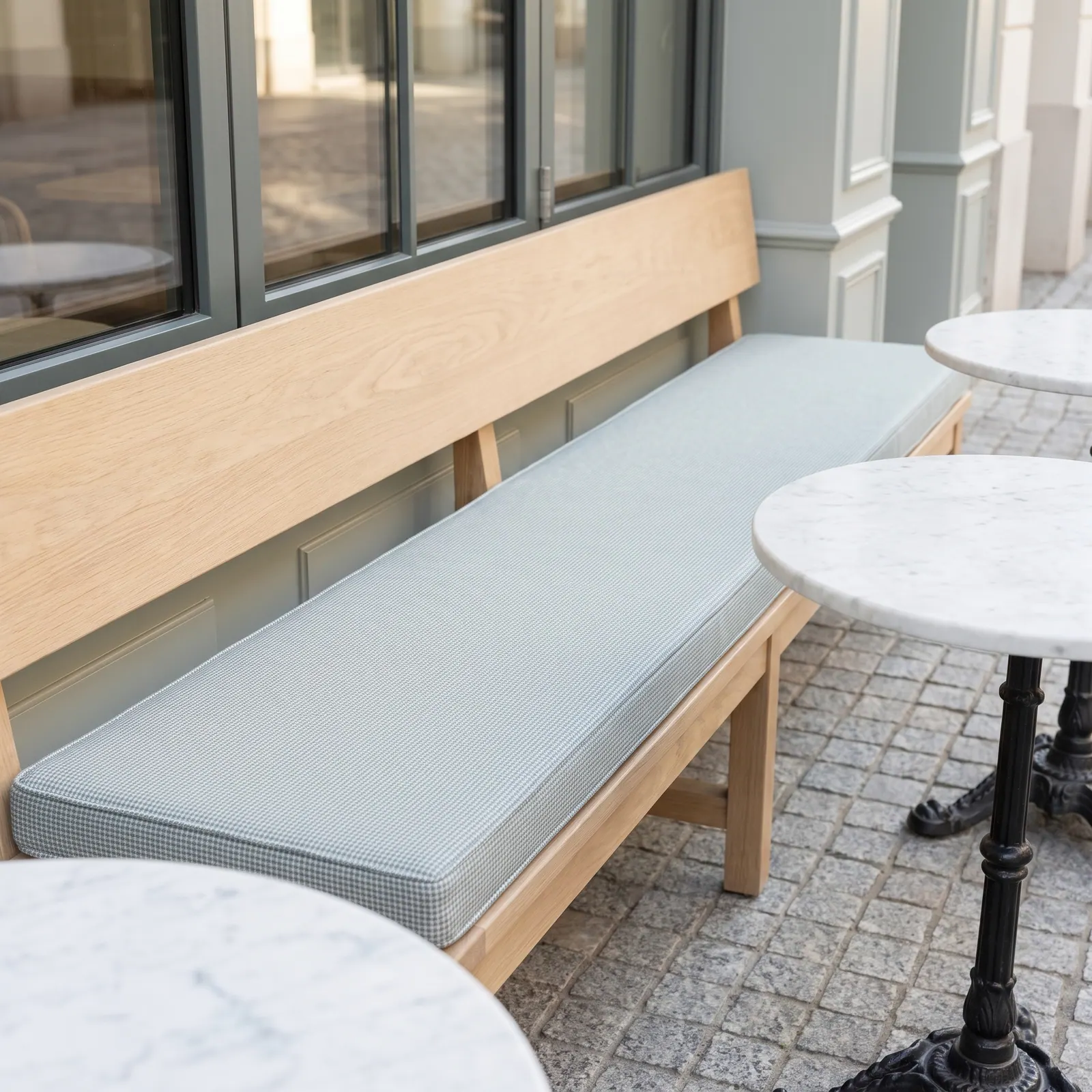
To make a narrow bench feel generous, cover its whole length with one continuous custom bench cushion in a fine, pale pattern. On this oak café bench a single aqua microcheck pad runs end to end with no seams between tables, the tall backboard handles support, and little round marble tables leave legroom. Handmade sizes can vary by 1 to 2 inches, so measure the bench itself.
Three questions first: tufting, sizes and brown linen
- A common question
I love the tufted French-style look, but it's more than I planned to spend. Is there a less expensive way to get close?
The workshop's answerYes. A tufted French-style set is priced as a whole, backrests and armrests included; one quote covered a 70 x 28 x 3 in (178 x 71 x 7.5 cm) seat with both. The cheaper route is a plain, non-tufted cushion filled with foam.
- A common question
My new bench cushion measures an inch or two off from what I ordered. Did something go wrong?
The workshop's answerProbably not. Every cushion is fully handmade, and the listing says a difference of 1 to 2 in (2.5 to 5 cm) is possible. A tufted cushion often settles when you shake and pat it: one came down from 27 in to 26 in (69 to 66 cm) that way.
- A common question
Which of your linens is the deepest chocolate brown?
The workshop's answerThe shop sent real photos of three browns side by side: L38, L77 and L19. That buyer was leaning toward L38 as the piping color against L-62 for the body.
Now, the reading
How one pad widens a sidewalk bench
A sidewalk bench is about the stingiest seat in town: long, shallow, and squeezed between a shopfront and a row of tables. The clever thing here is that nobody added anything. They took something away: the seams.
One continuous pad runs the full length of the oak bench. With no breaks, the eye reads a single seat, and a single seat always looks roomier than three short ones lined up like train cars. Guests slide along it between tables without landing on a join.
The box edge is modest and self-piped in the same aqua, so the outline is tidy without drawing a second line across a narrow space. A contrast welt would have fenced the bench in. A straight welt is a kind of honesty, and this one runs true from end to end.
The cloth is a water-repellent membrane fabric in a microcheck so fine it turns blue-gray at ten paces. That matches the sage-gray shopfront, and a soft color against a painted facade lets a shallow seat recede rather than shout. The white in the check picks up the marble tabletops.
Now the props. The tall oak backboard does the supporting, so only a seat pad is needed; a back cushion would have eaten inches of depth. Round white marble tables on black cast-iron bases keep corners away from knees and add the old bistro contrast. The granite setts underfoot keep all that pale color grounded in soft morning light.
What is the narrowest seat at your place, dear? A porch or mudroom bench plays by the same rule. Browse bench cushions, look at water-repellent membrane fabrics for outdoor spots, and read whether a long bench cushion should be one piece or two.
Pinned by Maggie: the café bench, end to end
Five pins along the bench, from the one continuous pad to the painted shopfront it borrows its color from.
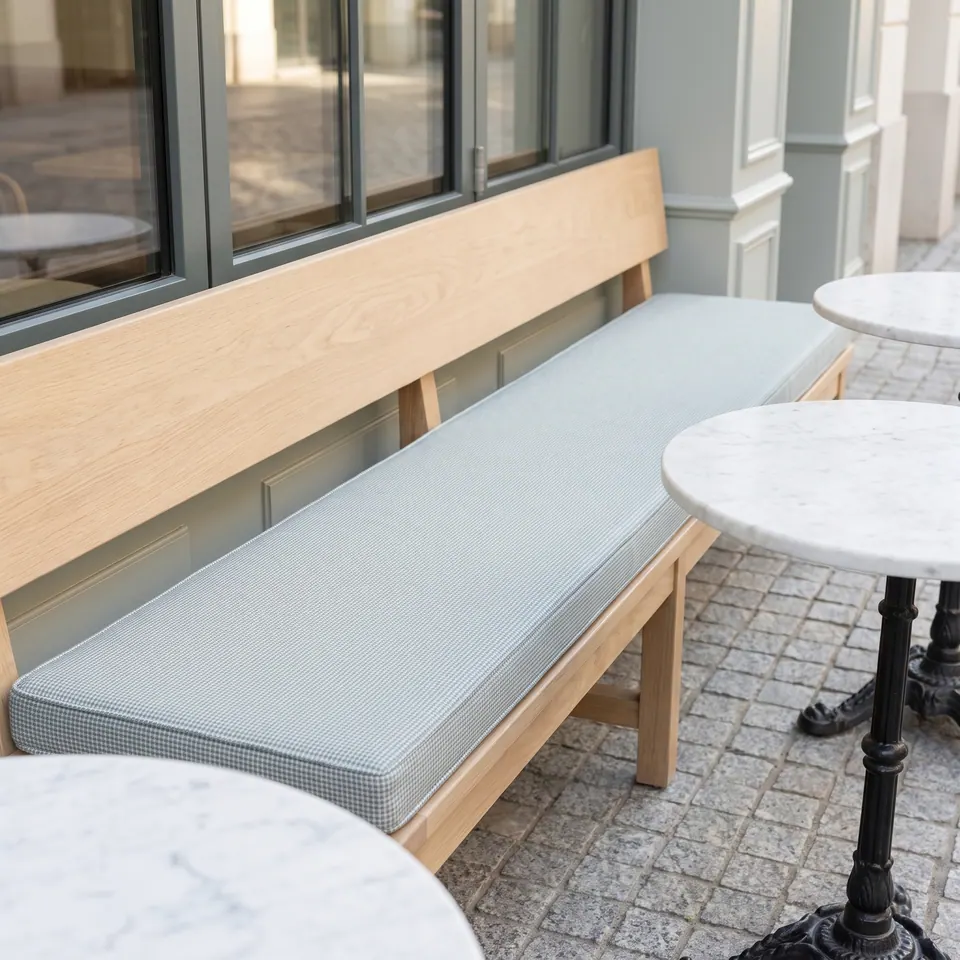
- One continuous pad
A single long pad means no seams where guests sit between tables.
- Oak backboard
The tall oak back does the supporting, so only a seat pad is needed.
- Marble bistro table
White marble tops repeat the white in the microcheck.
- Cast-iron base
Black iron legs add the classic bistro contrast to pale oak and soft aqua.
- Sage-gray shopfront
From a distance the fine check reads as blue-gray, matching the painted facade.
- One continuous padA single long pad means no seams where guests sit between tables.
- Oak backboardThe tall oak back does the supporting, so only a seat pad is needed.
- Marble bistro tableWhite marble tops repeat the white in the microcheck.
- Cast-iron baseBlack iron legs add the classic bistro contrast to pale oak and soft aqua.
- Sage-gray shopfrontFrom a distance the fine check reads as blue-gray, matching the painted facade.
A dorm bed, a headboard and move-in day
A parent in the US wrote to the workshop about the smallest room of all: a college dorm. They wanted a tufted cushion 30 in (76 cm) long and 24 in (61 cm) high to stand at the head of their daughter's bed as a soft headboard, in smoke or cream linen.
No listing option matched those numbers, so the workshop confirmed a thickness of 4 to 5 in (10 to 13 cm) and sent a custom order link. Then came the worry every freshman parent knows: would it arrive before move-in day? The shop confirmed the dorm address, shipped the next day, and delivery ran 3 to 5 business days.
The lesson I keep from it: a tufted cushion stood on end makes an easy headboard where a real one won't fit. And put the room number on the address, or it spends the semester in the dorm's package room.
A narrow-spot checklist, from one tight bench to another
- Measure the frame end to end, and ignore the old pad's label.
- Order one continuous piece where people slide along the seat.
- Pick a fine check or a plain; a small pattern reads as one calm color from across the room.
- Match the piping to the fabric so no extra line crosses a narrow space.
- Let a tall back do the supporting and keep the seat depth for sitting.
- Put round tables or stools near a shallow bench. Corners find knees.
On the cutting table: the café bench pad
| Cushion | One continuous box-edge seat pad the full length of an oak bench |
|---|---|
| Fabric | Water-repellent membrane cloth, aqua and white microcheck, code HM-03 |
| Piping | Self piping in the same microcheck |
| Back support | The bench's own tall oak backboard; no back cushion |
| Neighbors | Round white marble bistro tables on black cast-iron bases |
| Ground | Granite setts |
| Size tolerance | Handmade, so allow 1 to 2 in (2.5 to 5 cm) |
| Best for | Café terraces, porches and any long, shallow bench |

Have it made
Have this made — ask Maggie’s workshop
Have the tape measure handy when they call. Old cushions shrink and sag; the seat underneath does not. — Maggie
Leave your details and the workshop will call you to confirm measurements, fabric, foam and piping. No prices, dates or payment on this page: it is a request, not an order.
A narrow café bench looks wider under one continuous seat pad than under three short ones, because the eye reads a single unbroken seat.
Maggie
Questions buyers ask next
Can one cushion really cover a long café or porch bench?
Yes. A single long pad is common on café and porch benches, and it avoids a seam where people sit between tables. For a very long run, ask for firm foam so the pad keeps a straight line from one end to the other.
Do I need a back cushion if my bench has a high wooden back?
Usually not. A tall backboard already does the supporting, as the oak back does here, so a seat pad is enough. Skipping the back cushion also keeps the full seat depth for sitting, which matters on a shallow bench.
Why choose a tiny check instead of a solid for an outdoor bench pad?
A fine check is more forgiving of crumbs and water spots than a flat solid, yet from a distance it reads as one soft color. Here the aqua and white microcheck turns blue-gray from across the street and matches the painted shopfront.
Stitch straight — Maggie