A Reading by MaggieBanquette & Kitchen Nook Cushions
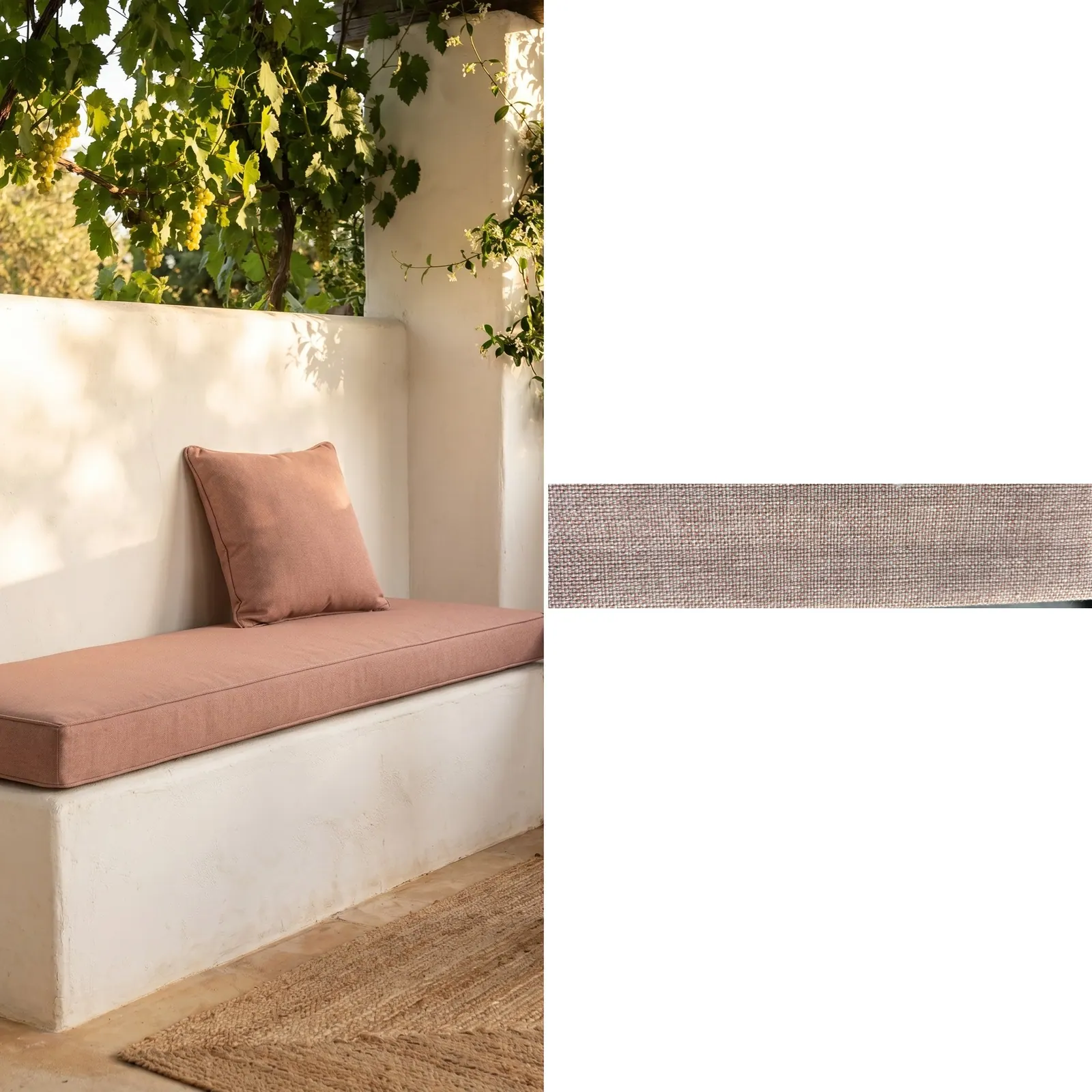
A terracotta pink banquette cushion on a whitewashed bench, put through a year of daily life
Grapevines overhead, a bowl of lemons, and a cushion that has to survive lunch, the dog and August. I took it apart on paper to see how it will age.

 Save
The quick answer
An outdoor banquette cushion ages well when it is cut to the measured seat, covered in a water-repellent fabric in a mid-tone solid, and split into separate pieces at the corner. Water-repellent fabric sheds spills but is not waterproof, so bring cushions in before heavy rain. A mid-tone looks right in both sun and moving shade.
The cushion, cut open
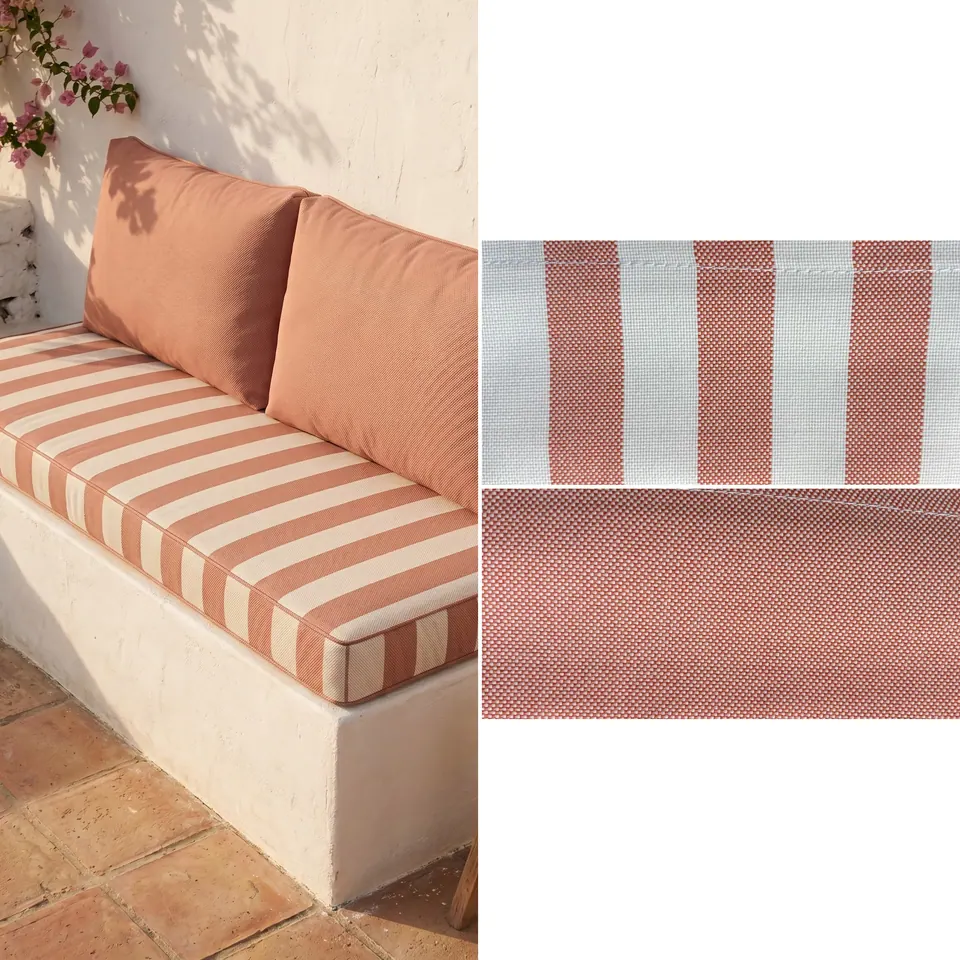
Cover fabric. A removable, zippered cover. Machine wash at 86°F (30°C) on a gentle cycle and air dry.
Piping. A fabric-covered cord sewn into the seams. It sits on the seam line, so it does not change the size.
Fiber wrap. Polyester fiber (Dacron) batting around the foam: it fills the cover out and softens the edges.
Foam core. About 2.0 lb/ft³ (32 kg/m³) high-resilience foam, firm to medium-firm, cut to the ordered size.
Zipper. Along the back band, as hidden as possible. The zipper side faces down or toward the wall.
Base panel. The underside of the cover. A non-slip fabric backing can cover the whole of it instead.
Pinned by Maggie
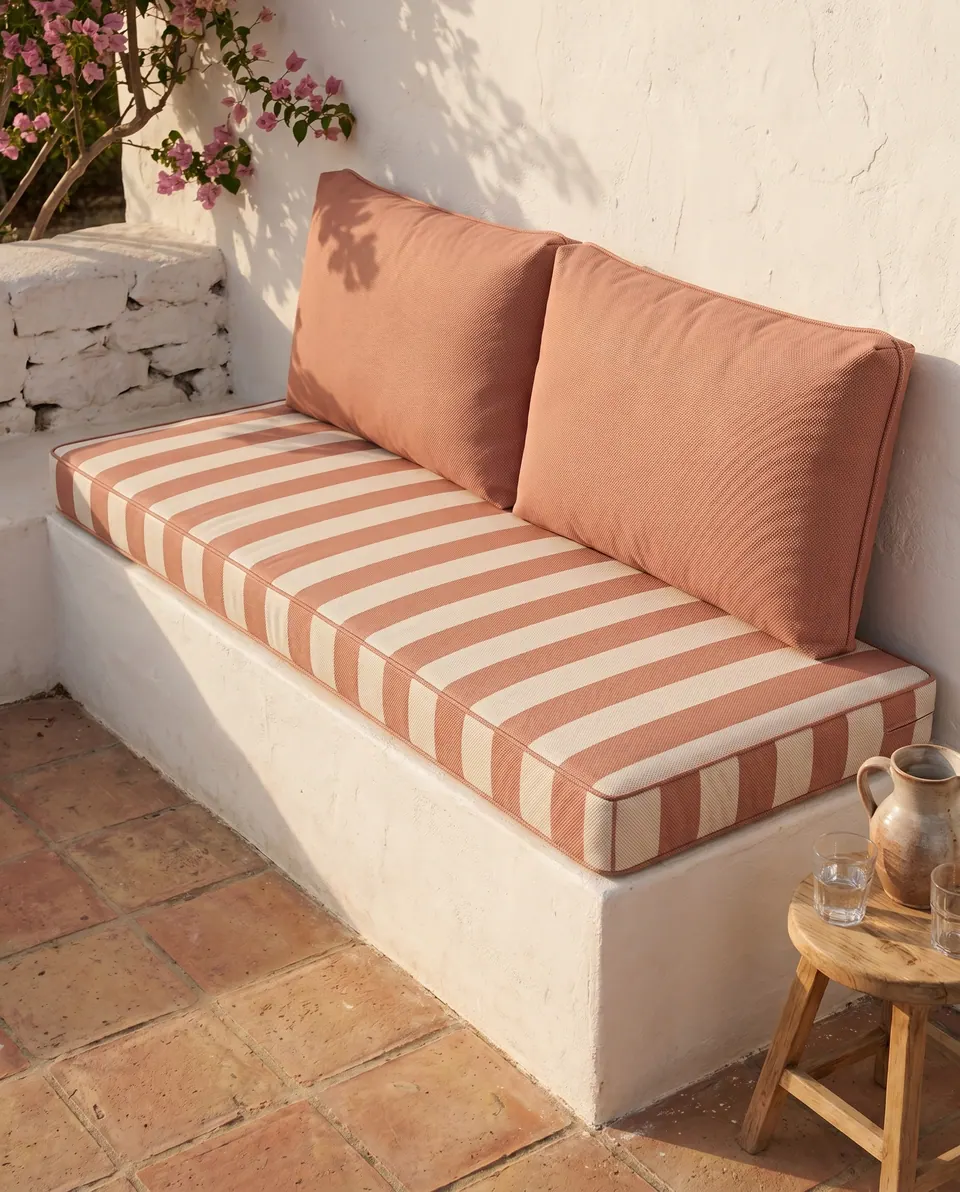
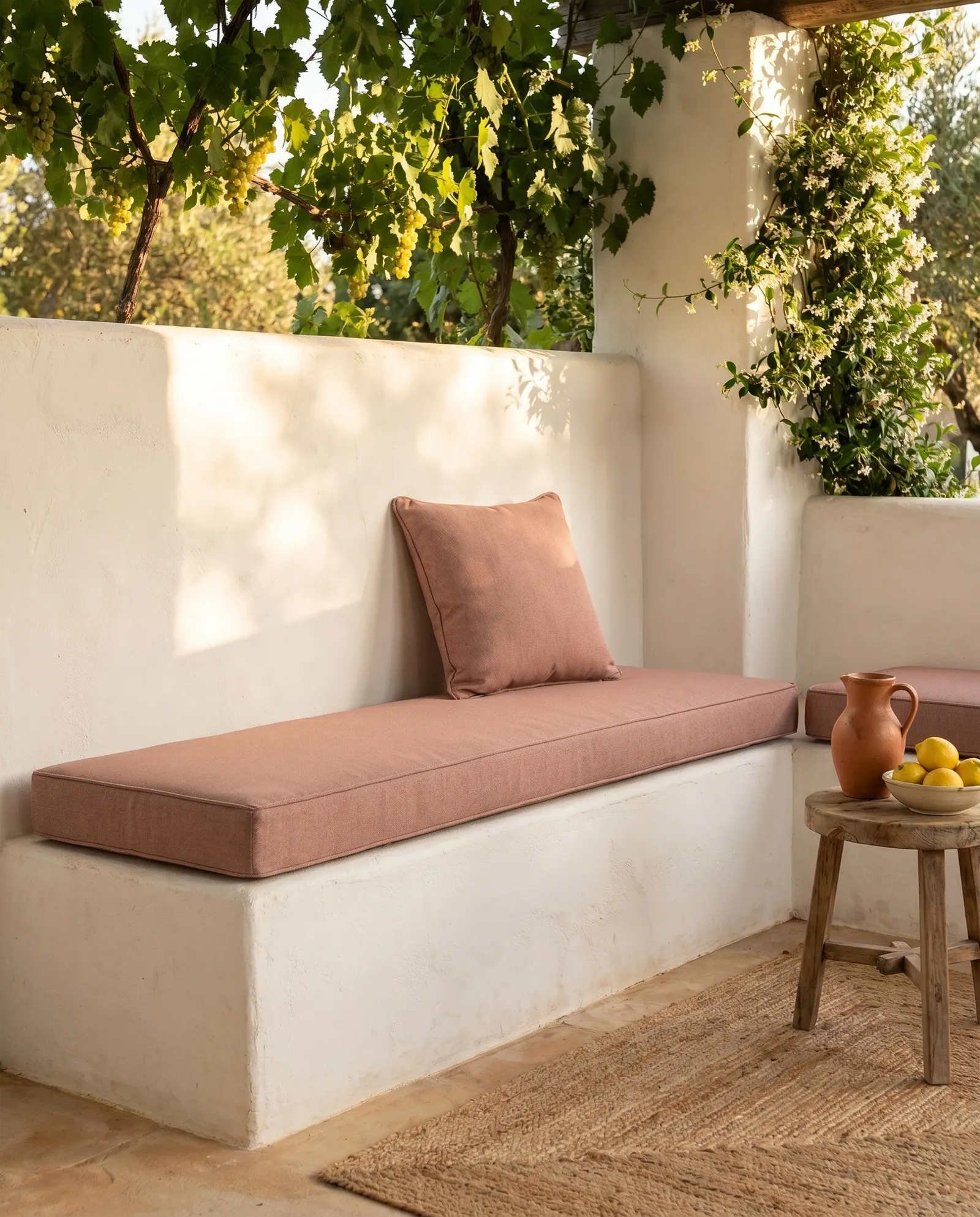
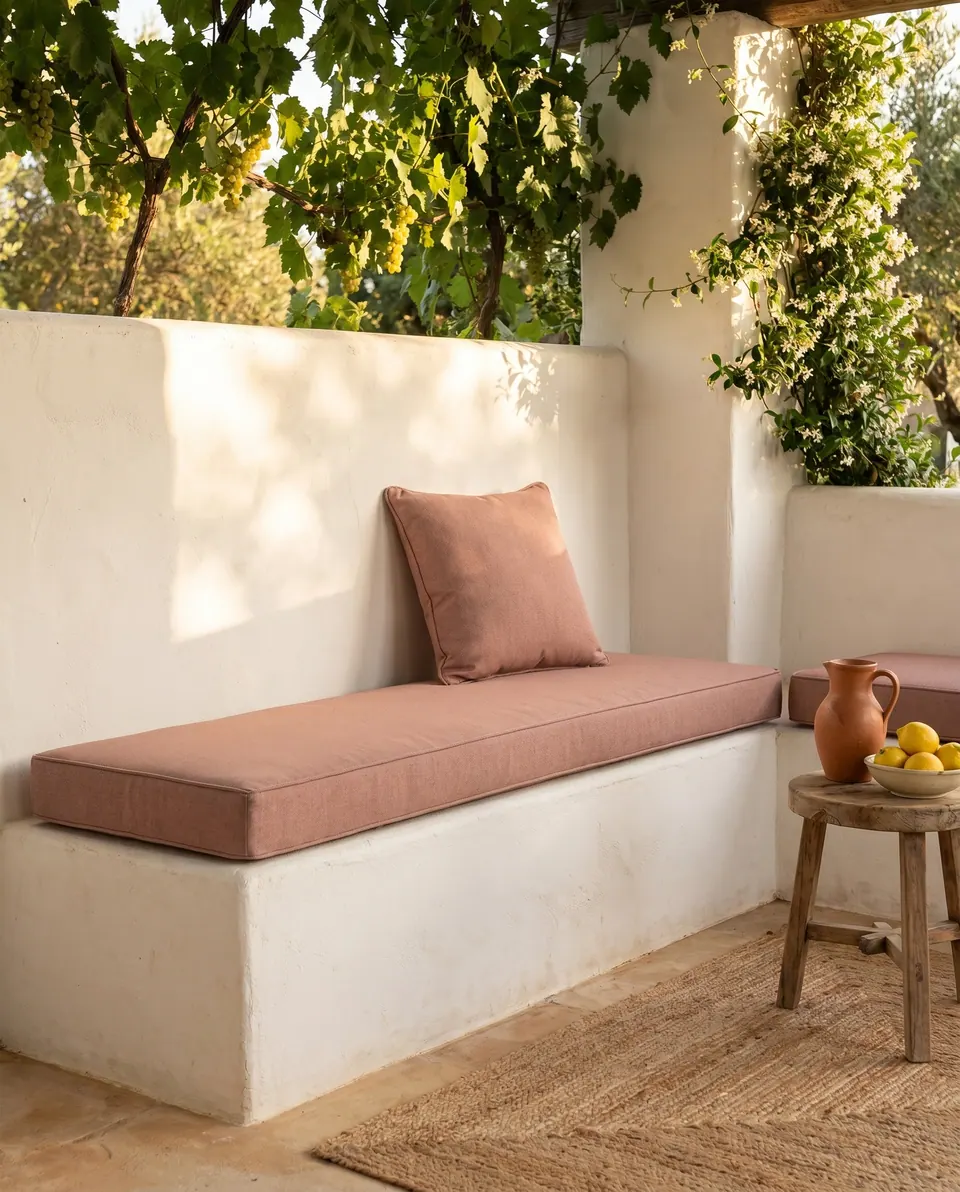
Five points on the whitewashed bench where daily life will leave its mark first.
- Clay pink seat cushion
An earthy pink solid looks like the plaster's warm shadow rather than a separate color.
- Matching square pillow
One pillow in the same fabric turns a flat ledge into a seat you can lean back on.
- Corner return cushion
The return is a separate cushion butted to the long run, easier to make and lift than one L-shaped piece.
- Woven jute rug
Jute underfoot adds a dry, natural texture that suits the rough plaster bench.
- Grapevine pergola canopy
Vine leaves throw moving shade, so a mid-tone solid was chosen that looks good in sun and shadow.
- Clay pink seat cushionAn earthy pink solid looks like the plaster's warm shadow rather than a separate color.
- Matching square pillowOne pillow in the same fabric turns a flat ledge into a seat you can lean back on.
- Corner return cushionThe return is a separate cushion butted to the long run, easier to make and lift than one L-shaped piece.
- Woven jute rugJute underfoot adds a dry, natural texture that suits the rough plaster bench.
- Grapevine pergola canopyVine leaves throw moving shade, so a mid-tone solid was chosen that looks good in sun and shadow.
Taking the banquette apart, layer by layer
Start underneath. Built-in masonry benches are rarely square, and plaster never is. A banquette cushion made to the measured seat is the difference between a tidy ledge and a sagging overhang, and an overhang is where wear begins: people perch on the unsupported edge, the foam folds, and the fabric rubs on the plaster lip.
Next, the pieces. The long run and the corner return are two cushions butted together, not one L. Two pieces sit better in a crooked corner, and each one can be lifted, turned and carried in alone.
Then the cover: a self-piped box in a water-repellent membrane fabric, in an earthy pink that looks like the plaster's own warm shadow rather than a separate color. One square pillow in the same fabric, set off center, turns a flat ledge into a seat you can lean back on. Self piping keeps the edge in the cushion's own color, and a straight welt is a kind of honesty: on a long outdoor run, you'll see at once if it wanders.
Finally, the setting, which decides how it all ages. The grapevine and star jasmine throw moving shade, so a mid-tone solid was the right call; white would glare in the sun and a bright stripe would fight the leaf shadows. The clay jug, the bowl of lemons on a rustic stool and the jute rug all say the same thing: warm, dry, a little rough, not precious. That is the rule I'd carry to any patio or porch cushion: a baked-earth solid before a bright stripe.
Who uses your outdoor bench hardest, dear: the children, the dog or the afternoon sun?
The daily-life test, scored
- Spills: water-repellent fabric beads a dropped drink so you can blot it. It is not waterproof; a soaking storm still reaches the foam.
- Sun and shade: clay pink looks the same under moving vine shadows, where white would glare.
- Kids on and off all day: a cushion cut to the seat has no overhang to fold.
- Crumbs: a plain, crease-free top has no buttons or creases to catch them.
- Pets: a baked-earth solid shows a stray hair less than chalk white does.
- Storage: two pieces at the corner, each light enough to carry in before rain.
Two walls, two seats, two round bolsters
A buyer wrote in about a built-in dining bench along two walls: seat cushions of 18 1/8 x 50 3/8 in (46 x 128 cm) and 18 1/8 x 41 3/8 in (46 x 105 cm), plus long cylindrical bolster backrests with rounded ends, about 50 3/8 in and 41 3/8 in (128 and 105 cm) long, all in the same linen. Note what they got right before anyone said a word: one seat per wall, butted at the corner, exactly like the terrace bench in the photograph.
The workshop confirmed it could make both, then asked for reference images before pricing the bolsters. A round bolster with rounded ends can mean three different things to three different people, and one picture settles it. I'd do the same with anything round: send the picture first, then the numbers.
- Sizes
- Seats 18 1/8 x 50 3/8 in and 18 1/8 x 41 3/8 in (46 x 128 and 46 x 105 cm); bolsters about 50 3/8 and 41 3/8 in (128 and 105 cm) long
- Fabric
- Linen, seats and bolsters matching
The lesson: For round bolster backrests, get a reference image before quoting.
Anatomy card: the terrace banquette
| Cushions | One long run plus a separate corner return, butted |
|---|---|
| Fabric | Water-repellent membrane fabric, terracotta pink solid |
| Piping | Self piping |
| Edge | Box edge, made to the measured seat |
| Top | Plain and crease-free, no tufts |
| Backs | Matching square pillow; round bolsters priced from a reference image |
| Weather | Sheds spills; bring in before heavy rain |
| Narrow recesses | Run the cushion straight past them |
| Best for | Terraces, patios and built-in masonry benches |

Have it made
Have this made — ask Maggie’s workshop
Numbers first, fabric second, piping last. Jot down what you have, and the workshop will go down the list with you, item by item. — Maggie
Leave your details and the workshop will call you to confirm measurements, fabric, foam and piping. No prices, dates or payment on this page: it is a request, not an order.
Buyer questions: quotes, wedges and awkward notches
- A common question
Does the quote include the piping, the filling and delivery? And can I have a plain cushion without tufts?
The workshop's answerYes, piping, filling and delivery were all included, in that case for two tufted bench cushions of about 53 x 17 1/2 in (135 x 44.5 cm), 2 in (5 cm) high. A plain, crease-free version is possible too. It is made with seating foam and costs more, though a lower-density foam and a more affordable velvet bring it back down.
- A common question
Can you make a reading nook seat cushion with a wedge backrest to go with it?
The workshop's answerYes. For a wedge, send the width, the height and the thickness at top and bottom. One set was a 36 5/8 x 25 5/8 x 2 3/4 in (93 x 65 x 7 cm) seat plus a wedge 25 5/8 in (65 cm) wide, 27 1/2 in (70 cm) tall and 7 7/8 in (20 cm) thick at the base.
- A common question
My bench has a thin board in the middle with a narrow recess. Can the cushion be cut to fit around it?
The workshop's answerNot reliably. A notch that narrow can't be sewn and still hold its shape. The workshop recommends running the cushion straight past the recess, as in its example template, and filling in your measurements on that guide.
Split an L-shaped outdoor banquette into two cushions at the corner. Two pieces fit a crooked wall better, and each can be carried in before rain.
Maggie
Questions buyers ask next
Can outdoor banquette cushions stay out in the rain?
Not all season. A water-repellent fabric sheds spills and light showers, but steady rain works in through seams and reaches the foam. Bring cushions in, or stand them on edge under cover, before heavy rain, and store them indoors over winter.
Why choose a mid-tone color for a cushion under a pergola?
Vine leaves throw moving patches of sun and shade across the seat. White glares in the sun and grays in the shade, and a bright stripe competes with the leaf shadows. A mid-tone solid, like a baked-earth pink, looks much the same in both.
How do I measure a masonry bench for a cushion?
Measure the seat itself at the front edge and again at the wall, since plaster benches are rarely square, and note the depth at each end. Order to the measured seat so the cushion neither overhangs the edge nor leaves a gap.
Stitch straight — Maggie
More photographs to read
 Save
 Save
 Save
 Save
 Save
 Save